
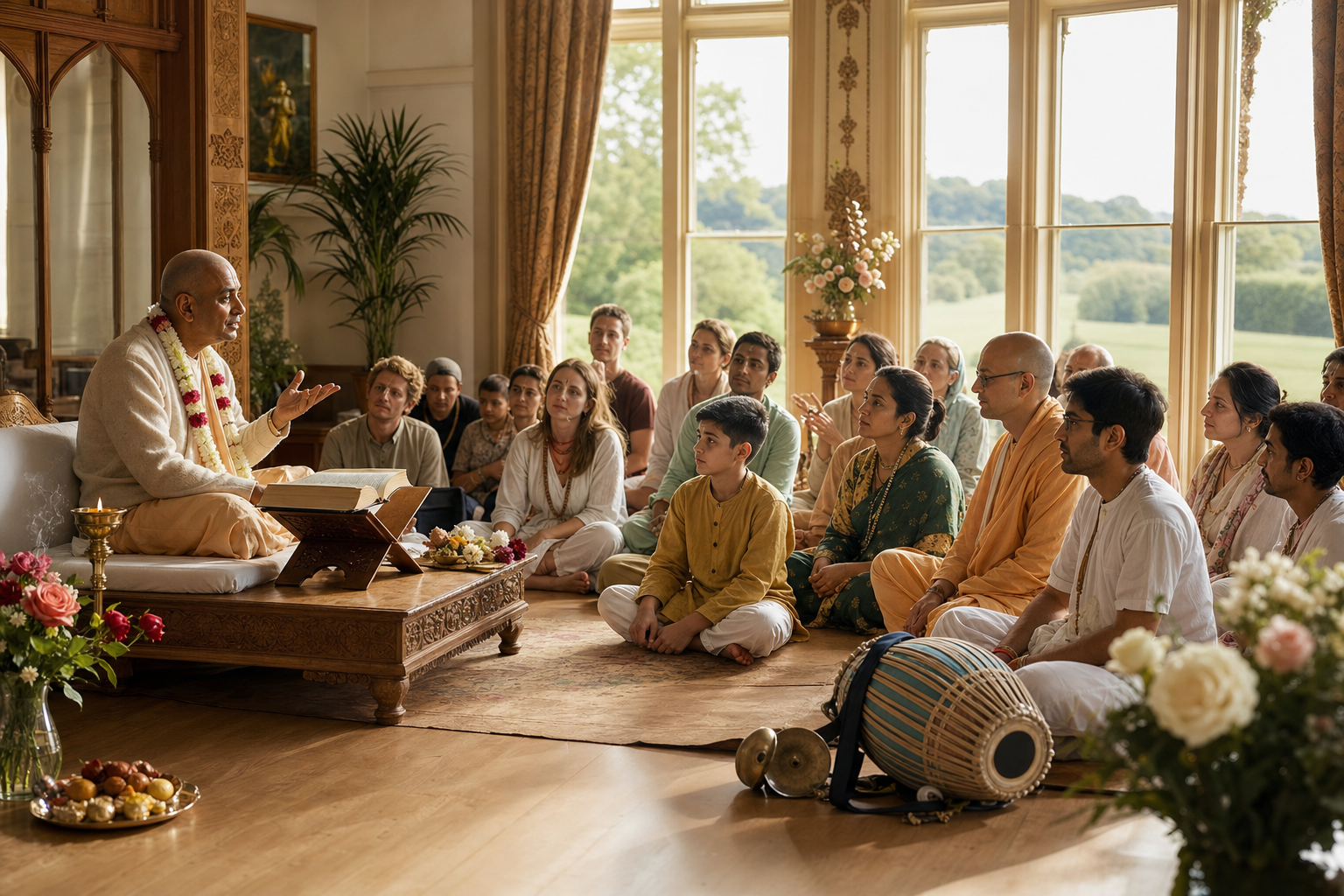
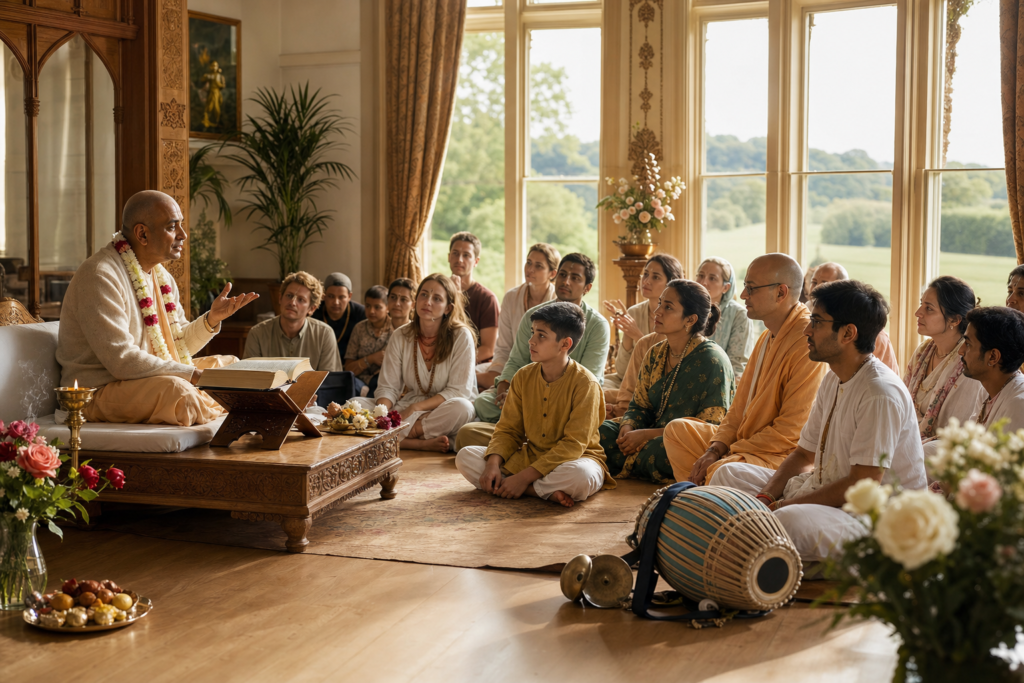
Bhaktivedanta Manor stands as one of the most important centers of Krishna consciousness in the United Kingdom, not merely because of its history, but because of the living culture of study, kirtan, seva, and disciplined spiritual practice that continues there. A class at Bhaktivedanta Manor is best understood as part of a wider Vaishnava educational tradition in which scripture is not treated as distant literature, but as a practical guide for character, community, and inner transformation.
The Manor is closely associated with ISKCON, the Hare Krishna Movement, and the teachings of Srila Prabhupada. Its classes usually draw upon foundational texts such as the Bhagavad Gita, Srimad Bhagavatam, and the works of the Gaudiya Vaishnava acharyas. The central aim is not abstract theology alone. The teaching method connects metaphysics, ethics, devotional practice, and daily conduct so that spiritual knowledge becomes visible in ordinary life.
In the Hindu Dharma framework, knowledge is not complete unless it reshapes the way one lives. A Bhaktivedanta Manor class therefore often moves between scriptural explanation and practical application. Concepts such as atman, dharma, karma, bhakti, seva, and surrender are explored with philosophical precision, yet they are also brought into the realities of family life, work, social responsibility, discipline, and emotional maturity.
The deeper significance of such classes lies in their ability to make ancient wisdom accessible without reducing its seriousness. The Bhagavad Gita, for example, is not presented as a slogan or a cultural symbol. It is approached as a rigorous dialogue on duty, consciousness, desire, fear, attachment, and the nature of the self. This allows the listener to engage with the text both intellectually and personally.
Bhakti, in this setting, is not sentimentality. It is a disciplined reorientation of the heart toward the Divine. Krishna consciousness emphasizes remembrance of Krishna through chanting, study, prasadam, service, worship, and ethical living. The class format helps clarify why these practices matter. They are not isolated rituals, but interlinked methods for purifying intention and developing steadiness of mind.
One of the most valuable features of the Bhaktivedanta Manor learning environment is its communal nature. Spiritual education is received in the presence of others who are also attempting to live by dharmic principles. This produces a form of learning that is both reflective and accountable. Questions arise naturally: how should one respond to conflict, how should one manage desire, how should one serve without ego, and how should one remain spiritually serious in a distracted age?
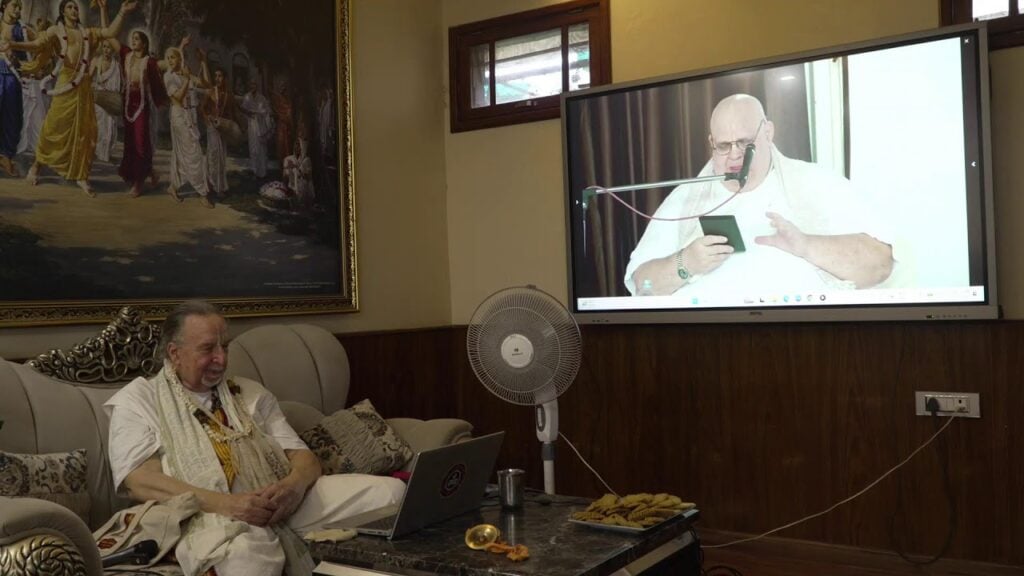
The Manor’s class culture also highlights the traditional guru-shishya relationship in a modern context. The teacher is not merely a lecturer delivering information. The teacher transmits a way of seeing. The listener is not merely a consumer of religious content. The listener becomes a participant in a lineage of inquiry, discipline, and devotion. This distinction is especially important in an era when spiritual knowledge is often fragmented into short clips and isolated quotations.
From an academic perspective, the class tradition at Bhaktivedanta Manor demonstrates how Hindu spiritual institutions preserve knowledge through repeated oral explanation. The same verses may be studied many times, but each hearing can reveal a new layer. This reflects a classical Indian approach to learning in which repetition is not redundancy; it is refinement. Understanding deepens as the mind becomes more prepared.
The emotional force of these classes comes from their relevance to ordinary human struggle. The listener may arrive with anxiety, fatigue, grief, ambition, confusion, or a sense of spiritual distance. Through the language of Krishna’s teachings, such experiences are not dismissed. They are placed within a larger map of consciousness. The individual is encouraged to see life as a field of responsibility and devotion rather than as a random sequence of pressures.
This is where the Bhagavad Gita becomes especially powerful. Arjuna’s crisis is not only a battlefield crisis; it is a human crisis. He is intelligent, sincere, and morally sensitive, yet he becomes overwhelmed. Krishna does not tell him to abandon thought. Krishna teaches him to see more clearly. A Bhaktivedanta Manor class rooted in this tradition can therefore speak to students, professionals, parents, elders, and seekers because the questions are timeless.
Another important dimension is the relationship between devotion and discipline. In many modern settings, spirituality is imagined as a private feeling. The Vaishnava tradition offers a more demanding and more constructive model. Devotion is cultivated through regulated practice, humility, study, association, and service. This structure gives spiritual life continuity, especially when emotion fluctuates.
The chanting of the holy names, especially the Hare Krishna maha-mantra, occupies a central place in this tradition. Its role is theological, meditative, and communal. It centers the mind, softens the heart, and gathers people around a shared spiritual sound. In the context of a class, chanting is not separate from learning. It prepares the listener to receive knowledge with attention and reverence.
Bhaktivedanta Manor also represents the journey of Hindu and Vaishnava traditions into the British public sphere. It is not only a temple complex; it is a cultural and educational institution where festivals, classes, youth programs, interfaith engagement, and community service intersect. This makes the Manor a significant example of how dharmic traditions adapt to new geographies while preserving theological depth.
The broader dharmic value of such a space is unity. Hinduism, Buddhism, Jainism, and Sikhism each preserve distinct teachings and disciplines, yet they share a civilizational concern for self-mastery, compassion, truth, non-exploitation, and liberation from ignorance. A class on Krishna consciousness can contribute to this wider unity when it presents Vaishnava teachings with clarity, humility, and respect for sincere spiritual paths.
Such unity does not require flattening differences. The Gaudiya Vaishnava tradition has its own theology of Krishna as the Supreme Personality of Godhead, its own devotional aesthetics, and its own lineage of saints and acharyas. Yet its emphasis on humility, service, chanting, and devotion can be appreciated across dharmic communities. This balance between conviction and respect is essential for serious religious dialogue.
Classes at Bhaktivedanta Manor also challenge the assumption that religious education is only for specialists. The temple classroom creates a bridge between scholar and practitioner, between scripture and kitchen, between philosophy and parenting, between worship and ethics. The result is a holistic model of education in which knowledge is measured by transformation of conduct.
For contemporary seekers, this matters deeply. Modern life often produces information without wisdom, speed without depth, and connection without inner steadiness. The Vaishnava classroom offers a counter-discipline. It asks the listener to slow down, hear carefully, examine motive, remember Krishna, and live with greater responsibility. This is why the setting remains relevant beyond the immediate community of devotees.
The technical structure of the teaching is also worth noting. A traditional class often begins with a Sanskrit verse or scriptural passage, followed by translation, commentary, theological unpacking, and practical reflection. This layered method protects the integrity of the source while allowing contemporary application. It prevents scripture from becoming either museum material or casual opinion.
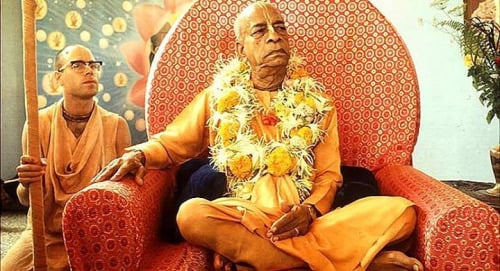
The role of Srila Prabhupada’s commentaries is central in this process. His writings present bhakti as both ancient and urgent, rooted in shastra yet directed toward modern humanity. At Bhaktivedanta Manor, his legacy is not only remembered historically; it is enacted through daily worship, education, prasadam distribution, festivals, and the continuing effort to make Krishna consciousness understandable to new generations.
A serious reading of this tradition also shows that bhakti is socially consequential. Devotion is expected to produce compassion, honesty, restraint, gratitude, and service. A person who hears class but remains careless in speech, exploitative in conduct, or arrogant in knowledge has not absorbed the teaching properly. The classroom therefore becomes a mirror in which spiritual aspiration is tested against daily behavior.
The Manor’s devotional culture gives particular importance to prasadam, the sanctified food offered to Krishna. In Vaishnava thought, prasadam is not merely symbolic hospitality. It expresses a theology of grace, gratitude, and purified consumption. Food becomes part of spiritual education because it teaches dependence on the Divine and respect for all living beings.
The aesthetic atmosphere of Bhaktivedanta Manor also contributes to learning. Sacred architecture, deity worship, kirtan, incense, scriptural recitation, and community participation form an integrated field of experience. The listener does not encounter philosophy as a dry abstraction. Philosophy is embodied in sound, sight, rhythm, discipline, and shared reverence.
This embodied approach is consistent with the wider Hindu understanding that the human being learns through multiple faculties. The intellect seeks clarity, the heart seeks devotion, the senses seek purification, and the body participates through service. A class becomes effective when it addresses the whole person rather than only the analytical mind.
At the same time, the academic value of such classes should not be underestimated. They preserve interpretive traditions, transmit Sanskrit vocabulary, explain theological categories, and train communities in scriptural literacy. For diaspora Hindus especially, this form of education helps maintain continuity across generations while allowing younger audiences to ask honest questions.
The diasporic context gives Bhaktivedanta Manor additional importance. Hindu families in the United Kingdom often navigate multiple cultural worlds. A temple class can help children and adults understand that Hindu identity is not limited to festivals or inherited customs. It includes philosophy, disciplined practice, ethical reasoning, and a sophisticated vision of consciousness.
For those approaching Krishna consciousness for the first time, the class environment can be a gentle entry point. It does not require prior mastery of Sanskrit or theology. What it requires is willingness to hear. This principle of attentive hearing, or shravanam, is foundational in bhakti. Spiritual life begins when the mind becomes humble enough to receive wisdom.
The enduring lesson of a Bhaktivedanta Manor class is that dharma must be lived, not merely admired. Scripture becomes meaningful when it shapes speech, choices, relationships, and priorities. Bhakti becomes real when it softens pride and strengthens service. Community becomes sacred when it helps individuals remember their highest purpose.
In this sense, Bhaktivedanta Manor remains a powerful spiritual classroom for the modern world. Its classes bring together ancient Hindu scriptures, Vaishnava devotion, community life, and practical ethics. They invite seekers to move from distraction to remembrance, from ego to service, and from theoretical belief to lived Krishna consciousness.
Inspired by this post on Dandavats.






Leave a Reply
You must be logged in to post a comment.