-
Neither Sat Nor Asat: Rigveda’s Nasadiya Sukta, Vedic Cosmology, and Sacred Paradox Explained

Rigveda’s Nasadiya Sukta opens with the paradox “neither sat nor asat,” a precise philosophical strategy rather than a rhetorical flourish. Read in concert with the Upanishads, the hymn marks a pre-categorical horizon where ordinary predicates fail, complementing later Vedantic distinctions between ultimate and conventional truth. Classical schools clarify its logic: Sāṅkhya’s causal latency, Nyāya’s theory…
-
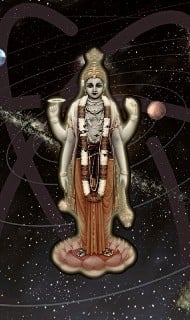
Decoding Vishnudharmottara Purana: The Awe-Inspiring Vyuha Manifestations of Vishnu

This article decodes the Vyuha doctrine of Vaishnava theology through the lens of the Vishnudharmottara Purana and the Pancharatra–Vaikhanasa traditions. It explains the fourfold emanations—Vasudeva, Sankarshana, Pradyumna, and Aniruddha—and the classical distribution of the six divine excellences across them. It shows how the Purana’s image-making canons turn metaphysics into clear, teachable iconography, especially in Caturvyuha…
-
Vedic Intelligent Design Revisited: Bhaktivedanta Institute, Flagellum, and Dharmic Unity

This essay revisits the Vedic conversation on Intelligent Design, spotlighting the Bhaktivedanta Institute’s early engagement with the bacterial flagellum while honoring the integrity of evolutionary biology. It explains the flagellum’s rotary motor in technical terms, outlines design arguments such as irreducible and specified complexity, and summarizes mainstream evolutionary responses involving modularity and exaptation. It then…
-
Decoding Srimad Bhagavatam 3.26.9: Sankhya, Consciousness, and a Roadmap to Dharmic Unity

This in-depth exploration of Srimad Bhagavatam 3.26.9, inspired by H.H Subhag Swami Maharaj’s discourse at ISKCON Mayapur, unpacks Kapila’s Sankhya as a precise map of consciousness, causality, and liberation. It clarifies how purusha, prakriti, time, and the three gunas co-operate to shape experience, and why that structure makes ethical effort and devotion both meaningful and…
-
Conquering the Disease of Envy: SB 3.29’s Remedy for Respect, Ahimsa, and Dharmic Unity

This deep-dive, inspired by a Brambleton, VA discourse on May 21, 2026, examines why envy (īrṣyā, asūyā, mātsarya) is the principal obstacle to authentic respect and spiritual growth. Drawing on Srimad Bhagavatam 3.29, it maps how envy aligns with rajas and tamas and why non-envious devotion in sattva is essential. The analysis integrates parallel remedies…
-
Spirituality of Nature: Sacred Dharmic Wisdom, Science-Backed Healing, Inner Resilience

This long-form guide presents an academic yet accessible exploration of the spirituality of nature across Hinduism, Buddhism, Jainism, and Sikhism. It grounds ecological reverence in the Upanishads and the Bhagavad Gita, links practices like mindfulness and pranayama to measurable health benefits, and shows how Ahimsa and Aparigraha become daily Environmental stewardship. Readers gain a stepwise…
-
Special Knowledge and Bhakti Wisdom in Uithoorn, Netherlands: HH SB Keshava Swami’s Insights

A thoughtful gathering in Uithoorn, the Netherlands (28.05.2025) honored HH SB Keshava Swami (Svayam Bhagavan Keshava Swami) and explored the theme of Special Knowledge through the lens of Gaudiya Vaishnavism. This analysis clarifies the distinction between jnana and vijnana, showing how knowledge matures when grounded in scripture, practice, and community. It outlines Indian epistemology’s core…
-
SB 4.9.37–53 Decoded: Dhruva’s Unshakable Devotion, Cosmic Boons, and Inner Renewal

Srimad-Bhagavatam Canto 4, Chapter 9, verses 37–53 narrate how Dhruva Maharaja’s devotion matures from personal austerity to public responsibility. The passage culminates in Dhruvaloka—symbolizing unwavering devotion—and a restored social order that validates rajadharma as service. Drawing on themes often highlighted by Kalakantha Prabhu, the analysis explains how bhakti integrates knowledge and action while transmuting anger…
-
Timeless Power of the Guru–Shishya Bond: Ancient Hindu Pedagogy That Shapes Character and Society

The Guru–Shishya tradition is a civilizational pedagogy that unites knowledge with character, shaping both competence and conscience. Drawing on the Upanishads and the Bhagavad Gita, it encodes reverence, inquiry, and service as the ethics of learning. Gurukulas integrated study with daily life, training the mind through śravaṇa–manana–nididhyāsana and broad curricula from Veda and Vedāṅgas to…
-
Beyond Rivalry: Why a True Vaidika Honors Tantra and a True Tantrika Reveres the Vedas

Vedas and Tantra are not adversaries but complementary avenues to the same truth, a reality long recognized across authentic lineages. This article traces their historical interdependence through the Agamas, Pancharatra, temple praxis, and Vedantic metaphysics to clarify why both are indispensable. It explains how mantra, yantra, mudra, nyasa, and Kundalini sadhana can integrate seamlessly with…
-
Shani Sade Sati for Tula Rashi: Viraya (Vyaya) Shani Effects, Timing, Remedies—A Deep-Dive Guide

Shani Sade Sati for Tula Rashi begins when Saturn enters Virgo, launching the first 2½-year phase known as Viraya (Vyaya) Shani. This period emphasizes 12th-house matters—expenditure, seclusion, sleep, and the dissolution of attachments—framed by Saturn’s discipline and Virgo’s analytic rigor. The analysis explains how Saturn’s special aspects from Virgo shape communication, partnerships, and career through…
-
Tasting the Whole Krishna: Beyond One‑Dish Devotion to the Complete Vishvarupa Experience

A Kerala Sadhya on a banana leaf offers the perfect metaphor for understanding Sri Krishna: tasting only the sweet payasam is not the same as experiencing the complete meal. This long-form reflection shows how the Bhagavad Gita, the Bhagavata Purana, and Vaishnava theology present a whole vision—Vishvarupa, six divine opulences, multiple rasas, and the vyūha…
-
Shiva’s Damaru: Decoding the Cosmic Rhythm of Creation, Balance, and Transformation

This long-form exploration decodes Shiva’s Damaru as a compact, technical map of creation, balance, and transformation in Hindu philosophy. It explains Nāda-Brahma, the A-U-M schema, and the panchakritya while situating the drum’s meaning within linguistic tradition via the Maheshvara Sutras and Panini’s grammar. Readers gain an acoustical and yogic understanding of the instrument, including how…
-
Self‑Born, Mind‑Born, Womb‑Born: Decoding the Profound Hindu Cosmology and Sanat Kumaras

Hindu cosmology describes creation in three interlinked stages: self-born (svayambhū), mind-born (mānasa), and womb-born (jarāyujā). Drawing on the Viṣṇu Purāṇa, Śrīmad-Bhāgavatam, and allied texts, this analysis shows how sarga (primary emanation) and visarga (secondary diversification) structure a descent from subtle principle to mental formation and biological life. The Sanat Kumaras and Nārada exemplify the mind-born…
-
Bhagavad Gita at New Govardhana: Profound Bhakti-Yoga Insights by HG Caitanya Caran das

On 05 May 2026, ISKCON New Govardhana Temple hosted a Bhagavad Gita class by HG Caitanya Caran das that united rigorous exegesis with practical Bhakti-Yoga. The session mapped Karma, Jnana, and Bhakti as an integrated pathway, grounding ethical action in devotion and clear discernment. Attendees received a concise practice blueprint: daily japa, structured reading, reflective…
-
Omnipotence and Sacred Sound: Why Krishna’s Words Remain a Living Presence Across Traditions

Omnipotence in Vedic philosophy explains how Krishna remains in unbroken companionship with living beings through sacred sound. Vaishnava theology teaches nāma–nāmi abheda, the non-difference between the Divine Name and the Divine Person, grounding the transformative power of the Hare Krishna Mahāmantra. The principle of śabda-brahman shows that divine words are not merely symbolic; they are…
-
Panchamukhi Ganapati Explained: Five Faces, Five Elements, and Mastery of the Senses

Panchamukhi Ganapati symbolizes the integration of the five elements and the five senses, aligning personal practice with Vedic cosmology. Drawing on the Ganapati Atharvashirsha, this exploration shows how Ganesha is identified with Earth, Water, Fire, Air, and Ether. The five faces are read as guardians of perception, action, and awareness, mapped by many iconographers to…
-
Niyama Vidhi in Purva Mimamsa: A Definitive Guide to Restrictive Injunctions and Dharma Precision

This in-depth guide clarifies niyama-vidhi (restrictive injunction) in Pūrva Mīmāṃsā and shows how it refines an already known duty by selecting a preferred means without creating a new obligation. It distinguishes niyama-vidhi from apūrva/utpatti-vidhi and parisankhyā-vidhi, and explains its cooperation with niṣedha and arthavāda within Vedic hermeneutics. Readers learn practical criteria for identifying a restrictive…
-
Decoding Panchamukhi Ganapati: Five Faces that Harmonize Elements, Senses, and Self

This in-depth exploration decodes Panchamukhi Ganapati as a five-faced synthesis of the five senses and the five great elements. It clarifies the classical mapping of indriyas to pancha mahabhuta and shows how the image guides pratyahara and allied yogic practices. Readers encounter multiple scholarly interpretations, from pancha prana and Pancha Kosha Viveka to the fivefold…