
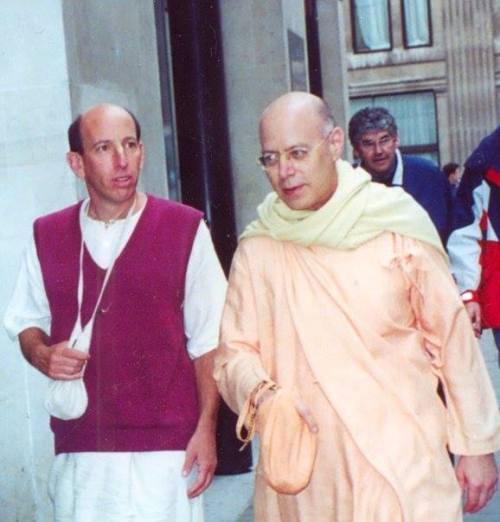
The remembrance of Tamal Krishna Goswami is not merely a private family reflection; it is also a study in how spiritual leadership, kinship, memory, and grief can meet in a single human life. Born Thomas G. Herzig and affectionately remembered within his family as Tommy, Tamal Krishna Goswami became one of the best-known early leaders of ISKCON, the International Society for Krishna Consciousness. Yet behind the public identity of a Goswami, teacher, organizer, disciple, and spiritual guide remained the intimate presence of an older brother whose absence continued to be felt in ordinary, deeply human ways.
His sudden passing in a car crash in India left a wound that could not be reduced to institutional history or devotional biography. The phone call announcing his death marked a decisive rupture for his surviving family and for many devotees who had relied on his counsel. In the language of grief, such a moment often becomes permanently fixed in memory: the day is not only remembered as a date but as a dividing line between a world in which a beloved person could still be called upon and a world in which his presence had to be encountered inwardly.
Tamal Krishna Goswami’s life carried several identities at once. He was a disciple of Srila Prabhupada, a preacher of Krishna consciousness, a sannyasi, a member of ISKCON’s leadership, a scholar of bhakti, a spiritual teacher, a mentor, and a public religious figure. At the same time, he remained a brother, an uncle, a family elder, and a person remembered through gestures rather than titles: the weight of a hand on a shoulder, the comfort of a hug, a glance that communicated more than words, and the familiar assurance that he was available when difficulty became too much to bear alone.
This dual remembrance is important because religious history can easily flatten a person into a role. A spiritual leader may be remembered through offices held, books written, institutions served, or disciples guided. Those details matter, especially in the history of Gaudiya Vaishnava practice in the modern world. But they do not exhaust the person. In the recollections surrounding Tamal Krishna Goswami, the public and the personal are inseparable. His influence on ISKCON and his tenderness toward his family belong to the same moral portrait.
Within ISKCON, Tamal Krishna Goswami is remembered as a strong, disciplined, and often demanding servant of Srila Prabhupada’s mission. His name is associated with the spread of Krishna consciousness, the challenges of institution-building, and the intense devotional culture of the movement’s formative decades. He was not simply a passive inheritor of a tradition; he was among those who helped carry Gaudiya Vaishnava teachings across geography, language, and culture during a period when Hindu spiritual traditions were becoming newly visible in the West.
The technical significance of his life lies partly in the nature of that transmission. Krishna consciousness, as taught by Srila Prabhupada, involves theology, ritual discipline, scriptural study, kirtan, prasadam, temple worship, guru-disciple relationships, and daily sadhana. To build communities around these practices outside their original cultural setting required more than enthusiasm. It required administration, training, translation, interpersonal judgment, and the capacity to present bhakti as both ancient and immediately livable. Tamal Krishna Goswami’s work must be understood within this demanding historical context.
His brother’s remembrance also shows another dimension of spiritual authority: people turned to him when they could not solve a problem or when life had become difficult. That detail is revealing. A religious teacher’s authority is not measured only by formal position, but by whether people trust that person in moments of distress. To be “the one to call” is to occupy a place of responsibility that is both practical and emotional. It means that others experienced him as decisive, dependable, and spiritually serious enough to help them move through confusion.
Descriptions of Tamal Krishna Goswami often contain a productive tension. He could be stern, and yet deeply loving. He could guide firmly, and yet hold his family with affection. He could appear formidable in spiritual leadership, and yet be remembered as the uncle who held a child close until laughter filled the room. This tension is not unusual in traditional guru cultures, where discipline and care are not always separated. The challenge, in any mature reflection, is to acknowledge both dimensions without sentimentalizing either one.
The remembrance of him as an uncle is especially moving because it rehumanizes a figure who might otherwise be encountered only through lectures, institutional memory, or devotional reverence. He adored the children in his family and held them close. Such moments matter because they reveal the embodied nature of love. Family affection is not abstract; it is felt in laps, shoulders, laughter, embraces, teasing, concern, and repeated phone calls asking how the children are doing. The sacred is often carried through precisely these ordinary acts.
The memories of childhood deepen this portrait further. A broken toy snap-gun, walks down Broadway in New York, astonishment at how much ice cream an older brother could eat, and the feeling of safety while climbing a children’s slide all belong to a world before public religious identity. These memories are not trivial additions to a spiritual biography. They are evidence that every religious life begins within human relationships. Before Tamal Krishna Goswami became known to thousands, Tommy had already been a brother whose presence shaped the emotional world of a younger sibling.
One of the most tender images is that of an older brother leading a younger child to the top of a slide and then racing to the bottom with arms open, ready to catch him. As a memory, it is simple. As a symbol, it is profound. It suggests protection, trust, risk, and surrender. In devotional vocabulary, surrender is often discussed in relation to Krishna, guru, and dharma. In family life, it is first learned through the reliability of those who catch us when we are too small to steady ourselves.
Years later, the two brothers walked through the dust-soft sand of Vrindavan and the forests of Vraja. That image brings together biography and sacred geography. Vrindavan is not only a physical place in the Gaudiya Vaishnava imagination; it is a landscape of remembrance, devotion, and divine intimacy associated with Sri Krishna. For two brothers to walk there together, after years of separation, was to move through both personal history and sacred memory. The hand on the shoulder became more than a familial gesture; it became a sign of reconciliation, continuity, and shared pilgrimage.
The reference to separation is significant. The brothers were apart for many years and came together again only in the mid-1990s. Yet when they were reunited, the relationship did not feel broken. This is a powerful observation about enduring bonds. Some relationships are sustained by constant contact; others survive through a deeper continuity that time does not erase. Their affection appears to have belonged to the second kind. When they were together again, love did not need to be reconstructed from nothing. It was recognized, resumed, and deepened.
In grief studies, this continuing relationship with the deceased is sometimes called a continuing bond. Rather than treating mourning as the severing of attachment, this view recognizes that love often changes form after death. The person is no longer physically available, yet the relationship can continue through memory, moral influence, prayer, conversation, places, stories, and the ongoing shaping of the self. The remembrance of Tamal Krishna Goswami reflects this reality with striking clarity: the relationship felt, in some ways, closer after his passing than before.
This does not make grief easy. A deepened inward bond does not remove the ache of absence. On some anniversaries, the loss becomes sharper, and the void becomes more difficult to intellectualize. The remembrance admits this honestly. There is gratitude, sadness, joy, appreciation, respect, and love, but also the plain statement of missing him. Such honesty is spiritually important. Dharmic traditions do not require emotional numbness. They offer frameworks for meaning, duty, devotion, and transcendence, but the human heart still mourns.
The lunar calendar reference adds another layer of meaning. In many Hindu traditions, sacred time is not measured only by the civil calendar. Tithis, lunar anniversaries, festival cycles, and ritual observances shape remembrance. To recall a death anniversary according to the lunar calendar places grief inside a religious rhythm. Memory becomes linked to cosmic time, and private mourning enters a broader pattern of devotion, prayer, and reflection.
Tamal Krishna Goswami’s passing in India also carries devotional resonance. India was not merely a geographical setting for his final moments; it was a sacred civilizational landscape tied to his spiritual vocation. For a disciple of Srila Prabhupada and a teacher of Krishna consciousness, India represented the living source of the bhakti tradition he served. His samadhi and the devotional memory associated with him continue to connect personal loss with pilgrimage, temple culture, and the wider sacred geography of Vaishnava life.
At the same time, this remembrance should not be confined narrowly to one institution. The emotional and philosophical themes are meaningful across dharmic traditions. Hinduism, Buddhism, Jainism, and Sikhism all preserve sophisticated reflections on impermanence, remembrance, discipline, compassion, service, and the shaping power of spiritual community. A tribute such as this can therefore serve a broader purpose: it invites reflection on how spiritual lives are measured not only by doctrine but by love, responsibility, humility, and the capacity to transform others.
The language of bhakti is especially suited to this remembrance because bhakti is not merely belief. It is relationship. It includes love for Krishna, reverence for guru, service to devotees, affection within community, and tenderness toward family. In Tamal Krishna Goswami’s life, these relationships overlapped. He was remembered as a staunch devotee and disciple, but also as someone whose family experienced him through warmth, concern, correction, humor, and tears. This integration of devotion and human affection is one of the most instructive aspects of his legacy.
The memory of him teaching his brother how to tie his shoes at the age of forty-five is almost startling in its intimacy. On the surface, it is a small domestic moment. Beneath the surface, it reveals a kind of care that is both playful and precise. It suggests an older brother who could still instruct, still correct, still guide, even in the smallest matters. In another context, such instruction might have felt condescending. Here it is remembered with affection because the relationship gave the act meaning.
The tears shared between the brothers are equally important. Spiritual men are sometimes remembered only through strength, command, learning, or sacrifice. Yet tears can be a form of truth. They reveal regret, tenderness, repentance, gratitude, and vulnerability. In bhakti traditions, tears are not automatically signs of weakness; they can mark the softening of the heart. The memory of shared tears therefore belongs naturally within a tribute to a Vaishnava teacher whose life was shaped by devotion.
The phrase “there was no one like him” may sound, at first, like the natural exaggeration of grief. Yet in context it points to the distinctive force of personality that many remembered in him. Some individuals occupy a large emotional and spiritual space. Their absence is felt not because they were flawless, but because their presence had weight. Tamal Krishna Goswami appears to have been such a person: intense, capable, loving, demanding, and unforgettable.
A balanced tribute must also recognize that strong spiritual leaders often leave complex legacies. Institutions remember achievements; families remember presence; disciples remember instruction; peers remember decisions; critics may remember controversies or difficulties. Academic and factual reflection does not require erasing complexity. Rather, it requires careful attention to what is being remembered in a particular text. Here, the focus is not administrative history or institutional debate. It is the enduring grief and gratitude of those who knew him as brother, guide, teacher, and protector.
That focus has value. In an age when public religious figures are often assessed through ideology, controversy, or institutional affiliation, intimate remembrance restores proportion. It asks a different set of questions. Did this person love deeply? Did others seek his help in crisis? Did he carry the teachings he received into the lives of real people? Did his presence create courage, discipline, devotion, and belonging? In the memories preserved here, the answer is affirmative and emotionally compelling.
The image of walking through London’s National Gallery adds an unexpected detail to the portrait. There, the younger brother could serve as a teacher for the first time, guiding Tamal Krishna Goswami through art. This reversal matters. Relationships mature when roles are allowed to shift. The older brother does not always remain the instructor; the younger brother, too, can offer knowledge, perspective, and service. Such mutuality suggests that their later relationship was not merely nostalgic. It had grown into adult reciprocity.
This is one reason the remembrance carries such emotional force. It is not only about missing childhood. It is about missing a relationship that continued to evolve. The brothers had known separation, reunion, memory, regret, laughter, pilgrimage, and shared tenderness. Their bond was not frozen in the past. It was alive, and because it was alive, the loss remained alive as well.
For readers within the Hindu and broader dharmic world, the tribute also raises a practical question: how should spiritual communities remember their elders? The answer cannot be only through formal praise. A meaningful remembrance should preserve teachings, acknowledge service, tell truthful stories, transmit values, and allow grief to remain human. When a community remembers only the office, it loses the person. When it remembers only private affection, it may lose the historical significance. A mature tribute holds both.
Tamal Krishna Goswami’s legacy is therefore best understood through layered memory. At one level, he was a prominent ISKCON leader and teacher connected to the global spread of Krishna consciousness. At another level, he was a disciple formed by Srila Prabhupada’s mission and the discipline of Gaudiya Vaishnava bhakti. At a still more intimate level, he was Tommy, the older brother whose hugs, scent, glances, jokes, corrections, concern, and physical presence remained irreplaceable.
The enduring ache expressed in the remembrance is not a failure of spiritual understanding. It is evidence of love. Dharmic traditions repeatedly teach that human life is temporary, that attachment must be purified, and that the self is more than the body. Yet they also honor gratitude, remembrance, seva, and the sacred obligations formed through relationship. To miss a departed loved one, especially one who embodied both family affection and spiritual guidance, is not contrary to dharma. It can become part of dharma when it matures into reflection, humility, and renewed commitment to what was noble in that person’s life.
In the end, the most powerful sentence is also the simplest: he is missed. Not as an abstraction, not as a historical figure alone, and not merely as a religious title, but as a brother whose presence once made the world feel safer and fuller. That is why the remembrance continues to matter. It preserves the truth that spiritual legacy is carried not only in institutions and books, but in the hearts of those who still feel a hand on the shoulder while walking through the dust of Vrindavan.
Inspired by this post on Dandavats.




Leave a Reply
You must be logged in to post a comment.