
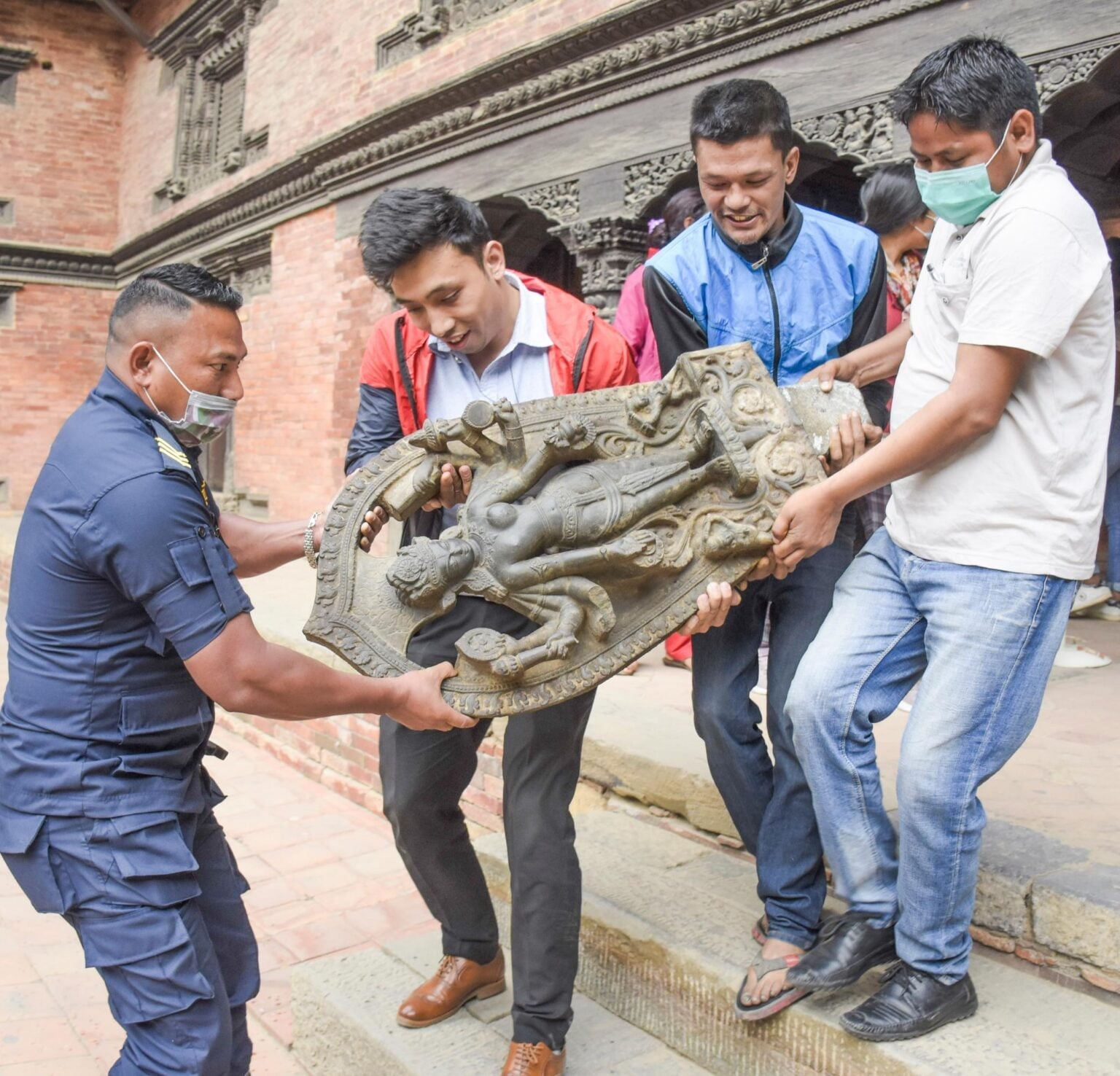
Nepal’s sacred heritage cannot be understood as a detached collection of antique objects. In the Kathmandu Valley, a stone murti, a wooden strut, a paubha painting, a chaitya, a temple water spout, or a metal image of Vishnu, Saraswati, Buddha, Lokeshwar, Bhairava, Taleju Bhavani, Ganesh, or Uma Maheshwar belongs to an active ritual ecosystem. These objects have historically received lamps, flowers, vermilion, water, milk, mantra, procession, seasonal festival, and family memory. Their significance lies not only in artistic excellence, but in the relationship between the Deity, the place, and the community that continues to serve and recognize that presence.
For centuries, Nepal’s rugged geography and restrictive entry policies insulated much of this sacred world from the global art market. Until the 1950s, foreign access remained limited, and this isolation had an unintended protective effect. Temples, monasteries, old palaces, shrines, courtyards, fields, crossroads, stupas, chaityas, and household sanctums preserved a dense civilizational landscape in which Hindu, Buddhist, and Jain traditions were not abstract categories but everyday practices. The Newar cultural world of the Kathmandu Valley especially demonstrates how Dharmic traditions can share space, ritual vocabulary, craftsmanship, and reverence without losing their distinct identities.
When Nepal opened more fully to the outside world, visitors encountered a sacred geography that many described through the vocabulary of art history. Carved wooden windows, protective motifs, stone icons, metal Deities, terracotta figures, paubhas, sacred spouts, and guardian images appeared to foreign eyes as an open-air museum. Yet that phrase, while visually evocative, also contained a dangerous misunderstanding. Kathmandu was not a museum. It was, and remains, a living civilization where ritual, architecture, memory, and daily movement are inseparable.
The international admiration of Nepali sacred art expanded sharply in the 1960s. Scholarly exhibitions, including Dr. Stella Kramrisch’s 1964 presentation of Nepali art in New York and Nepal’s 1966 exhibitions in Western Europe, introduced global audiences to the technical brilliance of Nepali sculpture and religious craftsmanship. Publications, catalogues, and academic writing brought prestige, but prestige also created demand. What had once been protected by geography and custom became visible to collectors, dealers, smugglers, and institutions far removed from the communities that worshiped these images.
From the late 1960s onward, Nepal’s sacred objects began disappearing at an alarming rate. The thefts were not limited to famous temples or well-known pilgrimage sites. Murtis were removed from community shrines, Buddhist monasteries, chaityas, stupas, family temples, rural sanctuaries, sacred niches, stone spouts, and even open fields. Many were taken at night, but some thefts occurred in broad daylight when villagers were away tending fields or attending ordinary work. The result was not merely the loss of sculpture. It was the rupture of worship, festival continuity, and inherited knowledge.
The technical pattern of the looting was depressingly systematic. Local intermediaries, often operating under economic pressure, were reportedly paid small sums to remove sacred images from their original sites. Middlemen and international traffickers then moved the objects through layered networks, false provenance claims, private collections, galleries, auction houses, and museums. In the global art economy, a consecrated image could become a high-value commodity. In Nepalese religious life, however, the same image remained a living Deity whose absence left a visible and emotional wound.
This distinction is central to the ethics of repatriation. A museum label may identify date, dynasty, material, and style; a community remembers the birthday offerings made before the image, the lamps lit at dawn, the first prayer before a journey, the annual jatra, the family vow, the neighborhood procession, and the quiet darshan on the way to work. Sacred heritage is not only a question of ownership. It is a question of relationship, continuity, and the right of a community to remain connected to its own sacred geography.
The case of Handigaon illustrates the scale of cultural injury. The ancient Newar settlement has reportedly lost a large share of its clan Deities. Some families continue to worship remaining fragments, including the surviving feet of a Goddess, because even a fragment can hold memory when the original form has been violently removed. Such practices reveal a profound religious resilience, but they also expose the inadequacy of treating looted sacred art as isolated museum property. When a Deity is stolen, the empty shrine continues speaking.
Pharping, Patan, Maligaon, Bhaktapur, Kathmandu Durbar Square, and other sacred sites present similar patterns of loss and adaptation. Communities have often commissioned replicas in order to continue puja, processions, and annual observances. These replicas preserve ritual rhythm, but they do not erase the pain of displacement. The original murti carries the layered touch of generations. Its surface may hold traces of vermilion, oil, water, incense, and flowers. Such marks are not incidental. They are evidence of living devotion.
The 1989 works of Lain Singh Bangdel and Jurgen Schick became essential to the documentation of Nepal’s stolen sacred images. Their photographs and records now function as critical evidence in provenance research. This is technically important because repatriation claims often require proof that an object came from a specific shrine, temple, monastery, or community site and was removed unlawfully. Without photographs, inventories, police reports, inscriptions, local testimony, or archival references, the legal path becomes far more difficult.
Nepal’s documentation problem remains one of the most serious obstacles to recovery. The country possesses more than two thousand years of religious art across open and active sacred spaces, yet many objects were never systematically photographed or inventoried before theft. The 2015 earthquake added another layer of vulnerability, as damaged temples and disrupted communities created conditions in which unreported losses could occur. In heritage recovery, absence of documentation often benefits the current holder rather than the original community.
The legal framework for protection includes Nepal’s Ancient Monuments Preservation Act of 1956, which prohibits destruction, alteration, and theft of protected ancient monuments. Nepal’s Constitution also places responsibility on citizens to protect community heritage. Internationally, the UNESCO 1970 Convention provides an important basis for reclaiming cultural property removed unlawfully. The United States and Nepal strengthened this framework through a bilateral Cultural Property Agreement signed in Kathmandu on January 8, 2026, aimed at curbing illicit trafficking of archaeological and ethnological objects.
The 2026 agreement matters because import restrictions can shift the practical burden at the border. If a suspicious object is intercepted, the carrier or trafficker may need to establish that it is not illicit, rather than forcing Nepal to reconstruct the entire history of a missing sacred object after it has already entered the market. This does not solve every problem, but it strengthens prevention. Heritage recovery requires both return and deterrence: the Deity already taken must be traced, and the next theft must be made harder.
Formal repatriation efforts began in the mid-1980s, and more than two hundred sacred objects have reportedly returned to Nepal from countries including India, the United Kingdom, Germany, Australia, Belgium, and the United States. These returns show that the global climate is changing. Museums and collectors increasingly face moral, scholarly, legal, and public pressure to examine provenance. Yet the pace remains slow when compared with the scale of loss, and many sacred objects still remain in galleries, storage rooms, private homes, auction catalogues, and institutional collections.
The Lakshmi Narayan murti from Patan has become one of the most significant modern examples. Stolen from Nepal and later identified at the Dallas Museum of Art, it was returned and reinstalled in 2021 after sustained work by activists, researchers, officials, and community members. The case also demonstrated the power of visual memory. Researcher and artist Joy Lynn Davis recognized the image because she had studied and painted the missing Deity. In heritage work, scholarship, devotion, photography, and community testimony can converge into evidence.
The National Heritage Recovery Campaign and digital initiatives such as Lost Arts of Nepal have expanded this model. Online comparison of old photographs, auction listings, museum databases, and community records has helped identify objects that once seemed permanently lost. This form of digital provenance research is technically demanding. It requires iconographic knowledge, attention to damage marks, inscriptions, dimensions, stylistic features, ritual context, and the ability to connect a museum object to a specific place rather than only to a broad regional label such as Nepal or Himalayas.
Several unresolved cases show why the work remains difficult. Sacred objects from the Taleju Bhavani Temple in Patan surfaced in an auction context in Paris. The Nil Barahi icon from Pharping was traced to the Asian Civilisations Museum in Singapore. The Taleju Bhavani necklace, associated with Kathmandu’s royal Goddess and bearing an inscription connected to King Pratap Malla, remains at the Art Institute of Chicago despite public concern and a repatriation request. Such cases reveal the gap between ethical clarity and institutional action.
Repatriation also raises complex questions after return. A recovered Deity may be damaged, ritually altered, or separated from a shrine that no longer exists. Some temples were destroyed or transformed. Some communities already installed replicas to maintain worship. Some returned objects require security arrangements that the original site may not yet be able to provide. The religious question is delicate: in many Hindu traditions, damage to a murti has ritual consequences, yet community attachment to the original can remain powerful. Nepal’s experience shows that heritage restoration must respect both shastra and local devotional judgment.
This sensitivity is especially important for a Dharmic understanding of sacred art. Hindu, Buddhist, Jain, and Sikh traditions all preserve, in different ways, the principle that sacred objects, places, scriptures, and institutions are not merely decorative. They are carriers of memory, discipline, learning, seva, and collective identity. Nepal’s story therefore speaks beyond one country. It asks whether modern institutions can recognize living sacred heritage as something more than art-historical material.
The academic language of provenance, title, acquisition, and custody is necessary, but it is incomplete without the human experience of loss. A family that loses its clan Deity loses a ritual center. A neighborhood that loses its Ganesh shrine loses the familiar point at which work, celebration, and uncertainty were once placed before the divine. A community that loses a processional icon may lose an annual festival. Over time, children may no longer learn the names, forms, and stories that earlier generations absorbed simply by living among them.
At the same time, Nepal’s heritage recovery movement offers a model of constructive cultural resilience. It does not depend only on anger, though anger at theft is understandable. Its strongest tools are documentation, legal clarity, community testimony, diplomatic engagement, scholarly rigor, respectful negotiation, public awareness, and technological skill. The work requires archaeologists, lawyers, priests, local elders, museum professionals, photographers, digital researchers, government officials, and ordinary devotees to act as custodians of a shared inheritance.
The ethical conclusion is clear. Sacred images removed from Nepal’s temples, monasteries, shrines, chaityas, and community spaces should not be treated as trophies of taste or anonymous examples of Himalayan art. Where provenance confirms unlawful removal, return is not an act of generosity; it is the correction of a historical wrong. Museums that cooperate in such returns strengthen their own credibility. Collectors who voluntarily return sacred objects participate in restoration rather than possession.
Nepal’s Deities are coming home slowly, one object, one file, one photograph, one negotiation, and one community memory at a time. The process is technical, legal, emotional, and spiritual. Its larger message is that cultural heritage protection must begin before theft, continue through documentation, and culminate in restoration wherever possible. For the Kathmandu Valley and for Dharmic civilization more broadly, the return of a murti is not simply the return of stone or metal. It is the return of worship, memory, dignity, and continuity.
Inspired by this post on Hindu Post.
