
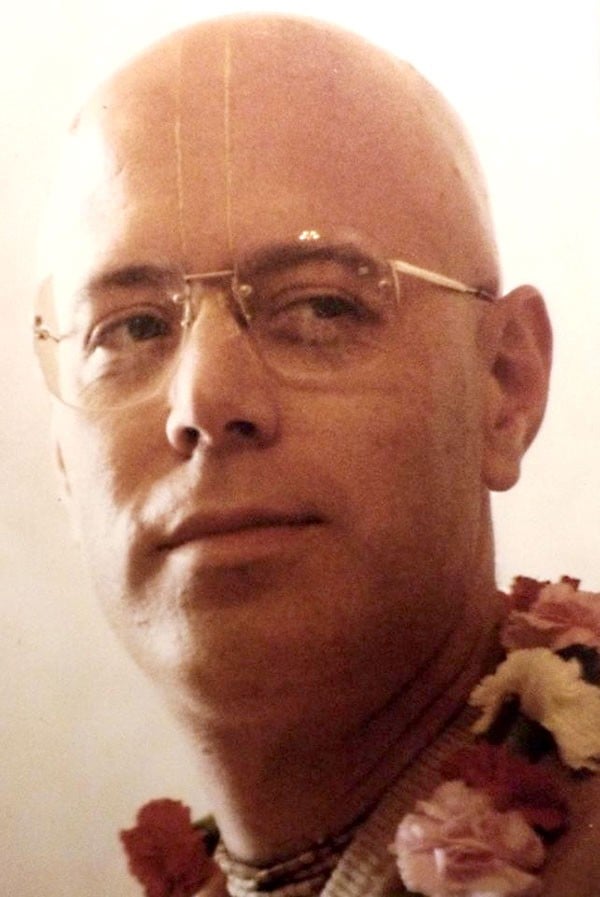
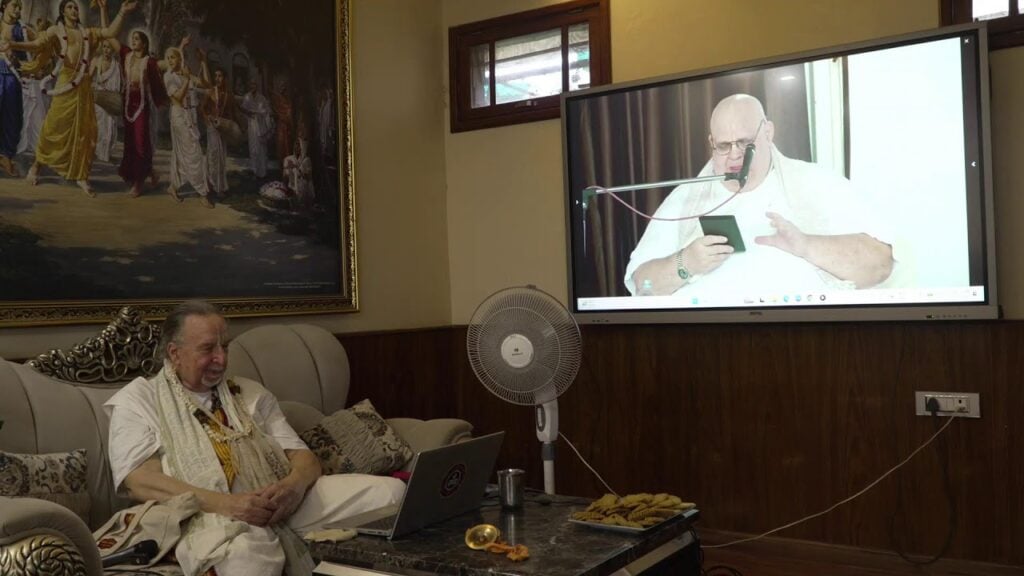
Hare Krishna. The remembrance of His Holiness Tamal Krishna Goswami by His Holiness Bhakti Charu Swami, delivered at Sri Mayapur Chandrodaya Mandir on February 18, 2015, is more than a memorial address. It is a carefully layered account of how Srila Prabhupada’s mission took root in the modern world, how the International Society for Krishna Consciousness grew from a small storefront into a global movement, and how one dedicated disciple became central to that history through service, discipline, intelligence, and deep personal loyalty.
The historical setting is essential. When Srila Prabhupada arrived in the United States in 1965, America had recently emerged from the Second World War into extraordinary material prosperity. Yet beneath the surface of that prosperity, many young people were restless. They had inherited comfort, consumer goods, institutional confidence, and the promise of material success, but they were also beginning to see that wealth could not answer every human need. In particular, it could not purchase love, meaning, belonging, or spiritual purpose.
This disillusionment gave rise to the counter-cultural mood of the 1960s. Many young Americans began questioning inherited social norms, organized religion, political authority, and conventional measures of success. Some searched for liberation through music, altered states, communal living, and radical forms of social experimentation. Bhakti Charu Swami’s reflection places Srila Prabhupada’s arrival within this wider historical moment: a materially wealthy society was producing spiritually hungry youth, and those youth were looking for an alternative strong enough to reorder life itself.
Srila Prabhupada offered that alternative in the form of Krishna consciousness. His message was neither merely cultural nor sentimental. It was rooted in the Bhagavad Gita, Srimad-Bhagavatam, the Gaudiya Vaishnava tradition, and the disciplic succession descending through Srila Bhaktisiddhanta Sarasvati Thakura. At the same time, it was presented with remarkable accessibility: chanting the holy names, honoring prasadam, studying sacred texts, regulating the senses, and living a life of seva. For a generation searching for sincerity, the clarity of this path became transformative.
The first ISKCON center at 26 Second Avenue in New York stands as one of the pivotal sites in modern Hindu and Vaishnava history. The physical space was modest, but Srila Prabhupada’s vision was expansive. He registered the institution as the International Society for Krishna Consciousness, a name that already contained a global future. Bhakti Charu Swami emphasized this as evidence of Srila Prabhupada’s spiritual foresight. In traditional language, such a saintly personality may be understood as trikaladarshi, one who sees time in its three aspects: past, present, and future.
From New York, the movement moved westward. San Francisco, Golden Gate Park, and Haight Ashbury had become magnets for the youth culture of the era. Mukunda Maharaj played a significant role in this expansion, first by helping secure the 26 Second Avenue storefront and later by assisting the establishment of Krishna consciousness on the West Coast. The San Francisco environment, with its intense search for alternative life, became fertile ground for Srila Prabhupada’s preaching.
It was in this atmosphere that Tamal Krishna Maharaj entered the movement. He joined Srila Prabhupada in 1968 after an encounter connected with the redwood forest area near San Francisco, where young seekers had gathered in a lifestyle removed from mainstream materialistic culture. Bhakti Charu Swami described the meeting as a kind of love at first sight. Tamal Krishna Maharaj left the commune and came with Srila Prabhupada to San Francisco, drawn by the personality, purity, and spiritual force of his guru.
Such accounts should not be reduced to romantic memory. They reveal a recurring pattern in the early history of ISKCON: spiritually receptive young people were not merely adopting a new lifestyle; they were being called into a demanding tradition of discipline, service, and surrender. Srila Prabhupada once told a devotee who lamented his past, "As soon as I called, you came." The remark captures a theological reading of the early movement: these disciples were seen as souls sent by Sri Caitanya Mahaprabhu and Srila Bhaktisiddhanta Sarasvati Thakura to assist Srila Prabhupada’s mission.
Tamal Krishna Goswami’s later service confirmed the depth of that calling. He was not a peripheral participant but a front-line organizer, preacher, manager, and strategist. When ISKCON acquired a major temple property in Los Angeles, Srila Prabhupada selected Tamal Krishna Maharaj as president. This was not a minor appointment. Los Angeles became one of ISKCON’s most important centers, and leadership there required discipline, administrative strength, theological commitment, and the ability to build a serious devotional culture in a fast-growing movement.
The same pattern appeared in the movement’s European expansion. Around that period, Shyamasundara Prabhu, Mukunda Maharaj, Gurudasa Prabhu, Malati Mataji, Yamuna Mataji, and Janaki Mataji had developed connections in London, especially with George Harrison of the Beatles. In the late 1960s, the Beatles held enormous cultural influence among global youth, and George Harrison’s attraction to Krishna consciousness helped bring public attention to the maha-mantra and devotional practice. Yet Bhakti Charu Swami clarified that Srila Prabhupada sent Tamal Krishna Maharaj to Europe not merely to cultivate celebrity association but to establish sankirtana, book distribution, and organized preaching.
That distinction is important. Krishna consciousness was not meant to remain a cultural curiosity attached to music, fashion, or counter-cultural identity. Its durability depended on books, daily sadhana, temple worship, disciplined community, and trained practitioners. In London, Paris, and Frankfurt, Tamal Krishna Maharaj helped establish this practical foundation. His work reflects a broader principle within dharmic traditions: spiritual inspiration must take institutional form if it is to serve society across generations.
His contribution to Mayapur was equally consequential. The sacred land where ISKCON later developed its international headquarters was not obtained easily. According to Bhakti Charu Swami’s account, several attempts to acquire land failed because local opposition disrupted the negotiations. Srila Prabhupada then sent Tamal Krishna Maharaj, who completed the arrangement. He came with a lawyer, sat beneath a banyan tree by the roadside, and finalized the agreement.
The image is striking: a young Western disciple, representing a global Vaishnava mission, sitting beneath a banyan tree in Bengal to secure land for the future of Mayapur. Tamal Krishna Maharaj later told Bhakti Charu Swami that when he returned to Calcutta at midnight, Srila Prabhupada was still awake, waiting. The signed deed was placed before Srila Prabhupada. In that moment, administrative competence, guru-seva, sacred geography, and historical destiny converged.
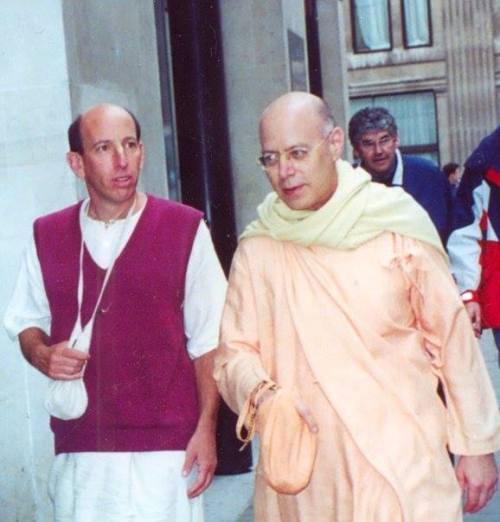
Bhakti Charu Swami’s first personal sight of Tamal Krishna Maharaj occurred in Mayapur. He recalled seeing Bhavananda Prabhu walking with a bright and handsome person whose presence immediately evoked respect. The impression was not simply physical. In devotional culture, the presence of a serious servant of the guru often communicates intensity, purpose, and spiritual authority before any formal introduction is made. That first sight filled the heart with appreciation and reverence.
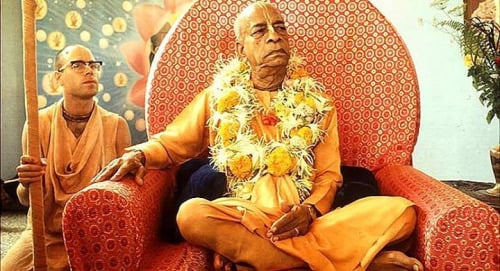
By 1977, Srila Prabhupada was in Mayapur, and Tamal Krishna Maharaj had become his secretary. Bhakti Charu Swami was then a new devotee, but Srila Prabhupada had asked him to translate his books into Bengali. This service gave him unusual access to Srila Prabhupada at a time when thousands of devotees longed for darshan and direct association. Translation was not merely linguistic work; it was a sacred responsibility to carry Srila Prabhupada’s teachings into Bengali with accuracy, devotion, and cultural sensitivity.
Srila Prabhupada gradually expanded that service. He gave Bhakti Charu Swami Bengali letters to answer, then Hindi letters, and dictated replies for him to handwrite before signing them. This culminated in Srila Prabhupada appointing him as secretary for Indian affairs. Srila Prabhupada then called Tamal Krishna Maharaj and suggested that Bhakti Charu Swami move into the same room. Thus began an intimate period of training and association that deeply shaped Bhakti Charu Swami’s understanding of service.
The room they shared was on top of the Lotus building in Mayapur. Bhakti Charu Swami remembered Tamal Krishna Maharaj’s daily discipline with particular clarity. He would rise around three o’clock in the morning and switch on Srila Prabhupada’s tape while preparing for the day. The sound of Srila Prabhupada’s voice became the first sound of the morning. This detail conveys more than routine. It demonstrates how a disciple organizes time, body, mind, and environment around remembrance of the guru and service to Krishna.
The relationship between the two was marked by affection, respect, humor, and hierarchy understood in spiritual rather than biological terms. By ordinary calculation, Bhakti Charu Swami was six months older, having been born in September 1945, while Tamal Krishna Maharaj was born in March 1946. Tamal Krishna Maharaj once joked, "You’re a senior to me, but I treat you like my junior." Bhakti Charu Swami, however, regarded him as spiritually senior because of his long-standing and intense service to Srila Prabhupada.
Their shared life continued through Mayapur, Bombay, Rishikesh, and Vrindavan. Tamal Krishna Maharaj would insist that they stay together, even when Bhakti Charu Swami suggested that he take a room alone. After Srila Prabhupada’s departure, Tamal Krishna Maharaj continued to share Bhakti Charu Swami’s room during visits to Mayapur until he received his own room in the Conch building. Such details reveal a relationship that combined institutional service with personal warmth.
One of the most memorable scenes took place in Rishikesh. Srila Prabhupada was staying there, and a few devotees were with him. In the afternoons, Tamal Krishna Maharaj and Bhakti Charu Swami would sometimes walk across Lakshman Jhula, cross the Ganges, and continue upstream. On one occasion, they sat on a boulder by the river. Tamal Krishna Maharaj remarked that Bhakti Charu Swami was fortunate to have been born in India, close to Vedic culture and Krishna consciousness.
Bhakti Charu Swami’s response complicates any simplistic assumption about birth and culture. He explained that before coming to Krishna consciousness, he had not been particularly close to Indian spiritual culture and had grown up under the impression that the West represented the best model of life. He then told Tamal Krishna Maharaj that the intensity of his service to Srila Prabhupada showed that he had been sent by Sri Caitanya Mahaprabhu. Tamal Krishna Maharaj laughed and replied, "You don’t know my background."
This exchange is valuable for contemporary readers because it reframes spiritual identity. Birth in India, birth in the West, inherited culture, and personal history all matter, but they are not the final measure of spiritual qualification. In the bhakti tradition, sincerity, surrender, seva, and faithfulness to the guru carry decisive importance. The movement of Krishna consciousness, like the wider dharmic family of Hindu, Buddhist, Jain, and Sikh traditions, repeatedly shows that inner transformation is not confined by geography or ancestry.
Bhakti Charu Swami also remembered Tamal Krishna Maharaj’s intensity. He was known for a strong temper and was sometimes jokingly called "Hot Tamale." Yet this temperament is presented within the context of affection, protection, and responsibility. One incident from Bombay became especially memorable. Tamal Krishna Maharaj, annoyed with Bhakti Charu Swami, sharply declared, "I curse you that you’ll get married!" For a brahmacari in that setting, such a statement felt devastating.
Bhakti Charu Swami went to Srila Prabhupada and reported the matter. Srila Prabhupada replied with spiritual wit and reassurance: "You’re already married. Go tell him that you’re already married to Krishna." The episode reveals several layers at once: the emotional intensity of early ISKCON life, Srila Prabhupada’s ability to resolve tension with theological clarity, and the deep sense that a devotee’s primary identity is defined by relationship with Krishna.
At the heart of the tribute is a frank admission of affection. Bhakti Charu Swami stated that although he had immense respect for Tamal Krishna Maharaj, the relationship also carried the warmth of friendship. The phrase "Tamal’s man" circulated among devotees, and Bhakti Charu Swami said he felt proud to accept that description. It indicated loyalty, trust, protection, and shared service. In devotional communities, such bonds are not merely social alliances; they are formed through years of sacrifice around a sacred mission.
The remembrance then turns toward Tamal Krishna Goswami’s disappearance. His passing was sudden. For six years he had not come to Mayapur for the GBC meetings because he was studying. He first completed undergraduate studies in America and then pursued doctoral work at Cambridge. When he returned to Mayapur after those years, he carried many plans, including the idea of establishing a university in Calcutta that could eventually extend to Mayapur. His intellectual interests, therefore, were not separate from his devotional commitments; they were directed toward education, institution-building, and the future of Krishna consciousness.
Yet soon after returning, he departed from the world. Some devotees felt that Tamal Krishna Maharaj may have known that his time was short. Bhakti Charu Swami recalled an experience two or three days before his passing. They were chanting together in Tamal Krishna Maharaj’s room when Tamal Krishna Maharaj stopped and said, "Take care of those boys in Calcutta." He referred to several disciples there and added, "You are their father."
Bhakti Charu Swami responded according to the accepted devotional etiquette: "No, I am the uncle. You are the father." In Vaishnava understanding, the spiritual master is the father, while the godbrothers of the spiritual master are honored as uncles. Tamal Krishna Maharaj repeated, "No, no. You are their father." At the time, the meaning was difficult to understand. In retrospect, Bhakti Charu Swami saw it as an indication that Tamal Krishna Maharaj was entrusting his disciples to another guardian before leaving.
This final exchange gives the tribute its emotional gravity. It shows a spiritual leader thinking not of position but of responsibility. The concern was not institutional control, reputation, or personal legacy. It was care for disciples, continuity of guidance, and the welfare of devotees who would need shelter after his departure. Such concern reflects the dharmic principle that leadership is measured by protection, not possession.
Tamal Krishna Goswami’s life, as remembered by Bhakti Charu Swami, therefore stands at the intersection of several histories: the American counterculture, the global expansion of ISKCON, the establishment of Mayapur, the development of sankirtana in Europe, Srila Prabhupada’s final years, and the maturation of Krishna consciousness as an educational and institutional movement. His personality combined sharpness, affection, scholarship, courage, and relentless service. Such a legacy continues to invite serious study, not only within ISKCON but within the broader history of modern Hindu spirituality and global dharmic movements.
The tribute also preserves the voice of Bhakti Charu Swami as a witness. His recollections do not read like detached biography; they carry the texture of shared rooms, early morning tapes, walks beside the Ganges, service under Srila Prabhupada, and the painful tenderness of final instructions. Academic history often depends on dates, institutions, and documents, but spiritual history also depends on remembered gestures, lived discipline, and the bonds formed through guru-seva.
For readers seeking insight into Srila Prabhupada, ISKCON, Mayapur, and Tamal Krishna Goswami, this remembrance offers a rare synthesis of history and devotion. It shows how a global movement is built through vision, but also through specific acts: securing a storefront, opening temples, distributing books, translating letters, acquiring sacred land, rising before dawn, caring for disciples, and accepting responsibility when others depart. These are the quiet mechanisms by which a spiritual tradition becomes durable.
All glories to His Holiness Tamal Krishna Goswami Maharaj. Gaura Premanande Haribol.
Inspired by this post on Dandavats.






Leave a Reply
You must be logged in to post a comment.