
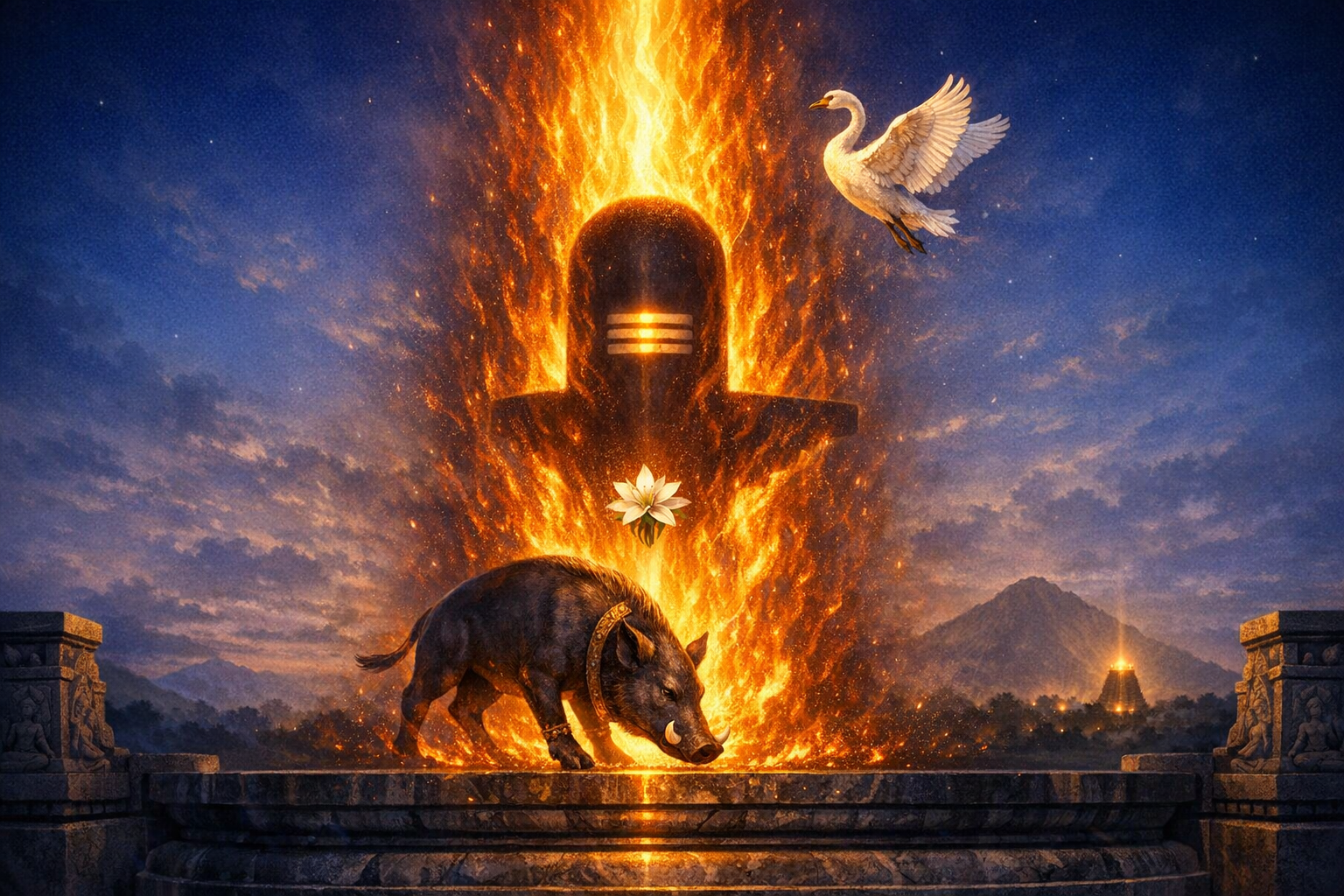
Among the profound narratives of Hindu sacred literature, the Lingodbhava legend—Shiva’s appearance as an infinite pillar of fire—stands out as a philosophical meditation on truth, ego, and the limits of human and divine cognition. More than a contest of supremacy between Brahma and Vishnu, the episode functions as a hermeneutic key to Hindu theology and ethics, asking why one deity resorted to untruth while another embraced honest limitation in the face of the Unfathomable.
Primary attestations of the episode occur in the Shiva Purana and the Linga Purana, with influential elaborations in the Arunachala Mahatmyam (a section associated with the Skanda Purana). Regional Sthala-puranas and ritual traditions, especially around Arunachaleshwara Temple (Tiruvannamalai), preserve the narrative’s liturgical and iconographic force. These sources converge on a consistent core: Shiva manifests as an endless flame, defying comprehension; Vishnu descends in search of its base; Brahma ascends seeking its summit; humility and truth are celebrated; ego and expedience are chastened.
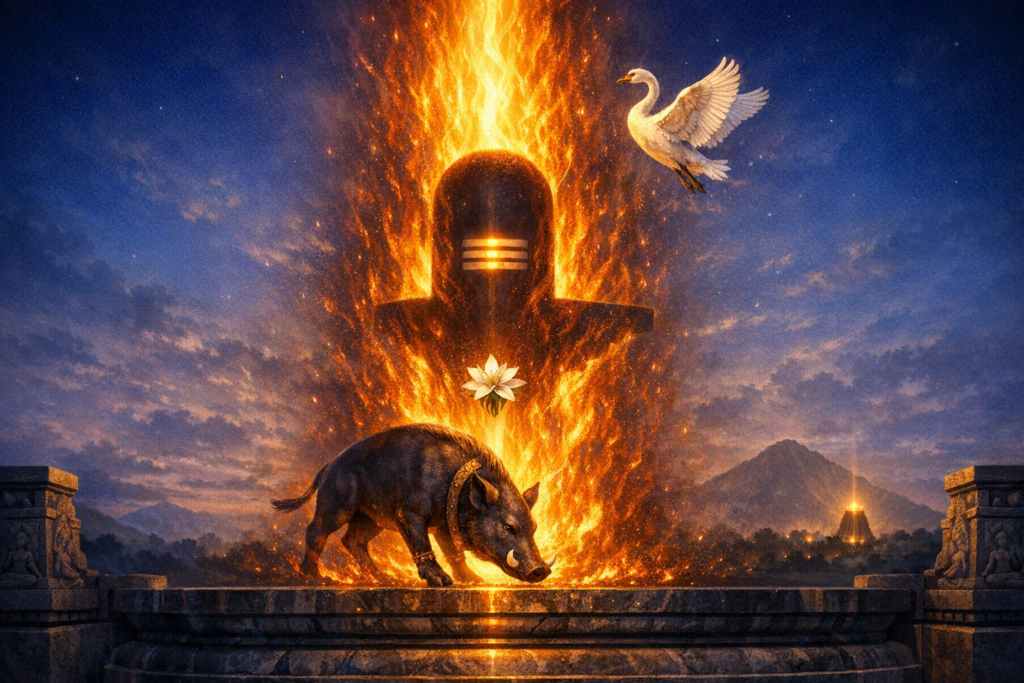
Condensed, the narrative unfolds thus. Confronted by a column of fire without origin or terminus, Brahma and Vishnu agree to test who can first discover its extremities. Vishnu takes the form of Varaha, plunging downward toward the base. Brahma assumes the form of a Hamsa, soaring upward to locate the crown. Time dilates into mythic measure as both efforts encounter the same reality: infinitude negates directional conquest.
Vishnu returns, acknowledging the impossibility of the task and offering satya—truthful confession of finitude—as his only victory. This admission is not failure; it is philosophical clarity. In Hindu ethical vocabulary, it exemplifies sattva guna: lucidity, equipoise, and reverence before truth.
Brahma, by contrast, encounters the ketaki (screw-pine) flower while aloft. Entangled in the ambition to prevail, he enlists the flower’s false testimony to claim he has reached the summit. The lie appears minor in narrative terms yet major in metaphysical import: in attempting to bound the boundless, speech fractures into distortion. The episode thus attributes to Brahma a lapse aligned with rajas guna: urge, assertion, and the hazards of self-importance.
Shiva then reveals the truth: neither top nor bottom was found because the flame signified anantatva—endlessness. Brahma’s untruth incurs censure: he is denied wide cultic prominence; the ketaki flower is excluded from Shiva’s worship. Vishnu’s humility, by contrast, is honored, reinforcing a fundamental axiom of dharma: satya (truth) and vinaya (humility) align with the cosmic order.
The ethical question—why Brahma lied and Vishnu did not—admits a nuanced theological reading. The Purana tradition often personifies cosmic functions through the Trimurti: Brahma (creation), Vishnu (maintenance), and Shiva (dissolution and transcendence). Creation’s dynamism easily shades into ahamkara (ego), the fiction of separate, self-sufficient agency. Maintenance, as guardianship, inclines toward truth-keeping and balance. The legend externalizes these dispositions to educate the conscience: unchecked creative assertion can tip into myth-making about one’s own powers; guardianship converges with humility before that which exceeds measurement.
This moral-psychological reading integrates seamlessly with Vedantic metaphysics. The Taittiriya Upanishad names Brahman as “satyam, jñānam, anantam”—truth, knowledge, and infinity. The pillar of fire, as an aniconic theophany, dramatizes anantam: the measureless. Attempting to objectify the Absolute through upward or downward traversal is methodologically flawed; honest recognition of finitude is therefore the first step toward valid knowledge (pramana) of the transcendent.
The Shiva linga, frequently misread as merely aniconic minimalism, is better understood—per traditional exegesis—as a “liṅga” (mark, sign) of that which eludes form even while sustaining all forms. Shaiva Siddhanta and allied traditions speak of Shiva in nishkala (formless) and sakala (with form) modalities; the linga occupies the pedagogic middle: tangible enough for devotion (bhakti), abstract enough to signal infinitude. From this angle, Lingodbhava functions as a charter myth for aniconic-shiva-linga-meaning and practice.
Temple art codifies the lesson with remarkable consistency. South Indian sanctums often display the Lingodbhava relief on the western wall of the garbhagṛha: Vishnu is rendered as Varaha seeking the base; Brahma appears as a Hamsa near the “top”; the ketaki flower hovers between them; Shiva emerges at the center, the vertical axis of infinitude. Kerala’s mural repertoire memorializes the scene as Lingodbhava Kalam, emphasizing chromatic flame bands that resolve into the linga’s silhouette—fire clarified as sign.
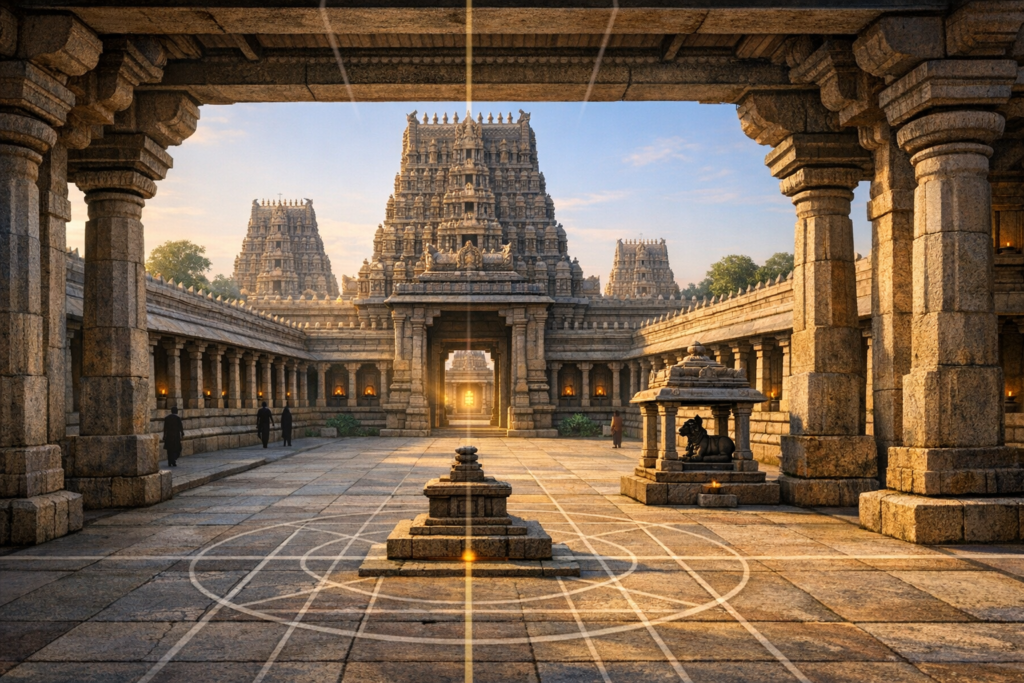
The annual Kārthigai Deepam at Arunachala translates the myth into public ritual. A massive beacon is lit atop the hill, visually linking the mountain—regarded in the Arunachala Mahatmyam as the cooled embodiment of the primordial flame—to the sky. The “Stone Pillar Karthigai Deepam” thus functions as performative theology: literal light discloses metaphorical infinity, and the community collectively rehearses humility before the Ineffable.
Ritual memory also preserves the narrative’s ethical sanctions. The ketaki flower, having borne false witness, is typically proscribed in Shiva worship—a liturgical reminder that speech divorced from truth undermines communion with the sacred. Regional exceptions exist, illustrating how Hindu practice integrates local aesthetic and botanical heritages without surrendering the story’s moral center.
The relative scarcity of Brahma temples—Pushkar being the best-known exception—is often attributed in popular teaching to the curse that follows the lie. Historically and theologically, this is complemented by a structural pattern: in lived Hinduism, creation is continuous and distributed rather than concentrated cultically, whereas preservation (Vishnu) and liberative dissolution/ground-of-being (Shiva) attract devotional centrality. The legend offers a narrative rationale without promoting sectarian diminishment.
Puranic hermeneutics further clarifies the non-sectarian spirit of the story. Each Purana rightly extols its chosen focus—Vaishnava, Shaiva, Shakta—as supreme for the purpose of devotion, not exclusion. Lingodbhava’s deeper thrust invites humility across traditions: truthfulness, not tribal triumph, is the mark of spiritual maturity. Hari-Hara iconography and composite shrines (e.g., Shankaranarayana forms) historically crystallize this unity-in-diversity within the dharmic family.
Jainism’s doctrine of Anekāntavāda—the insight that reality is many-sided—amplifies the legend’s epistemic humility. The well-known parable of the blind men and the elephant parallels Brahma and Vishnu’s partial approaches to the infinite pillar: each viewpoint grasps a facet; only truthfulness about limits forestalls error. Thus, a Jain philosophical lens reads Lingodbhava as an argument for intellectual modesty and ethical speech.
Buddhism’s Right Speech (samyag-vāc) and its diagnostic of ego-clinging (upadāna) also converge with the narrative. Where Brahma’s momentary expedience violates Right Speech, Vishnu’s confession exemplifies it. The pillar’s unattainability resonates with śūnyatā (emptiness as dependent arising): concepts cannot capture the whole; humility protects insight from solidifying into dogma.
Sikh thought frames the same truth positively: “Satnam” affirms the Name as Truth, and “Hukam” centers acceptance of the cosmic order that transcends individual assertion. In this light, Vishnu’s stance reads as alignment with Hukam, while Brahma’s lapse illustrates the dissonance created when will-to-win overrides reverence for Sat. Unity among Hindu, Buddhist, Jain, and Sikh perspectives thus emerges not by erasing differences but by honoring truth and humility as shared dharmic virtues.
The ethical implications for contemporary life are concrete. Public discourse, research, and leadership frequently confront the temptation to “reach the summit” narratively before the facts warrant it. Lingodbhava counsels the opposite: disclose limits, prize verifiable knowledge, and let humility guide inquiry. Truthful incompleteness builds trust; embellished certainty corrodes it.
Psychologically, the episode exposes ahamkara’s subtle maneuvers. The mind favors completion; when confronted with the Unknown, it can prefer plausible fictions over patient unknowing. Disciplines such as dhyana (meditation), japa (mantra recitation), and svadhyaya (self-study of scriptures) train attention away from egoic urgency toward witness-consciousness, enabling one to meet the “pillar of fire” within—those terrains of experience that resist quick resolution—with steadiness and honesty.
For practice-oriented readers, three classical commitments emerge. First, satya: integrate truthfulness in speech and self-reporting, especially under pressure. Second, vinaya: cultivate modesty in interpretive claims, allowing room for mystery. Third, anukampa (compassion): recognize that others, too, grapple with the Infinite’s opacity; meet disagreement with care rather than conquest. Together these embody an applied dharma consistent with the legend’s inner pedagogy.
From an art-historical vantage, Lingodbhava Kalam in Kerala and stone reliefs across Tamil and Kannada regions encode theology in visual grammar. The central vertical registers of flame, the flanking animal-forms of Varaha and Hamsa, and the witness-flower compose a didactic tableau: the measureless shines through measure; reverence arises where competition fails. Iconography thus participates in scriptural exegesis, offering a public curriculum in humility.
The Skanda Purana’s Arunachala Mahatmyam contributes a distinctive geological-poetic coda: the primordial fire “cooled” into stone, becoming the mountain itself. The hill as linga is not a metaphor only; it is a sacral geography where devotees circumambulate (girivalam), turning philosophical humility into bodily practice. In annual Kārthigai Deepam, the lit flame reunites stone and sky, time and eternity, narrative and vision.
Ultimately, the legend’s center is not punitive but pedagogic. Brahma’s lie and Vishnu’s truth are mirrors for the reader: will thought press for triumph, or will it stand in honest awe before what exceeds it? Within the dharmic universe, this question unites schools and lineages: truth and humility are the common grammar by which seekers approach the Real, whether named Shiva, Vishnu, Brahman, Satnam, or left unnamed in apophatic stillness.
Read this way, Lingodbhava ceases to be a sectarian scorecard and becomes a universal sadhana map. Where there is ego, there is narrative manipulation; where there is humility, there is light. The pillar of fire remains—inviting not conquest but communion, not supremacy but sincerity, not finality but faithful inquiry into the Infinite.
Inspired by this post on Hindu Blog.





Leave a Reply
You must be logged in to post a comment.