
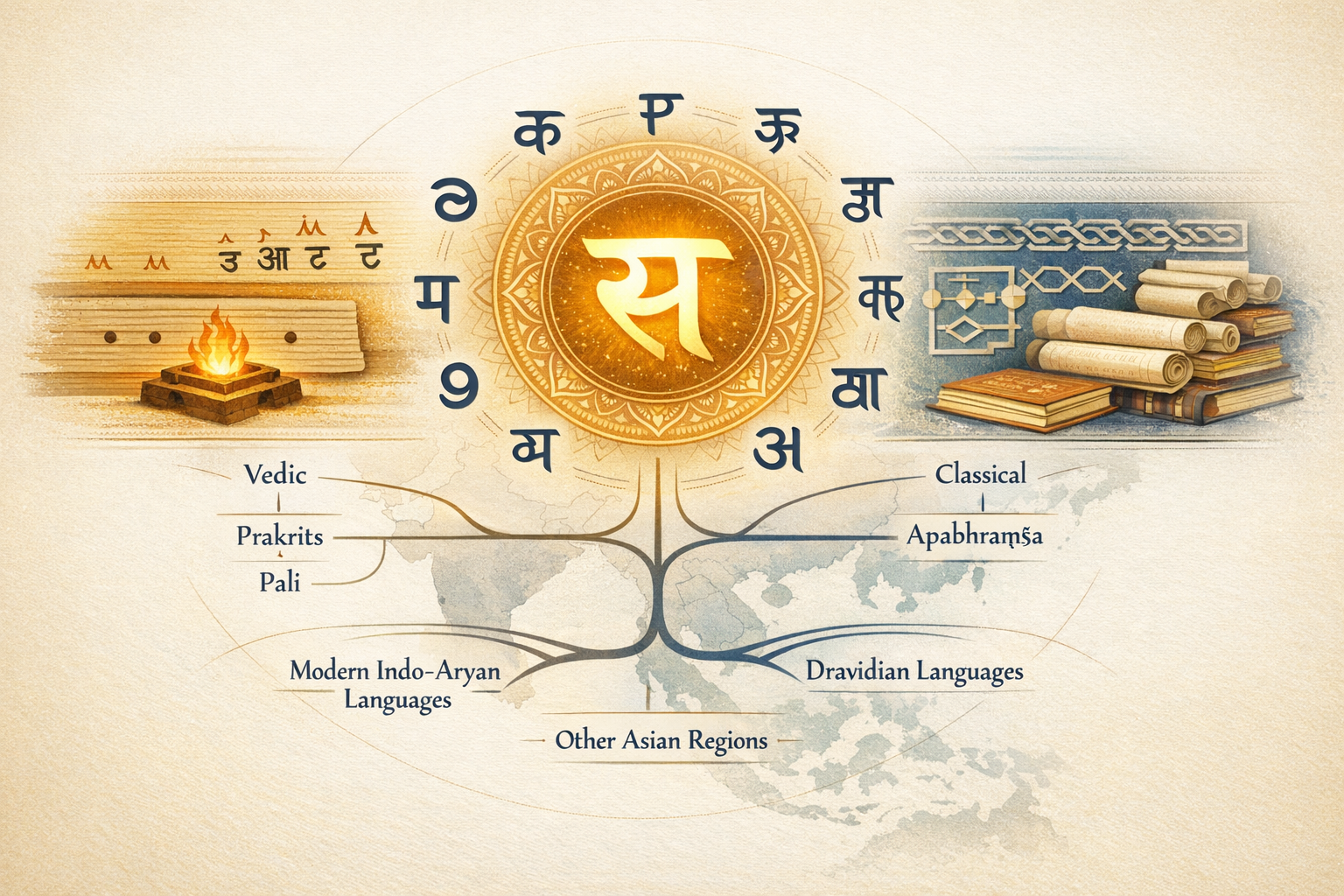
Sanskrit stands at the heart of South Asia’s civilizational memory—an intellectual lingua franca that shaped philosophy, ritual, literature, and governance across Hinduism, Buddhism, Jainism, and, through a shared lexicon and ideas, Sikhism. A precise understanding of its nature and history clarifies how Vedic Sanskrit differs from Classical Sanskrit, how both contain internal strata and regional or stylistic variants, and how Sanskrit relates to other languages of the subcontinent and beyond. This unified perspective reinforces the shared heritage of dharmic traditions and highlights the language’s continuing relevance for cultural cohesion and scholarly inquiry.
This article surveys three interlinked themes: the contrasts between “Vedic” Sanskrit (often called chandas) and Classical Sanskrit (bhāṣā), the further differences within each, and the multiple linguistic lineages that connect Sanskrit to Prakrits, Pali, Apabhraṃśa, and the modern Indo-Aryan and Dravidian languages. The treatment is technical yet accessible, weaving philological detail with insights from historical linguistics, epigraphy, and oral tradition—while situating Sanskrit within the broader values of dharmic pluralism and unity.
Chronologically, Vedic Sanskrit flourished from the earliest hymns of the Ṛgveda to the late Vedic prose of the Brāhmaṇas, Āraṇyakas, and early Upaniṣads (roughly the second to first millennium BCE). Classical Sanskrit, standardized by the grammatical tradition of Pāṇini’s Aṣṭādhyāyī and elaborated by Kātyāyana and Patañjali, took form in the middle of the first millennium BCE, becoming a pan-Indic learned language used for śāstra, kāvya, epic, and inscriptional prose for over two millennia.
Vedic Sanskrit preserves archaisms that align closely with reconstructed Proto-Indo-European features: a living pitch accent (with udātta, anudātta, and svarita), a rich verbal system including the injunctive and a productive subjunctive, and vowel lengthening (pluti) in vocatives and certain discourse markers. Metrical constraints, frequent second-position enclitics (a classic instance of Wackernagel’s law), and particles such as ha and u lend the Vedic hymns distinctive rhythm and discourse structure.
In Vedic, the injunctive combines with the prohibitive particle mā for negative commands, while root aorists and imperfects (with or without augment) appear with high frequency. The subjunctive expresses modality with semantic nuances largely lost in later stages. Sandhi rules apply, but metrical considerations can occasionally suspend them. Athematic noun and verb classes remain robust, and the middle voice is semantically vivid, often signaling participant involvement or benefit in ways that Classical Sanskrit tends to lexicalize.
By contrast, Classical Sanskrit streamlines morphology, making the injunctive obsolete and drastically restricting the subjunctive. The pitch accent ceases to be distinctive in ordinary speech, even as Vedic recitation preserves it for liturgical accuracy. Compounding (samāsa) expands dramatically—tatpuruṣa, bahuvrīhi, dvandva, and avyayībhāva—fueling the celebrated density and precision of classical śāstra and the ornate beauty of kāvya. Pāṇinian grammar systematizes a transregional norm, enabling a learned koine that could circulate among diverse communities and courts.
Semantically, Classical Sanskrit expands specialized terminologies for logic (Nyāya), grammar (Vyākaraṇa), ritual (Mīmāṃsā), metaphysics (Vedānta), poetics (Alaṅkāraśāstra), mathematics and astronomy (Gaṇita, Jyotiṣa), medicine (Āyurveda), and statecraft (Arthaśāstra). These śāstric idioms, while Pāṇinian in form, inflect style differently: aphoristic sūtra, discursive bhāṣya, didactic kārika, encyclopedic treatise, and elaborate courtly poetry.
The Vedic corpus itself exhibits layered differences. Early Ṛgvedic hymns differ from later Vedic prose in syntax, verbal categories, and discourse markers. The Brahmana texts introduce exegetical prose, etymological speculation (nirvacana), and ritual hermeneutics that move away from the hymnic idiom. The early Upaniṣads, while linguistically Vedic, anticipate philosophical lexemes that Classical Sanskrit will formalize and extend.
Differences also appear across śākhā traditions and recensions. The Śākala and Bāṣkala recensions of the Ṛgveda reveal variant readings and accentual placements; branches of the Yajurveda—the Śukla (e.g., Mādhyandina, Kāṇva) and Kṛṣṇa (e.g., Taittirīya, Maitrāyaṇīya, Kapiṣṭhala-Kaṭha)—differ in vocabularies, ritual sequencing, and phonological details; the Sāmaveda brings melodic elaboration and recitational conventions that affect syllabic weight and accent realization. Such intra-Vedic diversity reflects wide geographical spread, oral pedagogy, and functional differentiation.
Phonologically, Vedic preserves contrasts later neutralized or regularized in Classical Sanskrit. Retroflex segments, while present early, display distributional shifts; certain alveolar-like realizations and the behavior of liquids (e.g., ḷ) vary by śākhā. Over time, Classical Sanskrit converges on the Devanāgarī-based descriptive norm familiar from grammatical handbooks, masking regional phonetic colorings that lived on in recitation and local scholastic traditions.
Classical Sanskrit itself is not monolithic. “Epic Sanskrit” in the Mahābhārata and Rāmāyaṇa exhibits features that sometimes deviate from the strict Pāṇinian ideal, reflecting oral-period composition and performance aesthetics. Courtly kāvya cultivates elaborate compounds, figures of speech (alaṅkāra), and intertextuality. Technical prose aims for unambiguous reference and taxonomic clarity, often favoring shorter compounds and carefully defined terms. Jain Sanskrit and Buddhist Sanskrit (including so-called “Buddhist Hybrid Sanskrit”) register the imprint of Middle Indo-Aryan phonology and morphology while remaining broadly intelligible to classical readers.
Sociolinguistic layering is visible in drama, where Classical Sanskrit shares the stage with Prakrits: male Brahmin characters or kings often speak Sanskrit, while queens and heroines frequently use Śaurasenī or other Prakrits; ascetics may shift registers. This stylized multilingualism reflects historical diglossia in which Sanskrit served as a prestige bhāṣā alongside regional vernaculars, together generating a shared cultural sphere without erasing local identity.
The history of scripts mirrors this pluralism. Early inscriptions employ Brāhmī and, in the northwest, Kharoshṭhī. Later hands include Gupta scripts, Śāradā in Kashmir, Grantha in the south, Siddhaṃ for the transmission of Buddhist texts to East Asia, and the rise of Nāgarī/Devanāgarī, which becomes the early-modern and modern standard for Sanskrit printing. Sikh Gurmukhi, while historically tied to the Landa family, engages a lexicon profoundly shaped by Sanskrit, reflecting the broader Indic matrix that Sikh scripture draws upon through Braj, Sant-bhāṣā, and tatsama vocabulary.
Relations with other Indo-Aryan languages unfold in distinct chronological layers. From Old Indo-Aryan (Vedic and Classical Sanskrit) to Middle Indo-Aryan (Prakrits and Pali) and then to New Indo-Aryan (Hindi, Bengali, Marathi, Gujarati, Punjabi, Assamese, Odia, Nepali, Sinhala and others), phonology simplifies (e.g., reduction of consonant clusters, erosion of voiced aspirates in some branches), and morphology drifts toward analytic constructions. Apabhraṃśa serves as a crucial bridge between late Prakrits and the earliest attestations of New Indo-Aryan vernaculars.
Pali and the various Prakrits (notably Śaurasenī, Mahārāṣṭrī, and Ardhamāgadhī) stand in constant dialogue with Sanskrit. Buddhist canonical Pali and Jaina Ardhamāgadhī preserve Middle Indo-Aryan phonology and inflection while sharing a deep Sanskritic lexicon for core dharmic concepts such as dhamma/dharma, kamma/karma, mettā/maitrī, and paññā/prajñā. In Mahāyāna and Vajrayāna, mantric and philosophical literature circulate in Sanskrit and Buddhist Sanskrit, their dhāraṇīs traveling via Siddhaṃ manuscripts to East and Southeast Asia—further proof of Sanskrit’s integrative role across Buddhist communities.
Jain traditions likewise demonstrate bilingual and bidirectional flow. Early Jaina canons in Ardhamāgadhī and later Jaina Māhārāṣṭrī coexist with Jaina Sanskrit narrative and scholastic literature. Ethically central terms—ahiṃsā, anekāntavāda, tapas—resonate across Sanskrit, Prakrit, and Pali corpora, underscoring shared dharmic foundations while honoring distinct doctrinal developments.
Sikh scripture and literature—principally composed in Gurmukhi—draw on a wider North Indian linguistic ecology in which Sanskritic vocabulary remains a major resource. The presence of tatsama and tadbhava items, alongside Braj and Sant-bhāṣā idioms, illustrates a living bridge to Sanskrit and Prakrit/Apabhraṃśa layers. This shared lexicon supports a civilizational dialogue: core ethical ideas such as dharma, satya, seva, and dayā/karuṇā find cognate expression across Hindu, Buddhist, Jain, and Sikh texts, strengthening inter-traditional understanding without effacing doctrinal uniqueness.
Contact with Dravidian languages (Tamil, Kannada, Telugu, Malayalam) shaped both sides. Sanskrit contributed vast lexical strata—ritual, philosophical, and administrative terms—adopted as tatsama or nativized forms, while areal phonological features such as retroflexion (ṭ ḍ ṇ ḷ) and echo-reduplication patterns reflect deep bidirectional influence. Dravidian morphosyntax and literary canons evolved in close proximity to Sanskrit śāstra and kāvya, generating bilingual intellectuals who wrote in multiple languages and registers.
Munda and Tibeto-Burman contact further shaped the Indo-Aryan sprachbund. Areal traits such as dative subjects in experiencer predicates, complex predicate constructions (light verbs), and pragmatic particles diffused across genealogies, illustrating how Sanskrit and its descendants participated in a larger South Asian linguistic convergence. Rather than a single “source” dictating change, centuries of multilingual coexistence fostered shared solutions to communicative needs.
Beyond South Asia, Sanskrit vocabulary and concepts radiated across Southeast Asia (Khmer, Thai, Lao, Burmese, Javanese, Balinese), shaping royal titulature, legal ideas, calendrics, arts, and temple culture. Old Javanese (Kawi) literature shows dense Sanskrit interaction; Khmer and Thai inscriptions attest to long-standing Sanskrit literacy. In East Asia, the spread of Buddhist Sanskrit and Siddhaṃ script influenced religious vocabulary, mantra transmission, and scholastic exchange.
Transmission practices guard accuracy with remarkable sophistication. Vedic oral pedagogy distinguishes saṁhitā and padapāṭha text layers and employs recitational permutations (krama, jaṭā, ghanapāṭha) that function as built-in error-correction systems. Many reciters describe a palpable sense of awe when the melodic accent ascends and descends in precise sequence—a shared aesthetic that transcends sect and reinforces dharmic unity through sound, memory, and devotion.
Epigraphy offers complementary evidence. From Aśokan Prakrit inscriptions in Brāhmī and Kharoshṭhī to Gupta-era Sanskrit eulogies, inscriptions chart the ascent of Sanskrit as an inscriptional medium and the coexistence of local vernaculars. Copper plates, temple walls, and stone pillars record land grants, ritual endowments, and learned assemblies, mapping a multilingual administration that took Sanskrit as a transregional legal and cultural norm.
Technically, several contrasts between Vedic and Classical Sanskrit are diagnostic for learners and researchers: the presence vs. absence of a productive injunctive; widespread vs. highly restricted subjunctive; living pitch accent vs. accent neutralization in typical classical usage; greater frequency of athematic inflection and root aorists vs. more regularized paradigms; and differing discourse particles and clitic behavior. Recognizing these signals helps date passages, identify śākhā affiliations, and parse stylistic registers.
Within Vedic, internal variation includes evolving case endings (e.g., shifts in dative and genitive singulars in certain classes), the gradual decline of some verbal categories, and changes in metrical preferences. Within Classical Sanskrit, contrastive registers include epic narration (with residual archaisms and formulae), scholastic śāstra (terminological precision and definition chains), and lyric/epic kāvya (ornamentation and compressed compounding). Buddhist Sanskrit and Jaina Sanskrit show selective Middle Indo-Aryan influence while maintaining intelligibility to the classical reader through shared grammar and lexicon.
For the modern reader, appreciating Sanskrit’s relational web clarifies contemporary linguistic identities. Hindi, Bengali, Marathi, Gujarati, Punjabi, Assamese, Odia, Nepali, and Sinhala all balance tatsama Sanskrit vocabulary with inherited Middle Indo-Aryan (tadbhava) forms. South Indian languages employ extensive Sanskrit loanwords alongside deep indigenous literary traditions. This hybridity strengthens, rather than weakens, cultural self-understanding—mirroring dharmic pluralism.
In pedagogy, distinguishing Vedic from Classical pathways matters: students aiming to read śāstra and kāvya benefit from a solid Pāṇinian foundation; those engaging Vedic texts require additional training in accent, older verbal categories, metrical analysis, and padapāṭha conventions. A staged curriculum—Classical grammar, then epic prose and poetry, and finally Vedic recitation and metrics—builds durable competence while honoring each register’s integrity.
Digital corpora, treebanks, and searchable dictionaries (e.g., the Monier–Williams lexicon and Sanskrit morphological analyzers) now enable reproducible analysis across genres and periods. Epigraphic databases reveal regional orthographic habits and formulae; scanned grantha and śāradā manuscripts illuminate scribal norms. Such tools, combined with living oral traditions, create a uniquely triangulated view that is philologically rigorous and culturally anchored.
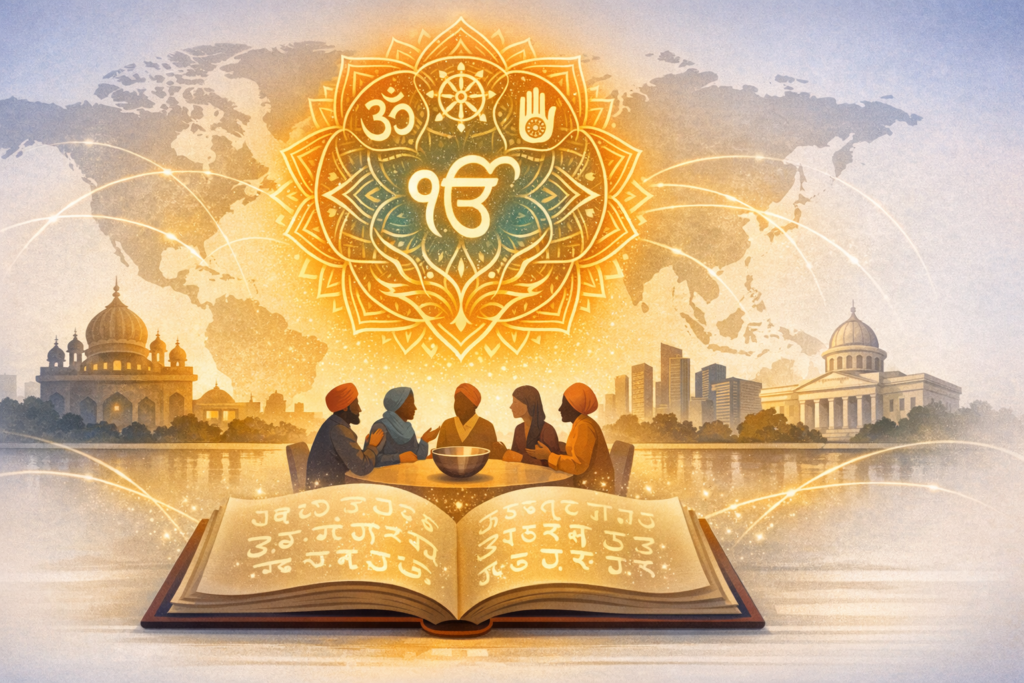
Ultimately, Sanskrit’s nature and history model unity in diversity. Vedic vs. Classical distinctions are real and technically instructive, yet they belong to a single evolving civilization that nurtured multiple languages and scripts without coercion. Hindu, Buddhist, Jain, and Sikh communities draw on overlapping Sanskritic vocabularies for truth (satya), non-harm (ahiṃsā), compassion (karuṇā), devotion (bhakti), wisdom (prajñā), and self-discipline (tapas). Appreciating these convergences deepens mutual respect and equips readers to participate in a shared future grounded in dharmic pluralism.
Viewed across millennia, Sanskrit is not a relic but a living repository: a disciplined science of language (vyākaraṇa), a treasury of philosophy and aesthetics, and a common meeting ground for India’s dharmic traditions. Understanding its internal varieties and external relationships is more than an academic exercise—it is a pathway to cultural literacy, interfaith empathy, and civilizational confidence.
Inspired by this post on Dandavats.









Leave a Reply
You must be logged in to post a comment.