

The Mimamsa darsana, among the six classical schools of Hindu philosophy, develops a rigorous account of the soul (ātman) through the lenses of Vedic authority, ritual performance, karma, and cosmic order (ṛta–dharma). Rather than centering mystical absorption or devotional surrender as the primary path, Mimamsa elevates Vedic injunctions and the grammar of duty as the sure means to align human intention with the moral architecture of the cosmos. This distinctive emphasis yields a technically precise, ethically disciplined understanding of what the soul is, how it acts, and why ritual action matters.
Situated as Pūrva-Mīmāṁsā (the earlier inquiry) vis-à-vis Uttara-Mīmāṁsā (Vedānta), this school begins with Jaimini’s programmatic concern: athāto dharma-jijñāsā, followed by the thesis codanā-lakṣaṇo dharmaḥ—dharma is known by Vedic injunction. The Veda (śruti) is apauruṣeya (authorless) and thus uniquely authoritative; its sentences are not speculative opinions but reliable guides to action that fashions moral outcomes across lifetimes. This hermeneutic orientation frames the soul’s journey as inseparable from performative adherence to dharma.
On the nature of self, Mimamsa maintains a plurality of eternal selves (ātmans), each the enduring subject that is knower (jñātā), agent (kartā), and experiencer (bhoktā). Many Mimamsakas, in conversation with Nyāya, take the self to be vibhu (all-pervading) and distinct from body, senses, and mind (manas). Conscious episodes arise when the internal organ (manas) connects the self to sense faculties; in the absence of such contact (as in deep sleep), conscious cognition does not manifest, even though the self persists unchanged. This yields a sober, law-like account of personhood through change, memory, obligation, and retribution.
How is the soul known? Mimamsa advances a sophisticated epistemology (pramāṇa-śāstra). The Prābhākara school recognizes five pramāṇas—perception (pratyakṣa), inference (anumāna), comparison (upamāna), postulation (arthāpatti), and verbal testimony (śabda)—and treats absence-knowledge within these. The Bhāṭṭa school of Kumārila adds a sixth, non-cognition (anupalabdhi), to account for knowing absence directly. Across these nuances, the reflexive presence of the self is securely affirmed through lived agency, memory-continuity, and the irreducible first-personality of experience—articulated, however, in a third-person analytical idiom grounded in pramāṇas.
Mimamsa’s most celebrated contribution to the soul–action nexus is the doctrine of apūrva (also called adṛṣṭa), the “unprecedented” or unseen potency produced by correctly performed Vedic rituals. Since many ritual results are temporally remote (e.g., posthumous benefits or heavenly attainments), apūrva mediates between a here-and-now act and a later fruit, preserving moral causality without invoking a discretionary divine distributor. In this way, apūrva safeguards the intelligibility and fairness of karma across births and worlds, ensuring that the soul’s ledger is coherent and just.
Ritual language in Mimamsa is not descriptive but performative. Injunctive sentences (vidhi) generate obligation and specify procedures; explanatory passages (arthavāda) support and clarify the rationale of duties; restrictive and permissive constructions delimit scope. By taking śabda-pramāṇa as decisive for dharma, Mimamsa articulates how sacred words reorganize inner motive, outer practice, and cosmic alignment. The soul thus advances not by mere belief or sentiment but by the structured fulfillment of Vedic duties that instantiate order.
Deities are acknowledged within this sacrificial universe as mantra-devatās who receive offerings and whose roles are enshrined in the Veda’s liturgical architecture. Classical Pūrva-Mīmāṁsā, however, neither requires nor centers a creator Īśvara to ground karmic fruition; apūrva and the eternality of Vedic authority suffice to sustain moral law. Later syntheses with Vedānta allow theistic reinterpretations without discarding Mimamsa’s hermeneutical core, demonstrating an intra-dharmic pluralism that is complementary rather than competitive.
The Mimamsa account of karma and rebirth presupposes that the soul carries adṛṣṭa across embodiments. Birth circumstances, capacities, and obstacles are not arbitrary; they are morally patterned outcomes of prior action. This vision stabilizes ethical confidence: what is done with deliberation and care leaves an imprint that returns with precision. The self is therefore not a fleeting aggregate but the durable subject of a multi-life curriculum in responsibility.
Mental processes occupy a crucial mediating role. The atomic manas, by contacting one sense at a time, coordinates streams of cognition that the self owns and remembers. States like deep sleep, dream, and waking are analyzed to clarify why consciousness waxes and wanes without compromising the self’s continuity. Such analyses anchor spiritual life in disciplined attention, careful inference, and fidelity to what lived experience can actually warrant.
Mokṣa in Pūrva-Mīmāṁsā is acknowledged yet not foregrounded as the sole telos. The Bhāṭṭa school typically defines liberation as atyanta-duḥkha-nivṛtti, the total cessation of suffering when bodily conditions—and hence painful contacts—fall away; it resists positively reifying blissful experiences that would still depend on psychophysical instruments. Prābhākaras characterize it as the self’s abiding in its own nature (ātma-svarūpāvasthāna), devoid of adventitious afflictions. In both, liberation is a stable, unentangled condition of the soul rather than a hedonic crescendo.
How does one move toward such freedom? Regular performance of nitya (obligatory) and naimittika (occasional) rites prevents demerit and steadily refines intention, while kāmya (desire-driven) acts, though permitted, are ethically ambivalent insofar as they reinforce worldly aims. Some later interpreters accept that dispassion plus right knowledge of self can culminate in mokṣa when residual karmas are exhausted, while staying faithful to Mimamsa’s insistence that dharma is known only from Vedic testimony. Renunciation and contemplation can therefore be harmonized with duty, not opposed to it.
A practical illustration clarifies the inner architecture. In Agnihotra or Darśa-Paurṇamāsa rites, sankalpa (deliberate resolve) aligns intention; mantras configure attention; offerings enact the transmutation of possession into participation; and śānti recitations integrate action with cosmic peace. Across this arc, apūrva is generated, karmic trajectories are reset, and the soul’s authorship of ethical history is renewed. The ritual is at once technical and transformative.
Mimamsa’s hermeneutics shaped much of later Hindu exegesis. Its tools—such as upakrama–upasaṁhāra (opening–closing concord), liṅga (indicative sign), vākya (sentence relation), and prakaraṇa (context)—became standard across Vedānta and Dharmaśāstra. This shared interpretive grammar serves unity among dharmic traditions by providing common methods for understanding scripture, duty, and liberation, even where metaphysical emphases diverge.
Engagements with neighboring darśanas deepen Mimamsa’s account of the soul. Vedānta’s nondual identity of ātman with Brahman, Sāṅkhya–Yoga’s plurality of puruṣas disciplined through nirodha, Nyāya–Vaiśeṣika’s robust realism and analytic theism, Jainism’s jīva–karma ontology with an ethic of ahiṁsā, and Buddhism’s anātman analysis that loosens clinging—all articulate complementary pathways to rectify intention and end suffering. Read together, these perspectives illuminate a dharmic ecosystem where ethical action, contemplative insight, and scriptural fidelity mutually reinforce human flourishing.
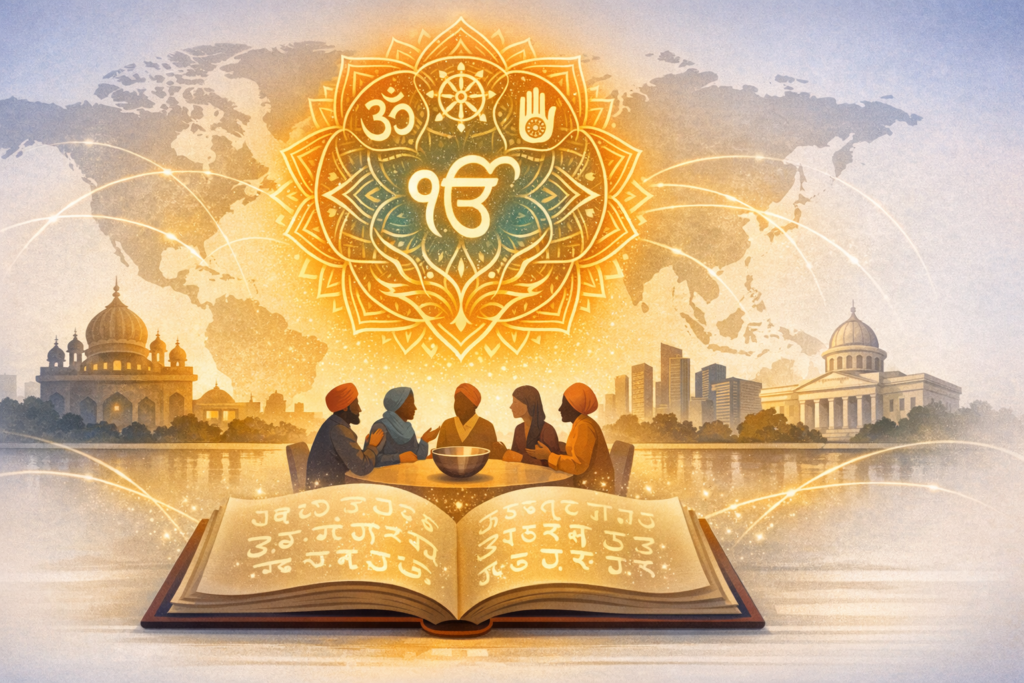
Within that ecosystem, Sikh tradition’s insistence on seva, truthful living, and remembrance (simran) resonates with Mimamsa’s affirmation that action molds destiny and purifies intention. Across Hinduism, Buddhism, Jainism, and Sikhism, karmic accountability and disciplined practice are not rival claims but convergent commitments to cultivate the person and serve the world. Mimamsa contributes the precision of ritual grammar and the assurance that rightly ordered duties yield rightly ordered lives.
The much-discussed Mimamsa–Īśvara debate highlights how apūrva preserves karmic fruition without invoking divine caprice. Yet Mimamsa’s non-reliance on a creator does not entail hostility to devotion; rather, it secures the autonomy of Vedic injunctions and the reliability of moral law. Later Hindu syntheses comfortably allow devotion and ritual to coexist, the former shaping sentiment and surrender, the latter structuring conduct and consequence.
Technically, Mimamsa’s soul theory also addresses puzzles of localization. If the ātman is all-pervading, how does it relate to a particular body at a particular place? The answer lies in contact theories that assign manas the role of connecting the ubiquitous self to specific psychophysical conditions, yielding determinate cognitions. Memory and responsibility then track the same enduring subject across changing embodiments, preserving agency and moral continuity.
Emotionally and existentially, this yields a reassuring world-picture. The cosmos is not morally indifferent; it is structured so that intention and act produce fitting results, sometimes beyond present sight but never beyond ultimate reach. For the soul, this means that hope is rational, responsibility is meaningful, and discipline is efficacious—qualities that invite steadiness rather than anxiety on the path.
From a contemporary standpoint, Mimamsa encourages translating sacrificial intelligence into varied forms of ethical action. Where fire-altars are rare, service, charity, study, and restraint become living yajñas that form character and generate apūrva-like moral momentum. The grammar endures: resolve, recitation, offering, and peace can inform civic duty as much as liturgy, guiding the soul toward clarity and compassion.
In summary, Mimamsa defines the soul as an eternal, responsible agent whose destiny is shaped by dutiful performance guided by apauruṣeya Veda. Apūrva secures the connection between present action and future fruit, legitimizing karmic justice without dependence on discretionary will. Liberation is a serene, unentangled condition marked by the cessation of suffering or the self’s settled abiding in its essence. Throughout, Mimamsa’s precision in language, logic, and liturgy offers a durable discipline for souls seeking order, meaning, and release.
Read in concert with allied dharmic traditions, this vision is not sectarian but synergistic. It supplies the technical backbone of ritual hermeneutics to a wider family of paths that prize moral causality, contemplative refinement, and scriptural wisdom. In doing so, Mimamsa helps weave a resilient unity-in-diversity where Hinduism, Buddhism, Jainism, and Sikhism illuminate one another’s strengths and share a common commitment to the elevation of human life.
Inspired by this post on Hindu Blog.








Leave a Reply
You must be logged in to post a comment.