
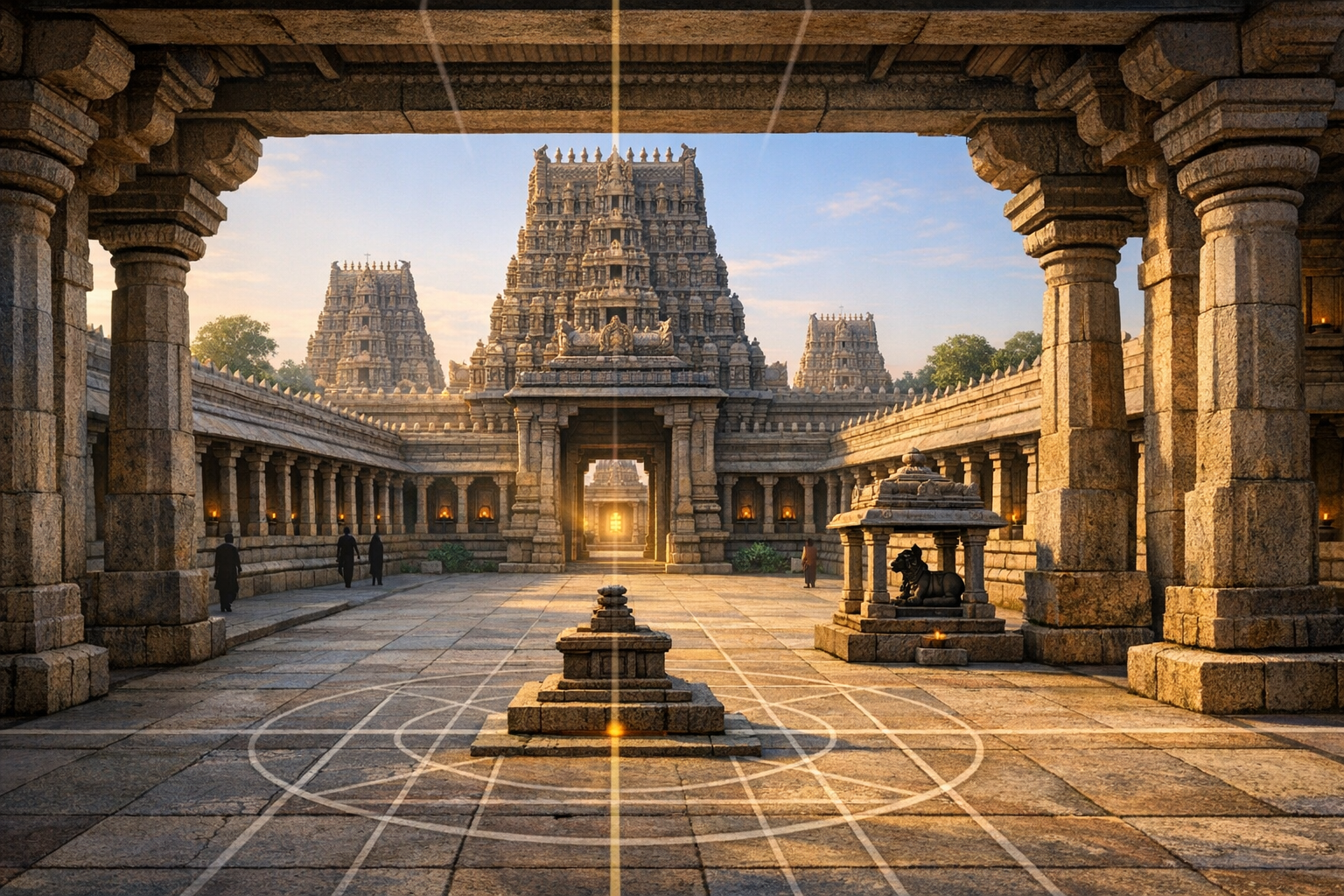
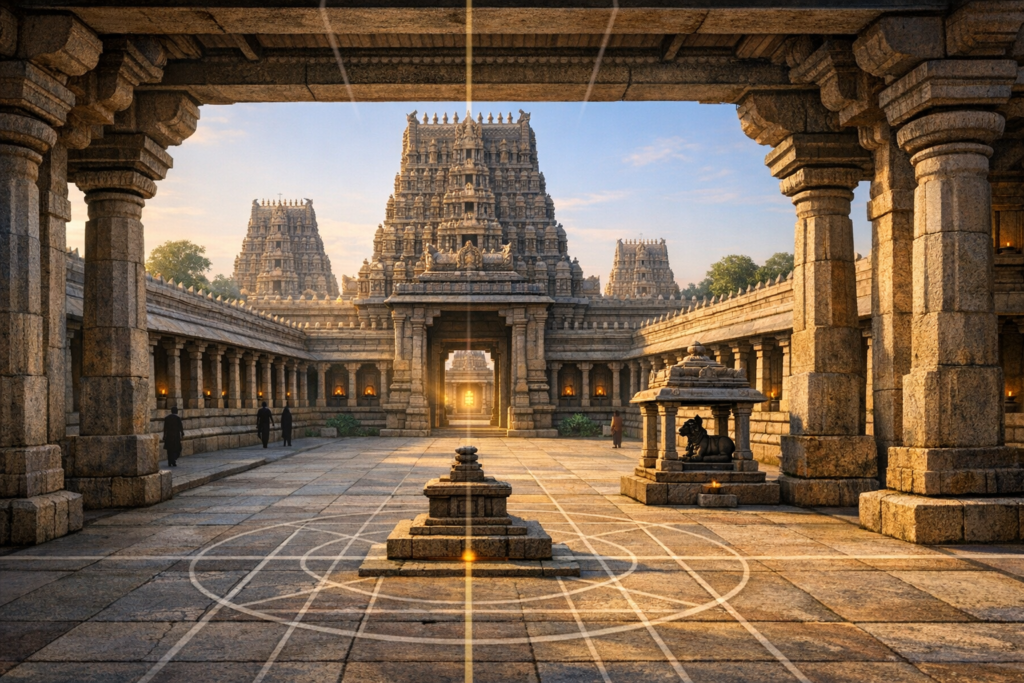
The prakara— the sacred enclosure or high wall that surrounds a Hindu temple—functions as far more than a physical boundary. Within Hindu temple architecture, it marks the deliberate transition from the profane world into a sanctified field of merit (kshetra), creating an experiential and symbolic passage toward the Divine. As a liminal membrane, the prakara clarifies orientation, calibrates movement, and frames the inner journey that culminates at the garbhagriha (sanctum), thereby embodying both architectural intelligence and spiritual intent.
Visitors frequently perceive an immediate shift upon crossing a gopuram into the prakara: footsteps meet cool stone, ambient sounds soften, and vision focuses through framed vistas toward the temple core. This sensory modulation is not incidental; it is an intentional design strategy that partners space, ritual, and psychology. The enclosure edits distraction and heightens attention, preparing the pilgrim for pradakshina (circumambulation) and darshan. In this way, the prakara choreographs devotion through built form.
Agamic literature and the Shilpa Shastras consistently assign the boundary wall a crucial role in establishing sacred order. The enclosure articulates the edge of the consecrated precinct and organizes thresholds (dwaras) at the cardinal directions, often aligned with guardian deities (dikpalas). While textual traditions differ by regional school—Shaiva, Vaishnava (including Pancharatra tradition), Shakta—there is shared agreement that the temple’s protective skin is an indispensable architectural and ritual element.
Cosmologically, the temple complex is a three-dimensional Vaastu-Purusha-Mandala, a spatial diagram expressing cosmic order. The prakara corresponds to the outer rings of this mandala, containing and stabilizing the microcosm while ushering devotees toward the axis mundi represented by the sanctum. Each gate is a controlled aperture—an intentional breach in the boundary—where the mundane is set aside and sanctity commences. By visibly stringing together these thresholds, the prakara externalizes the inner discipline that dharmic traditions cultivate.
Multiple concentric prakaras are a hallmark of many large South Indian temple complexes, where each enclosure progressively intensifies sacredness. In Tamil usage, praharam or prakaram denotes both the walled precinct and the circumambulatory corridor it contains, while the wall itself is also called madil. The celebrated sapta-prakara (seven enclosures) of Srirangam exemplifies this graduated sanctification: outer rings form a temple-city ecology, while inner rings refine ritual focus, culminating in the shrine of Sri Ranganatha.
Dravidian architecture often features tall gopurams piercing each prakara. As the devotee moves inward, the vertical emphasis of the outer towers yields to the concentrated mass of the sanctum. The corridors deepen and lengthen, their colonnades shaping measured rhythms of movement. Pillared mandapas integrate with the enclosures to host ritual, music, and processional halts, converting the walls and their verandas into living arteries of temple life.
Nagara and Kalinga traditions in North and Eastern India typically employ fewer, more compact enclosures but preserve the same boundary logic. The Lingaraja Temple at Bhubaneswar and the Jagannath Puri complex demonstrate high perimeter walls that command presence and delineate sanctity. At Puri, concentric walls and monumental gateways orchestrate both daily worship and grand processions, mediating between civic space and consecrated ground.
Materially, prakaras range from rough-hewn laterite and brick to finely jointed granite ashlar. They are engineered for longevity and load distribution, with thoughtful foundations, plinths, and drainage to protect cloisters from monsoon ingress. Lime mortars—traditionally blended with organic additives—once provided structural elasticity. Battlements, parapets, and inset niches transformed the wall into a layered element that is simultaneously protective, processional, and didactic.
The prakara is also a pathway. Pradakshina unfolds along its corridors, enabling a circumambulatory meditation that aligns breath, step, and mantra. The uniform width, shaded passages, and calibrated distance encourage one-pointedness over haste. Sub-shrines along the inner prakaras—Navagraha, guardian deities, and saintly figures—extend the pilgrim’s encounter with dharmic narratives and ethics, while reinforcing the centripetal pull of the sanctum.
Ritually, the enclosure integrates daily and festival life. Bali-sthalas (offering points) may punctuate routes; vahanas (processional vehicles) are housed and staged near gateways; and utsavas traverse expanded circuits that move from the inner prakaras to outer mada veedhis. During grand festivals, the prakara is the hinge that lets the temple breathe into the city and, in return, gathers the city back into the temple’s orbit.
The social dimension of the prakara is equally significant. Enclosures define a perimeter within which learning, music, sculpture, and service institutions historically clustered. Outer walls interface with markets, water structures, and civic streets, facilitating livelihood and hospitality. At times, prakaras also bore defensive duties, shielding sacred centers during political instabilities; their fort-like profiles attest to an era when culture and community sought refuge in sacred architecture.
Srirangam illustrates the temple-city model integrated with concentric prakaras. Each ring establishes a distinct layer of life—residential quarters, bazaars, ritual cloisters, and specialized mandapas—while the enclosures steadily tune attention toward the garbhagriha. The design makes the spiritual ascent tangible, compressing space and amplifying sanctity with each threshold crossed.
At Chidambaram, cardinal gopurams and layered enclosures frame the Chidambara Rahasya, the subtle vision of space-as-consciousness. The prakaras here are an education in alignment and axiality, balancing openness and enclosure so that sky, stone, and movement co-create contemplative clarity. The walls do not merely contain; they demonstrate the grammar of revelation.
Rameswaram’s famed corridors—among the longest in India—synthesize enclosure and promenade. As devotees perform pradakshina, long sight-lines carry the gaze toward sanctified focal points, and the steady cadence of pillars guides the mind inward. The prakara thus operates as a kinetic cloister, where devotion unfolds through measured steps.
At Thanjavur’s Brihadeeshwara Temple, the enclosure reads as both sacral and sovereign. Its disciplined geometry and robust wall profiles underscore Chola confidence in stone, while the emptiness it frames around the towering vimana magnifies the temple’s cosmic centrality. The prakara’s spareness is eloquent, allowing mass, light, and horizon to converse.
In Jagannath Puri, concentric walls and monumental gateways structure the sacred itinerary of the Ratha Yatra. The enclosure is integral to processional choreography, modulating the exchange between temple and town, and preserving the sanctum’s aura even as devotion flows outward on the chariots. Within these walls, temple governance, ritual timing, and public access coexist in a carefully balanced order.
Beyond India, Angkor Wat in Cambodia extends the principle with moats and vast enclosures, monumentalizing the sacred precinct at a territorial scale. While shaped by Khmer aesthetics and engineering, the conceptual consonance is unmistakable: sacred walls, cardinal gates, and axial promenades translate cosmology into stone and water, reinforcing how Hindu temple architecture traveled and adapted while preserving its spiritual core.
Across dharmic traditions, the enclosure-and-circumambulation paradigm is a shared language of sanctity. Buddhist stupas are ringed by vedikas and toranas, establishing a sacred perimeter and path for mindful walking. Jain temple-cities such as Shatrunjaya group shrines within defined precincts that guide ascent and contemplation. Sikh gurdwaras integrate a parikrama around the sanctum and sarovar, most famously at Harmandir Sahib. These convergences highlight an inclusive dharmic grammar: the boundary is not exclusionary; it is a compassionate aid to focus, humility, and shared spiritual striving.
Symbolically, successive prakaras can be read as a movement through sheaths of embodiment—annamaya, pranamaya, manomaya, vijnanamaya, and anandamaya koshas—toward clarity and bliss. Others map the progression to the chakras or to concentric rings of the mandala. In each reading, the enclosure is part of an educative architecture: it helps the devotee let go, step by step, of outward preoccupations and sink into presence.
Environmentally, the prakara moderates microclimate, offers shade, and controls drainage and runoff, ensuring that cloisters remain passable in monsoon conditions. Acoustically, it dampens urban noise while amplifying liturgical sound. In crowd management, the enclosure system distributes movement, separates functions, and protects fragile interiors, making it indispensable for both daily worship and large festivals.
Conservation of prakaras warrants interdisciplinary care. Structural stabilization must respect original materials and joints; vegetation management should protect foundations; and discreet visitor infrastructure—signage, lighting, wayfinding—should clarify circulation without diluting sanctity. Documentation of sculptural programs embedded within walls preserves iconographic scholarship, while community stewardship sustains the enclosure’s social life.
Ultimately, the prakara is a teaching in stone. It demonstrates how Hindu temple architecture unites cosmology, ritual, and community within a coherent spatial ethic. As a shared dharmic motif mirrored in Buddhist, Jain, and Sikh sacred precincts, the enclosure affirms a civilizational commitment to unity-in-diversity—inviting all who enter to move, one measured step at a time, from the worldly to the Divine.
Inspired by this post on Hindu Blog.









Leave a Reply
You must be logged in to post a comment.