

The Mahabharata’s Yaksha Prashna remains one of the most penetrating meditations on mortality in world literature. In the Vana Parva, a mysterious Yaksha bars the parched Pandavas from drinking at a forest lake unless its questions are answered. All but Yudhisthira disregard the warning and collapse. When confronted, Yudhisthira calmly responds to a cascade of inquiries that culminate in the greatest wonder: that although beings witness death daily, they live as if exempt from it. The traditional formulation captures the paradox in crystalline Sanskrit: 'ahany ahani bhūtāni gacchanti yama-mandiram; śeṣāḥ sthāvaram icchanti kim āścaryam ataḥ param'.
Located in Vana Parva (often catalogued around Chapter 313, verse 116 in some recensions), the episode offers more than narrative drama; it is a precise diagnostic of human denial. It identifies a default mental stance that mistakes the relative stability of the present body for permanence. The insight is not meant to evoke despair. Instead, it asks for lucidity: if death is inevitable, how should life be oriented so that the final transition becomes conscious, dignified, and spiritually fruitful?
Contemporary psychology corroborates the Mahabharata’s observation. Studies of mortality salience and denial indicate that humans construct buffers against the anxiety that the fact of death provokes. The Yaksha’s challenge does not reject such defenses outright; it redirects them. Rather than clinging to distractions, it recommends cultivating knowledge (vidyā), virtue (dharma), and steady awareness (smṛti) so that fear is gradually replaced by clarity and compassion. This is where a dharmic synthesis of ethics, meditation, and devotion becomes practical, not merely philosophical.
The Bhagavad Gita frames this orientation within the Vedic path of yoga. The Gita repeatedly links the quality of consciousness at the time of dying to the trajectory of rebirth and to the possibility of moksha. It teaches that attention refined over a lifetime becomes decisive at the threshold of death, as in the well-known assurance: anta-kāle ca mām eva smaran muktvā kalevaram; yaḥ prayāti sa mad-bhāvaṁ yāti nāsty atra saṁśayaḥ. Preparation for dying well, therefore, is inseparable from living well; it is an ongoing training of perception, intention, and remembrance.
Technically, this training can be viewed across three interlocking domains. First is ethical alignment (dharma), which quiets remorse and simplifies the inner landscape by bringing conduct into accord with conscience. Second is attentional stabilization (dhyāna and prāṇāyāma), which calms the nervous system, refines prāṇa, and renders awareness resilient under stress. Third is devotional-intuitive orientation (bhakti and smaraṇa), which gives the heart a luminous anchor so that, when the body loosens its hold, attention naturally turns toward what is timeless rather than what is passing.
Ethical alignment is foundational because karma and reincarnation are not abstract doctrines in this context; they are operational principles. When actions are guided by ahiṁsā, satya, asteya, brahmacarya, and aparigraha, the mind carries fewer unprocessed impressions (saṁskāras) into sleep and, by extension, into dying. Habitual truthfulness, gratitude, and service (seva) soften attachment and cultivate a felt sense that life is participatory and sacred. Such dispositions make the fear of dissolution less acute because the center of identity has been slowly re-situated from possessions and roles toward awareness itself.
Yogic and Upanishadic sources also clarify the phenomenology of dying through subtle anatomy. The human being is described as sheathed by pañca-kośa — annamaya, prāṇamaya, manomaya, vijñānamaya, and ānandamaya. With the ebb of udāna-vāyu and the withdrawal of prāṇa from the senses, attention can collapse into fear and confusion or it can open into presence, depending on prior cultivation. Practices that purify the antaḥkaraṇa (manas, buddhi, ahaṁkāra, citta) are therefore not ornamental; they directly influence the clarity available when the body can no longer sustain the usual reference points.
Key verses of the Bhagavad Gita articulate this progression with precision and empathy. Dehino ’smin yathā dehe kaumāraṁ yauvanaṁ jarā; tathā dehāntara-prāptir dhīras tatra na muhyati (2.13) situates change within a continuum rather than a catastrophe. Vāsāṁsi jīrṇāni yathā vihāya navāni gṛhṇāti naro ’parāṇi; tathā śarīrāṇi vihāya jīrṇāny anyāni saṁyāti navāni dehī (2.22) offers a compassionate metaphor that dignifies transition. Yaṁ yaṁ vāpi smaran bhāvaṁ tyajaty ante kalevaram; taṁ tam evaiti kaunteya sadā tad-bhāva-bhāvitaḥ (8.6) ties the last thought to the lifelong cultivation that precedes it, affirming that daily practice accrues into decisive capacity.
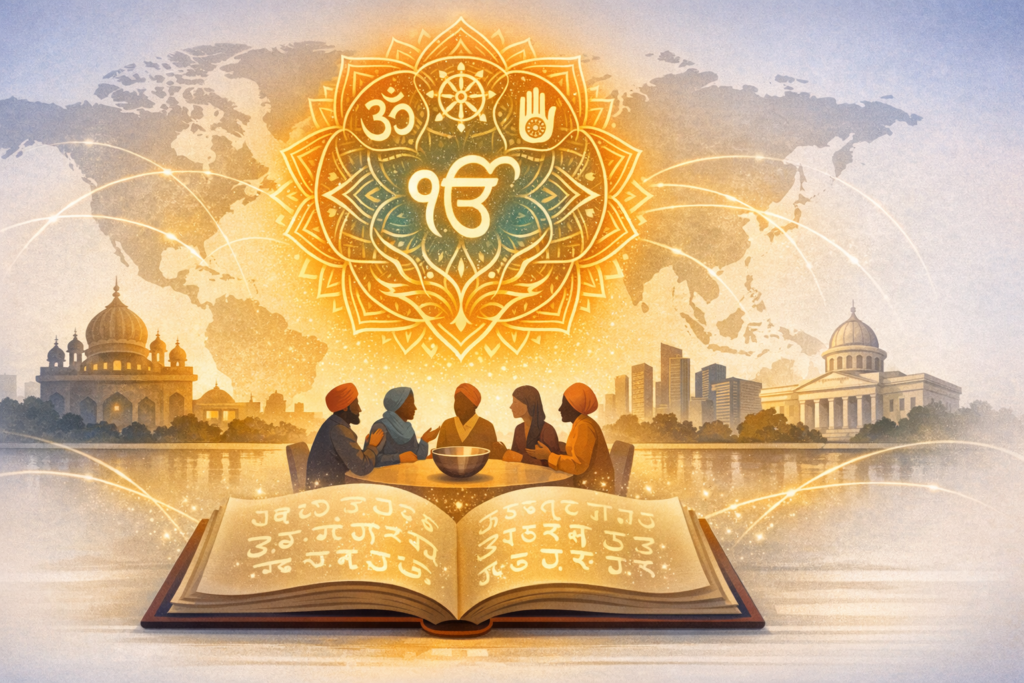
This core insight is shared across dharmic traditions, underscoring a civilizational unity in diversity. Buddhism’s maranasati (mindfulness of death) normalizes mortality as a catalyst for compassion and wisdom rather than nihilism. Jainism’s anitya-anuprekṣā (contemplation on impermanence) and its emphasis on samayik refine equanimity by loosening compulsive grasping. Sikhism’s Naam Simran and living in hukam orient remembrance toward the Divine in the midst of duty, so that courage and surrender coexist. Each stream employs distinct methods, yet they converge on the same watershed: ethical clarity, steady awareness, and devotional trust transform dying from a rupture into a consummation.
A practical, integrative protocol follows naturally from this shared vision. Daily, brief, high-quality sessions of prāṇāyāma and dhyāna can be timed to stabilize attention at predictable circadian windows, such as dawn and dusk. Mantra-japa — whether a Vaishnava mahā-mantra, a Śaiva pañcākṣarī, a Buddhist nembutsu, a Jain namokar, or Sikh Simran — entrains the mind-heart system to return home under pressure. Regular scriptural study (svādhyāya) across one’s own lineage, accompanied by contemplative journaling on finitude, converts abstract teaching into personally embodied insight. Periodic retreats of silence strengthen the capacity to witness thoughts and sensations without being carried away by them.
Alongside personal sādhanā, relational and communal preparations matter. Honest, compassionate conversations within families about values, end-of-life wishes, and spiritual priorities reduce confusion when crises arrive. Acts of reconciliation and forgiveness free attention from unresolved narratives. Seva — especially to those who are ill, elderly, or bereaved — trains empathy and normalizes the rhythms of aging and dying, making one’s own transition less foreign. Observances such as śrāddha or communal remembrance serve not merely as rites for the departed but as living curricula for the virtues the living still must cultivate.
At the threshold of dying, long-practiced simplicity becomes decisive. A quiet, clean space; gentle guidance that invites relaxed, unforced remembrance; soft mantra or scriptural recitation; and an emphasis on natural, unlabored breathing help attention rest in what is steady. When medical settings are involved, collaboration with caregivers to support spiritual practices — while honoring clinical realities — preserves dignity and agency. The aim is not to control outcomes but to create conditions in which the most skillful remembrance can arise without strain.
Common misconceptions deserve correction. Preparation for death is not morbid; it is life-affirming because it clarifies priorities, deepens love, and reduces needless conflict. Nor is it a passive escape; it requires sustained effort, discernment, and courage. The dharmic view does not deny grief; it dignifies it by placing it within a wider horizon where continuity of consciousness and moral causality have both explanatory power and practical consequence.
Returning to the Yaksha Prashna, the greatest wonder becomes a compassionate summons. Seeing that beings depart daily, one can choose denial or one can choose training. The Mahabharata, the Bhagavad Gita, and the wider dharmic traditions recommend training — a holistic yoga of dharma, meditation, and remembrance — so that when death arrives, it finds a mind already oriented toward truth, a heart already practiced in surrender, and a life already aligned with service. In that orientation, the forest lake of the story ceases to be a perilous trap and becomes a mirror, reflecting back the possibility of a conscious, peaceful, and meaningful transition.
Inspired by this post on Dandavats.









Leave a Reply
You must be logged in to post a comment.