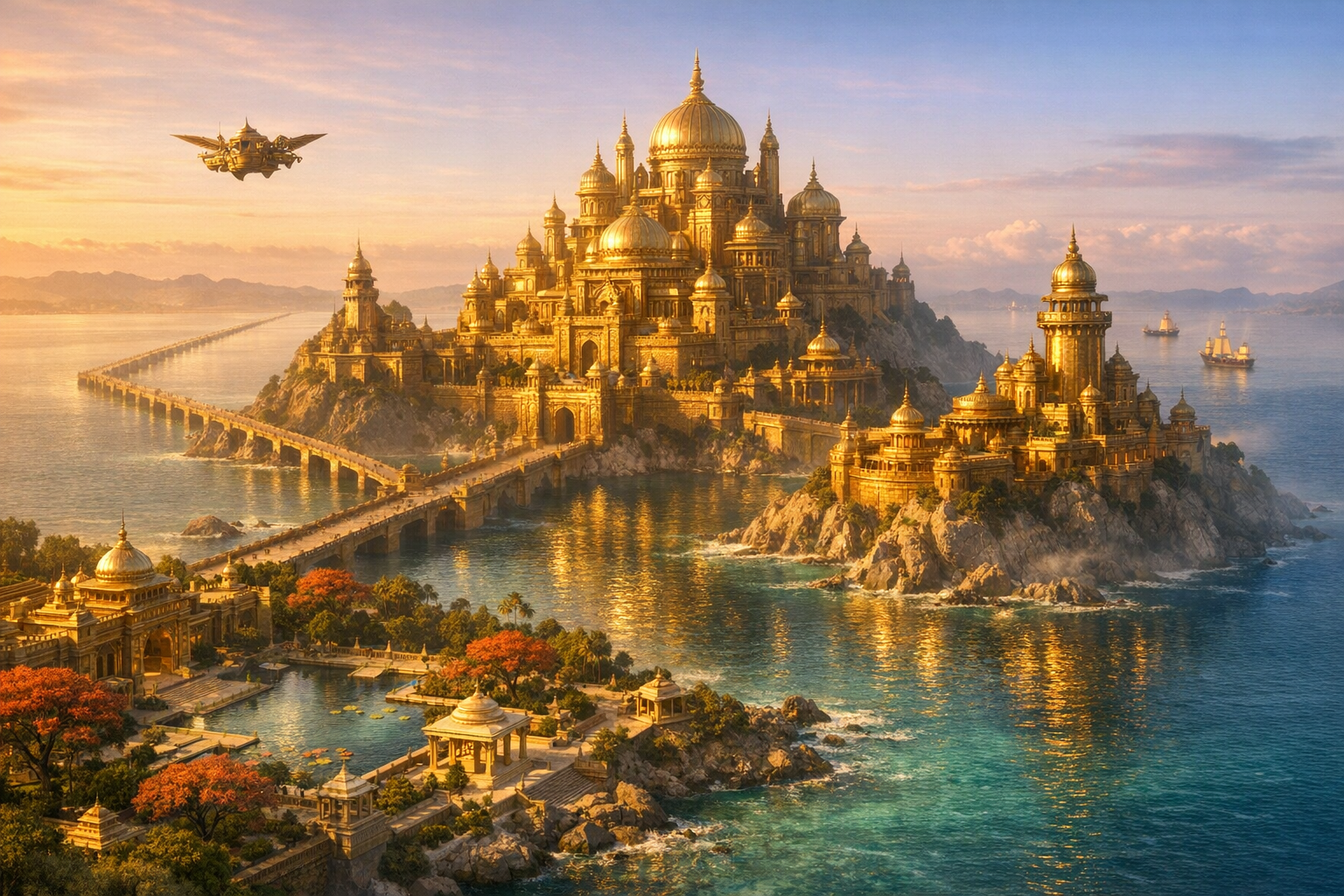
Lankapuricelebrated in the Valmiki Ramayana as the radiant city of goldstands at the confluence of mythic splendor, sacred geography, and moral philosophy. Perched upon Mount Trikuta and ringed by the ocean, the metropolis served as the arena where the cosmic contest between dharma and adharma unfolded and where the ethics of a dharma-yuddha were examined with exacting clarity.
According to the Itihasa–Purana tradition, Vishvakarma, the celestial architect, fashioned Lankapuri with flawless measures and resplendent metals. Some accounts describe the city as a divine gift first linked to Śiva and then entrusted to Kubera (Vaiśravaṇa); others detail its transfer across lineages before Ravana’s seizure. All streams converge on the city’s unsurpassed artistry and luminous goldwork, a triumph of Ancient Architecture in the sacred imagination of Hindu scriptures.
Mount Trikuta, literally the “three-peaked” massif, grounds the city in a topography that is at once geographical and symbolic. Classical descriptions situate the island fortress at a distance of about one hundred yojanas across the sea from the southern coast of Bhāratavarsha, a measure interweaving cartographic memory with sacred geography. The triadic peak resonates with Indic cosmologyorder, energy, and restraintironically shadowed by the excess that later consumed its ruler.
Genealogy and statecraft intertwine in Lanka’s political history. Kubera, son of Viśravas, is portrayed as an exemplar of ethical wealthartha aligned with dharmawhereas Ravana, his half-brother, wrests sovereignty through ambition unchecked by wise counsel. The transfer of power from Kubera to Ravana, preserved in the Uttara Kāṇḍa, becomes a canonical case study in how lobhaavariceunmoors kingship from rajadharma and imperils civic order.
Urban details in the Sundara and Yuddha Kāṇḍas are remarkably technical: Lanka’s ramparts gleam with metal alloys; bastions and moats layer its perimeter; monumental gateways punctuate axial avenues; and gardens such as Aśoka–Vātikā temper the metallic brilliance with living shade. The architectural grammar suggests a city planned to Vedic notions of measure (māna), orientation (dik), and auspicious proportion (tāla), scaled to imperial ambition and sophisticated ceremonial life.
The Sundara Kāṇḍa preserves what reads like an early reconnaissance dossier through Hanuman’s mission: observation of guard rotations, architectural weak points, the layout of Aśoka–Vātikā, and the morale of Lanka’s citizens. These passages offer proto-ethnography and battlefield intelligence embedded within epic poetry, underscoring how the Ramayana fuses aesthetics with practical statecraft.
Technological motifs deepen the impression of a sophisticated court. The Pushpaka Vimana symbolizes mobility, status, and the appropriation of deva technologies into royal spectacle. Siege craft, signal fires, and watchtowers animate Yuddha Kāṇḍa’s logistics, while references to Lanka’s harbors imply maritime capacity across the Indian Ocean littoraltrade, tribute, and sustained intercultural exchange.
The moral arc of the Ramayana pivots in Lanka. Vibhishana’s counsel to Ravana exemplifies the statesman’s duty to speak truth to power; his śaraṇāgati to Sri Rama displays how dharma accommodates remorse and reform. The ensuing campaign is framed not as annihilation but as restorationRama declines to rule a conquered city, reinstates Vibhishana, and thereby affirms that just war aims at re-equilibrating order rather than territorial aggrandizement.
The golden city also functions as ethical allegory. Gold, a conductor of brilliance and desire, becomes a trope for prosperity sutured to pride. Lanka’s radiance dazzles yet blinds; Ravana’s cultivated brilliancemastery of śāstras, devotion to Śiva, and valorcannot offset the strategic myopia born of lobha and ahaṅkāra. The fall of Lankapuri thus reads as an advanced seminar in moral psychology rather than a simple tale of martial triumph.
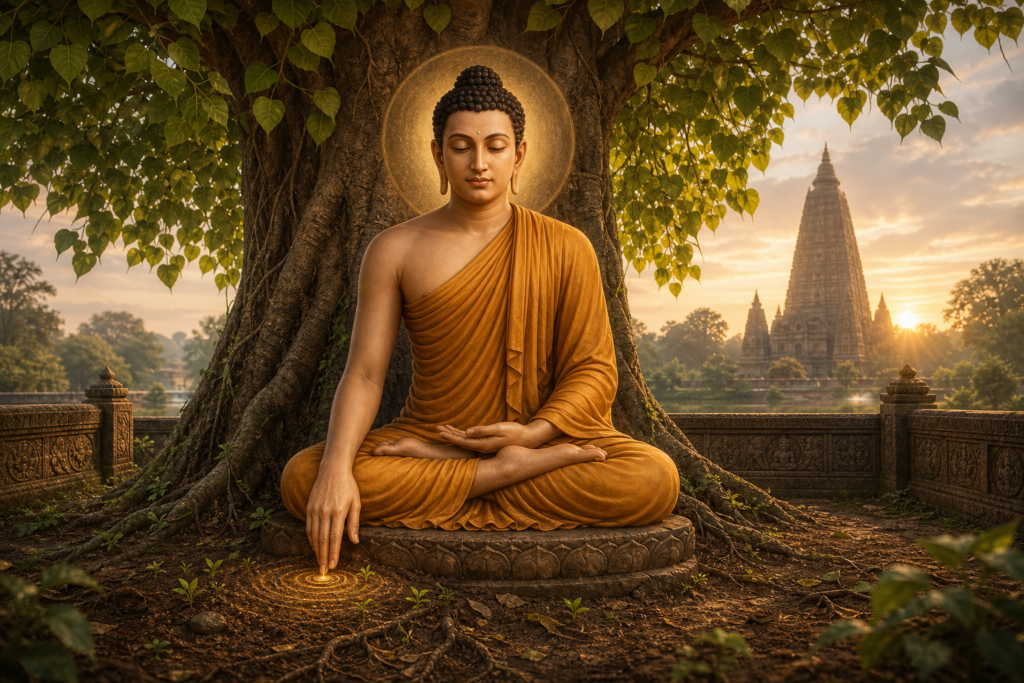
The warning about greed resonates across dharmic traditions, reinforcing unity in spiritual ethics. Hindu darśanas catalogue lobha as a root kleśa that distorts judgment; Buddhism lists lobha among the three defilements alongside dosa and moha; Jainism elevates aparigrahanon-possessivenessas a cardinal ethic against accumulation; and Sikh teachings warn unambiguously against lobh as one of the “five thieves.” The city of gold becomes a shared mirror in which Hindu, Buddhist, Jain, and Sikh readers jointly examine the cost of desire left untrained.
Comparative Ramayana traditions reinforce these themes without eroding doctrinal nuance. Kampaṉ’s Tamil Ramayanam lingers on the aesthetics and protocols of Lanka’s courts; Jain narratives such as Vimalasūri’s Paumacariya recalibrate violence and kingship to foreground ahiṃsā; Buddhist retellings in the Jātaka corpus reframe character motivations to exemplify civic virtues. Despite differences in emphasis, the moral through-linewealth guided by wisdomremains intact across the dharmic spectrum.
Sacred geography binds myth to place. The sea-girdled fortress, Mount Trikuta, Aśoka–Vātikā, and the causeway known as Seturemembered today as Rama Setu/Adam’s Bridgesketch an Indic mental map of the Indian Ocean’s northern rim. Pilgrimage, poetry, and place-names preserve this map not as forensic proof but as a cultural palimpsest, one that invites both archaeological curiosity and reverent silence.
From a governance perspective, Lanka presents two contrasting models of artha. Kubera symbolizes trusteeshipprosperity harmonized with restraintwhile Ravana stands for extractive accumulation. The policy lesson is precise: artha attains legitimacy only when continuously audited by dharma, a principle echoed from the Arthashastra through the Dharmaśāstra literature and reflected in the Ramayana’s narrative logic.
The city’s fall also sharpens rules of engagement in dharma-yuddha. Restraint in targeting, the inviolability of emissaries, and proportional response are repeatedly signaled, anticipating later just-war discourse. Where Ravana instrumentalizes kinship and counsel, Rama elevates deliberation and due process, demonstrating that means, no less than ends, constitute righteousness.
Read as urban symbolism, Lankapuri may be mapped onto the human psyche. The fortified walls resemble defensive habits; the glittering palaces mirror compulsions toward display; Aśoka–Vātikā represents the conscience that nurtures tenderness amid arrogance. When lobha captures the throne-room of intention, the city’s inner governance faltersa lesson as applicable to households and institutions as to empires.
Modern readers readily recognize the saga of greed in contemporary domainsspeculative markets, resource extraction, data hoarding, and reputational arms races. The Ramayana’s prescription is not rejection of wealth but its right placement: aparigraha to moderate appetite, dāna to circulate surplus, and satsanga to refine aspiration. In policy language, these translate into stewardship, accountability, and transparent metrics that keep artha subordinate to dharma.
Sri Lanka’s own cultural memoryBuddhist chronicles, Hindu temples, and shared festivals along the Palk Straitkeeps dialogue alive between history and heritage. Rather than collapsing myth into proof or dismissing it as fiction, a dharmic approach reads Lankapuri as civilizational pedagogy: a tale that teaches how to hold power, prosperity, and beauty without becoming possessed by them.
In this light, the “golden city that ignited celestial wars” is less an invitation to romanticize conflict and more a summons to cultivate inner statecraft. When artha bends to dharma, gold becomes grace; when artha outruns dharma, even celestial architecture becomes a prison. The decisive choice, as the Ramayana insists, is renewed in every generation and across all dharmic paths.
Thus the saga of greed still continuesnot as a fatalistic refrain but as an ethical alert. Lankapuri endures as a brilliant case study in how civilizations can integrate technological prowess, urban excellence, and maritime reach with the interior disciplines taught by Hinduism, Buddhism, Jainism, and Sikhism. The city’s truest reconstruction is found not in metal or stone, but in a shared commitment to wisdom guiding wealth and in the unity of dharmic traditions that uphold that ideal.
Inspired by this post on Hindu Blog.