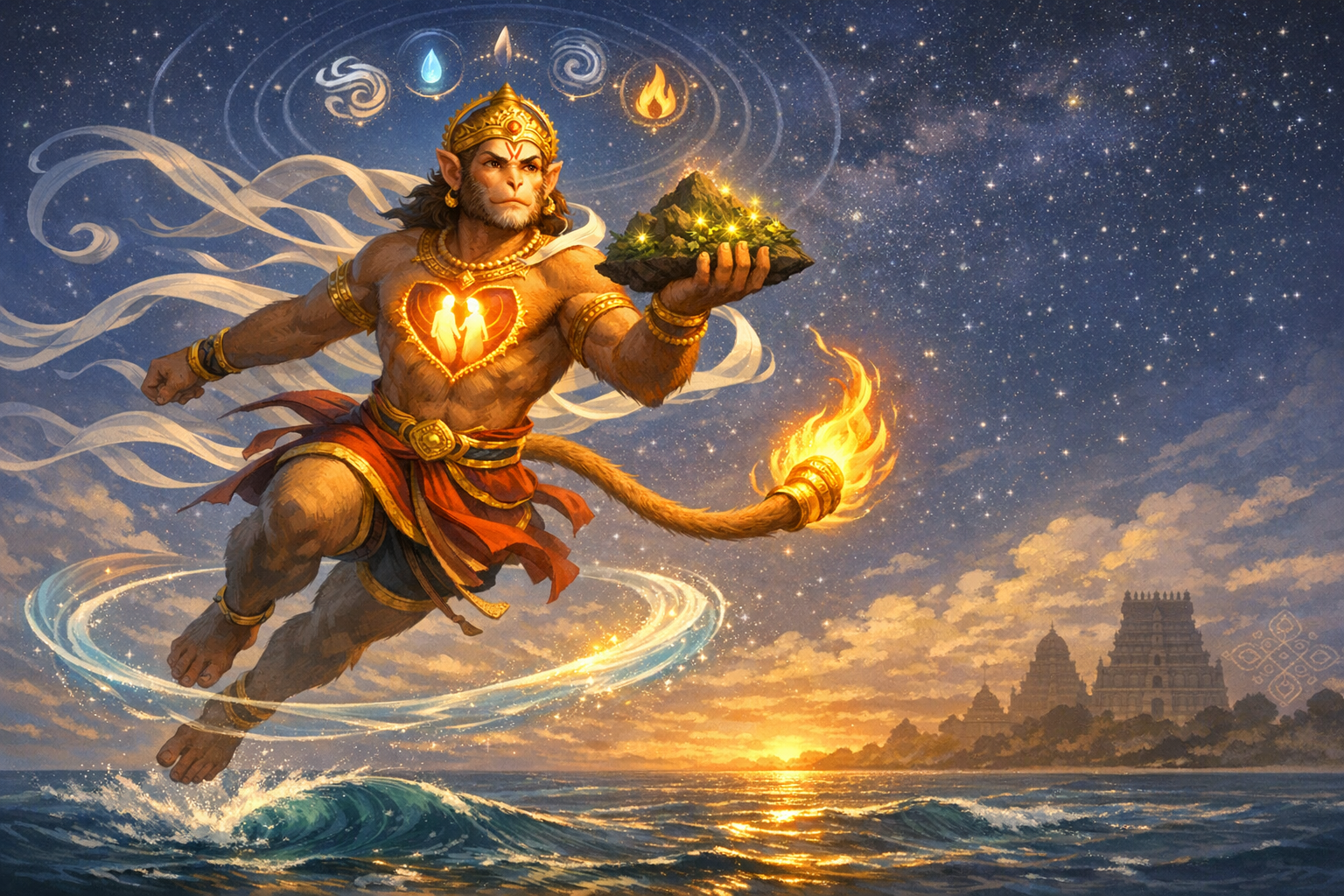
Hanuman stands in the Kamba Ramayanam not merely as the indefatigable sevaka of Sri Rama but as a living synthesis of the five great elements (pancha-mahabhutas) that structure both cosmos and personhood in Indian thought. Read through the poetic architecture of Kamban’s Iramavataram, his actions continually refract Vayu (air/wind), Jala (water), Akasha (space/ether), Agni (fire), and Bhoomi (earth) into an integrated spiritual science. This elemental grammar, familiar to Hindu philosophy, Yoga, and Ayurveda, also resonates with cognate frameworks in Buddhism, Jainism, and Sikhism, offering a unifying lens across the dharmic traditions.
Composed in classical Tamil and celebrated for its musical metres and evocative imagery, the Kamba Ramayanam adapts the pan-Indian epic into a Tamil ethos without diluting its metaphysical heart. In Kamban’s narrative, Hanuman’s leap, discernment, humility, and power are not incidental feats; they operationalize the very laws of the elements. The text thus becomes more than an epic retelling; it reads as a manual on elemental mastery, devotion (bhakti) harnessed by knowledge (jnana) and action (karma) in alignment with nature’s architecture.
Across Indian philosophical systems, the pancha-mahabhutas are not abstract categories. They govern sense functions (sound for akasha, touch for vayu, form for agni, taste for jala, and smell for bhoomi), bodily organization (doṣas and dhātus in Ayurveda), and the yogic journey from gross (sthula) to subtle (sukshma). Kamban encodes these associations into narrative, showing how a realized being moves in accord with elemental law. Seen this way, Hanuman’s exploits become exemplary case studies for elemental ethics, cognition, physiology, and sadhana.
Vayu is the first key, and in Hanuman it is both genealogy and praxis. As son of Vayu Bhagavan, he embodies the principle of prana: patterning movement, vigilance, and subtlety. Kamban often frames Hanuman’s speed and agility as wind’s sentience; breath is the bridge between intention and deed. In the Sundara Kanda, the calibrated power of his leap is not mere athleticism; it is pranic economy, the measure of breath mastered into unwavering one-pointedness. In yogic physiology, anahata (the heart center) is associated with air; Hanuman’s famed gesture of revealing Rama and Sita in his chest turns an elemental doctrine into a devotional icon, locating love and loyalty at the heart of vayu’s expansiveness and courage.
Jala, the water principle, manifests when Hanuman faces the ocean’s vast threshold. Kamban dwells on the sea’s living agency, a sentient expanse that must be engaged with care, adaptability, and respect. As he traverses waves and confronts beings born of the deep, Hanuman displays water’s intelligence: the capacity to yield without surrender, to flow while preserving direction. Encounters such as Surasa’s test and Simhika’s shadow-snare dramatize the inner hydraulics of attention; the aspirant must pass through liquidity’s illusions and constrictions, holding course with suppleness rather than brute force. In Ayurvedic terms, balanced jala sustains nourishment and cohesion; in the epic’s terms, it sustains serene resolve during the crossing.
Akasha, the subtle field of space and sound, is the open corridor through which Hanuman’s vow moves. The famous aerial arc across the sea becomes a meditation on spaciousness: the capacity to hold intention without contraction. In philosophical discourse, akasha grants room for all other elements to evolve and interact; in narrative, it grants Hanuman unimpeded scope to perceive, decide, and act with dharmic clarity. Kamban’s sky-borne imagery underscores a core yogic insight: when inner space is clear, perception is acute and timely action follows. Akasha also belongs to the auditory domain; Hanuman’s fidelity to Rama’s word, held in the heart as mantra, is space translated into duty.
Agni appears in Kamban with purificatory precision. When Hanuman’s tail is set on fire and Lanka blazes, the scene is not indiscriminate destruction but elemental rectification. Fire in Vedic and yogic frameworks transforms, refines, and discloses truth by consuming the occluding dross. In Kamban’s telling, the city lit by Hanuman’s flame reveals inner disorder to itself; adharma becomes visible, and thereby correctable. The transformation is as ethical as it is physical: agni, tied to sight and insight, burns through delusion. In a practitioner’s language, this is tapasthe disciplined heat that converts latent potential into lucid action.
Bhoomi, the stabilizing ground, shapes Hanuman’s ethos of humility and service. Kamban places Sita, daughter of the earth, at the story’s moral axis; to find her is to reorient the world to its ground of truth. Hanuman’s strength is always tethered to restraint, the mark of earth’s gravity. In the war books, when he lifts the herb-bearing mountain to restore life, the drama doubles as a treatise on earth’s medicines and the ethics of stewardship. Bhoomi governs smell and structure; in living terms, it governs integrity. Kamban aligns Hanuman’s steadfastness with earth’s patienceimmense power under perfect control for the sake of life.
These elemental portraits are not isolated cameos; Kamban choreographs their interplay. Vayu empowers the leap, akasha grants scope, jala demands adaptability, agni enacts discernment’s heat, and bhoomi anchors consequence. Together, they form a grammar of dharmic action under conditions of uncertainty. Readers who track the narrative at this register discover that ethics, yoga, and poetics share a common substratum: mastery is elemental before it is moral or political.
The Sundara Kanda, especially in Kamban’s hands, becomes a handbook for inner practice. Breath (vayu) is disciplined into still strength; space (akasha) is clarified so that soundvow, mantra, instructionresonates without distortion; attention flows like water (jala) around obstacles; fire (agni) is summoned to test and illuminate; and earth (bhoomi) receives, holds, and heals. This is bhuta shuddhi in narrative mode: purification and harmonization of the elements rendered as story. The effect is pedagogical without didacticism; one learns by watching Hanuman be the elements, not by being told to.
Hanuman’s iconography in Tamil lands further supports this reading. Even when depicted as Panchamukhi Hanuman in certain traditions, the fivefold form echoed by directional guardians gestures toward a universe ordered and protected across axes. While interpretive lineages differ on exact correspondences, the recurring five-ness keeps pointing back to elemental completeness: protection is comprehensive only when all elemental functions are awake and integrated.
The Kamba Ramayanam also aligns with the broader Indian conversation on panchikaranathe Vedantic account of how pure elements cooperatively combine to form the tangible world. Hanuman’s capacity to move from subtle to gross and backshrinking in Ashoka grove, expanding in battlemirrors this structural fluidity. What metaphysics states in concept, Kamban animates in character.
Cross-dharmic resonances strengthen this synthesis and support the objective of unity among dharmic traditions. In Buddhism, the mahābhūtas (pathavi, apo, tejo, vayo; with akasha often acknowledged) are analyzed in Abhidharma to understand experience without clinging; the same analytic sobriety underlies Hanuman’s calm when confronting Surasa and Simhika. In Jain thought, the elemental dimension of pudgala and the disciplined ethic of non-violence work together to demand restraint even when power is availableprecisely Hanuman’s stance when, having found Sita, he defers large-scale violence to Rama’s justice. Sikh wisdom encapsulates the elemental reverence in the line, “pavan guru pani pita, mata dharat mahat,” a vision Kamban’s epic affirms by showing air as teacher (breath-led mastery), water as nurturer (adaptability), and earth as mother (steadfastness). Across these traditions, elementality is the shared language of truth-seeking and compassion.
Ayurveda expands the elemental thesis into a living physiology of balance. Vayu modulates movement and nerve function, jala sustains cohesion and lubrication, agni governs transformation and metabolism, bhoomi provides structure and endurance, and akasha ensures connective space. Kamban’s Hanuman offers a model of embodied balance: explosive action without agitation, fluid responsiveness without drift, fierce discernment without cruelty, and grounded strength without inertia. The narrative thus speaks to contemporary seekers navigating overstimulation and fragmentation; elemental literacyreading and regulating the fiveremains a practical science of well-being.
From a yogic standpoint, Hanuman enacts the ascent from gross to subtle through disciplined prana, refined attention, and unwavering devotion. Practices such as pranayama and contemplations akin to bhuta shuddhi find an archetype in his conduct. Even the celebrated episode of burning Lanka may be seen as an inner kriya: when tail-fire (tapas) is yoked to discrimination, it cauterizes falsehoods while sparing what must live. Kamban’s poetic decisions highlight this ethical surgicality; agni is never spectacle, always purification.
Kamban’s Tamil poeticsits viruttam cadence, layered similes, and deft shifts in rasaserve the elemental hermeneutic. Wind is heard in meter, water in flow, fire in glinting metaphors, space in the long, clear line, and earth in the steady closure of stanzas. The literary craft is inseparable from the spiritual thesis, and this integration is precisely what makes the text durable across regions, languages, and schools of thought. Elemental truth is recognizably human and cosmological at once.
Finally, the elemental vision of Hanuman in the Kamba Ramayanam advances a plural, inclusive understanding of spiritual life consonant with the unity of dharmic traditions. Many paths can be honored because all walk within the same elemental world; what differs are methods and melodies, not ultimate concerns. Devotion has the breath of vayu, insight the light of agni, compassion the flow of jala, patience the weight of bhoomi, and wisdom the vastness of akasha. In giving these traits a single figure who serves without self-claim, Kamban offers an enduring lesson: spiritual power is the art of elemental harmony for the good of all.
In contemporary terms, the Kamba Ramayanam’s Hanuman provides a rigorous, relatable framework for ethical action and inner steadiness. One learns to breathe with purpose, to make room (inner space) for complexity, to flow around resistance while preserving direction, to apply discerning heat where necessary, and to return to ground without delay. That is the gift of a timeless epic read as elemental science. It is also a bridgelinking Hindu, Buddhist, Jain, and Sikh appreciations of nature into a shared civilizational grammar that prizes compassion, clarity, and courage.
Inspired by this post on Hindu Blog.