
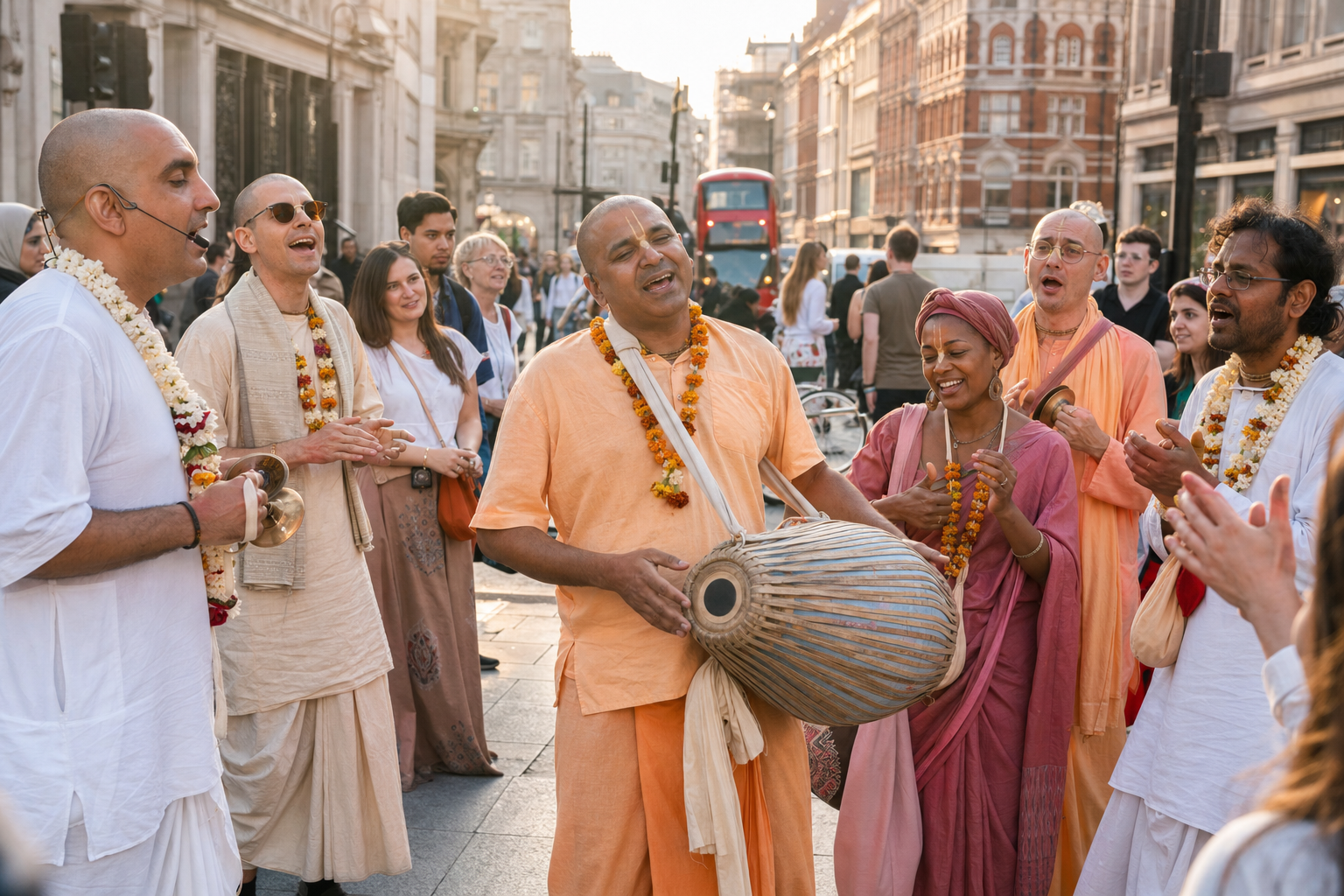

The supplied source title dates this record to 11 July 2026 and identifies its subject as Hare Krishna chanting among Londoners. The source itself contains a thumbnail but no transcript, precise location, participant names, route, crowd estimate or account of what occurred before and after the recorded moment. Those details therefore cannot be responsibly reconstructed. What can be examined is the documented subject: public Hare Krishna chanting in London and its historical, theological, psychological and civic significance.
A London street is normally organised around movement, commerce and destination. Commuters watch signals, visitors consult maps, workers move between appointments and traffic supplies a near-continuous mechanical pulse. Public kirtan interrupts that pattern without necessarily stopping it. A repeated melody, hand cymbals, drums and responsive voices briefly turn an anonymous thoroughfare into a participatory soundscape. Some pedestrians continue walking, some observe from a distance and some answer the refrain or begin to dance. The encounter can last seconds, yet it places an ancient devotional discipline within the ordinary experience of a modern city.
What does liberation mean in this setting?
The claim that chanting liberates Londoners requires careful interpretation. In Gaudiya Vaishnava theology, liberation concerns release from material bondage and the recovery of an enduring devotional relationship with Krishna. In psychology, a more limited form of release might describe a temporary reduction in rumination, emotional tension or attentional fragmentation. In sociology, coordinated singing may loosen urban anonymity by producing a short-lived sense of belonging. These meanings overlap in lived experience, but they are not interchangeable. A spiritual assertion about moksha or divine grace cannot be verified by the same methods used to measure stress, attention or social connection.
The mantra at the centre of the practice consists of sixteen invocations, conventionally analysed as thirty-two syllables:
Hare Krishna, Hare Krishna, Krishna Krishna, Hare Hare;
Hare Rama, Hare Rama, Rama Rama, Hare Hare.
The formula uses three sacred names in the vocative case, making it an act of address rather than a proposition or doctrinal argument. Gaudiya Vaishnava explanations commonly understand Hare as an appeal to the divine devotional energy, especially Rādhā, while Krishna and Rama address the all-attractive and joy-giving Supreme. Interpretive emphases vary among Vaishnava lineages, so a single English gloss should not be treated as exhaustive. Technically, the mantra’s compact vocabulary reduces the burden of generating new speech, allowing attention to return repeatedly to sound, meaning and devotional intention.
Japa, kirtan and sankirtana are related but distinct practices.
Japa generally refers to repeated mantra recitation undertaken individually, often with a mālā of 108 beads. Bhajan is a broad category of devotional song and may be individual or collective. Kirtan centres on sung praise, frequently through a leader-and-response pattern. Sankirtana emphasises collective glorification and may take place in a temple, home, festival or public street. These distinctions are not perfectly rigid in everyday usage, but they clarify why London street chanting is more than private meditation performed at higher volume: it is a deliberately communal form of bhakti.
A typical kirtan uses short melodic phrases that a leader sings and the gathering repeats. Mṛdaṅga or similar drums articulate the rhythmic cycle, karatālas mark recurring beats and a harmonium may sustain melody and drone. Instrumentation varies, and none of these features is mandatory in every setting. The response structure lowers the threshold for participation because a newcomer does not need to memorise a long composition. The leader supplies pitch, text and timing; the group mirrors them. Repetition can then support improvisation through changes in melody, tempo, dynamics and rhythmic density without abandoning the mantra itself.
This musical design has a practical cognitive logic. A predictable pulse provides a temporal grid. Repeated words reduce lexical uncertainty. Alternating phrases create periods of vocal action and attentive listening. Phrase endings can lengthen exhalation, while clapping and dancing recruit the motor system. The resulting state is not necessarily quiet or sedated. Energetic kirtan may increase physical arousal while simultaneously making attention more coherent and emotion more socially directed. Calmness is only one possible form of regulation; organised joy and purposeful energy are others.
The theological foundations of sacred sound
Chanting divine names belongs to a much older Indian devotional history than ISKCON. The Bhagavad Gita 9.14 associates steadfast devotion with continual glorification of the divine, while Śrīmad-Bhāgavatam 12.3.51 connects the chanting of Krishna’s name with freedom from material attachment. A version of the sixteen-name formula also appears in the Kali-Santaraṇa Upanishad, although textual recensions and the order in which the names appear are not uniform. These passages function as theological authorities within the tradition; they should not be presented as experimental evidence.
Gaudiya Vaishnavism gives the divine name an especially strong ontological status. The name is not treated merely as a verbal symbol pointing toward an absent deity. Devotional theology understands Krishna’s name and Krishna’s presence as intimately or non-dually related when the name is received and voiced with devotion. Chanting is therefore interpreted as encounter, service and remembrance. The practice aims not simply to suppress unwanted thoughts but to reorient desire, identity and action toward loving devotion.
Sri Chaitanya Mahaprabhu, who lived in the late fifteenth and early sixteenth centuries, made public nāma-saṅkīrtana a defining feature of the devotional movement associated with him in Bengal and Odisha. Congregational chanting crossed boundaries of formal learning and ritual competence because participation did not require mastery of Sanskrit philosophy or elaborate temple procedure. This accessibility helped sacred sound become both a spiritual discipline and a public culture. ISKCON later carried that Gaudiya Vaishnava inheritance into cities far beyond South Asia.
Why Hare Krishna became part of London’s cultural memory
The London story developed rapidly. According to the official ISKCON London historical timeline, three devotee couples arrived in September 1968, made contact with George Harrison later that year and recorded for Apple Records in July 1969. Their Hare Krishna Mantra single entered the UK chart in September 1969. The Official Charts archive records a peak position of number 12 and nine weeks on the chart. Public chanting was therefore heard not only on pavements but through records, radio, television and Britain’s popular-music culture.
A formal Radha-Krishna temple was established at 7 Bury Place in December 1969. The community moved to Soho Street in 1978, placing a permanent temple immediately beside one of central London’s most intensely commercial districts. The first London Ratha Yatra was also held in 1969, with a procession between Hyde Park and Trafalgar Square. These developments explain why saffron robes, drums, karatālas and the Hare Krishna refrain became recognisable features of the capital rather than a temporary countercultural curiosity.
The 2026 London Ratha Yatra took place on 24 May, separately from the source item dated 11 July. An ISKCON News account reported more than 10,000 participants and the distribution of more than 16,000 plates of prasadam; those figures are organiser-reported and should be understood as such. Nothing in the supplied thumbnail establishes that the July recording depicts Ratha Yatra, so the two events should not be conflated.
London is an especially revealing environment for public devotion. The Office for National Statistics identified it as England’s most religiously diverse region in the 2021 Census, with 25.3 per cent of residents reporting a religion other than Christianity. Approximately 5.1 per cent identified as Hindu, while 27.1 per cent reported no religion. A public chant in this context is heard by Hindus of many sampradayas, adherents of other religions, spiritually curious residents, secular listeners and people who simply want to pass through the street. Its audience is plural before the first note is sung.
That plurality explains the range of possible reactions. For a devotee, the sound may be darshan through hearing—a sacred meeting carried by the name. For a member of the Indian diaspora, it may evoke family memory, pilgrimage or festivals experienced elsewhere. For an unfamiliar listener, it may initially register as rhythm, colour and collective enthusiasm. Another person may experience it as unwanted noise. Academic honesty requires room for all these responses rather than treating visible smiles as proof that every passerby has undergone the same inner transformation.
How repetition may affect attention and emotion
Human attention is vulnerable to competition among external stimuli, memories, predictions and self-referential thought. Mantra repetition narrows the immediate task: hear or produce a stable sequence, notice departure from it and return. This resembles focused-attention meditation at a functional level, although the theological intention may be very different. The mantra becomes an attentional object with acoustic, semantic, emotional and devotional dimensions. Repetition does not eliminate thought; it supplies a reliable point of return whenever thought disperses.
Breathing may also contribute, but claims require restraint. Vocal phrases naturally coordinate respiration because sound is produced during exhalation. A measured chant can lengthen the outgoing breath, while humming and sustained vowels add vibration and auditory feedback. Fast public kirtan, however, does not reproduce a fixed clinical breathing protocol, and vigorous dancing can raise heart and respiratory rates. It is therefore inaccurate to promise that every kirtan automatically activates a particular autonomic pathway or produces an identical physiological state.
Rhythmic entrainment offers another explanatory layer. When participants anticipate a beat and align claps, steps or syllables with it, perception and movement form a feedback loop. Small timing differences are continuously corrected. The group consequently creates a shared temporal structure that no single participant controls completely. This coordination can make participation feel larger than individual effort, a sensation that devotional language may describe as surrender while social science may analyse as synchrony and shared intentionality.
Collective singing can also accelerate social connection. In one study of small and large singing groups, music-making was associated with increased perceived closeness and higher pain thresholds, the latter used as an indirect indicator rather than direct proof of a specific neurochemical mechanism. A 2026 systematic review of group singing among younger populations found promising associations with connectedness and well-being but judged the evidence insufficient for definitive causal conclusions. These findings help explain the social force of kirtan without demonstrating its theological claim of liberation.
Meaning and expectation are not incidental contaminants in this process. A remembered name, trusted community, sacred narrative or intention of surrender can alter how identical sounds are experienced. A devotee and an uninformed observer receive the same acoustic frequencies but not the same event. The former hears a personal address to Krishna within a disciplined tradition; the latter may hear an unfamiliar but appealing musical pattern. Any complete account must therefore include first-person meaning as data while avoiding the assumption that subjective conviction alone proves a universal causal claim.
What scientific research can—and cannot—support
A systematic review and meta-analysis of mantra-based meditation reported small-to-moderate reductions in anxiety, depression and stress compared with control conditions. The estimated standardised effects were approximately −0.46 for anxiety, −0.33 for depression and −0.45 for stress. Those results are relevant but not conclusive. The review included several forms of mantra practice rather than Hare Krishna kirtan specifically, most studies carried a high risk of bias, and long-term follow-up and psychiatric samples were limited.
Earlier evidence reviews reached more cautious conclusions when meditation was compared with active treatments rather than waiting lists or usual care. Study populations, instructor contact, group support, participant expectations, musical activity and spiritual commitment are difficult to separate. Laboratory work on Om chanting, Buddhist recitation or silent mantra repetition cannot automatically be generalised to a moving, call-and-response Hare Krishna gathering on a crowded street. The responsible conclusion is that repetitive vocal practices possess plausible attentional, respiratory and social mechanisms, while the magnitude and durability of their effects depend on context and remain incompletely measured.
Chanting should consequently not be advertised as a guaranteed cure for anxiety, depression, trauma or any medical condition. It may complement appropriate care when an individual finds it supportive, but it is not a substitute for qualified clinical assessment or treatment. Loud sound, dense crowds and rapid rhythmic stimulation can also be uncomfortable for people with sensory sensitivities, panic symptoms or certain traumatic associations. A compassionate spiritual culture allows them to step away without judgment and provides quieter forms of participation where possible.
Sacred sound in a shared civic space
Public chanting gives religion an audible presence. It communicates that faith is not confined to private belief or enclosed buildings, yet public manifestation carries responsibilities. UK guidance on freedom of religion or belief recognises the right to express belief individually or collectively, publicly or privately, while also rejecting coercion. In practice, lawful coordination, proportionate sound levels, unobstructed access, considerate duration, disability awareness and respect for non-participants help reconcile devotional expression with the rights of others.
The most persuasive public kirtan is invitational rather than possessive. A response may be offered, but it cannot be demanded. Literature may be shared, but refusal should be accepted immediately. Photography and video should account for consent and safeguarding, especially where children or vulnerable people are visible. Questions deserve clear answers without denigrating other traditions. These are not merely administrative courtesies; they express the bhakti virtues of humility, service and recognition of dignity.
When practised with such care, sankirtana can create a temporary devotional commons. Participants of different ages, occupations, ethnicities and levels of commitment contribute to one recurring refrain. A passerby does not need to surrender an existing identity to appreciate the music or respond respectfully. The street becomes a place where difference is encountered through rhythm rather than argument. That civic effect is modest and temporary, but in an often-isolated metropolis it remains meaningful.
A bridge among Dharmic traditions without erasing their differences
Sacred repetition is found throughout the Dharmic family. Hindu traditions employ nāma-japa, mantra, bhajan and kirtan in diverse Shaiva, Shakta, Vaishnava and other lineages. Sikh practice gives a central place to Gurbani kirtan, the sangat and remembrance of Naam. Buddhist communities chant sutras, recollections, dhāraṇīs, mantras or formulas such as nembutsu according to their schools. Jain practice includes recitation of the Namokar or Navkar Mantra, which venerates spiritually perfected and disciplined beings rather than a creator deity.
These traditions should not be collapsed into a claim that every chant addresses the same deity or seeks the same metaphysical result. Gaudiya Vaishnava devotion is relational and centred on Krishna. Sikh theology, Buddhist analyses of non-self and Jain teachings concerning jīva, karma and liberation retain distinctive vocabularies and commitments. Their shared ground lies at the level of disciplined remembrance, ethical formation, sound, attention and community—not theological interchangeability.
That distinction strengthens rather than weakens Dharmic unity. Respect does not require sameness. A Hare Krishna procession can honour the integrity of Buddhist, Jain, Sikh and other Hindu paths while confidently presenting its own practice. Each tradition demonstrates that liberation involves more than unrestricted preference: attention must be trained, conduct refined and self-centred habits confronted. Public devotion serves unity when it inspires curiosity and mutual protection rather than competition or claims that only one community is entitled to visibility.
Four defensible layers of liberation
Attentional liberation: During chanting, a participant may gain temporary distance from recursive planning, digital distraction or rumination. The effect need not be mystical to be valuable, but it is not guaranteed. Practice consists in returning after distraction rather than achieving a permanently blank mind.
Embodied liberation: Coordinated voice, breath, rhythm and movement can shift the felt organisation of experience. Tension may soften, energy may become more purposeful and self-consciousness may diminish. These changes are state-dependent and should not be confused with permanent recovery from illness.
Social liberation: Call-and-response reduces the distance between performer and audience. A stranger can enter through a single repeated phrase, while established participants must listen closely enough to remain together. The practice can temporarily replace anonymity with reciprocal attention.
Spiritual liberation: Gaudiya Vaishnava theology presents sincere chanting as a path beyond identification with the temporary body and mind, ultimately awakening prema, or pure love of Krishna. This is the deepest meaning intended by devotees. It is a theological and experiential claim evaluated through scripture, practice and spiritual testimony—not a clinical endpoint that an experiment can certify.
Keeping these four layers distinct prevents two opposite errors. The first is scientism: translating moksha into nothing more than a lower stress score. The second is exaggeration: treating a moment of visible enthusiasm as proof of irreversible spiritual attainment. A person may experience social warmth without accepting Vaishnava theology, while a devotee may regard spiritual benefit as present even when no immediate emotional uplift is felt.
How a newcomer can participate thoughtfully
No specialist preparation is required to listen. A newcomer may first observe the leader-and-response structure, notice the recurring beat and join only when comfortable. Participation can mean singing, clapping, moving gently, standing in respectful attention or asking a question afterward. There is no need to imitate an emotion, adopt religious clothing or claim a belief that has not been formed. Authentic curiosity is more valuable than performed enthusiasm.
A simple private experiment can be conducted for five minutes in a safe, quiet setting. The practitioner sits or stands comfortably, allows breathing to remain natural, recites the complete mantra at an unforced pace and notices when attention wanders. Attention is then returned to pronunciation, sound and meaning without self-criticism. A brief period of silence at the end helps reveal whether the mind, body or mood has changed. One session cannot establish a therapeutic effect, but it can show whether the practice is personally intelligible and sustainable.
Several misconceptions deserve correction. ISKCON is an influential institutional expression of Gaudiya Vaishnavism, not the totality of Hinduism or even of Krishna devotion. Public sacred-name chanting predates ISKCON by centuries. Repetition is not automatically mindless, although it can become inattentive; traditions of mantra practice repeatedly emphasise intention and careful hearing. Finally, joy is not evidence that suffering has vanished. Devotional practice may help a person meet grief, responsibility and uncertainty without pretending that they no longer exist.
Why the chant continues to matter
More than half a century after Hare Krishna first became a familiar sound in central London, the chant still asks the city to listen differently. It replaces novel information with remembered names, individual performance with response and hurried movement with at least the possibility of presence. Some Londoners will walk on, some will feel curious and others will recognise a spiritual home. None of these reactions should be fabricated into a universal story.
The most defensible conclusion is also the most compelling. Hare Krishna sankirtana makes a disciplined practice of remembrance, relationship and shared rhythm publicly available. Psychology can investigate its effects on attention and emotion; sociology can examine synchrony and belonging; history can trace its remarkable London journey; and theology can articulate its promise of liberation. Held together without confusion, these perspectives explain why sixteen repeated names can still create a powerful human encounter amid one of the world’s busiest cities.
Research note: This account draws on the supplied title and thumbnail, the official ISKCON London historical record, Official Charts data, Office for National Statistics Census findings, peer-reviewed reviews of mantra meditation and group singing, and UK guidance on freedom of religion or belief. Claims made by religious organisations are identified as theological or organiser-reported where appropriate. No unverified details about the specific 11 July 2026 recording have been added.
Inspired by this post on Dandavats.











Leave a Reply
You must be logged in to post a comment.