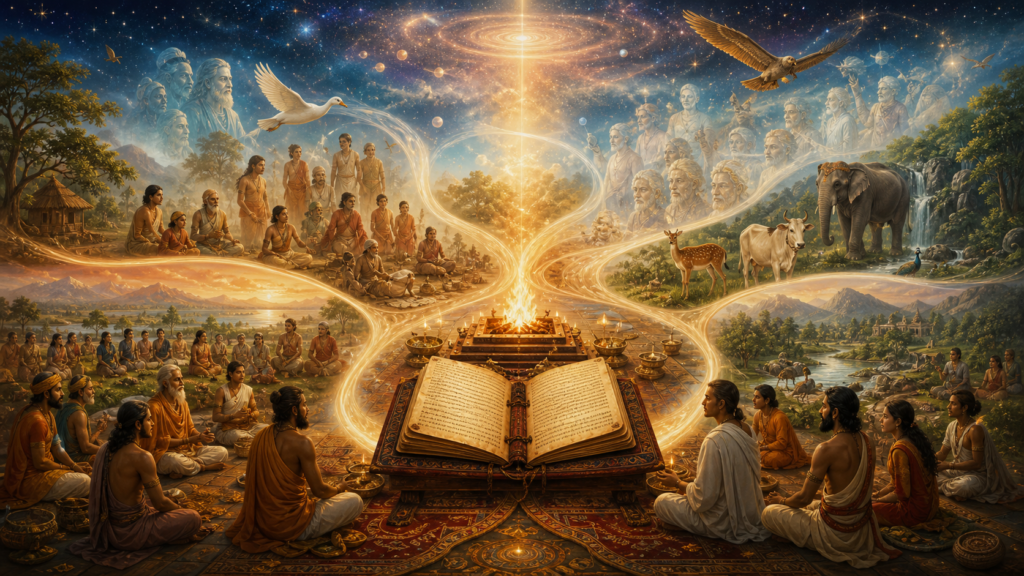
Hindu cosmology presents origins not as a clash of forces but as emergence from an undivided, luminous reality. Before time, space, and form, there is Brahman, the Infinite and Absolute, a ground of being without second. In this undifferentiated state, nothing is set apart from anything else; diversity rests unmanifest within unity. This vision, transmitted by the Vedas, Upanishads, and Puranas, frames creation not as an absolute beginning but as a manifestation and reabsorption that proceeds in rhythms, cycles, and patterns of subtle to gross unfoldment.
Key Upanishadic statements ground this metaphysics. Taittirīya describes Brahman as satyam jñānam anantam brahma, the limitless truth-consciousness; Chāndogya asserts sad eva somyedam agra āsīd, ekam eva advitīyam, that reality was one, without a second; Māṇḍūkya opens with om ity etad akṣaram idam sarvam, identifying Aum as the seed-sound of the totality. These declarations orient understanding toward a non-dual absolute that, without diminishing itself, appears as the many. They also communicate an epistemic ethos: the highest principle is grasped not by speculation alone but by disciplined insight.
In this framework, Brahman is described in two principal modalities: nirguṇa, without attributes, and saguṇa, with attributes. The power of manifestation is termed Māyā or Śakti, through which the unconditioned reality appears as Īśvara, the Lord, intelligible to consciousness and devotion. Classical Vedānta outlines a triadic cascade: Īśvara as the cosmic intelligence, Hiraṇyagarbha as the subtle or archetypal blueprint of the universe, and Virāṭ as the fully manifest, gross cosmos. This is not a linear historical sequence but a layered ontology linking pure consciousness to living experience.
Vedic hymns give voice to this mystery with philosophical precision. The Nāsadīya Sūkta (Ṛg Veda 10.129) speaks apophatically of an era when neither being nor non-being could be asserted, modeling intellectual humility before origins. The Hiraṇyagarbha Sūkta (Ṛg Veda 10.121) proclaims Hiraṇyagarbhaḥ samavartatāgre, the golden embryo that coheres order. Underlying these visions is ṛta, the cosmic order that sustains cycles and lawfulness without positing a singular, final beginning.
Hindu cosmology frequently links manifestation to vibration, sound, and measure. The notion of śabda-brahman, reality as sound, and the primacy of Om map the movement from undifferentiated silence to articulate creation. Lineages such as Kashmir Śaivism speak of spanda, the subtle throb of consciousness that playfully projects and withdraws appearances. The emergence of name-and-form (nāma-rūpa) follows this primordial articulation, giving contour to worlds, lives, and meanings.
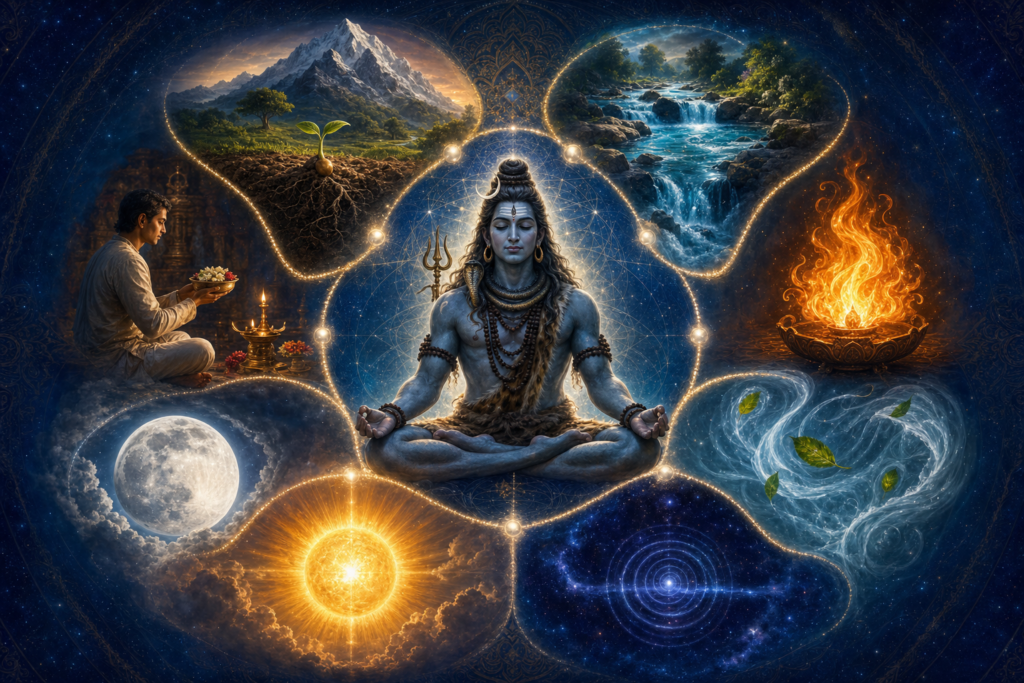
Philosophical schools add technical depth to the unfolding. Sāṅkhya models manifestation via two co-present principles: Puruṣa (pure consciousness) and Prakṛti (primordial nature). When Prakṛti’s three guṇassattva, rajas, tamasshift from equilibrium, the cascade proceeds: from mahat (cosmic intelligence) to ahaṅkāra (the I-sense), to subtle potentials (tanmātras), to the senses and mind (indriyas and manas), and then to the five great elements (pañca mahābhūtas). This map shows how the subtle becomes gross and how cognition, body, and world co-arise within a single ontological economy.
Advaita Vedānta integrates Sāṅkhya’s analytics with a non-dual core. The panchīkaraṇa doctrine details how subtle elements aggregate into gross elements, explaining embodiment and perception. Classical anthropology distinguishes sthūla (gross), sūkṣma (subtle), and kāraṇa (causal) bodies, nested with the five sheaths (pañca kośas) from physical to blissful. This layered view aligns with contemplative practice, guiding inquiry from gross to subtle so that awareness may recognize its source as Brahman.
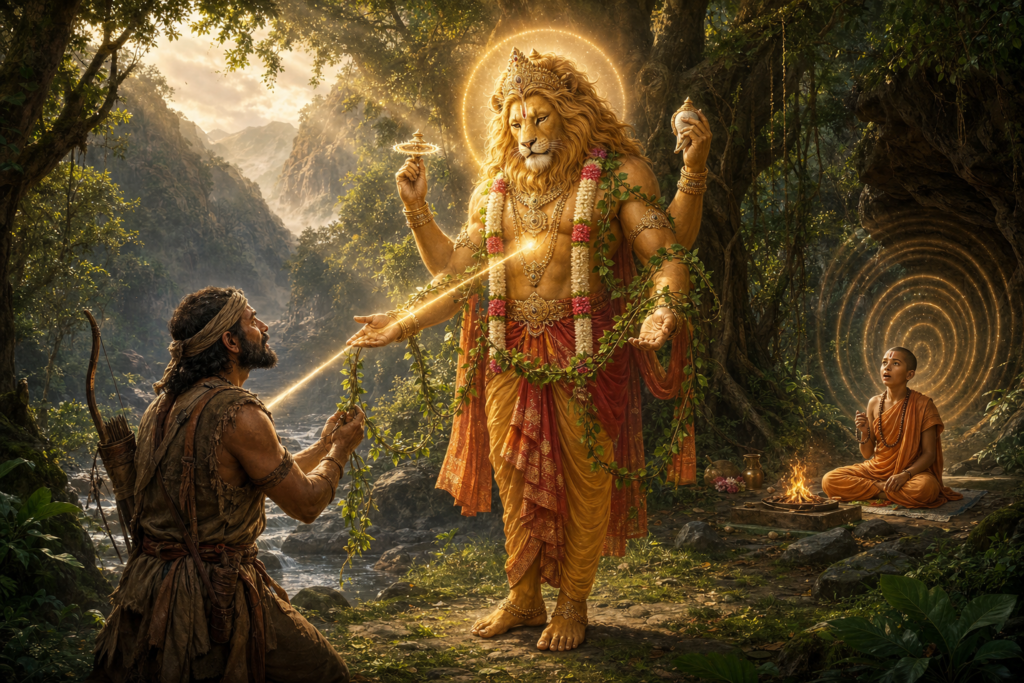
Purāṇic narratives render these abstractions into vivid archetypes. In Vaiṣṇava cosmology, Nārāyaṇa reclines on Ananta within the cosmic ocean; from his navel arises a lotus upon which Brahmāsymbol of ordered intelligencecreates worlds. Śaiva and Śākta traditions foreground the pulsation of Śiva-Śakti, the inseparable consciousness-energy dyad. Read figuratively, such images are instruments of understanding, coding metaphysics into symbols that speak to intuition, devotion, and reason at once.
Time, in this cosmology, is profoundly cyclic. A mahāyuga encompasses four yugas totaling 4.32 million years. One thousand mahāyugas compose a day of Brahmā, a kalpa of 4.32 billion years; fourteen manvantaras subdivide each kalpa, punctuated by transitional sandhyās. Creation (sṛṣṭi), sustenance (sthiti), and dissolution (laya or pralaya) proceed endlessly, preserving conservation of being while permitting renewal. This vision accommodates beginningless causal series and sidesteps the philosophical puzzles of a one-time creation ex nihilo.
Multiple kinds of dissolution sharpen the technical picture. Naimittika pralaya marks cyclical dissolution at the end of a kalpa; prākṛtika pralaya returns forms to undifferentiated Prakṛti; ātyantika pralaya signifies liberation from ignorance for the realized, where the appearance of bondage itself dissolves. These graded dissolutions mirror graded constructions, reinforcing the principle that what emerges by degrees returns by degrees.
Ethically and existentially, this cosmology invites alignment with dharma. If reality is a living order rather than random flux, then knowledge, self-restraint, compassion, and responsibility acquire cosmic significance. The same intelligence that patterns galaxies is accessible in the witness-consciousness of meditation and in the moral intuition that choices ripple beyond the self. Practice thus becomes a way of harmonizing microcosm and macrocosm.
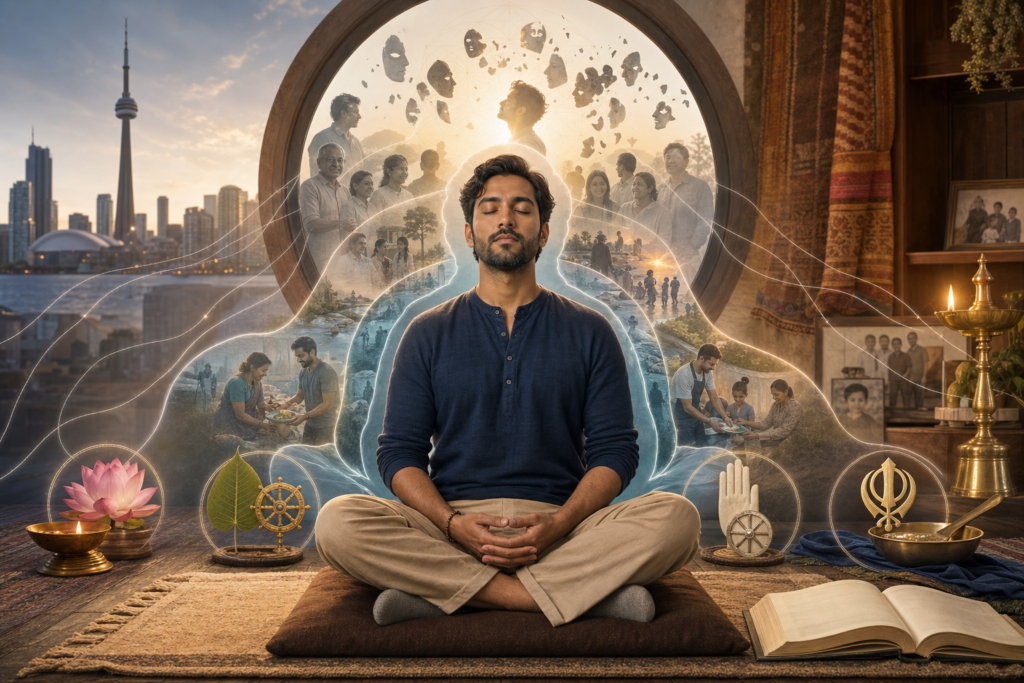
Dharmic unity becomes explicit when considering Buddhism, Jainism, and Sikhism alongside Hinduism. Buddhism emphasizes pratītya-samutpāda (dependent origination), cyclical world systems, and kalpas without positing a permanent creator, resonating with the shared intuition of beginningless causality and moral lawfulness. Jainism presents an anādi-ananta (beginningless and endless) cosmos with utsarpiṇī and avasarpiṇī time-cycles and a meticulous analysis of dravyas, paralleling the cosmological commitment to cyclical time and karmic accountability. Sikh thought centers Ik Onkar and hukam, the One reality and its sovereign order, affirming unity-in-diversity and purposeful emergence. Across these traditions, differences in terminology encode a common ethos: reality is intelligible, cyclic or ordered, and best approached through ethical living, contemplative clarity, and reverence for plurality.
Engagement with contemporary science need not flatten these insights into pseudo-equivalences. Rather, dialogue can focus on structural affinities: cyclic models of time, multilevel emergence from subtle to gross, and the adequacy of consciousness as a fundamental category. While cosmology in physics addresses measurable dynamics, dharmic cosmology adds a normative and experiential dimensionhow meaning, value, and awareness integrate with matter and energy. The two inquiries, properly distinguished, can still illuminate one another.
For practitioners and readers alike, the practical arc is clear. Meditation traces awareness from sensory complexity to silent witnessing; self-inquiry examines the I-sense and its identifications; devotion refines attention into love for the whole. In every mode, the journey moves from gross to subtle, then from subtle to source. The cosmological narrative is thus a contemplative roadmap: to know why the many appears is to remember the stillness from which it shines.
Hindu cosmology therefore begins in undifferentiated being and unfolds through ordered cycles, layered ontologies, and symbolic narratives. Its kinship with Buddhist, Jain, and Sikh perspectives highlights a civilizational commitment to plurality, disciplined inquiry, and compassion. Framed this way, creation is not a question answered once but a vision to be livedan invitation to read the universe as scripture and to let wisdom guide conduct in a shared world.
Inspired by this post on Hindu Blog.