
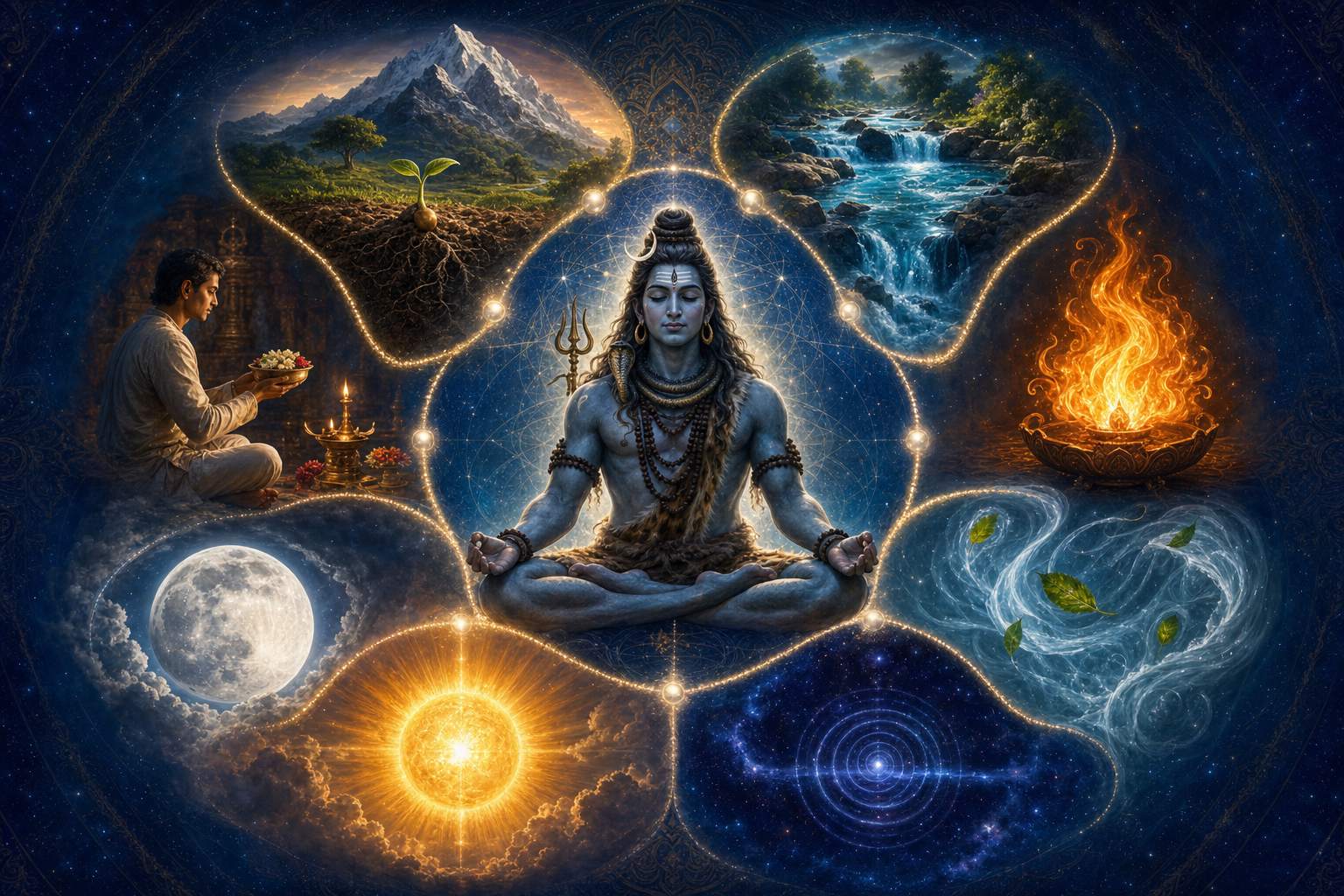
Ashtamurti: Shiva as the Universe Disclosed
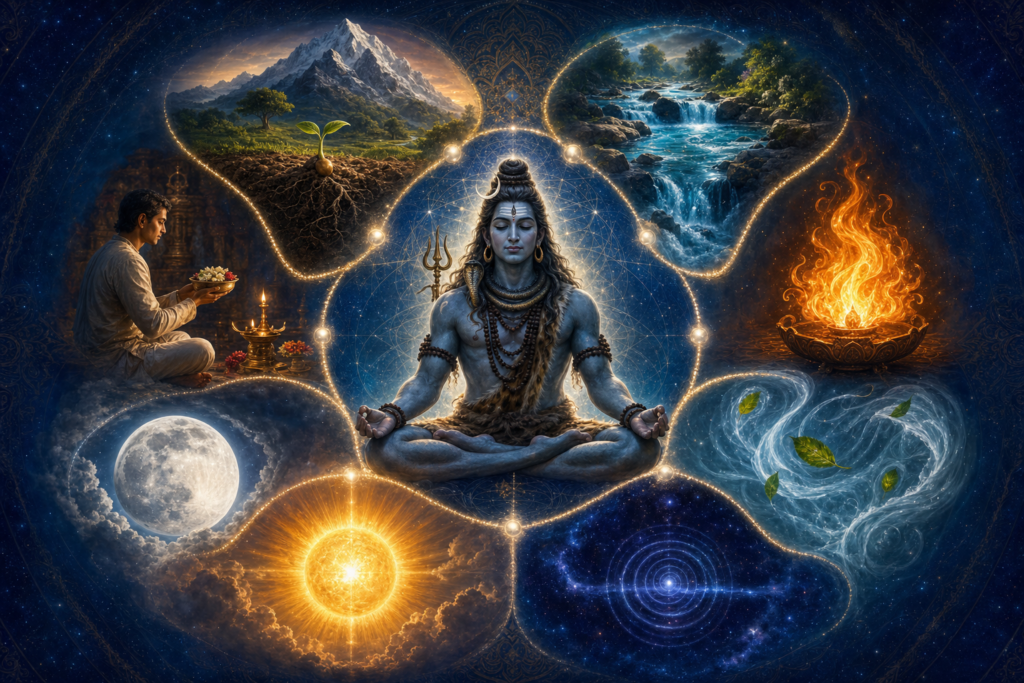
Shiva is often approached through a concentrated sacred image: the still ascetic of Kailasa, the dancing Nataraja, the compassionate householder beside Parvati, or the aniconic linga established in a temple sanctum. The doctrine of Ashtamurti expands that vision dramatically. It presents Shiva not only as a deity represented within the universe, but as the divine presence made perceptible through the fundamental conditions of existence itself. Earth, water, fire, air, space, the sun, the moon, and the conscious participant in sacred action become eight cosmic embodiments through which the one Lord sustains and pervades creation.
This vision changes the emotional and philosophical meaning of worship. The ground beneath a person’s feet is no longer spiritually inert. Water is more than a useful commodity, fire more than a source of heat, and breath more than an automatic biological process. The sun and moon disclose intelligible order, while the conscious being introduces responsibility into the cosmic structure. Ashtamurti therefore joins cosmology, ritual, spiritual practice, and ethics within a single framework: creation is sacred because it is apprehended as the embodied field of Shiva.
What the Word Aṣṭamūrti Means
The Sanskrit expression Aṣṭamūrti combines aṣṭa, meaning eight, with mūrti, meaning an embodied form, manifestation, configuration, or perceptible presence. In ordinary religious usage, mūrti can denote a consecrated image, but its semantic range is much wider. In this doctrine, the term does not describe eight statues or eight unrelated gods. It describes Shiva as the one reality possessing eight cosmic bodies. The English spelling Ashtamurti is convenient for search and general reading, while Aṣṭamūrti more closely represents the Sanskrit pronunciation.
The number eight should not be understood as a boundary placed around the limitless. The forms organize experience without exhausting Shiva’s nature. Shaiva texts can affirm that Shiva is present as earth or fire while also maintaining that the supreme reality exceeds every name, quality, and visible form. Ashtamurti is consequently a theology of disclosure rather than confinement: the eight forms reveal where the divine may be recognized, not where the divine finally ends.
The Vedic Background: Rudra Throughout the Living World
The mature Ashtamurti doctrine belongs to a long history of reflection on Rudra-Shiva. Its background can be recognized in the Vedic hymns that address Rudra across forests, mountains, waters, roads, animals, settlements, occupations, and unpredictable forces of nature. The celebrated Śatarudrīya, preserved in forms such as the Taittirīya Saṃhitā 4.5 and the Vājasaneyi Saṃhitā 16, repeatedly salutes Rudra in places that conventional thought might divide into sacred and ordinary. This does not yet provide the later standardized eightfold map, but it establishes the theological grammar from which that map becomes intelligible: Rudra cannot be restricted to a distant heaven or a single ritual location.
A particularly important antecedent appears in Śatapatha Brāhmaṇa 6.1.3.10–18. A divine child asks Prajāpati for a name and receives eight names in succession: Rudra, Śarva, Paśupati, Ugra, Aśani, Bhava, Mahān Deva, and Īśāna. The passage connects them respectively with fire, waters, plants, wind, lightning, rain, the moon, and the sun. It finally calls them eight forms of Agni. This is a Vedic precursor rather than the completed Purāṇic doctrine, and that distinction matters. It reveals an early process in which multiple natural, atmospheric, and celestial powers were gathered into the identity of Rudra.
The early list is not identical to the mapping most familiar in later Shaiva literature. Aśani, associated with lightning, eventually gives way to Bhīma in a prominent later enumeration; plants and rain are reorganized into the broader elemental categories of earth and water; and the conscious sacrificer or individual self becomes one of the eight forms. These differences are not textual defects. They show a living tradition arranging inherited names within changing ritual and philosophical systems. An academically responsible account therefore distinguishes textual stages instead of forcing every source into one supposedly timeless chart.
From Vedic Rudra to Upanishadic Universality
The Śvetāśvatara Upaniṣad supplies another decisive foundation. It does not simply reproduce the standard Ashtamurti list, but it portrays Rudra as the one ruler who stands within all beings and encompasses the worlds. Verses 2.17, 3.2–11, 4.10–16, and 6.11 develop themes of divine immanence, cosmic lordship, hidden interior presence, and transcendence. The declaration that Shiva is all-pervading because he dwells in the interior of every being gives philosophical depth to the later identification of natural forms as his bodies.
The Upanishadic perspective also prevents Ashtamurti from becoming a merely material catalog. Rudra-Shiva is hidden in beings, present in the heart, and associated with consciousness and liberation. The cosmos is not treated as a collection of objects to which a divine label has been attached. It is a structured field sustained, entered, known, and surpassed by the supreme Lord. This is why the later inclusion of the individual self or sacrificial participant is so important: the knower belongs within the sacred cosmos that is being known.
The Purāṇic Formulation
The best-known correspondence is stated explicitly in the Śatarudra-saṃhitā of the Śiva Purāṇa. Its sequence is Śarva as earth, Bhava as water, Rudra as fire, Ugra as wind, Bhīma as ether or space, Paśupati as the individual soul, Īśāna as the sun, and Mahādeva as the moon. The text describes the universe as pervaded by these forms in the manner of pearls held together by a thread. The metaphor preserves both multiplicity and unity: the forms remain distinguishable, yet their coherence depends upon one pervasive reality.
The Liṅga Purāṇa likewise identifies earth, water, fire, wind, space, sun, moon, and the sacrificer as Shiva’s cosmic bodies. In the course of its explanation, the eighth form can also be expressed through the Ātman or jīva. This variation clarifies why some summaries list the yajamāna, the person responsible for a sacrifice, while others list the individual soul. Both formulations place conscious participation inside the cosmic scheme. The eighth member is not simply another physical substance; it is the embodied center from which action, offering, knowledge, and accountability arise.
The Viṣṇu Purāṇa also preserves an account of eight Rudra manifestations and their cosmic stations. Its presence in a major Vaishnava Purāṇa is significant. It demonstrates that the eightfold Rudra motif circulated across a wider Purāṇic environment and should not be reduced to a narrowly isolated sectarian invention. The assignments and order are not identical in every recension or text, but the underlying intuition remains recognizable: Rudra’s identity extends through cosmic powers and living existence.
Kālidāsa and the Eight Forms Made Perceptible
Kālidāsa gives the doctrine one of its most elegant literary expressions in the benedictory verse opening the Abhijñānaśākuntalam. The invocation identifies water as the first creation, fire as the carrier of the duly offered oblation, the conscious offerer, the sun and moon as regulators of time, space as the medium associated with sound, earth as the matrix of seeds, and air as that by which living beings breathe. Shiva is asked to protect through these eight perceptible bodies. The phrase pratyakṣābhis tanubhir aṣṭābhiḥ is especially revealing: the divine is approached through forms available to experience, not only through abstract speculation.
Kālidāsa’s arrangement also shows how carefully the eight members have been chosen. Matter, life, time, perception, and ritual agency are all represented. Water and earth make generation possible; fire transforms; air animates; space accommodates; the sun and moon measure and regulate; and the offerer turns existence into intentional participation. In one verse, poetic imagery becomes a compact philosophy of the inhabited cosmos.
The Śivamahimna Stotra reinforces the same vision. Verse 26 identifies Shiva with the sun, moon, air, fire, water, space, earth, and the Self, while verse 28 gathers the eight names Bhava, Śarva, Rudra, Paśupati, Ugra, Mahādeva, Bhīma, and Īśāna. The surrounding verses simultaneously insist that Shiva is everything and beyond everything. This juxtaposition captures the doctrine’s central tension with unusual precision: every form may disclose Shiva, yet no finite inventory can contain him.
The Standard Eightfold Map
The following exposition uses the widely cited Śiva Purāṇa correspondence. It should be treated as a standard Shaiva map rather than the only list ever transmitted. Each pairing operates at several levels. It identifies a cosmic domain, interprets a divine name, evokes a function in lived experience, and suggests an ethical or contemplative orientation. The result is not eight disconnected symbols but an interdependent structure of support, nourishment, transformation, movement, openness, consciousness, illumination, and rhythm.
1. Śarva as Earth: Support, Form, and Patience
Śarva is associated with pṛthvī, the earth. Earth represents stability, extension, weight, endurance, and the capacity to support embodied life. Seeds rest in it, bodies arise through its nourishment, dwellings stand upon it, and bodies eventually return to it. To call earth a form of Shiva is therefore to recognize divine presence in the patient ground of existence rather than only in extraordinary visions.
Within classical elemental analysis, earth does not mean the planet alone. It names the principle of solidity and formed resistance encountered through embodied experience. In several philosophical systems it is especially associated with smell, the most materially specific of the sensory qualities. These categories are cosmological and phenomenological; they should not be mistaken for the definitions of modern geology or chemistry.
Śarva’s earthly form encourages a spirituality of grounded responsibility. Food, soil, forests, minerals, buildings, and bodies cannot be treated as unrelated to sacred life. A person touching the ground before beginning a task, tending a garden, protecting fertile soil, or receiving food with gratitude participates in an intuition compatible with Ashtamurti: support is not passive or disposable. It is a divine condition that makes every other activity possible.
2. Bhava as Water: Becoming, Continuity, and Nourishment
Bhava is associated with apas or water. The name Bhava is traditionally connected with being, becoming, and coming into existence. Water aptly expresses this generative dimension. It circulates through clouds, rain, rivers, plants, animals, and human bodies; assumes the shape of its container; carries nourishment; cleanses; and reconnects apparently separate regions through an unbroken cycle.
In classical elemental thought, water signifies liquidity, cohesion, and the conditions under which life is sustained. Taste is commonly identified as its distinctive sensory quality. This does not imply that all liquids are chemically identical or that ancient cosmology anticipated molecular science. It means that water supplied a conceptual language for continuity, binding, refreshment, fertility, and adaptive form.
Bhava’s watery form makes reverence immediately practical. Polluted water, careless waste, and denial of clean water to communities become more than technical failures when water is understood as a body of the divine. The doctrine does not provide a ready-made modern environmental statute, but it supplies a powerful moral orientation: what sustains life deserves restraint, gratitude, equitable care, and protection.
3. Rudra as Fire: Transformation, Sacrifice, and Intensity
Rudra is associated with agni, fire. This pairing preserves one of the oldest layers of the tradition; the Śatapatha Brāhmaṇa explicitly identifies Rudra with Agni. Fire illuminates and consumes, cooks and purifies, warms and threatens. Its sacred meaning lies precisely in this double capacity. Transformation is never merely decorative: one condition ends so that another may emerge.
Vedic ritual gives fire a mediating role because offerings placed in it are conveyed beyond their visible state. At the bodily level, later Indian traditions frequently use the language of fire for digestion, metabolism, perception, discipline, and concentrated intelligence. Such correspondences are traditional models, not substitutes for clinical physiology. Their value lies in recognizing that life depends upon regulated transformation. Too little fire produces inertia; uncontrolled fire destroys its own support.
Rudra as fire also clarifies why Shiva can appear both fearsome and auspicious. The same force that burns limitation can make renewal possible. An emotionally relatable experience occurs whenever loss, disciplined effort, or difficult truth strips away an obsolete identity. Ashtamurti does not romanticize suffering, but it provides language for understanding that transformation often carries heat. Sacred intensity requires wisdom, boundaries, and direction.
4. Ugra as Air: Motion, Force, and Living Breath
Ugra, a name conveying fierceness or formidable power, is associated with vāyu, air or wind. The connection is already present in the Śatapatha Brāhmaṇa, where a strongly blowing wind is described through Ugra. Air is invisible, yet its movement is known through touch, sound, pressure, weather, and the animation of living bodies. It demonstrates that lack of visible form does not imply lack of power.
In classical cosmology, air signifies motion and is especially associated with touch. In yogic and medical traditions, prāṇa is related to breath and vital activity, although prāṇa should not be reduced to atmospheric oxygen. Breath provides an experiential bridge: it is voluntarily regulated for a time but can never be possessed absolutely. Every inhalation depends upon an exchange between body and world.
Recognizing Ugra in air can make an ordinary breath spiritually arresting. The practitioner does not manufacture the condition of life but receives and participates in it. This insight can foster humility as well as ecological concern for breathable environments. It also discourages the fantasy of complete isolation. Life is relational at its most basic level: the atmosphere continually crosses the boundary that the individual imagines around the body.
5. Bhīma as Space: Vastness, Relation, and the Possibility of Sound
Bhīma, meaning formidable, tremendous, or awe-inspiring, is associated with ākāśa, commonly translated as ether or space. Space may appear empty, yet nothing can be located, separated, heard, or related without it. The doctrine treats openness not as an insignificant absence but as a positive condition that permits worlds, bodies, motion, and communication to appear.
Classical Indian accounts often identify sound as the distinctive quality of ākāśa. The claim belongs to a philosophical analysis of perception and elemental causation, not to the abandoned luminiferous ether of nineteenth-century physics. Translating ākāśa simply as outer space can therefore be misleading. It includes spatial accommodation and the subtle condition under which auditory experience becomes possible.
Bhīma’s form is contemplatively profound because space holds without clinging. A room can receive activity because it is not already filled by one immovable object; a pause can make speech intelligible; mental openness can permit a new understanding to arise. None of these analogies proves a metaphysical thesis, but each helps explain why space evokes divine vastness. The apparently empty interval is structurally indispensable.
6. Paśupati as the Individual Self or Sacrificial Participant
Paśupati means Lord of paśu, a term that can denote cattle, creatures, or, in developed Shaiva theology, embodied souls bound by limiting conditions. This form is associated in different presentations with the individual self, the conscious being, or the yajamāna. A yajamāna is the person who undertakes and bears responsibility for a sacrifice; the word should not automatically be translated as the officiating priest. Kālidāsa’s invocation similarly places the conscious offerer among Shiva’s perceptible bodies.
This sixth form prevents the doctrine from becoming a theory of sacred matter without subjectivity. Earth, water, fire, air, and space provide the field, but a conscious being recognizes value, makes choices, undertakes vows, and converts possession into offering. The universe becomes ritually meaningful when action is performed with intention and accountability. The participant is included in the sacred whole without being declared the autonomous master of it.
The Paśupati correspondence must be interpreted with philosophical care. Non-dual Shaiva systems may emphasize consciousness as Shiva’s own self-revelation, whereas dualist or pluralist Shaiva systems preserve a real distinction between the Lord, individual souls, and the bonds that constrain them. In the well-known triad pati-paśu-pāśa, Shiva is the Lord, the soul is the bound creature, and pāśa is bondage. Ashtamurti provides a shared symbolic framework, but it does not erase these doctrinal differences.
7. Īśāna as the Sun: Illumination, Direction, and Ordered Time
Īśāna, the ruler or sovereign, is associated with the sun. The Śatapatha Brāhmaṇa explains this relation through the sun’s ruling position in the visible order. Sunlight makes forms perceptible, structures day, supports biological life, and provides a primary measure for calendars and seasons. The solar form therefore unites knowledge, vitality, authority, and time.
Illumination has both physical and intellectual resonance. Just as the eye cannot distinguish color and form in complete darkness, understanding requires a disclosure through which what was concealed becomes evident. Īśāna as sun does not turn an astronomical body into a simplistic allegory. It recognizes that light is simultaneously experienced as a cosmic fact and a natural language for knowledge.
The sun also disciplines human pretensions. No ruler, institution, or individual generates the fundamental light by which earthly activity proceeds. Dawn arrives without consulting private ambition, and sunset imposes rhythm upon work. Solar contemplation can therefore combine confidence with humility: clarity is powerful, but it is received within an order larger than the isolated self.
8. Mahādeva as the Moon: Rhythm, Nourishment, and Reflective Light
Mahādeva, the Great God, is associated with the moon or Soma. In Purāṇic cosmology, the moon nourishes plants, is linked with Soma, and participates in the rhythms by which ritual time is calculated. Its waxing and waning make change visible without destroying continuity. The moon appears different from night to night, yet its identity is not exhausted by any one phase.
The lunar form complements the solar form. The sun illuminates directly and defines the day; the moon offers a gentler, reflected luminosity and organizes the tithi-based ritual calendar. Together they represent time not as an empty sequence of numbers but as patterned recurrence. Festivals, fasts, agricultural observations, and sacred nights become coordinated through celestial rhythms.
Mahādeva as moon also offers an emotionally resonant model of change. A person passing through diminished energy, uncertainty, or inwardness need not interpret every decrease as annihilation. The lunar cycle suggests phases, return, and patient renewal. This is a contemplative insight rather than a guarantee about personal circumstances, but it allows vulnerability and transformation to be held within a larger rhythm.
Why the Doctrine Contains Five Elements and Three Additional Forms
The first five members constitute the pañcamahābhūta: earth, water, fire, air, and space. If Ashtamurti were concerned only with material manifestation, the list could have ended there. The addition of the sun, moon, and conscious participant makes the model more comprehensive. The luminaries introduce illumination, nourishment, temporal measurement, and cyclic order. The individual self or yajamāna introduces awareness, intentional action, and moral responsibility.
The resulting structure can be read as a compact account of an experienced world. There must be stable form, cohesion, transformation, motion, and spatial relation. There must also be light by which forms appear, rhythm by which processes unfold, and a conscious center capable of recognizing and responding. The eight forms consequently describe not only what the cosmos is made from, but how a meaningful cosmos becomes inhabitable and intelligible.
Several classical systems arrange the sensory qualities in an increasingly differentiated sequence. Space is associated with sound; air with sound and touch; fire with sound, touch, and visible form; water adds taste; and earth adds smell. The details and causal explanations vary among Sāṅkhya, Vedānta, Nyāya-Vaiśeṣika, Tantra, and other traditions. It is therefore better to speak of a family of classical models than of one universally identical Hindu theory.
Ancient Elements Are Not Modern Chemical Elements
The word element can create confusion. The mahābhūtas are not entries in a periodic table, and Ashtamurti should not be presented as a concealed account of atomic physics. Earth represents solidity and support, water liquidity and cohesion, fire luminosity and transformation, air movement, and space accommodation. These are broad cosmological and experiential principles developed within premodern systems of inquiry.
Respect for the doctrine does not require pseudoscientific claims. Its intellectual strength lies in integrating perception, ritual, embodiment, and value, not in anticipating every conclusion of modern science. Contemporary scientific descriptions can explain physical processes with extraordinary precision, while Ashtamurti asks a different set of questions: how should existence be interpreted, what makes the world sacred, and what responsibilities follow when the environment and the conscious self are understood within one divine field?
Immanence Without Reducing Shiva to the Material World
Ashtamurti is frequently described as pantheistic because it identifies Shiva with cosmic forms. That comparison can be useful, but it remains incomplete. Many Shaiva sources also insist that Shiva exceeds manifestation, governs it, enters it through power, and remains unconfined by it. The language of panentheism, in which the world exists within the divine while the divine surpasses the world, may sometimes come closer, but it too is a modern comparative label rather than a native category shared by every Shaiva school.
The doctrine is best approached through the paired affirmations found in the textual tradition: Shiva is present as these forms, and Shiva is more than the sum of these forms. The first protects spirituality from world-denial by locating sacred presence in embodied reality. The second protects theology from reducing the supreme to a finite inventory. Immanence and transcendence are held together rather than treated as mutually exclusive alternatives.
This balance also explains the continuing importance of temple worship. If Shiva pervades creation, a consecrated linga is not rendered unnecessary. It becomes a disciplined center in which attention, mantra, offering, memory, and community are gathered. Conversely, worship in a temple does not imply that Shiva is absent outside it. The sanctum intensifies recognition; Ashtamurti extends that recognition into the world.
Shiva, Shakti, and Manifestation
Many Shaiva systems understand manifestation through the inseparability of Shiva and Shakti. Shiva is not a male deity acting upon an unrelated, passive universe; Shakti is the divine power through which consciousness, activity, differentiation, and embodiment appear. Ashtamurti can therefore be read as Shiva’s cosmic embodiment through inseparable power. This prevents the doctrine from being interpreted as though dynamic nature were spiritually inferior to a remote, motionless divinity.
The precise relation between Shiva, Shakti, souls, and material principles differs among Śaiva Siddhānta, non-dual traditions of Kashmir, Pāśupata thought, Purāṇic devotion, and regional sampradayas. A comprehensive account should preserve that plurality. Ashtamurti is a shared image of divine pervasion, not proof that every Shaiva lineage holds an identical metaphysics.
Ritual Meaning: The World as an Extended Altar
The inclusion of fire and the yajamāna gives Ashtamurti an unmistakable ritual dimension. A sacrifice requires material support, water, transformative fire, moving air, spatial order, correct timing, and an accountable participant. The cosmic forms are therefore not merely objects admired from a distance; they constitute the conditions under which offering becomes possible. Ritual reenacts a structure already present in the cosmos.
This perspective deepens the idea of yajña. Offering need not be reduced to the destruction of a substance in fire. At its broadest, it is the conversion of private possession into relationship, duty, gratitude, and shared benefit. The conscious participant ceases to behave as an isolated consumer and recognizes dependence upon earth, water, energy, atmosphere, time, community, and inherited knowledge.
Traditional worship may invoke Shiva through the eight names, contemplate the corresponding forms, perform abhiṣeka, recite hymns, or honor the elements through established ritual procedures. Exact mantras and sequences differ by text, region, initiation, and lineage. No single modern summary should be presented as a universally binding Ashtamurti ritual. Where formal practice is intended, guidance from a competent tradition remains more reliable than an improvised internet formula.
Contemplation Through Body and Cosmos
The eight forms also support contemplative reflection. Solidity can be recognized in bones and tissues, liquidity in bodily fluids, transformative heat in metabolism, movement in breath and circulation, and space in bodily cavities and the field of perception. Sun and moon can be contemplated through waking rhythms, activity, rest, and changing time. Consciousness appears as the participant who observes, chooses, and offers.
These correspondences belong to traditional contemplative and medical languages; they are not literal biomedical equations. Their purpose is to soften the imagined wall between microcosm and macrocosm. The body is not a sealed object placed inside nature. It is continuously sustained by food, water, heat, air, space, light, and time. Ashtamurti gives this dependence a sacred interpretation.
A simple nonsectarian observation practice can draw upon this logic without claiming to reproduce a canonical rite. The practitioner may notice bodily weight as earth, hydration as water, warmth as fire, breath as air, openness as space, clarity as sunlight, changing mood and rhythm as moonlight, and awareness as responsible participation. The aim is not fantasy or forced visualization. It is sustained attention to relationships ordinarily ignored.
Temple Geography and the Five Element Tradition
Ashtamurti is related conceptually to the South Indian pañcabhūta-sthala tradition, which associates Shiva temples at Kanchipuram, Tiruvanaikaval, Tiruvannamalai, Srikalahasti, and Chidambaram with earth, water, fire, air, and space. The two systems should not be treated as identical: the temple network represents five elemental manifestations, whereas Ashtamurti adds the sun, moon, and conscious participant. Their affinity nevertheless shows how cosmology can become sacred geography, architecture, pilgrimage, and embodied memory.
The doctrine also should not be confused with a requirement that Shiva appear in eight humanlike images. An Ashtamurti representation may be visual, liturgical, conceptual, or geographic. Nor is it the same as the Aṣṭabhairavas, the eight directional guardians, the eleven Rudras, or every other Hindu grouping that happens to use the number eight. Similar numbers do not establish identical theology.
An Ethical Vision of Interdependence
The Śiva Purāṇa draws an explicit ethical consequence from the eightfold doctrine. After describing the cosmic forms, it treats the harming or captivity of another person as an offence against the eight-formed Shiva. The statement prevents cosmic theology from remaining detached from conduct. If conscious beings belong within Shiva’s embodied field, cruelty toward them cannot be insulated from religious life.
The same reasoning supports an environmental ethic, although it should not be anachronistically described as a complete modern ecological program. Soil degradation injures the material support of communities. Water contamination attacks a condition of life. Polluted air enters bodies regardless of social boundaries. Wasteful energy use and destructive extraction reveal a failure to perceive dependence. Ashtamurti supplies an ontology of reverence from which contemporary duties can be thoughtfully developed.
Reverence, however, requires more than poetic admiration. A river praised as sacred can still be polluted; earth addressed as divine can still be exploited; animals placed under Paśupati can still be neglected. The doctrine reaches ethical maturity only when recognition changes behavior. Conservation, restraint, cleanliness, humane treatment, responsible consumption, and equitable access to shared resources become practical tests of theological sincerity.
The sun and moon add a further ethical insight by placing human action within time. Resources regenerate at different rates, bodies require cycles of work and rest, and communities inherit consequences from previous generations. A civilization that recognizes sacred rhythm is less likely to treat endless acceleration as an unquestioned good. Time itself becomes a teacher of proportion.
Dharmic Unity Without Erasing Real Differences
Ashtamurti is specifically a Shaiva doctrine, yet its ethical and contemplative implications can participate in respectful dialogue across Dharmic traditions. Buddhist analyses of the great elements examine solidity, cohesion, temperature, and motion without identifying them as forms of Shiva. Jain traditions develop a distinct cosmology of jīva and ajīva and extend moral consideration to earth-bodied, water-bodied, fire-bodied, air-bodied, and plant beings. Sikh teachings proclaim the one divine Reality as present throughout creation and use kinship language for air, water, and earth, while not adopting Ashtamurti theology. Similar reverence does not require metaphysical sameness.
Hindu traditions themselves offer multiple eightfold classifications. The Bhagavad Gītā 7.4, for example, lists an eightfold lower prakṛti consisting of earth, water, fire, air, space, mind, intellect, and ego. That scheme differs from Shiva’s five elements, two luminaries, and conscious participant. Comparison can reveal a shared effort to integrate matter, mind, and cosmic order, but responsible scholarship does not merge distinct lists simply because both contain eight members.
Dharmic unity is strongest when it rests on informed respect rather than forced equivalence. Ashtamurti can contribute a Shaiva voice to a larger conversation about interdependence, non-harm, disciplined perception, and the sacred value of life. Buddhism, Jainism, Sikhism, Vaishnavism, Shaktism, and other traditions can remain intellectually distinct while cooperating around duties that protect beings, communities, and the natural world.
Common Misunderstandings
Ashtamurti does not mean eight avatars. An avatar normally refers to a descent or embodied appearance with a particular narrative and purpose. The eight forms are pervasive cosmic embodiments or domains. Earth does not function as an avatar in the same way that a deity assumes a named narrative incarnation.
The list is not absolutely uniform in every source. The Śatapatha Brāhmaṇa, Viṣṇu Purāṇa, Śiva Purāṇa, Liṅga Purāṇa, Kālidāsa, and later hymns preserve overlapping but not perfectly identical arrangements. The most familiar later map is authoritative within its textual setting, but historical variation should be acknowledged rather than concealed.
The conscious form is not merely another physical element. Paśupati, the jīva, the Ātman, the yajamāna, and the offerer are related through different textual explanations, but they are not interchangeable in every philosophical context. Their common function in the eightfold structure is to represent conscious, responsible participation.
The doctrine does not abolish transcendence. Identifying Shiva with the cosmos need not mean that the supreme reality is exhausted by material objects. Major sources combine cosmic identity with language of lordship, interior presence, freedom, and the reality beyond names and attributes.
The doctrine is not a license for pseudoscience. Symbolic correspondence, philosophical analysis, ritual cosmology, and empirical science can be respected without being confused. Claims that the eight forms secretly encode modern particle physics, chemistry, or astronomy require evidence that the traditional texts do not provide.
A Practical Eightfold Reflection
A contemporary reader can approach Ashtamurti through eight disciplined questions. What forms of earth support the present life, and are they being cared for? Which waters sustain the body and community, and are they protected? What must fire transform, and where must destructive intensity be restrained? How does breath reveal dependence upon a shared atmosphere? What space is needed for listening, learning, and relationship? How can conscious agency become service rather than domination? What clarity does the solar form demand? What cycles of rest, change, and renewal does the lunar form make visible?
This reflection is valuable precisely because it moves between the cosmic and the intimate. A person may encounter Śarva while standing on ordinary ground, Bhava while drinking water, Rudra while preparing food, Ugra during a conscious breath, and Bhīma in a moment of silence. Īśāna appears with daylight, Mahādeva with the night’s changing moon, and Paśupati in the responsibility to choose well. No spectacular event is required for the world to become spiritually legible.
The emotional power of Ashtamurti lies in this recovery of nearness. Spiritual life can sometimes feel confined to rare experiences, distant pilgrimage sites, or difficult philosophical abstractions. The eight forms do not diminish those disciplines, but they reveal that sacred presence has never been absent from the conditions of daily existence. The challenge is not to manufacture Shiva’s presence; it is to refine perception and conduct until that presence is no longer ignored.
Conclusion: Creation as Shiva’s Living Body
Ashtamurti presents one of Shaiva philosophy’s most integrated accounts of divine immanence. Its five elemental forms explain support, cohesion, transformation, movement, and spatial relation. The sun and moon introduce illumination, nourishment, time, and rhythm. The individual self or sacrificial participant introduces consciousness, offering, and responsibility. Together they describe a cosmos that is material without being spiritually inert, ordered without being lifeless, and sacred without being confined to a single location.
The doctrine’s textual history—from Vedic accounts of Rudra’s many names, through Upanishadic universality, Purāṇic systematization, Kālidāsa’s poetry, and devotional hymns—also demonstrates the creativity of Hindu tradition. Continuity does not require every source to repeat one fixed table. The enduring insight is deeper than the arrangement: Shiva pervades the worlds, lives within beings, receives the offering, shines through time, and remains greater than every form through which he is known.
Seen through Ashtamurti, reverence for Shiva cannot end at the temple door. It extends to soil and water, energy and atmosphere, silence and space, cycles of work and rest, and every conscious being capable of suffering or flourishing. The universe becomes an extended sanctuary, while ethical life becomes a form of worship. That is the doctrine’s lasting force: it turns recognition of divine presence into a demand for humility, disciplined attention, and care for the whole field of creation.
Inspired by this post on Hindu Blog.





Leave a Reply
You must be logged in to post a comment.