
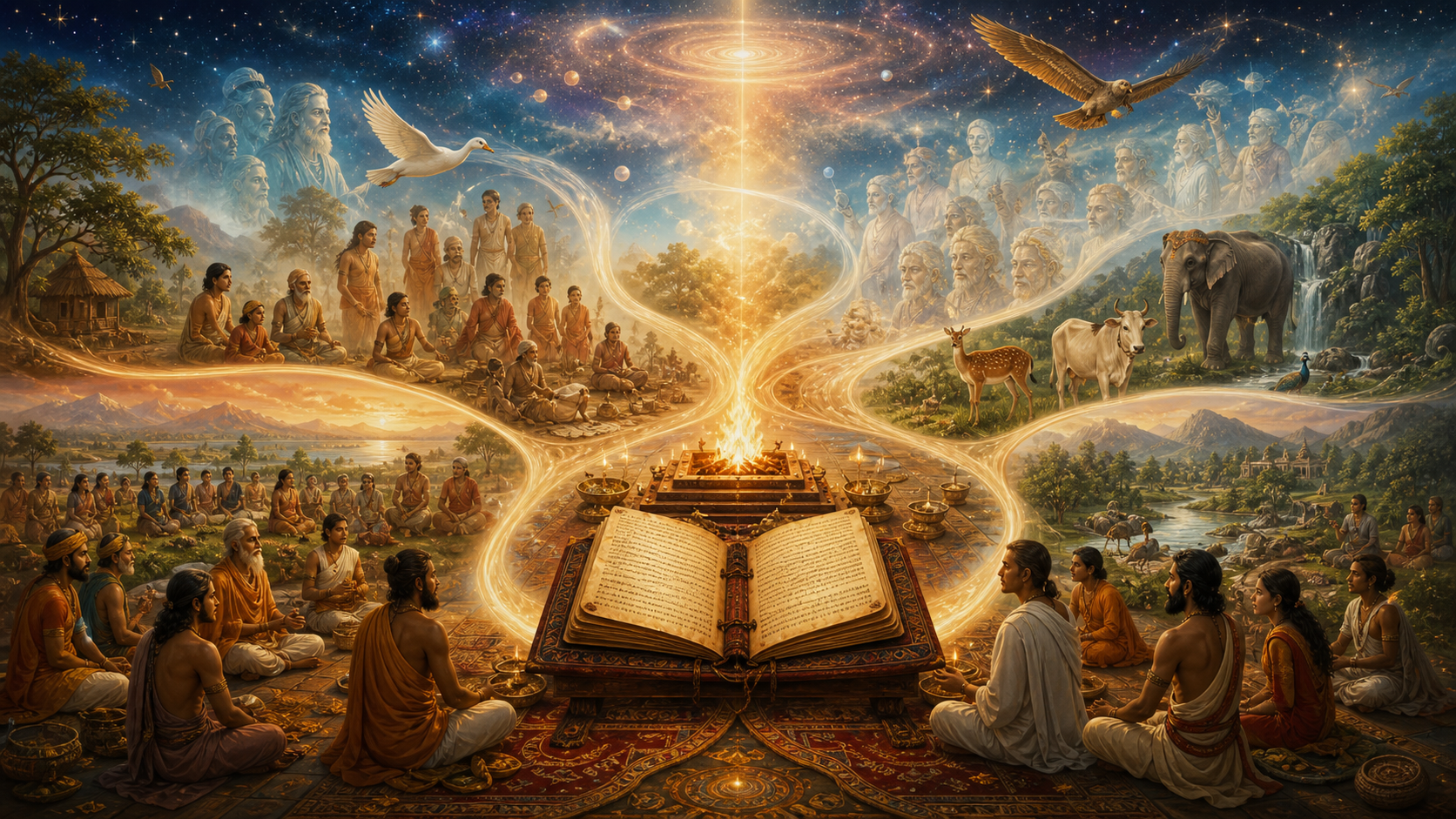
Panchajana is often introduced as a classification of five powerful kinds of beings in Hindu scriptures. A closer reading produces a more compelling and accurate conclusion: the term preserves several layers of Vedic thought rather than one universally fixed list. Depending on the passage and its interpreter, Panchajana can denote five peoples, five ancient communities, five classes of beings, five social groups, or a symbolic totality of life gathered within cosmic order.
This ambiguity is not a defect that must be eliminated. It reveals how Hindu scriptures were transmitted through ritual practice, grammatical analysis, philosophical commentary, and changing historical settings. A reader expecting five neatly defined supernatural beings may initially find the evidence unsettled. Yet that very uncertainty opens a richer view of Vedic literature, in which a compact expression can connect society, ritual, cosmology, ancestry, and consciousness.
The concise meaning of Panchajana
In its earliest Rigvedic setting, the expression pañca janāḥ most directly means “five peoples” or “five communities.” Historical scholarship frequently associates those peoples with the Pūru, Yadu, Turvaśa, Anu, and Druhyu groupings, although not every occurrence necessarily identifies five named tribes. Later Vedic and commentarial traditions supplied cosmological and social lists, while a modern inclusive interpretation identifies devas, human beings, ancestors, animals, and birds.
The most responsible answer therefore distinguishes textual levels. The Rig Veda supplies the ancient expression; Brāhmaṇa literature, the Nirukta, the Upanishads, Vedānta commentary, and later reference traditions explain it in different ways. None of these interpretations should automatically be projected backward into every Rigvedic verse.
What the Sanskrit expression actually says
The Sanskrit components appear simple. Pañca means five, while jana can mean a person, people, community, race, tribe, or class of living beings. The noun is related to the verbal root √jan, associated with birth and generation. In Vedic passages, pañca janāḥ is commonly a phrase consisting of the numeral and a plural noun; later usage also treats Pañcajana as a compound. Sanskrit lexicographical traditions consequently preserve several meanings rather than a single definition.
The semantic range of jana is decisive. Translating it as “conscious beings” may suit a philosophical interpretation, but that is not its only lexical sense. In a political hymn it can indicate peoples; in ritual language it can address communities of participants; in later cosmology it can include nonhuman orders of existence. Etymology alone cannot determine which meaning a particular verse requires.
Panchajana should therefore not be treated as the Sanskrit equivalent of a modern biological taxonomy. Nor does the word, by itself, establish five scientifically measurable levels of consciousness. It belongs to ancient poetic, ritual, social, and metaphysical vocabularies whose categories overlap without corresponding exactly to those of contemporary science.
The Rigvedic foundation: five peoples gathered around an offering
A central reference occurs in Ṛgveda 10.53.4–5. The brief expression pañca janā mama hotraṃ juṣadhvam calls upon the five peoples to accept or take pleasure in the speaker’s priestly offering. The surrounding language concerns nourishment, sacrifice, and beings worthy of worship. The verse confirms that the five are addressed collectively, but it does not pause to enumerate them.
Traditional ritual explanations connect this mantra with the hotṛ, the priest responsible for reciting Rigvedic verses, and with the Darśapūrṇamāsa rites associated with the new and full moons. This setting matters because ritual speech creates a field of participation larger than the individual sacrificer. Even so, the ritual application does not by itself prove that the verse originally meant devas, humans, ancestors, animals, and birds. That specific enumeration belongs to an interpretive layer.
Another revealing occurrence appears in Ṛgveda 1.89.10, where Aditi is identified with heaven, the middle realm, familial relations, all the gods, the five peoples, what has been born, and what will be born. The verse’s rhetoric is expansive. In that context, the five peoples contribute to an image of wholeness rather than functioning as an isolated chart of five species.
Rigvedic expressions related to five peoples, five settlements, five lands, and five directions have encouraged a geographical interpretation as well. In spatial symbolism, five can signify the four cardinal directions together with the centre. Panchajana can accordingly operate as a totalizing expression: the communities distributed through the inhabited world, viewed from the ritual or political centre.
Modern historical-philological research commonly connects the phrase with the Pūru, Yadu, Turvaśa, Anu, and Druhyu peoples. The Oxford discussion of Rigvedic society treats the five peoples as part of the social landscape of mobile, kin-based communities that could form alliances or oppose one another. The identification is influential and contextually persuasive, but it remains prudent to say that these groups are associated with the expression rather than mechanically substituted into every verse.
Why Hindu sources preserve more than one list
Ancient Indian interpreters were already aware that Panchajana was difficult. Their alternatives show that disagreement did not begin with modern scholarship. The expression could be explained historically, cosmologically, socially, ritually, or philosophically. These readings should be studied as evidence of a living interpretive tradition, not arranged into an artificial contest in which only one can retain all value.
First interpretation: the five Rigvedic peoples. The Pūru, Yadu, Turvaśa, Anu, and Druhyu are frequently presented as the five major tribal or confederated peoples. On this reading, Panchajana belongs primarily to early Vedic social and political vocabulary. The word “people” is preferable to modern racial terminology because jana refers to a social community and does not encode a modern biological theory of race.
Second interpretation: five orders of beings. A traditional list associated with the Aitareya Brāhmaṇa identifies devas; human beings; Gandharvas together with Apsarases; serpent beings; and Pitṛs, or ancestors. This is a genuinely cosmological Panchajana model. It spans divine, terrestrial, liminal, chthonic, and ancestral domains rather than arranging modern zoological classes.
Third interpretation: a list preserved in the Nirukta. In its discussion of Ṛgveda 10.53.4, Yāska’s Nirukta records an understanding based on Gandharvas, Pitṛs, Devas, Asuras, and Rākṣasas. The significance of this passage lies not merely in the five names but in its method: an ancient work of Vedic semantic explanation openly preserves interpretive plurality. A critical English edition of the Nighaṇṭu and Nirukta provides the relevant philological background.
The Asuras and Rākṣasas in this list should not be reduced to interchangeable embodiments of absolute evil. The semantic and theological histories of these classes are complex. In early Vedic language, asura can express lordly power and is not always opposed to deva in the manner familiar from later narratives. Epic and Purāṇic traditions develop sharper conflicts while still portraying considerable diversity among individual beings.
Fourth interpretation: four varṇas and a fifth community. The Nirukta attributes to Aupamanyava an explanation in which the four varṇas are joined by the Niṣādas. Later commentators also employed versions of this reading. It should be understood as a social interpretation from a particular historical framework, not as proof that every Rigvedic use of Panchajana describes a permanent social hierarchy.
Fifth interpretation: devas, humans, ancestors, animals, and birds. A modern devotional and encyclopedic presentation identifies Devas, Manuṣyas, Pitṛs, Paśus, and Pakṣis. This is the model most closely aligned with the popular description of Panchajana as five classes of conscious beings. It offers a spiritually and ecologically inclusive framework, but accuracy requires labelling it as one interpretation rather than the undisputed definition of the Rigvedic phrase.
These lists do not align through a simple substitution scheme. Serpent beings in one list do not automatically become animals in another, Gandharvas do not merely stand for birds, and historical tribes cannot be converted into metaphysical levels of awareness. Each interpretation answers a different question about the term: who constitutes the Vedic world, who participates in ritual order, which communities form society, or what realities ultimately depend upon Brahman.
The popular fivefold model examined carefully
The fivefold model of Devas, Manuṣyas, Pitṛs, Paśus, and Pakṣis remains valuable when presented with textual caution. It turns Panchajana into an account of interdependence: celestial powers, living human communities, remembered ancestors, terrestrial animals, and winged life all participate in an ordered cosmos. Its strength is ethical and contemplative rather than taxonomically final.
1. Devas: luminous powers and divine persons. The Sanskrit word deva is associated with brightness and designates deities addressed throughout Vedic literature. Agni, Vāyu, Sūrya, Indra, Varuṇa, Uṣas, and many others possess distinctive names, relationships, functions, and personalities. Some are closely connected with observable realities such as fire, wind, sun, dawn, rain, or moral order, but describing them as nothing more than natural forces would flatten the theological and ritual complexity of the hymns.
Within yajña, devas are recipients of offerings, partners in reciprocity, guardians of order, and sources of power or blessing. Philosophical traditions later interpret divine plurality in different ways: as forms of one ultimate reality, as real dependent divinities, as manifestations of Īśvara, or as personal beings within a graded cosmos. Panchajana alone does not settle those doctrinal questions.
2. Manuṣyas: human beings and deliberate moral agency. Human life occupies a prominent place in Hindu philosophy because it permits reflection on dharma, conscious ethical choice, disciplined sādhanā, ritual responsibility, study, devotion, and the pursuit of mokṣa. Human embodiment is therefore often praised as a rare opportunity rather than celebrated as a licence for domination over other forms of life.
The claim that humans are the only beings capable of spiritual development is too absolute. Hindu narratives repeatedly portray devas, animals, Nāgas, Gandharvas, ancestors, and other beings as capable of devotion, knowledge, moral action, transformation, or liberation through divine grace. The more defensible claim is that many Hindu traditions regard human birth as especially suited to intentional practice because it combines vulnerability, self-awareness, and freedom of response.
3. Pitṛs: ancestors and continuity across generations. Pitṛs are not simply a poetic synonym for elderly relatives. Vedic and later Hindu traditions recognize an ancestral order linked with death, lineage, memory, offerings, and obligations between generations. Practices such as śrāddha express gratitude and acknowledge that an individual life is sustained by inherited bodies, languages, knowledge, labour, and relationships.
The emotional significance of this category is readily understood. In a family remembering parents or grandparents, ancestry is not an abstract theory of the past; it is a felt continuity of names, habits, stories, duties, and unresolved responsibilities. The Pitṛ category gives ritual form to that experience while placing familial memory within a larger cosmological order.
4. Paśus: terrestrial animals and embodied dependence. In Vedic Sanskrit, paśu can refer broadly to an animal or creature and often has the more specific economic and ritual sense of livestock. Translating it as the entire “animal kingdom” is therefore an expansive modern usage. That expansion can support a constructive ethical reading, but it should not be confused with the terminology of modern zoology.
Animals make human dependence visible. Food systems, agriculture, transport, soil renewal, pollination, companionship, and habitat health all expose the fiction of complete human independence. Hindu traditions contain varied historical practices concerning animals, yet ahiṃsā, compassion, restraint, and respect for embodied life provide strong resources for evaluating those practices rather than romanticizing the past.
5. Pakṣis: birds as living creatures and symbolic intermediaries. Pakṣin literally denotes a winged being and commonly means a bird. Birds occupy a vivid place in Hindu scriptures: Garuḍa conveys royal and Vaiṣṇava symbolism; the haṃsa becomes associated with discernment and spiritual freedom; Jaṭāyu embodies courageous sacrifice in the Ramayana; and ordinary birds mark seasons, landscapes, and the rhythms of dawn.
Separating birds from other animals may appear unusual to a modern biological reader. Its logic is symbolic and phenomenological rather than zoological. Birds traverse earth and sky, migrate across visible boundaries, and communicate through calls that structure human experience of time and place. Those qualities make them natural images of mobility, aspiration, vision, and passage between realms. They do not, however, prove that Pakṣis formed the original fifth Rigvedic people.
In what sense are the five “powerful”?
The word Panchajana does not literally mean “five powerful beings.” Power is an interpretive description of what the categories contribute. Devas embody cosmic and sacred potency; humans exercise reflective and moral agency; ancestors transmit identity and obligation; animals sustain ecological and material systems; and birds evoke movement across boundaries. Their power lies in participation and relationship, not in five equal measurements of supernatural force.
This reading also discourages a simplistic hierarchy. The categories possess different modes of existence and agency, but difference need not imply contempt. A ritual worldview can distinguish gods, humans, ancestors, animals, and birds while recognizing that no category exists in isolation. The fivefold structure becomes a grammar of relationship rather than a ladder of worth.
Does Panchajana describe five levels of consciousness?
Some contemporary interpretations map the five categories onto aspects of the psyche: devas become elevated faculties, humans represent reflective awareness, ancestors signify inherited dispositions, animals express instinct, and birds symbolize transcendence. Such a map may be contemplatively useful, but it is allegorical. It should not be presented as the explicit meaning of Ṛgveda 10.53 or as a neurological theory anticipated by the Vedas.
Even the phrase “levels of consciousness” requires care. Hindu philosophical schools disagree about the self, mind, embodiment, karma, and ultimate reality. Advaita Vedānta, Viśiṣṭādvaita, Dvaita, Sāṃkhya, Yoga, Mīmāṃsā, and devotional traditions do not reduce their accounts of conscious life to one common Panchajana system.
The doctrine of rebirth does, however, provide a broader setting in which forms of embodiment are morally and spiritually connected. A jīva may pass through different conditions of existence according to the account accepted by a particular tradition. This continuity can support humility toward nonhuman life, but it should not be used to erase the real differences among scriptural cosmologies.
The Upanishadic turn: from five groups to their ultimate ground
Bṛhadāraṇyaka Upaniṣad 4.4.17 contains the compact expression yasmin pañca pañcajanā ākāśaś ca pratiṣṭhitaḥ. The verse directs attention toward the reality in which the five Panchajanas and space are established, identifying that ground with the immortal Self and Brahman. The philosophical emphasis is therefore not merely on cataloguing five groups but on discovering what supports them.
The phrase pañca pañcajanāḥ also generated a technical Vedāntic debate. Could “five groups of five” refer to the twenty-five principles of Sāṃkhya? Brahma Sūtras 1.4.11–13, as explained in Vedānta commentaries, reject the assumption that numerical resemblance alone proves such an identification. The complementary passage instead leads interpreters toward prāṇa and related faculties, while other commentarial explanations retain cosmic or social groups.
This debate illustrates a fundamental rule of scriptural interpretation: a number cannot be detached from grammar, adjacent verses, genre, and commentarial method. Five may organize a teaching, but it does not automatically identify the same five entities everywhere. Panchajana in a Rigvedic invocation, an Upanishadic reflection, and a Purāṇic story must be interpreted within three different textual environments.
Panchajana is not the same as Pāñcajanya
Panchajana is often confused with Pāñcajanya, the famous conch of Vishnu or Krishna. The words are related but not interchangeable. Pañcajana can designate the five peoples or a being named Pañcajana. Pāñcajanya, marked by the lengthened initial vowel in careful transliteration, is a derivative form and the proper name of the conch. Bhagavad Gita 1.15 states that Krishna blows Pāñcajanya while Arjuna and Bhima sound their own named conches.
A narrative in Śrīmad Bhāgavatam 10.45.40–44 describes a powerful Daitya named Pañcajana who moves underwater in the form of a conch. Krishna kills him while searching for the lost son of his teacher Sāndīpani. The boy is not found within the being, so Krishna takes the conch and proceeds to the realm of Yama, where the search reaches its resolution. This story belongs to the mythology of Pāñcajanya and should not be used as the definition of the Rigvedic five peoples.
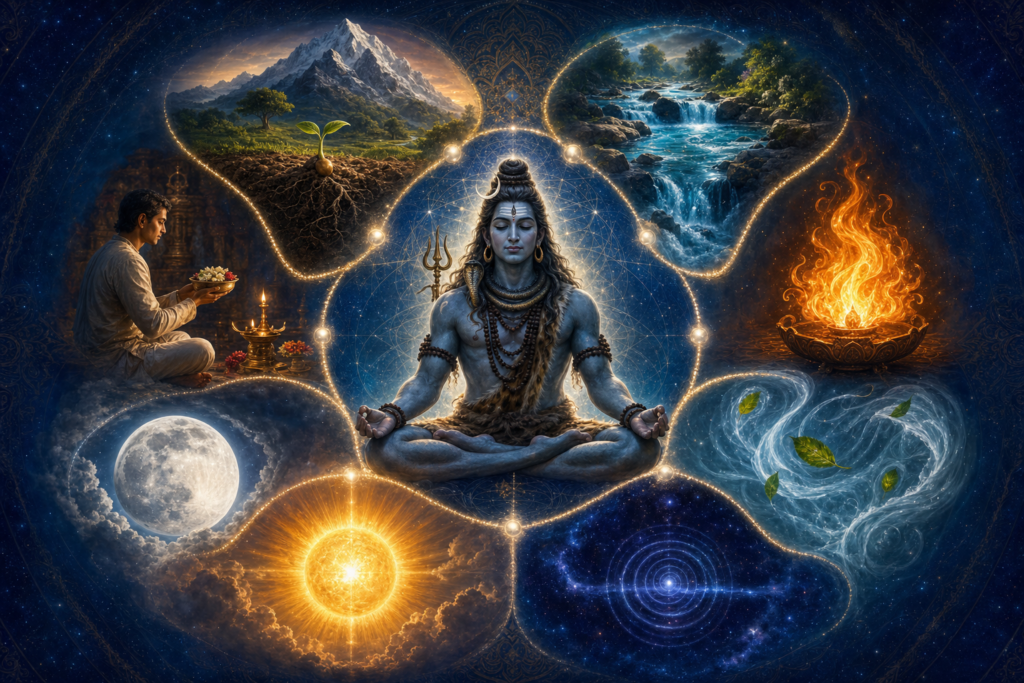
Panchajana should likewise not be confused with the pañca mahābhūtas, the five great elements commonly identified as earth, water, fire, air, and space. The elements constitute a different fivefold doctrine. Symbolic traditions may connect Pāñcajanya or other sacred objects with the elements, but similarity in the number five does not establish textual identity.
Contemporary relevance without anachronism
The inclusive fivefold interpretation can contribute to ecological reflection when it is presented as a contemporary application rather than a claim that the Rig Veda formulated modern environmental science. By placing humans beside divine, ancestral, animal, and avian communities, the model challenges the assumption that human interests exhaust the meaning of the cosmos.
Its ecological value is practical. Rivers, forests, animals, birds, climate, agriculture, and human health belong to interdependent systems. A society that destroys habitats eventually damages its own food security, bodily health, cultural memory, and sacred geography. Panchajana can serve as a contemplative vocabulary for this interdependence even though environmental policy requires additional scientific evidence and modern institutions.
The ancestral dimension adds a temporal form of responsibility. Ethical action is owed not only to present communities but also to those whose labour made the present possible and to descendants who will inherit its consequences. Remembering Pitṛs can therefore deepen reflection on stewardship, provided that a modern ethical application is not confused with a literal translation of every ancestral rite.
Panchajana also offers a disciplined model of pluralism. The textual tradition preserves several interpretations without collapsing them into one. Historical, ritual, cosmological, social, and metaphysical readings can be compared, criticized, and situated. Unity emerges through a shared search for meaning, not through the erasure of difference.
A bridge among Dharmic traditions
Panchajana is specifically rooted in Vedic and Hindu textual history, so it should not be imposed upon Buddhism, Jainism, or Sikhism as though all four traditions possessed an identical cosmology. A more respectful dialogue begins by preserving distinctions. Buddhist teachings develop their own accounts of sentient realms and compassion; Jain philosophy offers a highly technical classification of jīvas and a rigorous ethic of ahiṃsā; Sikh teaching emphasizes the divine source permeating creation and the ethical demands of humility, remembrance, and service.
These traditions can nevertheless meet around a shared resistance to arrogant human isolation. Compassion for living beings, responsibility for conduct, reverence for truth, disciplined self-transformation, and awareness of interdependence provide genuine points of conversation. Such unity is strongest when it does not pretend that doctrinal differences are superficial.
How Panchajana should be studied
The first question should always be textual: where does the word occur? A Rigvedic verse, a Brāhmaṇa explanation, an Upanishadic teaching, a grammatical commentary, and a Purāṇic narrative have different purposes. Identifying the source prevents a later interpretation from being presented as the self-evident meaning of an earlier passage.
The second question is grammatical: does the passage contain pañca janāḥ, the compound Pañcajana, or the derivative Pāñcajanya? Small changes in vowel length, number, and compound formation can separate five peoples from a named being or Krishna’s conch.
The third question concerns context. Words surrounding Panchajana may point toward ritual participants, political communities, divine beings, sensory faculties, or a mythological individual. Context is stronger evidence than an attractive numerical parallel drawn from an unrelated doctrine.
The fourth question concerns the interpreter. Yāska, Aupamanyava, Śaṅkara, later Vedāntins, historical philologists, and modern devotional teachers employ different methods and answer different concerns. Naming the interpretive tradition is a mark of intellectual honesty, not a weakening of faith.
The final question separates textual statement from constructive insight. A verse may explicitly address five peoples; a commentator may identify them; and a contemporary reader may draw an ecological lesson. All three can be meaningful, but they are three distinct kinds of claim.
Common questions about Panchajana
Is Panchajana a single deity? Usually not. In Vedic discussion it most often concerns five peoples or classes. Pañcajana can, however, also be the proper name of a mythological being in later narratives, which is one reason the term requires contextual reading.
Are the five always Devas, Manuṣyas, Pitṛs, Paśus, and Pakṣis? No. That is a meaningful inclusive interpretation, but Vedic, Brāhmaṇa, Nirukta, social, and historical explanations supply other lists. It should be introduced as one model rather than the only scriptural answer.
Are the five peoples definitely Pūru, Yadu, Turvaśa, Anu, and Druhyu? They are the leading historical identification and illuminate many Rigvedic contexts. Yet the phrase can also function collectively, approximately meaning the peoples as a whole, especially where five is connected with lands or directions.
Does Panchajana teach five ascending levels of consciousness? Not explicitly in the foundational Rigvedic passages. Psychological and spiritual mappings are later allegorical applications. They may support meditation or teaching, but they should not be mistaken for the literal grammar of the hymns.
Is Panchajana Krishna’s conch? No. Krishna’s conch is Pāñcajanya. Pañcajana can be the name of the being associated with its origin story, while pañca janāḥ denotes five peoples. Careful spelling protects three different ideas from being merged.
What is the most important philosophical lesson? Panchajana shows that existence can be imagined as a network of communities rather than an isolated human domain. The Upanishadic treatment adds a further question: what is the reality in which all such communities, together with space itself, are grounded?
Conclusion: a fivefold expression with many legitimate horizons
Panchajana is more profound when its complexity is preserved. In the Rig Veda, it evokes five peoples participating in social, ritual, and cosmic order. Historical interpretation associates them with five major Vedic communities; Brāhmaṇa and Nirukta traditions identify different classes of beings; social commentators supply another map; the Upanishads redirect attention toward the Self or Brahman that supports all categories; and modern spiritual interpretation draws devas, humans, ancestors, animals, and birds into an ethic of interdependence.
The enduring insight is not that every Hindu scripture teaches one immutable list of five powerful beings. It is that the sacred world exceeds the isolated individual. Divine powers, communities, ancestors, nonhuman life, memory, place, and ultimate reality meet within a larger order. Read with philological care and philosophical openness, Panchajana becomes both an ancient expression and a disciplined invitation to recognize unity without denying diversity.
Primary reference points: Ṛgveda 10.53.4–5 and 1.89.10; Aitareya Brāhmaṇa traditions concerning the five peoples; Yāska’s Nirukta 3.8; Bṛhadāraṇyaka Upaniṣad 4.4.17; Brahma Sūtras 1.4.11–13; Bhagavad Gita 1.15; and Śrīmad Bhāgavatam 10.45.40–44. These passages should be read with their surrounding verses and, where possible, more than one translation or commentary.
Inspired by this post on Hindu Blog.






Leave a Reply
You must be logged in to post a comment.