
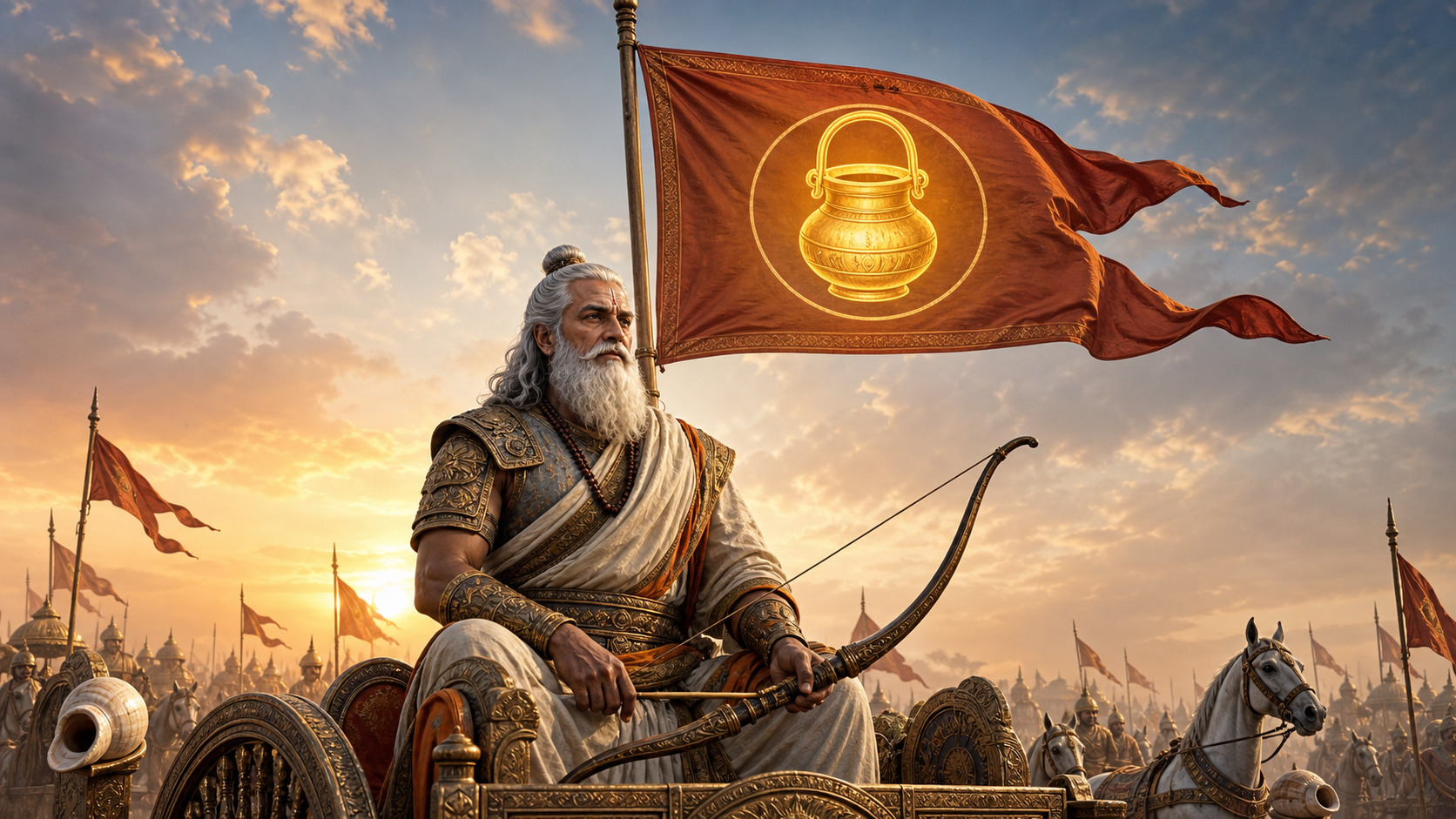
In the Mahabharata, the Kurukshetra War is never presented as a mere collision of armies. It is a battlefield of vows, lineages, ethical tensions, inherited loyalties, and spiritual symbols. Among the many emblems raised above the chariots of kings and warriors, the banner of Drona occupies a particularly meaningful place because it carries the paradox of his life: the ascetic’s vessel flying over a war-chariot.
Drona, also known as Dronacharya, stands at one of the most complex moral intersections in the Mahabharata. He is a Brahmin by birth, a preceptor by social function, a master of celestial weapons by training, and a commander in a devastating war by circumstance. His flag, associated with the kamandalu, is therefore not an ornamental detail. It is a compact visual statement about a man who carries the marks of spiritual discipline while moving through the terrible machinery of Kshatra Dharma.
The kamandalu, traditionally a water vessel carried by ascetics, rishis, renunciants, and seekers, belongs to the symbolic world of restraint, purity, learning, tapas, and sacred discipline. It is not a weapon. It does not wound, cut, pierce, or conquer. It holds water, the element associated with life, purification, offering, and inner clarity. When such an emblem appears on Drona’s banner in the Kurukshetra War, the Mahabharata quietly forces the reader to confront the tension between spiritual knowledge and martial action.
The battlefield banners of the Mahabharata function as more than military identifiers. They are dhvajas, visible markers of inner identity. Arjuna’s chariot bears Hanuman, pointing to devotion, strength, memory, and the living continuity between the Ramayana and the Mahabharata. Bhishma’s banner reflects authority and ancestral grandeur. Karna’s standard communicates royalty, pride, and heroic defiance. In the same symbolic grammar, Drona’s kamandalu announces that the warrior on that chariot is not simply another fighter. He is a teacher carrying the burden of sacred learning into a morally fractured war.
Drona’s life begins not in the courtly world of political ambition but in the lineage of sages. He is the son of Bharadvaja, one of the revered rishis of the Vedic and epic tradition. His very name is linked to a vessel, since the epic tradition associates his unusual birth with a container. This background makes the kamandalu on his flag especially suggestive. The emblem recalls not only his Brahmin identity but also the vessel-like nature of his life: he receives knowledge, stores it, transmits it, and finally becomes consumed by the consequences of how that knowledge is used.
The Mahabharata repeatedly shows that knowledge is not morally neutral in the hands of human beings. Drona teaches both the Pandavas and the Kauravas. He forms Arjuna into the supreme archer of his generation. He trains warriors who later stand on opposite sides of the same battlefield. This is one of the epic’s most painful insights: instruction given within a fractured moral order can become divided against itself. The teacher’s gift may serve dharma in one hand and adharma in another.
The kamandalu on Drona’s banner therefore becomes a sign of disciplined knowledge under ethical strain. It asks whether sacred learning can remain pure when tied to royal patronage, personal grievance, debt, and military obligation. Drona is not portrayed as a simple villain, nor as an uncomplicated sage. He is a deeply human figure: brilliant, austere, proud, wounded by poverty, bound by gratitude, attached to his son Ashwatthama, and caught in the political web of Hastinapura.
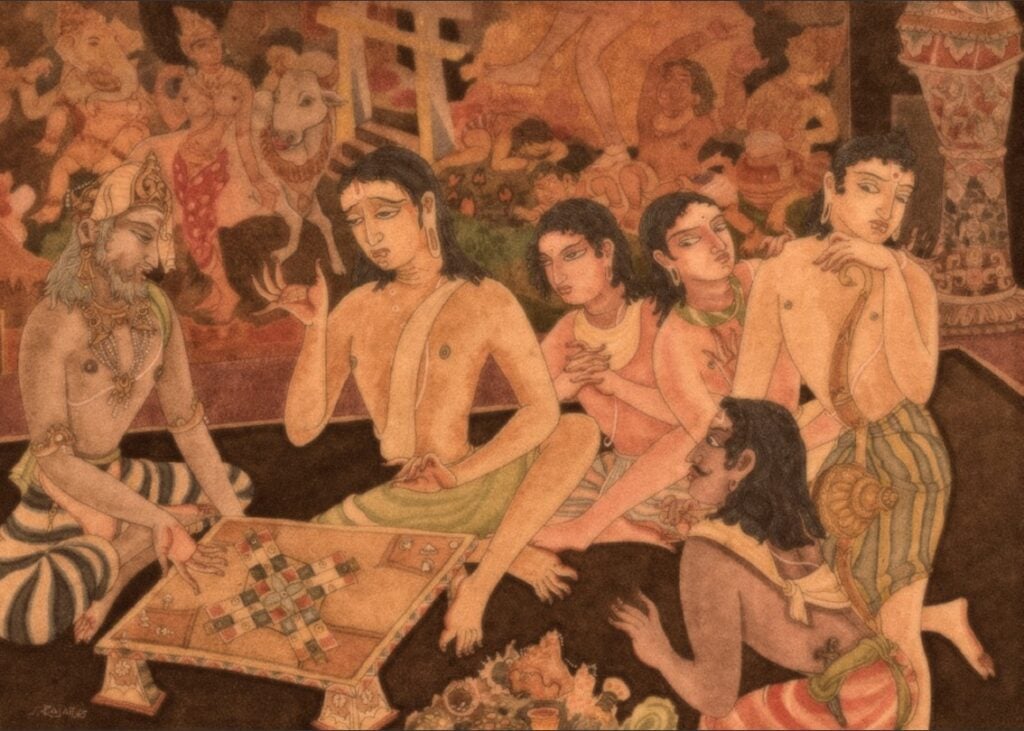
His relationship with Drupada is central to understanding this tension. Drona’s humiliation at Drupada’s court becomes one of the turning points of his life. A man trained in Brahminical learning and martial science is stung by social insult and material deprivation. The later demand for guru dakshina, in which his students defeat Drupada, reveals how personal hurt can enter the space of teaching. Here the Mahabharata does not offer a shallow moral lesson. It presents the danger of knowledge when wounded memory becomes inseparable from authority.
For readers of the Mahabharata, this is one reason Drona remains unsettling. He is worthy of reverence as a guru, yet his actions invite scrutiny. He gives Arjuna extraordinary training, but the episode of Ekalavya raises difficult questions about hierarchy, access to knowledge, social boundaries, and the ethics of excellence. He serves the Kuru throne, yet his heart is not free from affection for the Pandavas. He leads the Kaurava army, yet he knows the spiritual stature of Krishna and the martial greatness of Arjuna. His kamandalu-bearing banner therefore rises over a divided self.
The emblem also illuminates the difference between Brahma-tejas and Kshatra-tejas. Brahma-tejas is the radiance of knowledge, austerity, mantra, teaching, and inward discipline. Kshatra-tejas is the radiance of courage, protection, statecraft, and righteous force. Hindu thought does not always place these powers in absolute opposition. Ideally, they cooperate: wisdom guides power, and power protects wisdom. Drona’s tragedy lies in the fact that these two energies do not fully harmonize within him during the war. His knowledge is vast, but his political alignment is compromised.
This is why the kamandalu is such a powerful symbol in the Kurukshetra setting. On an ordinary ascetic’s path, the vessel signifies renunciation, simplicity, and purification. On Drona’s war-banner, it becomes more ambiguous. It still signifies learning and austerity, but it also reveals displacement. The object of tapas has been lifted into a theatre of violence. The water-pot of restraint flies above arrows, conches, drums, horses, and severed loyalties.
The Mahabharata often communicates through such visual contrasts. Krishna, who could wield cosmic power, becomes Arjuna’s charioteer. Bhishma, who vows celibacy and loyalty, becomes bound to a throne whose decisions he does not always approve. Karna, born with divine armor, lives under the shadow of social rejection and mistaken allegiance. Drona, bearer of sacred knowledge, becomes commander of an army fighting against many of his own beloved pupils. The kamandalu on his flag belongs to this larger epic method: symbols reveal contradictions that speeches alone cannot resolve.
In technical terms, the Mahabharata’s use of banners reflects the ancient Indian understanding of identity in war. A warrior’s standard made him visible to allies and opponents across a crowded battlefield. It helped troops locate commanders, preserved formation, and carried psychological force. Yet in epic literature, the banner is also an interpretive device. It externalizes character. It turns the chariot into a moving statement of dharma, lineage, temperament, and destiny.
Seen in that light, Drona’s banner performs several functions at once. Militarily, it identifies him. Culturally, it marks him as a Brahmin and teacher. Spiritually, it recalls restraint and purity. Narratively, it exposes irony. Philosophically, it raises the question of whether learning without complete self-mastery can protect a person from moral entanglement. This layered symbolism is one reason the Mahabharata remains central to Indian epics, Hindu scriptures, and the study of dharma.
The kamandalu also evokes the discipline of the guru-shishya tradition. A teacher is expected to be a vessel of knowledge, transmitting what has been preserved through tapas, study, and lived discipline. Drona certainly fulfills this role at the level of skill. His students become extraordinary warriors. Yet the epic asks a harder question: is the transmission of skill enough, or must knowledge also be joined to moral clarity? The answer implied by the war is sobering. Skill without dharmic alignment can magnify destruction.
This insight has enduring relevance. In every age, societies train specialists, strategists, administrators, technologists, and leaders. The Mahabharata’s portrait of Drona suggests that mastery alone is insufficient. The deeper test is whether knowledge remains accountable to dharma. A person may hold the vessel of wisdom, but the content of that vessel must be guarded from ego, resentment, fear, and dependency on power.
Drona’s loyalty to the Kuru throne is one of the most debated aspects of his character. He is not blind to Duryodhana’s flaws. He is not ignorant of the Pandavas’ virtues. Yet he remains bound to the side that sustains him materially and politically. The kamandalu, in this context, becomes a silent rebuke as much as an emblem. It reminds the reader that a life shaped by sacred learning can still become constrained by obligation when inner freedom is incomplete.
The emotional power of this symbol lies in its recognizability. Many readers encounter in Drona a familiar human struggle: the difficulty of living up to one’s own ideals when relationships, debts, institutions, and ambitions pull in different directions. The kamandalu suggests purity, but the battlefield reveals conflict. The distance between the two is the space in which the Mahabharata conducts much of its moral inquiry.
Drona’s fall in the war deepens this symbolism further. His death is brought about through a morally complex strategy involving the announcement of Ashwatthama’s death, framed in a way that breaks his will. The episode is troubling because it involves truth, half-truth, necessity, and the ethics of war. Drona lays down his weapons when his deepest attachment is struck. The warrior-sage is not defeated merely by physical force. He is undone through the vulnerable bond of fatherhood.
This final moment returns the reader to the meaning of the kamandalu. The ascetic’s vessel implies detachment, but Drona is profoundly attached to Ashwatthama. The emblem of renunciation flies above a man whose heart is bound by paternal love, pride, and grief. The Mahabharata does not condemn such love as inherently wrong. Rather, it shows that attachment, when not governed by wisdom, can become the point through which even the mighty are broken.
It is also important to read Drona’s symbolism without reducing the Mahabharata to a single sectarian frame. The epic belongs to the wider dharmic imagination, where Hindu, Buddhist, Jain, and Sikh readers have all historically engaged questions of duty, non-violence, righteous action, self-control, and the ethical use of power in different ways. Drona’s kamandalu can therefore be appreciated as part of a shared civilizational conversation: knowledge must be disciplined, power must be restrained, and action must be examined in the light of moral responsibility.
The kamandalu’s association with water also offers a subtle interpretive possibility. Water purifies, but it also reflects. It takes the shape of the vessel that holds it. Drona’s knowledge, like water, takes the shape of the institutions and intentions through which it flows. In Arjuna, that knowledge becomes disciplined archery guided eventually by Krishna’s teaching. In the Kaurava cause, it becomes part of a military order unable to free itself from Duryodhana’s ambition. The same training produces different moral outcomes because the inner vessel differs.
This makes Drona’s flag one of the more intellectually rich symbols in the Kurukshetra War. It does not merely say, “Here is a Brahmin warrior.” It says, more profoundly, “Here is sacred learning under the pressure of history.” It reveals the danger of separating intellectual brilliance from ethical responsibility. It also honors the dignity of the teacher’s office while acknowledging the frailty of the individual teacher.
In Hindu symbolism, objects often carry layered meanings shaped by ritual, narrative, and philosophical context. The conch may announce divine presence and martial readiness. The discus may signify cosmic order and decisive power. The bow may represent discipline and directed will. The kamandalu signifies inwardness, purity, tapas, and the preservation of life-giving wisdom. Its presence on Drona’s banner therefore creates a deliberate tension with the destructive environment of war.
The Mahabharata’s greatness lies in refusing easy answers. Drona is not dismissed because he fights for the Kauravas, nor is he absolved because he is a revered teacher. He is studied. His virtues and failures are held together. The kamandalu makes that study visible. It keeps before the reader the ideal that Drona represents and the tragic distance between that ideal and his wartime choices.
For modern readers, this symbol remains unusually relevant. Institutions still honor knowledge, but knowledge can be enlisted by power. Teachers still shape the future, but teaching can be affected by status, favoritism, fear, and ambition. Experts still carry the vessels of specialized learning, but expertise requires ethical orientation. Drona’s banner warns that the possession of knowledge does not automatically produce wisdom.
At the same time, the kamandalu should not be read only as accusation. It is also a reminder of Drona’s genuine stature. He is not merely a court servant or battlefield commander. He belongs to the lineage of learning. His presence in the epic preserves the memory of a civilization that valued the teacher as a transmitter of power, discipline, and sacred responsibility. The tragedy is powerful precisely because the figure is great.
The banner also helps explain why the Mahabharata is not simply a war epic. It is a study of dharma under pressure. Every great warrior enters Kurukshetra carrying a visible sign, but each also carries invisible burdens. Drona carries the burden of knowledge, debt, affection, status, and divided loyalty. The kamandalu gathers these burdens into a single image that can be read across ritual, philosophy, history, and literature.
In the end, Drona’s kamandalu flag teaches that dharma is not secured by identity alone. A Brahmin may become entangled in violence. A warrior may become an instrument of divine teaching. A king may fail in justice. A student may surpass the teacher. The Mahabharata insists that conduct, intention, self-knowledge, and alignment with truth matter more than external designation.
This is the enduring force of Drona’s emblem in the Kurukshetra War. The ascetic vessel above his chariot does not erase the battlefield; it interprets it. It asks the reader to look beyond weapons and victories toward the moral condition of the person who acts. It transforms a military banner into a philosophical mirror.
Drona’s kamandalu remains one of the Mahabharata’s most profound symbolic details because it holds together purity and conflict, wisdom and attachment, teaching and violence, reverence and critique. It reminds every generation that knowledge must be more than accumulated power. It must be purified by self-restraint, guided by dharma, and protected from the ambitions that turn sacred learning into an instrument of destruction.
Inspired by this post on Hindu Blog.



Leave a Reply
You must be logged in to post a comment.