
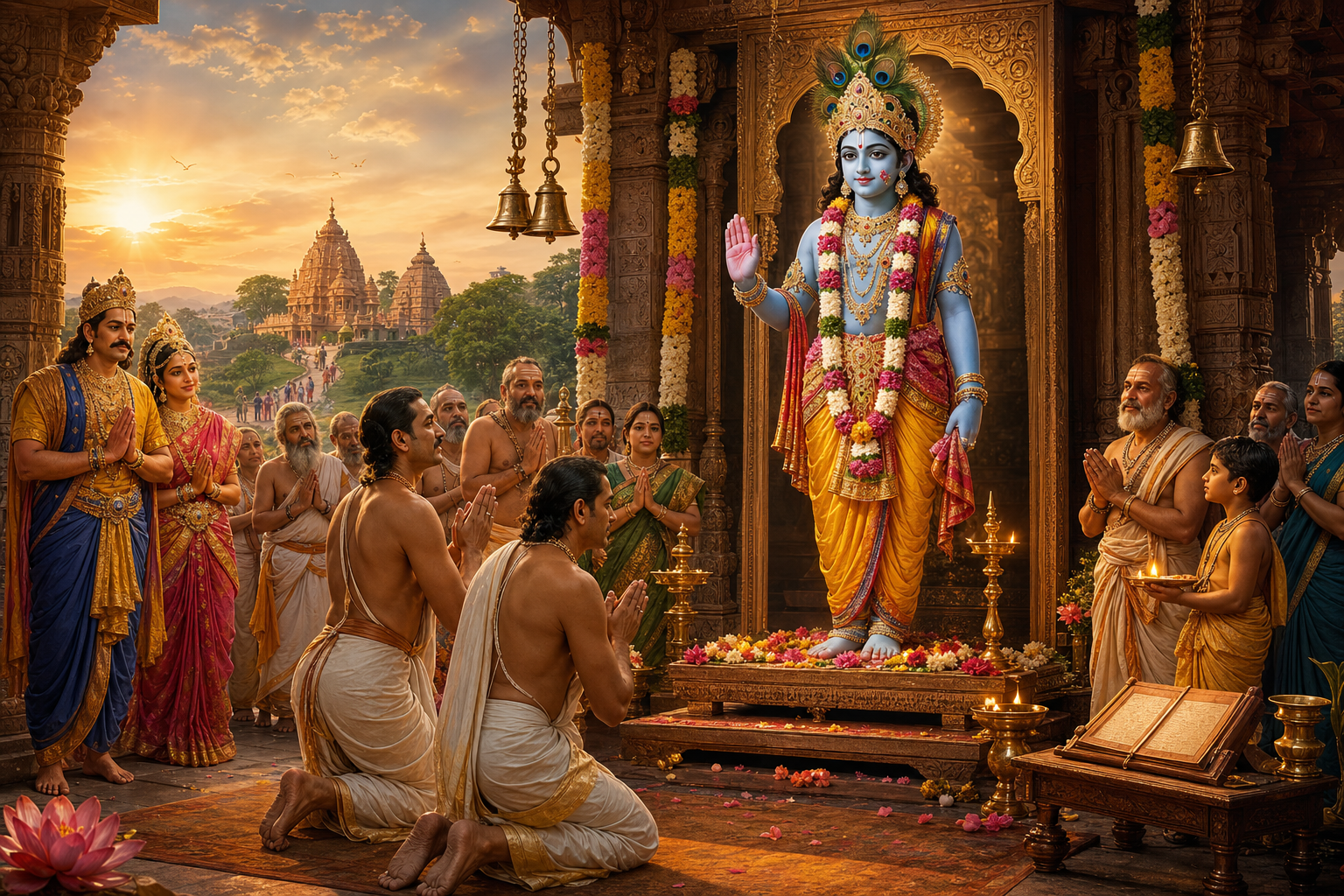
Śrī Caitanya-caritāmṛta Madhya-līlā 5.114-133 presents one of the most memorable devotional conclusions in the narration of Sākṣi-gopāla: truthfulness, when joined with humble bhakti, becomes powerful enough to move society, kingship, temple culture, and the heart of the devotee. The passage follows the dramatic moment in which Lord Gopāla personally confirms the promise made by the elderly brāhmaṇa to the younger brāhmaṇa. What begins as a family dispute over an inconvenient vow becomes a theological statement about dharma, divine witness, and the living relationship between the Deity and the devotee.
The immediate context is essential. Two brāhmaṇas had traveled together on pilgrimage, and the younger had served the elder with unusual sincerity. In gratitude, the elder promised his daughter in marriage before the Deity of Gopāla in Vṛndāvana. Social pressure later made that promise difficult to fulfill. The younger brāhmaṇa, instead of seeking personal revenge, appealed to Gopāla as the witness of truth. The Deity’s journey from Vṛndāvana to Vidyānagara is therefore not merely a miracle story; it is a sacred argument that truth, promise, service, and devotion belong together.
Verses 114-133 begin after the marriage has been completed and the truth has been publicly vindicated. Gopāla declares satisfaction with the truthfulness of both brāhmaṇas and invites them to ask for a blessing. This is theologically significant because the passage does not present divine grace as arbitrary. Grace appears in response to satya, sevā, humility, and a willingness to protect another person’s religious integrity. The younger brāhmaṇa does not reduce dharma to personal benefit; he wishes the elder’s promise to remain intact. The elder, though weakened by family pressure, still retains reverence for truth and dependence on the Lord.
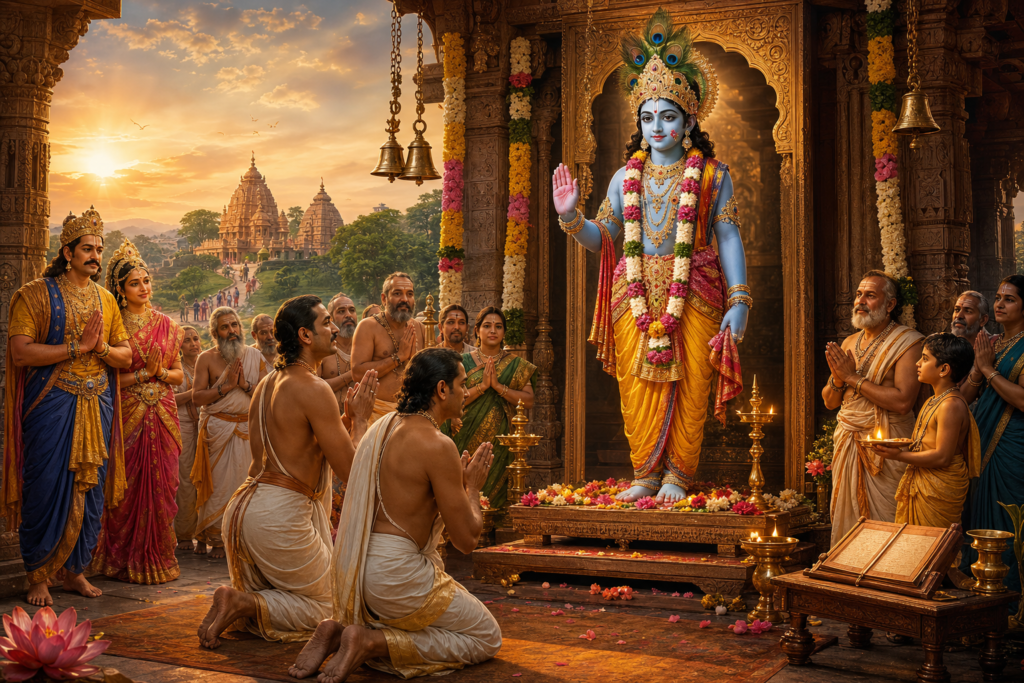
The requested benediction is also striking. The brāhmaṇas do not ask for wealth, prestige, social victory, or long private happiness. They ask that Gopāla remain there so that people throughout the world may understand His mercy toward His servants. Their request transforms an individual miracle into a public sacred memory. In dharmic traditions, such memory is not passive nostalgia. It becomes pilgrimage, temple service, communal narration, and moral education. A place becomes holy not only because something extraordinary occurred there, but because that event continues to teach succeeding generations how to live.
Gopāla remains, and the two brāhmaṇas engage in His service. This movement from conflict to worship reveals a central pattern in the story. Dharma is not completed when a legal or social dispute is resolved. It matures when the resolution becomes service. The young brāhmaṇa’s victory does not end in humiliation of the opposing family; it culminates in sevā. The elder’s restored honor does not end in self-justification; it culminates in service. The community’s amazement does not remain a spectacle; it becomes darśana and devotion.
As news of the event spreads, people from many regions come to see Gopāla. This detail shows how sacred reputation travels through oral culture, pilgrimage networks, and communal testimony. The name Sākṣi-gopāla, “Gopāla the witness,” emerges from an act of divine participation in human moral life. In many modern settings, testimony is associated with documents, signatures, recordings, and courts. The Caitanya-caritāmṛta preserves a more expansive vision: truth is also witnessed by conscience, community, sacred space, and the Divine.
The king’s arrival introduces the political dimension of the episode. A ruler hears the account, visits Gopāla, becomes satisfied, constructs a temple, and arranges regular worship. The passage quietly teaches that good governance should recognize and support sacred culture without reducing it to political display. The king does not create the sanctity of Sākṣi-gopāla; he responds to it. His role is administrative, architectural, and protective. In this way, temple culture becomes a meeting point of devotion, public memory, art, architecture, ritual order, and social cohesion.
The construction of the temple is therefore not a secondary detail. It represents the institutionalization of remembrance. A miracle witnessed by villagers becomes a stable center of worship. Regular service, or sevā, protects the event from fading into rumor. The temple gives form to gratitude, and daily worship gives rhythm to theological memory. This is one reason temples across Hindu traditions function not merely as places of private prayer but as civilizational archives. They preserve stories, songs, festivals, lineages, food traditions, sculpture, music, and ethical imagination.
The text then explains that Sākṣi-gopāla remained in Vidyānagara for a long time before later historical developments connected Him with King Puruṣottama-deva of Orissa. The movement from Vidyānagara to Kaṭaka, and eventually the association with the devotional world of Jagannātha, places Sākṣi-gopāla within the wider sacred geography of eastern India. This geography is not merely territorial. It is devotional. Vṛndāvana, Vidyānagara, Kaṭaka, and Jagannātha Purī become linked through līlā, pilgrimage, royal patronage, and the circulation of sacred narratives.
King Puruṣottama-deva’s devotion adds another layer to the passage. After conquering Vidyānagara, he prays that Gopāla come to his kingdom. The account emphasizes that Gopāla accepts the king’s prayer because of devotional service. This is important for interpreting the episode carefully. Royal power alone does not move the Deity. Conquest alone does not sanctify possession. The determining principle is bhakti. The king’s authority becomes spiritually meaningful only when subordinated to devotion and service.
The Māṇikya-siṁhāsana, the jeweled throne brought to Jagannātha Purī, further links sovereignty with surrender. A throne usually symbolizes political authority, but here it is offered to Lord Jagannātha. The symbolism is powerful: the highest seat belongs not to human ego but to the Divine. In the dharmic imagination, kingship is legitimate when it recognizes a higher moral order. This principle resonates across Hindu, Buddhist, Jain, and Sikh ethical worlds, where power is repeatedly judged by restraint, compassion, truthfulness, service, and accountability.
The Queen’s offering of a pearl introduces a tender devotional moment after the larger public and political movements of the story. She sees Gopāla and wishes to offer a precious ornament for His nose. Her thought is intimate, simple, and devotional: if there were a place for the pearl, she could offer it. The narrative then moves through dream revelation. Gopāla informs her that in His childhood His mother had pierced His nose and placed a pearl there with great effort, and that the same opening remains available for her offering.
This dream episode is rich in bhakti theology. Gopāla does not receive the Queen’s devotion as a distant monarch receiving tribute. He responds as Kṛṣṇa of Vraja, still bearing the signs of childhood affection from Mother Yaśodā. Theologically, the Deity is not an inert object decorated by human sentiment. The Deity is present as a personal recipient of love. The Queen’s desire to offer the pearl is answered by a disclosure of divine intimacy: the child of Vraja, the royal temple Deity, and the witness of truth are one continuous presence.
When the King and Queen inspect the Deity and find the opening in the nose, the offering becomes complete and a great festival is held. Festival here is not entertainment detached from doctrine. It is communal confirmation that devotion has been received. The joy belongs to the royal family, the priests, the devotees, and the public. This shared joy reflects a central strength of Hindu temple culture: a personal vow or offering can become collective celebration when it is placed within sacred order.
The concluding statement of the section says that from that time Gopāla remained in the city of Kaṭaka and continued to be known as Sākṣi-gopāla. The name itself carries the entire theology of the passage. “Sākṣi” means witness, but the witness here is not passive observation. Gopāla witnesses truth, protects dharma, honors devotion, corrects social injustice, accepts service, inspires royal patronage, and draws pilgrims. The name becomes a compressed theological archive.
Several philosophical themes emerge from these verses. First, satya is not treated as an abstract virtue. Truthfulness is relational. A promise made before the Divine binds the speaker, affects families, challenges social vanity, and may require courage when public opinion turns hostile. Second, bhakti does not erase ethical obligation; it intensifies it. The younger brāhmaṇa’s devotion makes him more concerned with preserving the elder’s truth than with securing his own advantage. Third, sacred images in the bhakti tradition are approached as living presences, not as symbolic reminders alone.
The social dimension is equally important. The original conflict involved status anxiety: wealth, learning, family prestige, and social perception. The story critiques the tendency to let reputation overpower righteousness. Yet it does so without promoting bitterness between groups. The passage ultimately restores harmony through truth and service. This is especially relevant for a blog committed to unity among dharmic traditions. The lesson is not sectarian triumphalism; it is the universal dharmic demand that relationships be governed by honesty, humility, and reverence for the sacred.
In a contemporary reading, Sākṣi-gopāla also speaks to the crisis of trust in public and private life. Modern societies produce contracts, digital records, institutional processes, and legal mechanisms, yet people still suffer when words are casually broken. Families fracture over promises. Communities lose confidence when leaders speak without accountability. Religious life becomes shallow when vows are treated as ceremonial rather than binding. The Sākṣi-gopāla narrative reminds readers that the spoken word, especially when connected to dharma, carries spiritual weight.
The passage also provides a refined understanding of humility. The younger brāhmaṇa is not passive. He travels, argues, appeals, and insists on truth. Yet his motive remains purified by concern for the elder’s religious integrity. This is dharmic assertiveness rather than egoistic aggression. It offers a useful model for ethical life: truth should be defended firmly, but the defense of truth should not become hatred. The aim is restoration, not destruction.
The elder brāhmaṇa’s role is psychologically realistic. He knows the truth but is pressured by family fear, social shame, and emotional weakness. The text does not flatten him into a villain. Gopāla’s satisfaction with both brāhmaṇas suggests that his underlying truthfulness remains visible to the Divine, even though he falters. This nuance is valuable. Dharma traditions often recognize that human beings are not merely good or bad; they are tested by circumstances, attachments, fear, and social dependence. Grace works by bringing hidden sincerity back into alignment with action.
The Queen’s pearl offering then completes the emotional arc of the section. After the stern issues of promise, dispute, kingship, and temple establishment, the narrative returns to tenderness. A small opening in the Deity’s nose becomes a place where royal devotion meets the memory of Mother Yaśodā’s affection. The passage therefore balances public dharma with intimate love. The same Gopāla who upholds truth in an assembly also receives a pearl with the sweetness of Vraja-bhakti.
For readers of Śrī Caitanya-caritāmṛta, Madhya-līlā 5.114-133 is not merely the closing portion of a miracle account. It is a compact teaching on how sacred traditions preserve ethical life. A vow becomes a test. A Deity becomes a witness. A village becomes a pilgrimage center. A king becomes a servant. A queen’s ornament becomes a festival. A name, Sākṣi-gopāla, becomes a permanent reminder that the Divine is present where truth and devotion meet.
The enduring relevance of this passage lies in its integration of philosophy, social ethics, ritual culture, and devotional emotion. It shows that Hindu scriptures do not separate inner spirituality from public conduct. Bhakti is not an escape from responsibility; it is responsibility illumined by love. Dharma is not merely rule-following; it is truthfulness protected by compassion. Temple worship is not only ritual; it is the disciplined preservation of divine encounter. In that sense, Sākṣi-gopāla continues to witness not only an ancient promise but the ongoing human struggle to make speech, action, and devotion one.
Inspired by this post on Dandavats.





Leave a Reply
You must be logged in to post a comment.