

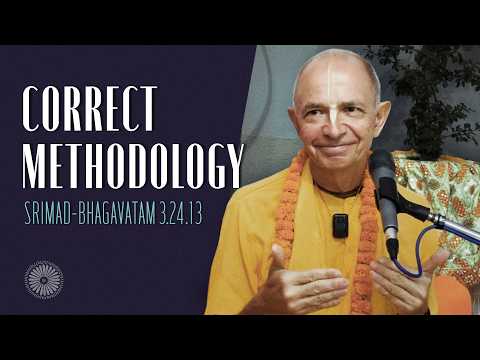
The class titled Bhagavatam Class 4.23 19-39 by Kalakantha Prabhu, hosted by Krishna House Gainesville, turns attention to one of the most concentrated endings in the Fourth Canto of the Śrīmad-Bhāgavatam. These verses complete the account of Mahārāja Pṛthu, a ruler remembered not merely for political strength, but for disciplined retirement, yogic clarity, devotional absorption, and the final dignity of a life offered to Kṛṣṇa consciousness.
The passage under discussion, Śrīmad-Bhāgavatam 4.23.19-39, begins with Queen Arci entering the forest with Pṛthu and ends with a phala-śruti, a statement of the transformative benefits of hearing, chanting, and describing Pṛthu Mahārāja’s life. Its literary movement is striking: it begins with the quiet austerity of a queen walking barefoot into forest life, moves through the mystery of death and spiritual ascent, and closes by inviting every listener into the same path of remembrance.
The wider chapter is necessary for understanding these verses. Pṛthu has already completed the responsibilities of kingship. He has protected the earth, governed with accountability, arranged social welfare, and then deliberately stepped away from power. His retirement is not escapism; it is the classical dharmic movement from public duty toward spiritual concentration. The king who once managed a kingdom now governs the senses, the mind, and the life air with even greater seriousness.
Queen Arci’s entrance into the forest is therefore not a decorative detail. Śrīmad-Bhāgavatam 4.23.19 presents her as a royal woman of delicate upbringing who voluntarily follows her husband into conditions for which palace life had not prepared her. The text emphasizes the contrast between refinement and austerity: the feet that had scarcely touched the earth now accept the forest path. In theological terms, this marks the movement from comfort to consecration.
Śrīmad-Bhāgavatam 4.23.20 deepens that portrait. Arci eats fruits, flowers, and leaves, lies on the ground, and becomes physically thin. Yet the verse states that she does not experience the hardship as misery because her consciousness is absorbed in service. This does not reduce her to passive suffering. Rather, within the narrative logic of the Bhāgavata Purāṇa, her strength lies in voluntary devotion, disciplined companionship, and a spiritual purpose shared with Pṛthu.
A responsible reading must distinguish between scriptural description and modern prescription. The passage belongs to an ancient sacred narrative shaped by ideals of renunciation, fidelity, and spiritual intensity. It should not be used to romanticize coercion, social pressure, or harm. The dharmic principle that remains meaningful is not imitation of external austerity, but the transformation of attachment into service, the honoring of agency, and the recognition that spiritual life must be grounded in sincerity rather than compulsion.
When Arci sees that Pṛthu no longer shows signs of life, she laments briefly and then performs the necessary rites. The brevity of her lament is not emotional coldness. In the Bhāgavata’s spiritual psychology, grief is acknowledged but not allowed to erase knowledge. Mourning appears, but it is placed within a disciplined vision of the soul, the temporary body, and the higher destination of a devotee whose consciousness has been fixed on the lotus feet of the Lord.
The description of Arci entering the funeral fire is among the most sensitive elements in this section. Historically and theologically, the text presents her act as extraordinary and voluntary within a sacred narrative. Ethically, contemporary readers should not treat such an act as a model for practice. The enduring lesson is better understood as total inner dedication, not bodily destruction. The life-affirming core of dharma requires protection, compassion, and spiritual responsibility.
The reaction of the celestial women in verses 23-26 is important. They shower flowers and praise Arci, comparing her service to the way Lakṣmī serves Viṣṇu. This comparison is theological, not merely social. It frames Arci’s devotion as an expression of sacred alignment: her mind, speech, and body are harmonized around a single spiritual intention. In the language of bhakti, such alignment is more powerful than external status.
The upward movement of Arci after Pṛthu is also symbolic of consciousness. The Bhāgavata often uses spatial imagery, ascent, crossing, and reaching a higher planet, to describe liberation from material entanglement. Here, Arci follows Pṛthu not simply as a wife follows a husband, but as devotion follows devotion. Her destination is shaped by shared spiritual absorption, not by biological relation alone.
Verse 27 makes the theological claim explicit: human life is short, but devotional service opens the path back to Godhead. This is a central teaching of the Bhāgavata Purāṇa. The value of life is not measured only by duration, possessions, recognition, or institutional power. Its highest value lies in whether consciousness becomes purified, whether the heart becomes attracted to Kṛṣṇa, and whether one’s actions become part of a liberating discipline.
Verse 28 then offers a sharp critique of fruitive struggle. To gain a rare human birth and spend it entirely on difficult labor for temporary results is described as a form of self-deception. This critique remains psychologically relevant. Modern life often rewards exhaustion, comparison, and constant acquisition, yet leaves the inner person restless. The Bhāgavata does not condemn responsible work; it challenges work that has lost connection with dharma, service, and liberation.
Maitreya’s summary in verse 30 presents Pṛthu as powerful, liberal, magnificent, and magnanimous. These are not ornamental royal virtues. They describe a dharmic leader whose authority is inseparable from character. Pṛthu’s greatness lies in the arc of his whole life: he accepts power, uses it for welfare, relinquishes it at the right time, disciplines the body and mind, and leaves the world in remembrance of Kṛṣṇa.
The technical depth of the chapter is especially clear when these closing verses are read alongside the preceding yogic account. Pṛthu raises the life air through the body, withdraws the elements into their cosmic sources, and dissolves bodily identification through knowledge, renunciation, and devotional strength. This sequence reflects Sāṅkhya and yoga categories, including earth, water, fire, air, sky, senses, mind, ego, and mahat-tattva. Yet the Bhāgavata places these disciplines under the supremacy of bhakti.
That point is crucial. Pṛthu is not presented as a yogī seeking power, nor as a philosopher satisfied with abstraction. Earlier in the chapter, his realization of Paramātmā leads him beyond independent fascination with yoga and jñāna. The final aim is Kṛṣṇa consciousness. In this theological structure, yoga becomes complete when it supports remembrance of the Lord, and knowledge becomes complete when it removes false ego and strengthens devotion.
Verses 31-39 shift from narrative to instruction. The listener is told that hearing, reading, chanting, and describing the life of Pṛthu can elevate consciousness and deepen attraction to the Lord’s lotus feet. This is the Bhāgavata’s pedagogy of sacred memory. A life becomes spiritually useful not only when it is lived well, but when it is remembered well, narrated well, and transmitted in a way that reforms the hearer.
The phala-śruti should not be reduced to a mechanical promise. Its deeper logic is transformative association. To hear about Pṛthu is to associate with his virtues: responsibility, restraint, generosity, surrender, and devotion. Repeated hearing gradually reorders desire. What begins as story becomes contemplation; what begins as contemplation becomes aspiration; and aspiration, when nourished by practice, becomes character.
The blessings described for different social locations in verse 32 reflect the traditional varṇa framework of the text. A brāhmaṇa gains brahminical strength, a kṣatriya gains royal capacity, a vaiśya gains prosperity, and a śūdra becomes an excellent devotee. A contemporary academic reading can recognize the historical social vocabulary while also noticing the larger devotional principle: sacred hearing is not restricted to one class. The narrative is addressed as a public spiritual resource.
Verse 33 makes that inclusiveness even clearer by stating that the benefit of hearing applies regardless of whether one is male or female. Within the devotional frame, access to spiritual advancement is not limited by gender. The heart capable of reverence is eligible for transformation. This point is especially valuable for a dharmic readership committed to unity among Hindu, Buddhist, Jain, and Sikh traditions, because each tradition honors disciplined listening, ethical refinement, and liberation from ego in its own distinctive language.
Verse 34 says that hearing the narration three times brings reputation to the unknown and learning to the uneducated. The literal promise sits within a broader educational vision. Repeated sacred hearing forms memory, vocabulary, discrimination, and moral imagination. In a culture where spiritual knowledge was transmitted orally as well as textually, repetition was not redundancy. It was the method by which wisdom became embodied.
Verse 35 extends the benefits to longevity, prosperity, heavenly elevation, and the counteracting of Kali-yuga contamination. The language is expansive, but its practical insight is clear. Narratives of dharma counteract the fragmentation of the age by giving the mind stable ideals. They remind communities that success without virtue is fragile, knowledge without humility is incomplete, and ritual without devotion becomes thin.
Verse 36 applies the narration to rulers who seek victory. Read narrowly, this may seem political. Read through the life of Pṛthu, it becomes a lesson in legitimate authority. Pṛthu’s rule was powerful because it was aligned with dharma and service. Victory in such a framework is not mere conquest; it is the capacity to govern oneself and others without abandoning accountability to the Supreme and responsibility toward society.
Verse 37 is one of the most practical instructions in the section. Even a pure devotee absorbed in Kṛṣṇa consciousness should continue to hear, read, and encourage others to hear about Pṛthu. Spiritual maturity does not make hearing obsolete. It makes hearing deeper. The same narration that instructs a beginner nourishes an advanced practitioner because sacred texts operate through repeated contact, layered meaning, and continual purification.
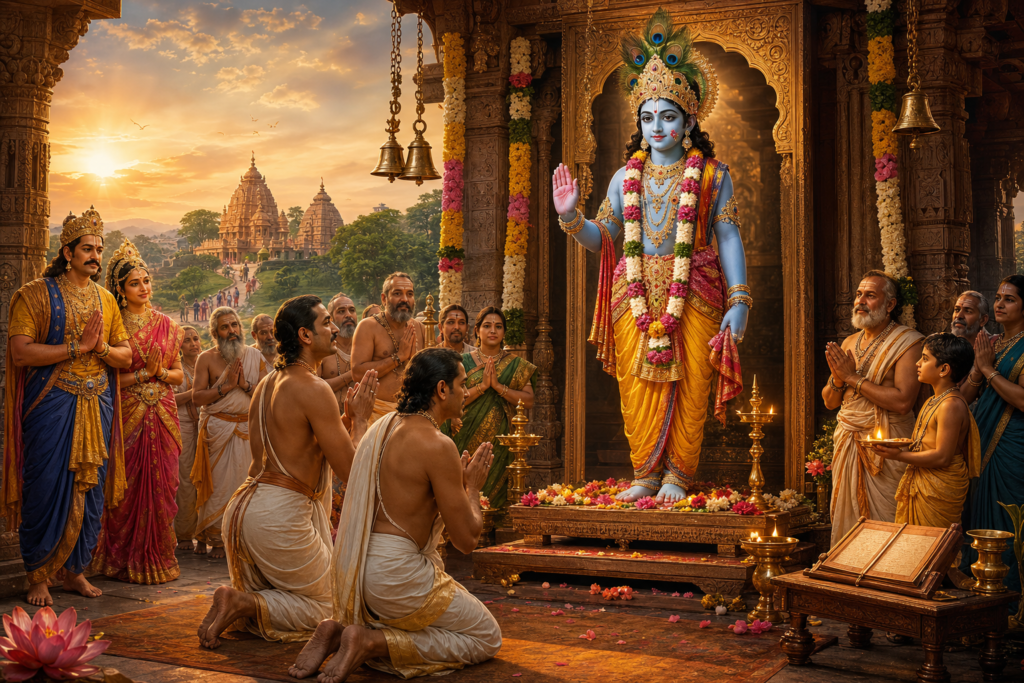
This explains the enduring importance of Bhagavatam classes in communities such as Krishna House Gainesville. A public class is not only an information session. It is a shared act of śravaṇam, attentive hearing, in which text, teacher, and community create an environment for reflection. The value lies not only in learning what happened to Pṛthu and Arci, but in asking what their lives reveal about duty, aging, renunciation, companionship, leadership, and surrender.
The emotional power of this passage lies in its realism about endings. Pṛthu grows old. Public life ends. The body is relinquished. Arci grieves. The community looks back and remembers. These are universal human experiences. The Bhāgavata does not deny them; it places them within a sacred horizon. Death becomes intelligible when life has been directed toward service, and memory becomes healing when it carries spiritual instruction.
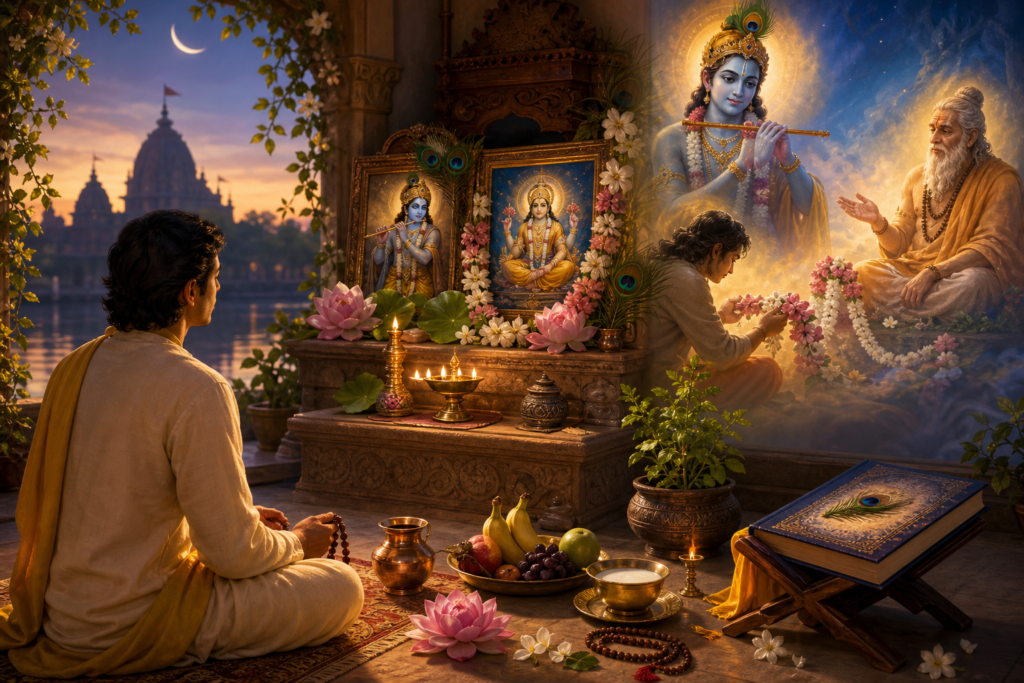
For contemporary readers, the most accessible practice is not severe forest austerity but disciplined remembrance. Hearing the Śrīmad-Bhāgavatam, chanting the names of the Lord, studying with humility, serving others, and reducing unnecessary attachment are practical ways to honor the same current of devotion. The path is not measured by spectacle. It is measured by steadiness, sincerity, compassion, and the gradual softening of the heart.
The passage also invites unity across dharmic traditions. Although its theology is distinctly Vaiṣṇava, its ethical concerns are widely resonant: detachment from ego, disciplined life, reverence for teachers, remembrance of the sacred, compassion in community, and liberation from ignorance. A Hindu, Buddhist, Jain, or Sikh reader may articulate the metaphysics differently, yet still recognize the seriousness with which the text confronts impermanence and calls for a life beyond selfish consumption.
The final verse, Śrīmad-Bhāgavatam 4.23.39, brings the entire section to its devotional conclusion. Regular reading, chanting, and describing Pṛthu’s activities increases firm faith and attraction for the lotus feet of the Lord. Those lotus feet are presented as the boat for crossing the ocean of nescience. This metaphor is central to the Bhāgavata’s spiritual world: the human being is not abandoned in confusion, because sacred sound, saintly example, and divine shelter provide a means of crossing.
Thus, Bhagavatam 4.23.19-39 is not merely the end of a royal biography. It is a compact theology of completion. Pṛthu completes duty through renunciation. Arci completes companionship through devotion. Maitreya completes narration through instruction. The listener completes the circle by hearing with reverence and allowing the story to become a force of inner reformation.
Primary textual reference: Śrīmad-Bhāgavatam, Canto 4, Chapter 23, Mahārāja Pṛthu’s Going Back Home, especially verses 4.23.19 through 4.23.39. Video context: Bhagavatam Class 4.23 19-39 by Kalakantha Prabhu, Krishna House Gainesville.
Inspired by this post on Dandavats.






Leave a Reply
You must be logged in to post a comment.