Tag: Guru-Shishya Tradition

  • Forge Unshakable Students: Aashishta, Balishta, Driddhishta as the Pillars of Mastery

    Forge Unshakable Students: Aashishta, Balishta, Driddhishta as the Pillars of Mastery

    This article distills a timeless triad for student development—Aashishta (complete faith), Balishta (integrated strength), and Driddhishta (stability)—into a practical, research-aligned roadmap. It defines each quality, shows their interdependence, and aligns them with shared values across Hinduism, Buddhism, Jainism, and Sikhism to support unity in diversity. Readers will find implementable school practices: mentorship circles inspired by…

  • HG Daivi Shakti Mataji revives Srila Prabhupada-lilamrita: Devotion, Method, Dharma Unity

    HG Daivi Shakti Mataji revives Srila Prabhupada-lilamrita: Devotion, Method, Dharma Unity

    This Vrindavan-focused analysis of Srila Prabhupada Lilamrita—framed by insights associated with HG Daivi Shakti Mataji—shows how a well-sourced spiritual biography can simultaneously inform scholarship and deepen sadhana. It outlines the text’s historiographical method, balancing documentation with a devotional register rooted in Gaudiya Vaishnava theology. Readers gain clarity on key narrative arcs, from the Jaladuta voyage…

  • Gurmat Sangeet Certification: Master Raags, Shabad Kirtan, and Timeless Sikh Devotional Heritage

    Gurmat Sangeet Certification: Master Raags, Shabad Kirtan, and Timeless Sikh Devotional Heritage

    Gurmat Sangeet is the living Sikh tradition of sacred music, where Shabad is sung within the grammar of raag and taal to cultivate contemplation and ethical action. A well-designed certification program grounds training in the Guru Granth Sahib’s raag-based structure, emphasizing accurate pronunciation (santhiya), faithful use of ਰਹਾਉ (rahāo), and historically aware performance. Learners progress…

  • The Fragrance of Truth: Why Dharmic Spiritual Wisdom Must Never Be Bought or Sold

    The Fragrance of Truth: Why Dharmic Spiritual Wisdom Must Never Be Bought or Sold

    A flower does not sell its fragrance—this classical metaphor explains why authentic spirituality in Hinduism, Buddhism, Jainism, and Sikhism cannot be commodified. Drawing on the Upanishads, the Bhagavad Gita, and core dharmic values such as aparigraha, seva, and anekantavada, this analysis distinguishes stewardship from sale and gratitude from price. It shows how guru–shishya pedagogy, dhamma-dana,…

  • Bond of Love Part II: HG Jagattarini Dasi on Bhakti, Sacred Art, and Dharmic Unity

    Bond of Love Part II: HG Jagattarini Dasi on Bhakti, Sacred Art, and Dharmic Unity

    This archival overview documents Bond of Love Interview Series ~ Part II – HG Jagattarini dasi (Vaishnavi Ministry NA), a live-streamed conversation centered on bhakti, sacred art, and community formation. It analyzes how narrative pedagogy and devotional aesthetics transmit core Hindu spiritual traditions with clarity and depth. By highlighting women in spirituality, the program strengthens…

  • Curiosity as Sacred Practice: How Hinduism Champions Inquiry, Dialogue, and Self-Realization

    Curiosity as Sacred Practice: How Hinduism Champions Inquiry, Dialogue, and Self-Realization

    This article presents a rigorous, accessible account of why Hinduism treats curiosity as a sacred discipline. It traces the spirit of inquiry from the Upanishadic dialogues and Bhagavad Gita to Nyaya logic, Mimamsa hermeneutics, Vedanta inquiry, and Yoga’s epistemology. It explains pramana—valid means of knowledge—and shows how disciplined questioning is bound to ethics, humility, and…

  • Choose Mental Fuel, Not Noise: Dharmic Wisdom to Protect Self‑Respect and Clarity

    Choose Mental Fuel, Not Noise: Dharmic Wisdom to Protect Self‑Respect and Clarity

    This essay presents a rigorous, dharmic framework for curating a nourishing “mental diet” that protects clarity and self‑respect in an age of digital distraction. Drawing on the Upanishads, the Bhagavad Gita, and Yoga Sutra, it explains how sattva, abhyasa–vairagya, and pratyahara translate into concrete media habits. Buddhist thought contributes the four nutriments and wise attention;…

  • The War They Could Not Win: How Dharmic Resilience Defied Empire and Erasure

    The War They Could Not Win: How Dharmic Resilience Defied Empire and Erasure

    This long-form analysis explains why attempts to subdue India’s civilizational core repeatedly failed. It argues that dharmic polycentricity—rooted in Hindu, Buddhist, Jain, and Sikh traditions—produced resilient networks of ethics, learning, and care beyond the reach of central control. Drawing on the Revolt of 1857, British Colonial Rule, and the intellectual countercurrents of Vivekananda and Aurobindo,…

  • Mahaperiyava’s Living Grace: Academic Portrait of the Sage of Kanchi’s Path to Unity

    Mahaperiyava’s Living Grace: Academic Portrait of the Sage of Kanchi’s Path to Unity

    Shri Chandrashekarendra Saraswati Swamigal (Mahaperiyava), the 68th Jagadguru of Kanchi Kamakoti Peetam, exemplified Advaita Vedanta through disciplined practice, inclusive compassion, and service. This academic portrait situates his life within the Shankaracharya Parampara, outlining how padayatra, temple revitalization, and Vedic learning strengthened communities. It clarifies core methods—sadhana-chatuṣṭaya and śravaṇa–manana–nididhyāsana—while showing how bhakti and karma integrate with…

  • Samavartana Unveiled: The Transformative Rite of Return and the Making of a Householder

    Samavartana Unveiled: The Transformative Rite of Return and the Making of a Householder

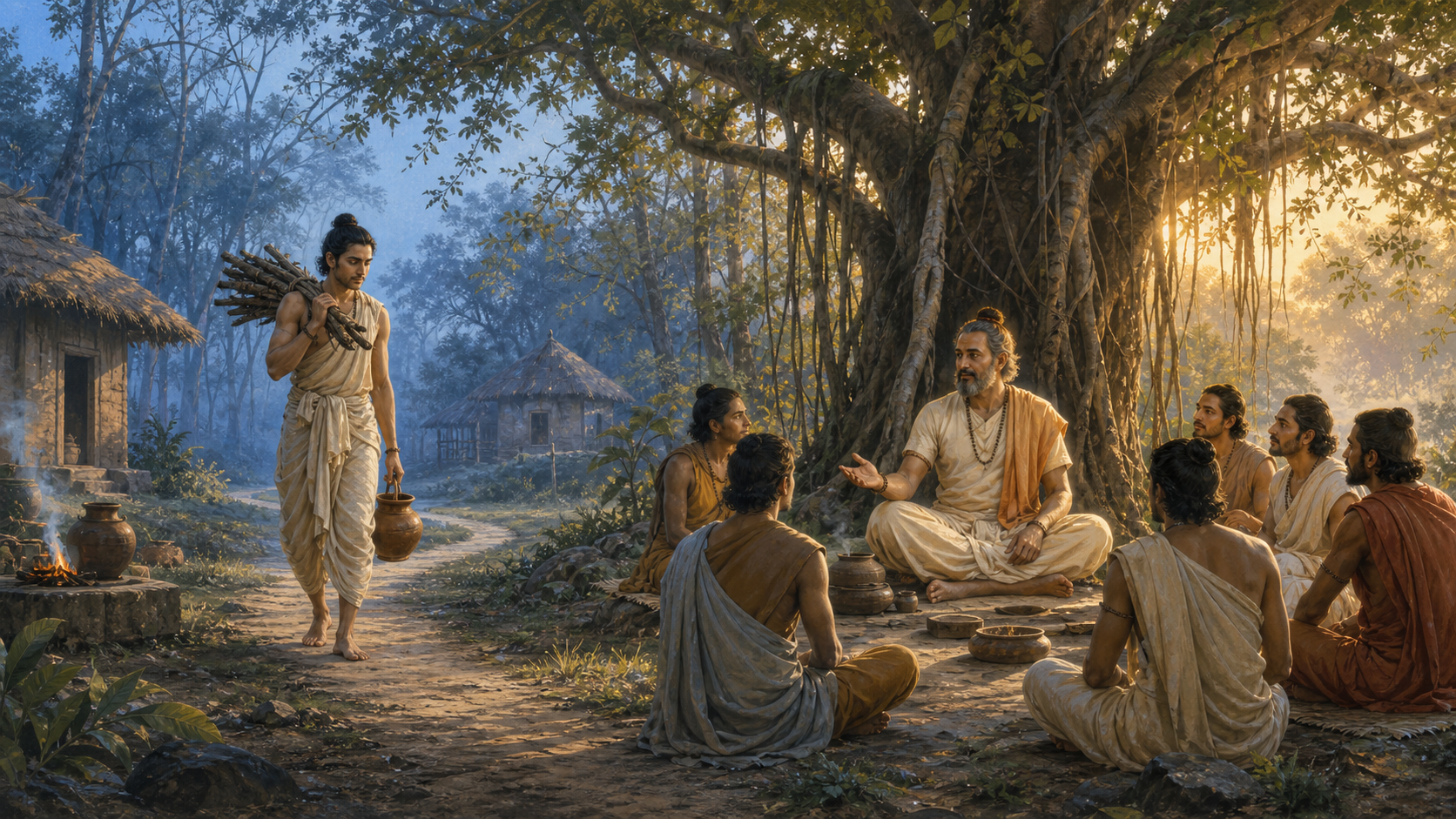
    Samavartana—Hindu Dharma’s rite of return—formally completes Brahmacharya and inaugurates the ethical agency required for Grihastha. Grounded in the Grihya Sutras, Dharmasutras, and the Taittirīya Upaniṣad’s convocation counsel, it transforms private learning into public responsibility through guru-dakṣiṇā, ritual bathing, and vows of truth, duty, and lifelong study. The rite prepares the Snātaka for pañca-mahāyajñas—daily disciplines that…

  • Srila Prabhupada’s 1976 Vrindavan Marathon: Seva, Scholarship, and Global Sankirtana

    Srila Prabhupada’s 1976 Vrindavan Marathon: Seva, Scholarship, and Global Sankirtana

    In 1976 at Vrindavan, Srila Prabhupada’s day began at mangal arotik and ended past midnight with a Mathura pandal program before more than twenty thousand attendees. Eyewitness details—such as the right-hand lesson during a morning walk—reveal how subtle etiquette conveyed dharmic principles. His apology for speaking in Hindi at the pandal highlighted humility and inclusive…

  • Bond of Love with HG Akuti dd: Profound insights on Bhakti, Seva, and Dharmic Unity

    Bond of Love with HG Akuti dd: Profound insights on Bhakti, Seva, and Dharmic Unity

    This in-depth preview examines the Bond of Love Interview Series featuring HG Akuti dd, streamed by Vaishnavi Ministry on July 11, 2025, and situates it within the global evolution of ISKCON’s Bhakti Tradition. The analysis shows how love-centered devotion (prema-bhakti), seva, and the Guru-Shishya Tradition converge to strengthen community resilience in digital settings. Cross-dharmic parallels—maitrī…

  • HH SB Keshava Swami at ISKCON Dallas: Timeless Bhakti-Yoga Wisdom and Dharmic Unity

    HH SB Keshava Swami at ISKCON Dallas: Timeless Bhakti-Yoga Wisdom and Dharmic Unity

    This analysis examines HH SB Keshava Swami’s ISKCON Dallas lecture as a model of rigorous, text-rooted bhakti-yoga tailored for a global audience. It clarifies Gaudiya Vaishnava frameworks such as sambandha–abhideya–prayojana, the nine limbs of devotion, and the acintya-bhedabheda philosophy. Readers gain practical methods to integrate mantra meditation, kirtan, seva, and shastra study into daily life.…

  • Beyond Guru Worship: Living Sanatana Dharma through Practice, Pluralism, and Service

    Beyond Guru Worship: Living Sanatana Dharma through Practice, Pluralism, and Service

    Public celebrations of guru anniversaries have grown spectacular, but the risk of drifting from teachings to personality worship is real. This essay reframes devotion through a Dharmic lens shared by Hinduism, Buddhism, Jainism, and Sikhism: live the message, not the messenger. It maps classical yardsticks of authentic progress—yamas and niyamas, lokasangraha, simran and seva, sīla…

  • HG Daivi Shakti Mataji on Srila Prabhupada Lilamrita: Unveiling a Transformative Gaudiya Legacy

    HG Daivi Shakti Mataji on Srila Prabhupada Lilamrita: Unveiling a Transformative Gaudiya Legacy

    This analysis situates HG Daivi Shakti Mataji’s focus on Srila Prabhupada Lilamrita within a rigorous, source-aware approach to Gaudiya Vaishnavism. It explains how the biography blends archival research, oral histories, and textual study to illuminate Srila Prabhupada’s life, teachings, and institution-building. Readers gain a clear framework for study—triangulating letters, interviews, and BBT records while appreciating…

  • Rishi in Hinduism: Unveiling the Vedic Seer’s Meaning, Power, and Living Relevance

    Rishi in Hinduism: Unveiling the Vedic Seer’s Meaning, Power, and Living Relevance

    This article clarifies what “rishi” means in Hinduism and why the term remains central to Vedic and Upanishadic thought. It explains the rishi as a mantradraṣṭā—seer of the mantra—within the apauruṣeya doctrine of the Vedas, and shows how the rishi–devatā–chandas triad anchors ritual practice. Readers gain a structured understanding of classical classifications (Brahmarṣi, Devarṣi, Rājarṣi,…

  • Hindu Wisdom Beyond Pride: Shattering Ego’s Illusion to Reveal the Sacred in All Creation

    Hindu Wisdom Beyond Pride: Shattering Ego’s Illusion to Reveal the Sacred in All Creation

    This essay examines the illusion of worthlessness through Hindu philosophy and a classic teaching tale, The Search for the Void. It explains how ahaṃkāra (ego) and avidyā (misapprehension) distort judgment, while the Upaniṣadic vision—īśāvāsyam idaṁ sarvam and sarvaṁ khalvidaṁ brahma—reveals intrinsic, relational value. A detailed retelling of the Guru–Śiṣya narrative shows how “void” becomes a…

  • Spiritual Thirst: Building Unshakable, Heartfelt Devotion across Dharmic Traditions

    Spiritual Thirst: Building Unshakable, Heartfelt Devotion across Dharmic Traditions

    Spiritual thirst is the disciplined, whole‑hearted longing for the Divine or ultimate truth, expressed across Hinduism, Buddhism, Jainism, and Sikhism through listening, singing, remembrance, contemplation, and seva. Drawing on Yoga Sutra principles such as tivra samvega and nairantarya abhyase, it emphasizes intensity and unbroken practice over half‑hearted effort. The Varkari saints exemplify steadiness through kirtan,…

  • Decoding the True Guru: Parampara, srotriyam, and brahma-nistham for Dharmic seekers

    Decoding the True Guru: Parampara, srotriyam, and brahma-nistham for Dharmic seekers

    What makes a true guru, and how can seekers discern reliable guidance today? Drawing on the Upanishadic standard of “srotriyam” (lineage-grounded hearing) and “brahma-nistham” (unwavering dedication to the Supreme Truth), this analysis shows why parampara safeguards Vedic wisdom from speculation. It explains how a realized teacher blends scriptural fidelity with lived steadiness, aligning with the…

  • From One Morsel of Mercy to Love of God: SB 1.5.25, Prasadam, and the Science of Bhakti

    From One Morsel of Mercy to Love of God: SB 1.5.25, Prasadam, and the Science of Bhakti

    The discourse on SB 1.5.25 by HG Srutakirti Prabhu at ISKCON France presents a precise, practice-centered account of how honoring prasadam from pure devotees initiates purification and awakens spiritual attraction. Rooted in the Bhagavata Purana and the Bhakti Tradition, the talk maps a concrete act—receiving sanctified food with gratitude—to the classic stages of devotional growth…