

The central question is deceptively simple: what is truly essential in human life, and what merely appears essential because society has learned to admire it? Human beings often pursue intelligence, knowledge, wealth, fame, beauty, influence, and strength as though these possessions were valuable in themselves. Yet a careful ethical and spiritual analysis suggests that many of these prized attainments are not values at all. They are instruments. Like a knife, they can serve healing or harm, nourishment or violence, protection or exploitation. Their moral status depends not on their existence, but on the intention, character, and worldview that guide their use.
This distinction between tools and values is one of the most important lessons in Hindu philosophy and wider dharmic thought. A tool has utility; a value has direction. A tool expands capacity; a value determines purpose. Intelligence can illuminate truth, but it can also rationalize cruelty. Wealth can support education, temples, community service, and social welfare, but it can also deepen vanity and domination. Fame can inspire people toward courage and service, but it can also glorify shallow ambition. Beauty can point the mind toward harmony, but it can also become a commodity that wounds both the viewer and the viewed. Strength can protect the vulnerable, but without dharma it can become oppression.
The problem, therefore, is not that these tools exist. The problem is that modern society frequently mistakes them for the essence of life. Public culture often gives its greatest attention to celebrities, magnates, political actors, intellectual elites, and influencers, not because they necessarily embody wisdom or compassion, but because they visibly possess some combination of wealth, fame, beauty, knowledge, and power. In traditional language, these qualities resemble the opulences associated with Bhagavan: unlimited wealth, strength, fame, knowledge, beauty, and renunciation. The resemblance is psychologically significant. Human beings appear to be drawn toward divine attributes, yet they often chase their fragmented reflections in personalities who may or may not be guided by virtue.
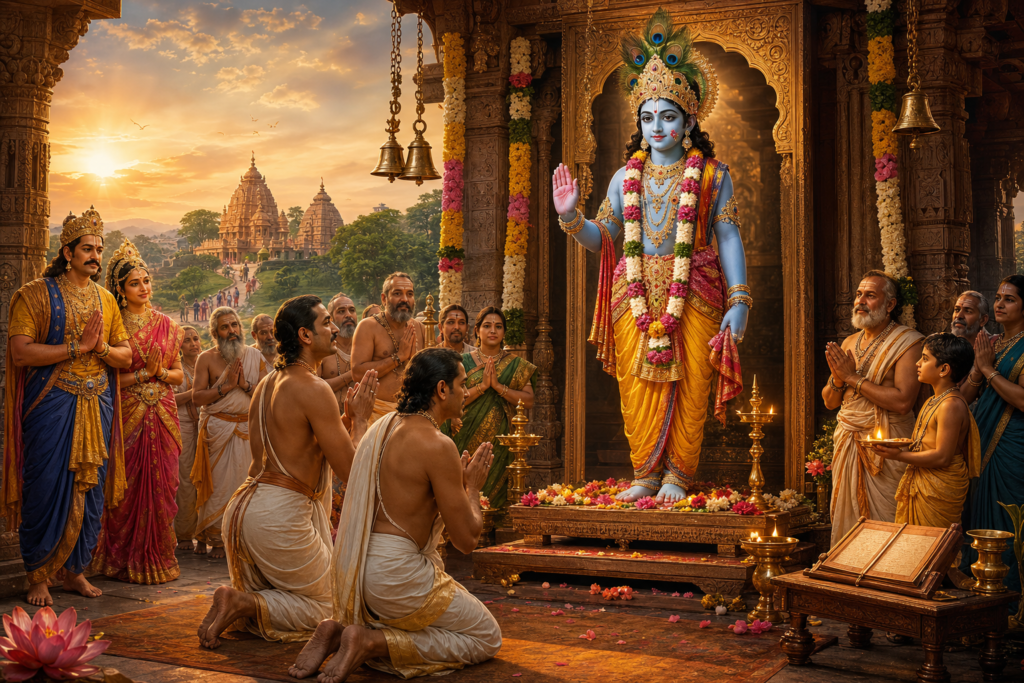
In temples, devotees may wait patiently for darshan of the Lord in deity form. In public life, crowds may wait with similar intensity to glimpse a famous actor, athlete, politician, or public intellectual. The comparison is not meant to equate these experiences spiritually, but to expose a pattern of human longing. People seek radiance, greatness, mastery, and transcendence. When these desires are disconnected from devotion, ethics, and self-knowledge, the longing that should lead toward spiritual refinement may instead become an attachment to spectacle. The heart searches for the infinite, but the senses settle for the glittering finite.
The Bhagavad gita provides a disciplined framework for understanding this confusion. It teaches that human action and consciousness are shaped by the three gunas: sattva, rajas, and tamas. Sattva clarifies, harmonizes, and elevates. Rajas agitates, competes, and binds the mind to restless desire. Tamas obscures, degrades, and pulls consciousness toward inertia, confusion, or harm. These categories are not merely abstract metaphysics; they are practical tools for ethical diagnosis. The same external activity can take on a different moral and spiritual quality depending on the guna that governs it.
Knowledge under sattva becomes a means of truth, humility, and liberation. Knowledge under rajas becomes a means of status, argument, and control. Knowledge under tamas becomes a weapon of distortion, denial, and destructive cleverness. Wealth under sattva supports responsibility, generosity, preservation of culture, and care for all life. Wealth under rajas becomes a display of superiority and appetite. Wealth under tamas funds degradation, addiction, violence, or exploitation. Fame under sattva can amplify noble conduct; under rajas it feeds ego; under tamas it can normalize cruelty and confusion. Thus, the tool is not the essence. The guna that animates it reveals its ethical destination.
This is why the pursuit of tools without values is ultimately incoherent. A nutcracker has purpose only when there are nuts to crack. A keyboard and mouse are meaningful only when connected to a functioning system. Wires and electrical tape matter only in relation to electricity. In the same way, knowledge, beauty, influence, and wealth become meaningful only when connected to higher values such as kindness, empathy, forgiveness, tolerance, truthfulness, humility, reverence for life, and love. Without those values, society manufactures instruments without cultivating the wisdom required to use them.
This insight has deep consequences for education. When education becomes only a system for producing technical competence, competitive advantage, and economic productivity, it may succeed in creating highly capable individuals while failing to cultivate humane persons. Ancient Vedic Education placed heavy emphasis on character, discipline, reverence, self-control, and service before entrusting students with higher knowledge. The point was not anti-intellectualism; it was intellectual responsibility. Knowledge was powerful and therefore morally dangerous when detached from dharma. The student had to become fit for knowledge, not merely informed by it.
Modern education, by contrast, often treats value formation as optional, private, or secondary. Secular public systems may rightly seek fairness among diverse communities, yet the complete removal of sacred and ethical formation can leave a vacuum. In that vacuum, market values, political ideology, celebrity culture, and technological acceleration become the default teachers. Students learn how to compete before they learn why competition must be restrained by compassion. They learn how to acquire information before they learn how to discern wisdom. They learn how to build powerful systems before they learn what kind of human being should be trusted with power.
This does not mean that education must become sectarian or coercive. The broader dharmic concern is not domination by one community over another, but the recovery of ethical seriousness. Hinduism, buddhism, jainism, and sikhism all preserve rich traditions of disciplined conduct, self-examination, compassion, restraint, service, and liberation from ego-centered living. Their metaphysical languages differ, and their practices are diverse, but their civilizational contribution converges around a shared warning: human capacity without moral purification can become dangerous. A society that teaches skill without self-mastery creates cleverness without wisdom.
Religion itself, however, must also be examined through the same lens. Sacred institutions, scriptures, rituals, identities, and communities are meant to help human beings awaken to truth and live in alignment with dharma. Yet religion can also be reduced to a tool. It can be used to preserve ego, justify prejudice, gain power, control others, or create social superiority. When religion is separated from its essence, it no longer functions as a living path of transformation. It becomes a passive instrument in the hands of whatever motive possesses the person using it.
The metaphor of food clarifies the point. Food is life-giving when used according to its proper function, but the same food can become harmful if misused. Similarly, religious teaching is meant to nourish the soul, refine conduct, and orient the person toward the divine. When severed from compassion, humility, and truth, it can be misapplied. The fault does not lie in the existence of sacred teaching, just as the fault does not lie in the existence of food. The danger arises when function is forgotten and ego takes control.
The Bhagavad gita addresses this directly in its seventeenth chapter, where faith, sacrifice, austerity, and charity are analyzed according to sattva, rajas, and tamas. Religion in sattva is steady, sincere, disciplined, and oriented toward purification. Religion in rajas is performed for recognition, prestige, or reward. Religion in tamas is marked by confusion, harshness, coercion, or harm. This classification is intellectually sobering because it prevents simplistic thinking. The mere presence of religious language does not guarantee spiritual authenticity. The quality of consciousness behind the action must be examined.
This principle is crucial for religious harmony and for unity among dharmic traditions. A practice is not purified by identity alone. A label does not make a person compassionate. A ritual does not automatically destroy arrogance. A sacred text does not benefit the reader who approaches it as ammunition rather than guidance. The dharmic measure is transformation: whether conduct becomes more truthful, less selfish, more generous, less violent, more disciplined, and more capable of seeing the sacred presence in all beings.
The question then naturally arises: if religion can be misused, why not discard religion and retain only ethical values? If a person is kind, generous, honest, loving, and open-hearted, is that not sufficient? This question deserves serious attention. The sastra recognizes the purity of goodness in its highest form. The platform of God consciousness is described as suddha sattva, where virtue is not performed for display, advantage, or emotional self-image, but exists in its purified state. Goodness for the sake of goodness is already a noble condition.
Yet the difficulty lies in human limitation. Most people do not fully embody the values they sincerely admire. Youthful idealism often begins with great moral energy, but it can weaken under disappointment, failure, social pressure, ambition, fatigue, and the discovery of one’s own contradictions. A person may wish to be compassionate but grow resentful. One may value humility but still crave admiration. One may speak of universal love while quietly seeking control. The ethical life is demanding because the ego can convert even virtue into self-decoration.
This is where devotion becomes philosophically significant. If the individual sees the self as the independent source of love, empathy, and moral excellence, disappointment is almost inevitable. The person eventually encounters inner poverty and becomes discouraged. But if divine goodness is understood as the source, and the individual self as a limited channel through which that goodness may flow, moral effort becomes less egocentric and more sustainable. Whatever goodness appears is received with gratitude rather than pride. Whatever limitation remains becomes a reason for humility rather than despair.
In this devotional framework, the person does not use religion as a tool for self-magnification. Rather, the person becomes a tool for the active principle of religion: divine love expressed through conduct. Kindness is no longer a performance that proves personal virtue. Tolerance is no longer a badge of superiority. Service is no longer a transaction for recognition. The heart is trained to act because dharma is intrinsically worthy and because the Lord, dwelling in all hearts as witness, is pleased by sincere effort.
The Bhagavad gita’s portrait of the dear devotee in 12.13-20 is therefore not merely devotional poetry; it is an ethical psychology. The one dear to Krishna is non-envious, friendly, compassionate, free from possessiveness and false ego, equipoised in happiness and distress, forgiving, self-controlled, and steady in devotion. These qualities are not ornamental. They are the living substance of religion. They reveal whether spiritual practice has entered the character or remains only on the tongue, in the costume, in the institution, or in the argument.
This also reframes renunciation. Renunciation is not merely the absence of possessions or the rejection of worldly roles. It is the refusal to let tools become idols. Wealth may remain, but it is held as stewardship. Knowledge may expand, but it is held with humility. Influence may arise, but it is used for protection and upliftment. Beauty may be appreciated, but not commodified. Strength may be cultivated, but not weaponized against the weak. The essential act of renunciation is to place every capacity in the service of dharma rather than ego.
In social terms, this distinction can renew public life. Politics without values becomes manipulation. Economics without values becomes extraction. Technology without values becomes domination or distraction. Education without values becomes credentialism. Religion without values becomes identity management. Even activism without values can become rage seeking moral language. The question is not whether society should have tools, institutions, and systems; it must have them. The question is whether they are animated by sattva, inflamed by rajas, or clouded by tamas.
A dharmic society does not reject intelligence, wealth, beauty, fame, or strength. It orders them. It asks knowledge to serve truth, wealth to serve welfare, beauty to serve refinement, fame to serve responsibility, and strength to serve protection. It understands that the highest use of power is not self-display but guardianship. It understands that the highest use of learning is not superiority but illumination. It understands that the highest use of religion is not boundary-making for ego, but inner transformation and reverence toward all life.
The unity of Hinduism, buddhism, jainism, and sikhism becomes especially meaningful at this point. Each tradition offers its own vocabulary for disciplining desire, reducing ego, cultivating compassion, and aligning life with a higher reality. Hindu dharma speaks through Bhagavad Gita, bhakti, karma, jnana, and yoga. Buddhist traditions emphasize awakening from craving and ignorance. Jainism gives extraordinary emphasis to ahimsa and restraint. Sikhism centers devotion, seva, equality, courage, and remembrance of the Divine. Their differences should not obscure their shared insistence that the human being must be ethically transformed.
The contemporary crisis is thus not a shortage of tools. It is a shortage of purified aims. Humanity has unprecedented technical ability, institutional scale, communication power, and material production. Yet anxiety, loneliness, ecological strain, social distrust, ideological aggression, and spiritual confusion continue to grow. This paradox confirms the old diagnosis: tools cannot provide meaning by themselves. The more powerful the tool, the more dangerous it becomes when detached from wisdom. The more advanced the civilization, the more urgent its need for values.
The essential, then, is not the glitter of capacity but the character of its use. Intelligence is essential only when directed toward truth. Wealth is essential only when governed by responsibility. Fame is essential only when it amplifies noble conduct. Strength is essential only when restrained by compassion. Beauty is essential only when it elevates rather than consumes. Religion is essential only when it remains connected to its life-giving essence: devotion, humility, self-discipline, truthfulness, and love for all beings as belonging to the Divine.
When religion is consciously offered to the Lord, it is restored to its proper function. It no longer exists as social ornament, ideological weapon, inherited label, or psychological compensation. It becomes a path by which the human being is refined from self-centeredness toward service. In that purified condition, religion is not another neutral tool among many. It becomes the living channel through which values are anchored, protected, and embodied. The tool is reunited with its purpose, and the purpose is reunited with its source.
The practical conclusion is demanding but clear. A person should not ask only what can be acquired, displayed, mastered, or controlled. The deeper question is what those acquisitions will serve. Every gift, whether intellectual, social, artistic, financial, physical, or spiritual, must be examined in the light of dharma. If it serves ego, it binds. If it serves harm, it degrades. If it serves truth, compassion, and devotion, it becomes sanctified. What is essential, finally, is not possession but orientation: the turning of all human capacity toward the well-being, awakening, and upliftment of life.
Inspired by this post on Dandavats.


Leave a Reply
You must be logged in to post a comment.