
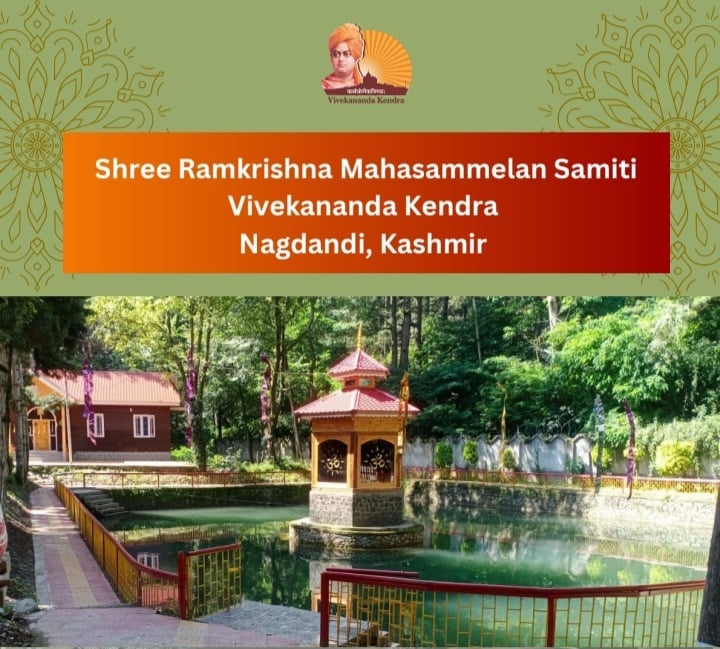
About two kilometres from the celebrated Achabal Mughal Garden in Anantnag district, and approximately 70 kilometres by road from Srinagar, Vivekananda Kendra Nagdandi occupies a distinctive place in the cultural geography of Jammu and Kashmir. Set near the forest edge, the complex is at once an ashram, a spiritual retreat, a centre of cultural memory, a residential campus, a platform for social service and a demonstration site for modern horticulture. Its history shows how a secluded spiritual discipline can gradually acquire an enduring public purpose.
Why Nagdandi matters. Nagdandi is significant not simply because buildings, festivals and programmes have accumulated there. Its deeper importance lies in institutional continuity. A small hermitage survived the death of its founder, changes in management, decades of political violence, the displacement of much of the community that had sustained it, and the practical difficulties of operating a residential centre in Kashmir. That survival transformed the site into a case study in spiritual leadership, community stewardship, cultural preservation and national integration.
A spiritual itinerary before an institution. Swami Ashokananda was born Deenabandhu Mukherjee. According to the received account, he entered the spiritual order under Shrimad Swami Sachitananda ji, identified as a direct disciple of Mata Sharda. This lineage connected his later work in Kashmir with the Ramakrishna spiritual tradition of Bengal, but his institution would eventually develop a regional character shaped by Kashmir’s landscape, communities and religious calendar.
Swami Ashokananda arrived in Kashmir in 1932 and initially stayed at Kathleshwar Mandir in Srinagar’s Tankipora area, on the banks of the Vitasta (Jehlum). His presence attracted a circle of devotees rather than a formal organisation. Men and women associated with the Ogra, Katjoo, Dhar and Tarozdar families were among those remembered as early followers. Their participation is historically important because religious institutions are rarely built by solitary teachers alone; they become durable when personal devotion develops into a network capable of preserving memory, land and responsibility.
In 1934, Swami Ashokananda moved to Nandkeshwar temple at Sumbal. After approximately five years there, he undertook a Yatra to the Krishenganga region near Teetwal. The narrative describes two years of seclusion in woodland beside the Krishenganga river. This period established the contemplative foundation of the work that followed. Nagdandi did not begin as a conference centre or a planned service campus; it emerged from a disciplined life of movement, solitude, meditation and sustained contact with devotees.
The account supplied for this history dates Swami Ashokananda’s appearance in the Achabal area to 1941. In wooded hills near the settlement, he is said to have constructed three mud huts: one for residence, one for cooking and one for meditation. The separation of these functions reveals the simplicity of the original design. Shelter, food and spiritual practice formed the complete institutional programme. The name Nagdandi gradually became attached to the hermitage and then to the expanding ashram.
A chronology that requires scholarly care. The historical record available online is not completely uniform. The supplied narrative gives 1941 as the establishment year, whereas the current institutional history of Shri Ramkrishna Mahasammelan Ashram and a Vivekananda Kendra report use 1937. The difference could reflect separate stages in Swami Ashokananda’s arrival, occupation of the land and formal organisation, but no primary deed or contemporaneous diary examined for this study resolves it. An academic account should therefore preserve the discrepancy instead of silently selecting one date.
Nag-Panchami has long been observed as the ‘sthapana-divas’ of the ashram. This annual observance performs more than a ritual function. A foundation festival renews institutional memory by linking present participants with the austere beginnings of the three mud huts. It converts history into a recurring community practice and allows each generation to understand that the present campus is the outcome of accumulated service rather than a single construction project.
As news of the hermitage spread, residents of nearby areas and visitors from other parts of the Kashmir Valley began meeting Swami Ashokananda. A.K. Ogra, Barrister Narendrajit Singh and his wife Sushila, Dr. Karan Singh and Dr. Shivji are remembered among the frequent visitors. Such names help reconstruct the social world around the ashram, although a complete institutional history would also need correspondence, visitor registers, photographs and oral testimony from less publicly visible participants, including women, workers and neighbouring residents.
Land, community patronage and formal organisation. Swami Ashokananda eventually expressed the need to expand the ashram. Supporters from Achabal, Anantnag and Srinagar responded by transferring land near the hermitage. The Katjoo family is also associated with a land contribution in the Chatragul area of Kangan in Ganderbal. These acts changed Nagdandi’s institutional possibilities: donated land could support worship, accommodation, orchards, utilities, gatherings and future construction in ways that the first three huts could not.
The institutional account describes a holding of roughly 100 kanals. The conversion deserves correction because it has sometimes been rendered as approximately 12 hectares. A Jammu and Kashmir government land-reform reference equates 100 kanals with 12.5 standard acres, which is approximately 5.06 hectares. A 2024 field report separately referred to 87 kanals at the Nagdandi site. The figures may describe different parcels or different stages of demarcation, but the underlying revenue records would be required to determine the exact area and ownership history.
With expansion came formalisation. Shree Ramkrishna Mahasammelan Samiti was created, and the ashram was dedicated to the new entity. Contemporary institutional material commonly uses the name Shri Ramakrishna Mahasammelan Ashram–Vivekananda Kendra, abbreviated as SRMA-VK, although spellings and abbreviations vary across older accounts. The supplied narrative states that property records stand in the institution’s name rather than personally in the name of Sri Ramakrishna Paramhans. Because the underlying land registers were not available for independent inspection, that statement is best treated as an institutional account rather than a substitute for a certified title search.
The transition from Swami Ashokananda to Eknath Ranade. During the 1960s, Swami Ashokananda came into contact with Eknath Ranade, the principal organiser behind the Vivekananda Rock Memorial. Ranade had earlier served as general secretary of the Rashtriya Swayamsevak Sangh and became organising secretary of the memorial committee in 1963. The distinction is chronologically important: the official chronology of Eknath Ranade records that Vivekananda Kendra itself was founded in 1972, so references to him as its leader during the 1960s apply a later designation retrospectively.
Swami Ashokananda reportedly executed a ‘Will’ in 1970. The inherited narrative says that it first contemplated transferring full management responsibility to Ramakrishna Ashram, Belur Math, with Eknath Ranade as an alternative. It further states that Belur Math did not assume management and that Ranade proceeded with the consent of close devotees and disciples. The institutional website dates the ashram’s association with the Kanyakumari organisation to 6 October 1970, even though Vivekananda Kendra was formally founded in 1972. This may indicate an initial relationship with the Vivekananda Rock Memorial organisation, followed by later incorporation into the Kendra’s structure, but the ‘Will’, resolutions and correspondence should be studied before drawing a definitive legal conclusion.
Swami Ashokananda attained ‘nirvana’ in 1971. His devotees constructed a ‘samadhi’ within the ashram grounds, giving the founder a permanent presence in the landscape he had cultivated. A succession crisis can weaken an institution built around one spiritual personality. Nagdandi avoided that outcome by combining reverence for its founder with a new organisational framework capable of managing land, programmes, volunteers and construction.
Adv. P.N. Bhat of Anantnag became one of the decisive figures in that transition. He contributed time, money, professional ability and sustained personal commitment under Ranade’s guidance. His role demonstrates a recurring feature of successful voluntary institutions: visionary leadership becomes operational only when local stewards translate broad ideals into documents, construction decisions, financial discipline and daily supervision.
Ranade viewed Nagdandi as a cultural bridge between Kashmir and Kanyakumari. The formulation was geographical, but its meaning was institutional. It linked two distant ends of India through travel, residential programmes, shared study and service. After Ranade’s death in 1982, Vivekananda Kendra continued developing the project. The resulting centre became a living expression of his belief that a memorial should not remain inert stone; it should generate disciplined human activity.
Integration without cultural uniformity. National integration is most durable when it permits regional traditions to remain visible. At Nagdandi, the Kashmir-to-Kanyakumari connection need not imply that local history should be absorbed into a generic national culture. Navreh, the memory of Vitasta (Jehlum), Kashmiri pilgrimage networks and the experience of displacement give the centre a specifically Kashmiri character. Participants arriving from other states encounter that regional inheritance, while Kashmiri participants gain access to a wider network of service and exchange.
The ashram is rooted primarily in the Ramakrishna-Vivekananda stream of Sanatana Dharma. Its integrative principle, however, can be understood in a wider Dharmic setting without reducing distinct traditions to sameness. Hindu, Buddhist, Jain and Sikh traditions possess different scriptures, institutions, metaphysical positions and disciplines, yet they can meet through shared commitments to ethical self-cultivation, compassion, seva, restraint, truth-seeking and human dignity. This approach supports dialogue while respecting doctrinal difference. It also aligns spiritual continuity with peaceful cooperation among people of every faith.
A recollection from July 1974 captures the human scale of Ranade’s work. During a Kashmir tour, he accompanied a college student and young activist from Srinagar to Nagdandi. The visitor was struck by the ashram’s setting and by the construction taking place under Ranade’s supervision, and met Adv. P.N. Bhat there for the first time. Such encounters matter because institutional commitment often begins before a person holds any formal office: a journey, a landscape and a meeting can make an abstract mission emotionally tangible.
Conflict, displacement and institutional survival. Nagdandi entered its most precarious period during 1989–90, when targeted killings, militant violence, threats and fear precipitated the mass displacement of Kashmiri Hindus from the Valley. The community that had supplied many devotees, administrators and supporters was suddenly dispersed. The ashram faced not only a security threat but also an institutional vacuum: property, worship, maintenance and records still required attention when the ordinary base of participation had been severely disrupted.
The management responded through vigilance, coordination with the civil administration and assistance from security forces. Institutional accounts state that these measures protected the premises from major loss. Vivekananda Kendra had posted full-time volunteers at Nagdandi from the 1970s and continued maintaining a presence during the difficult years between 1990 and 2010. Datta Ram, Kalyan and Vivek are particularly remembered in this context. Their contribution consisted in continuity itself: remaining present, maintaining essential functions and preventing abandonment from becoming irreversible.
This history requires precise language. Responsibility belongs to the militant organisations, ideologues and individuals that carried out or enabled violence; it should not be transferred indiscriminately to an entire religious community. Remembering the suffering and displacement of Kashmiri Hindus is compatible with building principled intercommunity relations. Indeed, a 2024 field report described Nagdandi’s work with local Muslim farmers and recorded an aspiration to restore harmonious Hindu-Muslim-Sikh relations. Historical accountability and peaceful coexistence are complementary when neither is used to erase the other.
In 2010, Vivekananda Kendra shifted from the earlier full-time-volunteer arrangement to an Administrative Committee chaired by a person with roots in Kashmir. Brij Lal Bhat, a retired senior officer of the Jammu and Kashmir government with a longstanding association with both the ashram and the Kendra, was appointed Chairman, or Prakalp-Pramukh. The change introduced a locally anchored governance structure while preserving organisational affiliation with Vivekananda Kendra, Kanyakumari.
Brij Lal Bhat and the meeting of technical knowledge with social service. Bhat’s public-service background was particularly relevant to Nagdandi. The Government of India’s Padma Awards 2026 citation booklet records that he was born in Anantnag in 1945, completed postgraduate study in horticulture and undertook specialised training in marketing and refrigeration at Washington State University. His government responsibilities included agricultural export zones, horticulture planning and marketing, externally assisted projects, produce markets, packaging, cold-chain development and propagation methods for fruit and nut crops.
That experience helps explain why Nagdandi’s later development combined religious and cultural activity with orcharding, infrastructure and administrative planning. The connection is not incidental. A residential ashram requires food systems, water, sanitation, transport, maintenance, land management, risk controls and a stable operating model. Technical competence allows spiritual intention to become reliable service rather than remaining dependent on occasional enthusiasm.
Over the following decade and a half, the Administrative Committee expanded activities, renovated buildings and strengthened the centre’s capacity to host programmes. Its work also preserved continuity with Swami Ashokananda, Eknath Ranade and earlier devotees. This balance between inherited purpose and adaptive management is central to Nagdandi’s resilience: legacy defines why the institution exists, while administration determines whether that legacy can remain functional.
A ritual calendar that carries cultural memory. The ashram’s annual programme includes Pooja Archana & Traditional festivals, Navreh (New Year Day), Durga Ashtami, Ram Navami, Nagpanchami and observances connected with Mata Kheer Bhawani Mela. Vivekananda Kendra reports also mention Universal Brotherhood Day and National Youth Day. Together, these events create a calendar of return. For displaced families in particular, a recurring festival can reconnect memory, place, language, food, worship and intergenerational identity.
The Mata Kheer Bhawani observance illustrates how worship and service reinforce one another. In June 2024, the ashram’s branch organised its 26th annual Bhandara service at Tulmulla and at the Central University of Kashmir premises in Ganderbal. Meals and refreshments were provided to pilgrims so that practical needs did not obstruct religious participation. The service also created a disciplined setting in which volunteers could practise hospitality, coordination, food safety and collective responsibility.
Yoga forms another major strand of the programme. All India Yoga Shivir, International Yoga Day, spiritual retreats and regular Yoga Varga activities are designed around a wider understanding of Yoga than physical exercise alone. The Kendra’s model connects Yogabhyas, Pranayam, meditation, study, group reflection and Shram-Samskar. This structure treats the body, intellect, emotions and social responsibility as related dimensions of personality development.
A Vivekananda Kendra report records that a ten-day योग शिक्षा शिविर – नागदंडी काश्मीर held from 25 June to 4 July 2024 brought together 46 participants from Jammu and Kashmir, Delhi, Maharashtra, Gujarat, Andhra Pradesh, Karnataka and Tamil Nadu. The residential format is important: participants do not merely attend a lecture and depart. Shared routines, meals, study, physical discipline and service create sustained interpersonal contact across regional boundaries.
The programme portfolio also includes personality-development camps for children, health-care and sanitation activity, an ‘ashray’ function for young people and those in acute need, and outreach among displaced Kashmiris in Jagti Township. Activities have additionally involved employees appointed in the Valley under the Prime Minister’s employment package and their children. These initiatives address a less visible consequence of displacement: cultural return requires social confidence, community networks and safe places to gather, not merely physical access to ancestral locations.
Infrastructure as the material basis of continuity. Nagdandi’s buildings support programmes conducted daily, monthly, seasonally and annually. The supplied account lists Vivekananda Bhawan, an administrative block, two dormitories and first-floor space intended for library use. It gives the hall an area of approximately 3,500 square feet, while an independent 2024 report describes about 4,000 square feet. Architectural drawings or completion records would be needed to reconcile whether the figures measure the hall alone or a larger built component.
A Shree Ramakrishna temple of approximately 1,400 square feet replaced an older damaged structure. The development was followed by the Pran Pratishta of Thakur Sri Ramakrishna Paramahansa’s Vigraha on 2 May 2025. According to Vivekananda Kendra’s report of the ceremony, the observance included Panch Sahakar Havan, Purnāhuti and installation conducted according to the Sri Ramakrishna Paddhati, with monks from several Ramakrishna Mission centres participating.
Other facilities illustrate adaptive reuse. ‘Sanatan Samiksha Bhawan Hut’, described as a multipurpose space of roughly 900 square feet, was opened for participants. ‘Eknath Bhawan’ emerged from the major renovation of an abandoned building formerly used for paddy grass, scrap and storage. It provided 24 beds and four lavatory points. Swami Ashokananda Bhawan received renovation, while the Vivekananda Memorial and adjoining lawn created a visual focus for the mission of ‘man-making & nation-building’.
Accommodation figures reflect continuing development. The supplied account records capacity for approximately 100 pilgrims. The official 2026 Padma citation states that capacity increased from 12 people to around 150 and refers to ₹8.85 crore in heritage-development support intended to raise future capacity to about 400. These numbers should not be merged: one describes an earlier operating level, another a later reported level and the largest a planned capacity. Distinguishing completed, commissioned and proposed infrastructure is essential to transparent reporting.
Buildings alone do not constitute residential capacity. Reliable occupancy depends on potable water, power, wastewater disposal, lavatory ratios, bathing facilities, fire safety, winterisation, accessibility, waste management, kitchen throughput, transport and trained supervision. At a forest-edge site exposed to snow and seasonal travel constraints, preventive maintenance is especially important. A technically mature infrastructure plan would therefore publish not only bed counts but also utility capacity, inspection schedules, emergency routes and programme-specific occupancy limits.
Horticulture as applied seva. High-density apple and walnut orchards are among Nagdandi’s most distinctive projects. They are intended both to generate institutional income and to function as demonstration blocks for the surrounding farming community. This model extends the meaning of service: agricultural knowledge is placed on visible land where cultivators can examine techniques, compare plant performance and evaluate whether less productive parcels can support higher-value crops.
High-density orcharding is a production system rather than merely a larger number of trees. Its performance depends on cultivar and rootstock selection, spacing, canopy architecture, support systems, irrigation, nutrient delivery, pollination, pruning, disease management, labour availability, expected bearing age and market access. The system may produce earlier and more uniform harvests, but it can also require greater establishment capital, technical supervision and dependable water. A demonstration orchard is most useful when these trade-offs are documented rather than presented only through successful harvests.
An independent field report published in 2024 described local Muslim farmers visiting the ashram to study its apple and walnut cultivation. That interaction gives the orchards a social value beyond their yield. Knowledge exchange around a shared rural economy can create practical cooperation across community boundaries. The same report referred to early-bearing walnut material, although cultivar details and comparative trial data would be necessary before its performance could be assessed agronomically.
From a technical perspective, the demonstration blocks would benefit from annual reporting of tree survival, yield per hectare, grade distribution, water use, input cost, labour days, pest incidence, post-harvest loss and net return. Training outcomes could be measured through farmer visits, repeat consultations, adoption on neighbouring land and changes in productivity. Such indicators would convert an attractive orchard into a replicable extension model and help distinguish ecological sustainability from financial self-reliance.
A repeatable operating model. Nagdandi’s programme calendar can be understood at four levels. Daily activity sustains worship, maintenance, study and hospitality. Monthly or periodic classes support Yoga Varga, Swadhyaya Varga, Samskar Varga and Kendra Varga. Seasonal programmes respond to the agricultural cycle, pilgrimage calendar and weather. Annual festivals, retreats and residential camps bring together larger groups and renew connections with people living outside Kashmir.
A useful evaluation framework would separate inputs, activities, outputs and outcomes. Land, buildings, volunteers, finances and partnerships are inputs. Camps, worship, meals, orchard demonstrations and youth sessions are activities. Participants, residential nights, meals served, classes held and farmers trained are outputs. Stronger cultural confidence, healthier habits, improved agricultural practice, renewed interregional relationships and more resilient community institutions are intended outcomes. The distinction prevents a busy calendar from being mistaken automatically for long-term impact.
The centre’s implicit theory of change is nevertheless coherent. A safe and well-maintained place enables people to gather. Repeated gathering supports trust and disciplined learning. Shared worship, Yoga, study, service and work deepen relationships. Those relationships allow displaced families to reconnect with Kashmir, visitors from other states to understand the Valley more closely, and neighbouring residents to cooperate on practical concerns. In this model, national integration grows through sustained human contact rather than ceremonial language alone.
Research, archives and institutional accountability. Nagdandi’s history now spans nearly nine decades under either of the published founding chronologies. The most urgent heritage task is therefore not another commemorative claim but a professionally organised archive. The founder’s ‘Will’, land deeds, demarcation records, committee resolutions, correspondence with Belur Math and Eknath Ranade, photographs, architectural plans, programme registers and oral histories should be catalogued, digitised and preserved with appropriate access controls.
Archival discipline would help resolve the differing establishment dates, the 87- and 100-kanal descriptions, the changing institutional names and the precise sequence of management transfer. It would also broaden the historical record beyond prominent office-holders. Testimony from volunteers, cooks, gardeners, neighbouring farmers, women participants, security personnel and displaced families could reveal how the institution actually survived and functioned during periods when formal reports were sparse.
Operational resilience requires equally serious safeguards. Residential programmes for children need documented child-protection procedures and trained supervisors. Kitchens and sanitation systems need public-health standards. Construction near forest land requires fire planning and ecological sensitivity. Financial reporting should distinguish restricted project funds from routine expenditure, while governance documents should define authority, succession and conflict-of-interest rules. These practices do not diminish spiritual trust; they protect it.
The 2026 Padma Shri and its proper context. On 23 June 2026, President Droupadi Murmu conferred the Padma Shri on Brij Lal Bhat during the second Civil Investiture Ceremony at Rashtrapati Bhavan. The official field of recognition was Social Work. The government citation highlights his efforts to promote peace and harmony, his earlier contribution to Jammu and Kashmir’s horticulture sector, his leadership at SRMA-VK Nagdandi, youth integration, orchard demonstration blocks and infrastructure development.
The distinction is an individual national honour, not a blanket certification of every institutional claim. Its significance lies in the combination of public administration, horticultural modernisation and post-retirement community service represented by Bhat’s career. For Nagdandi, the award brings national attention to work that developed through many contributors across several generations. The most constructive response is therefore to recognise Bhat’s leadership while also remembering Swami Ashokananda, Eknath Ranade, Adv. P.N. Bhat, the full-time volunteers, local committees and communities that sustained the centre.
Why the mission endures. Nagdandi has survived because it performs three functions simultaneously. It protects memory through worship, festivals, the ‘samadhi’ and continued association with Kashmir. It provides service through accommodation, food, Yoga, youth activity, sanitation and agricultural demonstration. It builds relationships through residential contact among participants from different regions and through cooperation with neighbouring communities. If any one of these functions were isolated, the institution would be weaker.
For a visitor, the emotional force of Nagdandi lies in the contrast between origins and present scale. Three mud huts once separated residence, cooking and meditation; the contemporary campus contains a temple, halls, dormitories, renovated buildings, orchards and memorial spaces. Yet the most important continuity is not architectural. It is the continued attempt to join inner discipline with public responsibility—to make contemplation productive of service and cultural belonging productive of cooperation.
Nagdandi’s future credibility will depend on how carefully it preserves that balance. Growth should remain proportionate to water, sanitation, ecology and management capacity. Cultural renewal should honour the experience of displaced Kashmiri Hindus without encouraging collective hostility. National integration should deepen regional understanding rather than flatten difference. Spiritual authority should be supported by archival evidence, transparent governance and measurable service outcomes.
Understood in this way, Vivekananda Kendra Nagdandi is more than a monument to a founder or an outpost of a national organisation. It is a living experiment in resilience. Its long passage from woodland seclusion to structured social service demonstrates how vision becomes durable only through land stewardship, disciplined volunteers, technical expertise, community participation and ethical memory. That combination makes Nagdandi a mission and a vision in action—and a valuable model for cultural institutions seeking to serve both heritage and humanity.
Research note. This synthesis distinguishes between the supplied source narrative, Vivekananda Kendra’s institutional reports, an independent 2024 field report, Jammu and Kashmir government material and the Government of India’s 2026 Padma citation. Dates, land areas, building sizes and accommodation figures have been qualified where those sources differ. Primary deeds, the reported 1970 ‘Will’ and contemporaneous management resolutions remain necessary for a definitive legal and chronological history.
Inspired by this post on Hindu Post.





Leave a Reply
You must be logged in to post a comment.