
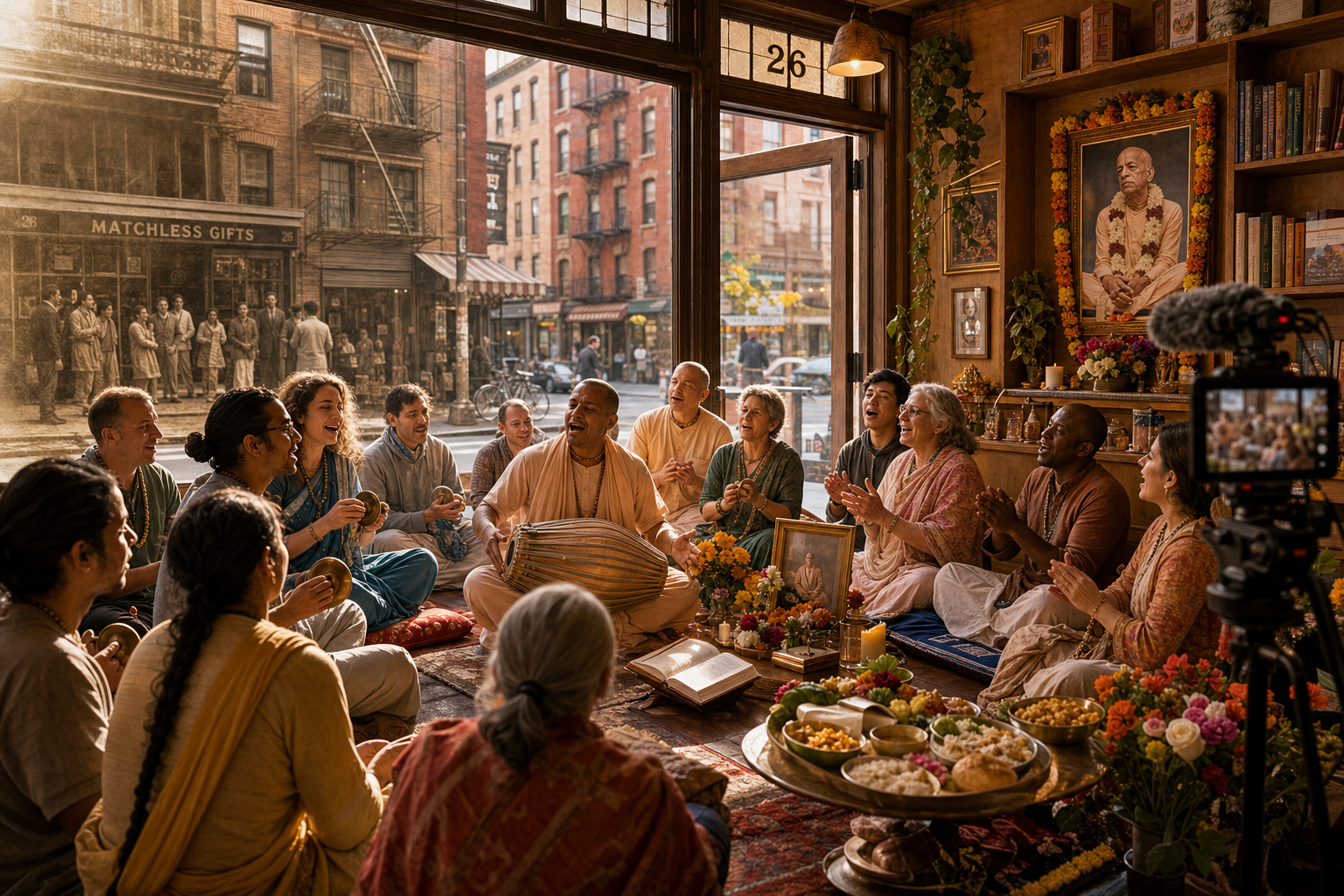
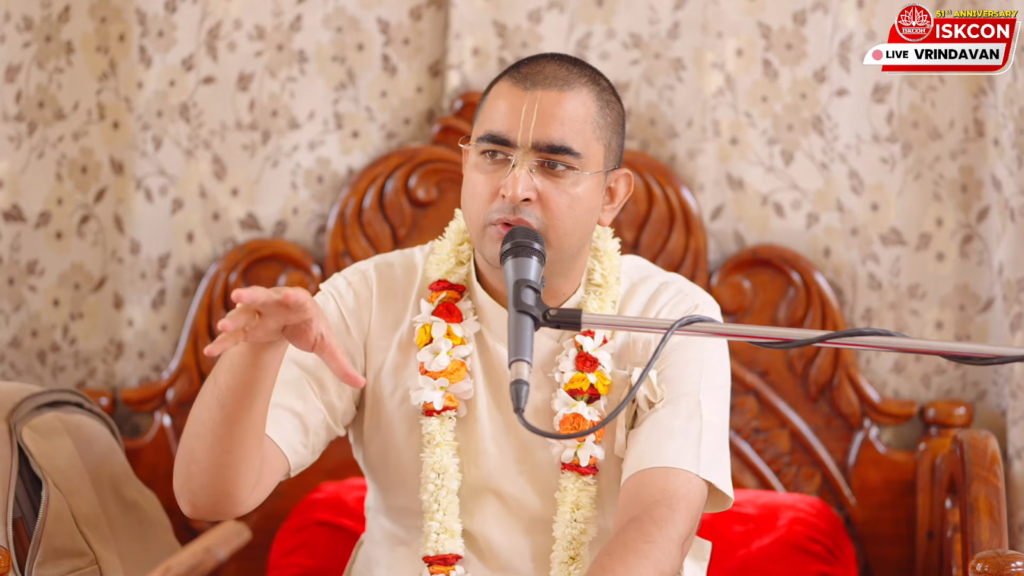
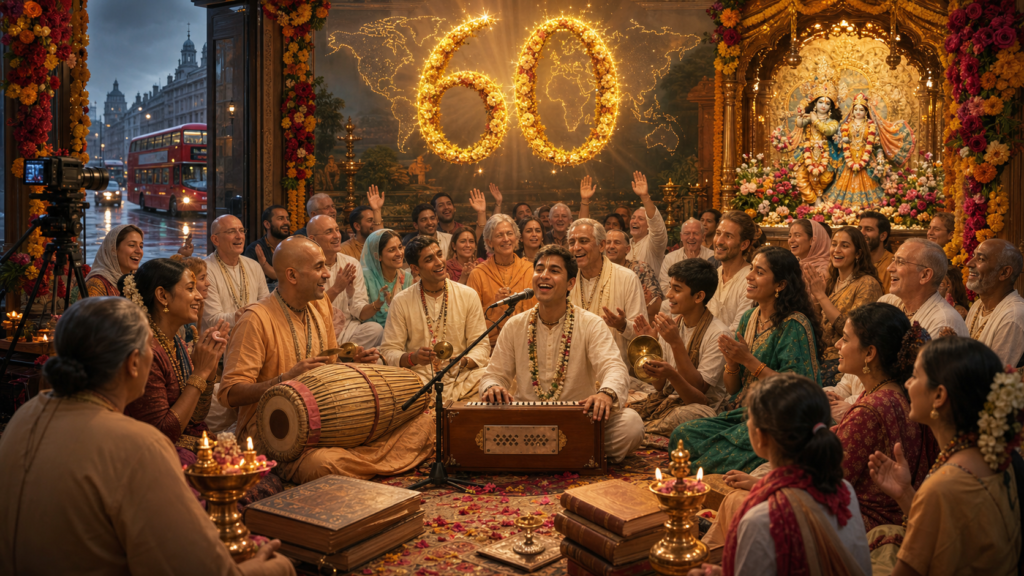
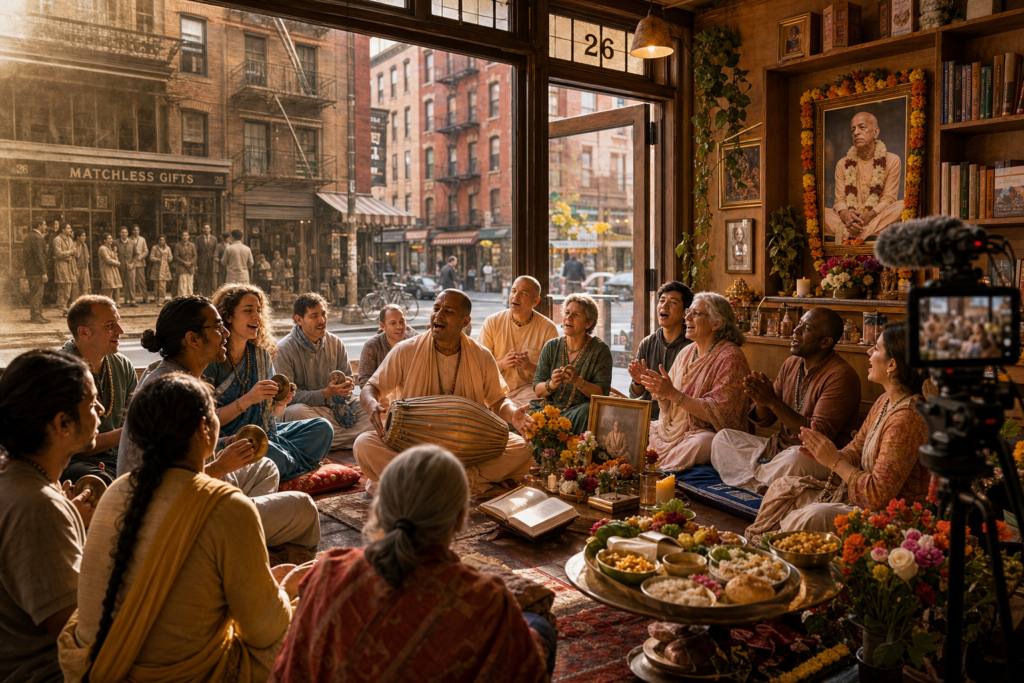
A historic livestream from the place where ISKCON took institutional form. Under the published 2026 anniversary program, Day 7 fell on Sunday, July 12, at Matchless Gifts, 26 Second Avenue, on New York City’s Lower East Side. It was the seventh day of an observance that began on July 6 and culminated on July 13, the sixtieth anniversary of the International Society for Krishna Consciousness. The recording connects the movement’s legal and devotional origins in 1966 with the memories, practices, and questions carried by its contemporary community. Its historical force lies not simply in an anniversary number, but in the return of kirtan, recollection, and hospitality to the compact storefront from which an international religious institution developed.
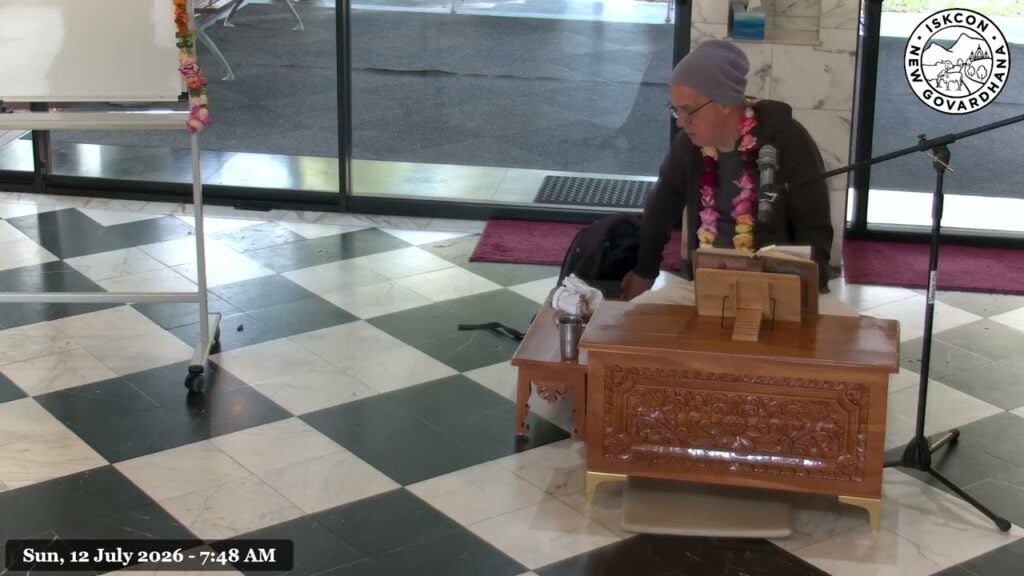
Channel and recording. The embedded program retains the source title ISKCON 26 2nd Avenue @Matchless Gifts is live and is presented by the ISKCON 26 2nd Avenue @Matchless Gifts channel. The generic livestream title identifies the place and broadcaster, although it does not by itself provide a transcript, chapter markers, a verified speaker sequence, or a detailed description of the proceedings.

Evidence and scope. The supplied source page contains the livestream, a still image, and a channel label, but no speaker-by-speaker synopsis. This contextual account therefore does not invent quotations or attribute particular statements to participants. It distinguishes between what the recording can document, what the published schedule announced, and what historical sources establish. The program details are drawn from the official Matchless Gifts anniversary page and the corresponding ISKCON News schedule. A scheduled appearance should still be checked against the recording before it is treated as confirmed attendance.
Day 7 within the anniversary calendar. The published schedule described the Sunday gathering as an 11:00 a.m. to 2:00 p.m. program of memories with disciples of Srila Prabhupada, followed by a Sunday feast. Its listed participants were Radhanath Swami, Jadurani Devi, Yogesvara Dasa, Arcita Dasa, Yadubara Dasa, and others. This placed Day 7 immediately before the July 13 Incorporation Day finale, for which Radhanath Swami was scheduled to address the theme The Future. The sequence gave the weekend a deliberate structure: retrospective testimony on Sunday was followed by institutional reflection on the exact anniversary date.
The wider week of observances. Matchless Gifts announced daily access to the historic storefront, classes, kirtan, prasadam, and public harinama processions between 26 Second Avenue and Tompkins Square Park. Most evening sessions were scheduled at the original storefront, while the Saturday evening program moved to the Bhakti Center at 25 First Avenue and included a dramatic presentation about ISKCON’s incorporation. This combination of pilgrimage, oral testimony, congregational music, public procession, theatre, and shared food made the anniversary more than a sequence of speeches. It presented history through several media at once: place, body, voice, movement, image, and meal.
Why 26 Second Avenue matters. According to the official history of Matchless Gifts, A. C. Bhaktivedanta Swami Prabhupada reached the United States in 1965 after crossing the Atlantic aboard the cargo ship Jaladuta. Following a brief stay in Butler, Pennsylvania, he returned to New York and worked under materially difficult conditions to introduce bhakti-yoga. During the summer of 1966, two early supporters helped him rent a ground-floor storefront at 26 Second Avenue. The premises had previously housed a curio shop called Matchless Gifts, and the inherited commercial name remained attached to the site after its religious transformation.
A commercial sign became a historical symbol. The phrase Matchless Gifts was not originally created as an ISKCON slogan. It belonged to the former shop, yet its survival produced an unusually powerful form of cultural memory. A name associated with retail was gradually reinterpreted as a fitting description of devotional knowledge, sacred sound, and spiritual hospitality. Academically, this is an example of a semantic afterlife: a material remnant acquires new meaning because a community repeatedly connects it with formative events. The sign is therefore valuable not because it proves a theological claim, but because it demonstrates how religious communities preserve and reinterpret ordinary urban objects.
The incorporation was a process, not an isolated instant. A published chronology of Srila Prabhupada’s activities in 1966 records that a July 6 meeting settled the proposed society’s name, that a constitution of association was approved and delivered to legal counsel on July 7, and that ISKCON was incorporated on July 13. Religious activity had already begun before the filing, but incorporation converted a small circle of students and visitors into an institution with a defined name, public purposes, and the capacity for continuity. The 2026 anniversary consequently marked both a devotional origin and a legal-organizational milestone.
The seven purposes provide the institutional framework. The Governing Body Commission’s historical overview explains that ISKCON’s incorporating document articulated seven purposes. In summary, they concern systematic spiritual education; the presentation of Krishna consciousness through the Bhagavad-gita and Srimad-Bhagavatam; the creation of fellowship centered on Krishna; the encouragement of congregational chanting; the establishment of sacred places; the cultivation of a simpler and more natural way of life; and the publication and distribution of religious literature. These purposes are historically important because they show that the society was conceived as a coordinated program of theology, education, community, ritual, place-making, and communication.
The anniversary translated those purposes into practice. Talks and remembered experiences served spiritual education. Kirtan and harinama enacted the commitment to congregational chanting. The preservation and use of 26 Second Avenue treated a modest storefront as a sacred place of collective memory. Prasadam joined religious meaning to practical hospitality, while the livestream extended communication beyond the room. The alignment is not exact in every detail, but it helps explain why the anniversary program combined historical testimony with ritual action. ISKCON’s founding purposes were not displayed merely as archival language; they appeared as categories of lived religious activity.
The architecture of accessibility. The first center was neither a monumental temple nor a secluded retreat. It was a small, street-level commercial unit embedded in a dense urban neighborhood. That spatial form mattered. A storefront window made activity visible, a door close to the sidewalk reduced the physical threshold for entry, and a multipurpose room could accommodate chanting, lectures, conversation, food distribution, and informal encounters. The site demonstrates how adaptive reuse can support religious innovation: existing urban architecture is reorganized through sound, images, seating, ritual objects, and repeated patterns of gathering.
Sacredness emerged through use as well as memory. Devotees commonly describe 26 Second Avenue as a tirtha, or place of pilgrimage. In an academic account, that description is best understood as a community’s religious classification rather than as a neutral property of the building. The storefront became sacred within ISKCON because it was associated with Srila Prabhupada’s teaching, early kirtans, institutional formation, and the disciplined practices of the first community. Its significance has then been renewed through restoration, pilgrimage, storytelling, anniversaries, and continuing programs. Sacred geography, in this case, is produced through the relationship between material location and transmitted memory.
Preservation has already shaped the site’s history. As the early congregation expanded, the original storefront became too small and the temple moved to larger premises. The official Matchless Gifts history records that the space was leased again, renovated, rededicated, and reopened to the public in July 1991 for ISKCON’s twenty-fifth anniversary. That intervention is an important part of the story. The contemporary site is not an untouched room preserved outside time; it is a restored and actively interpreted heritage space. Its present meaning depends on both the events of 1966 and later decisions to recover, maintain, and reactivate it.
Gaudiya Vaishnava identity. ISKCON understands itself as a modern institution within the Gaudiya Vaishnava tradition of Hinduism. Its theology places loving devotion to Krishna at the center of spiritual life and gives particular importance to the teachings associated with Sri Caitanya. The institutional title Founder-Acharya identifies Srila Prabhupada not only as the legal founder but also as the exemplary teacher whose interpretations, translations, practices, and organizational instructions established the movement’s normative direction. Recognizing this lineage is essential: the anniversary concerns a specific tradition with its own texts, theology, ritual vocabulary, and history, rather than an undifferentiated form of global spirituality.
Bhakti-yoga as disciplined devotion. Bhakti is often translated as devotion, but within this setting it includes a structured combination of hearing sacred texts, chanting divine names, remembering Krishna, worship, service, ethical discipline, association, and the offering of everyday activity. The term yoga indicates an ordered spiritual path rather than merely an emotional state. This distinction helps explain the anniversary’s format. Memories generate affection and gratitude, but those emotions are situated within recurring practices. Kirtan, scriptural discourse, service, pilgrimage, and prasadam give devotion an embodied and communal form.
Kirtan joins theology to social participation. In Gaudiya Vaishnava practice, kirtan commonly involves the sung or recited glorification of the divine, often through call-and-response chanting accompanied by instruments. It communicates theological content through sacred names while also creating a participatory social field. Musical expertise may guide the gathering, but the form allows a room to answer together. From an analytical perspective, kirtan can be studied through rhythm, repetition, leadership, response, gesture, and spatial arrangement. The practice is simultaneously doctrinal, aesthetic, emotional, and social, although a recording cannot verify the interior spiritual experience of any participant.
Harinama reconnects the storefront with the city. The anniversary’s public chanting route between Matchless Gifts and Tompkins Square Park retraced an axis associated with ISKCON’s early New York history. Harinama moves devotional sound beyond an interior gathering and into shared urban space. It also turns movement through streets into a form of remembrance: the distance between storefront and park is experienced physically rather than encountered only on a map. For participants, the procession can function as worship and pilgrimage; for observers, it becomes a visible encounter with a religious tradition operating in the public sphere.
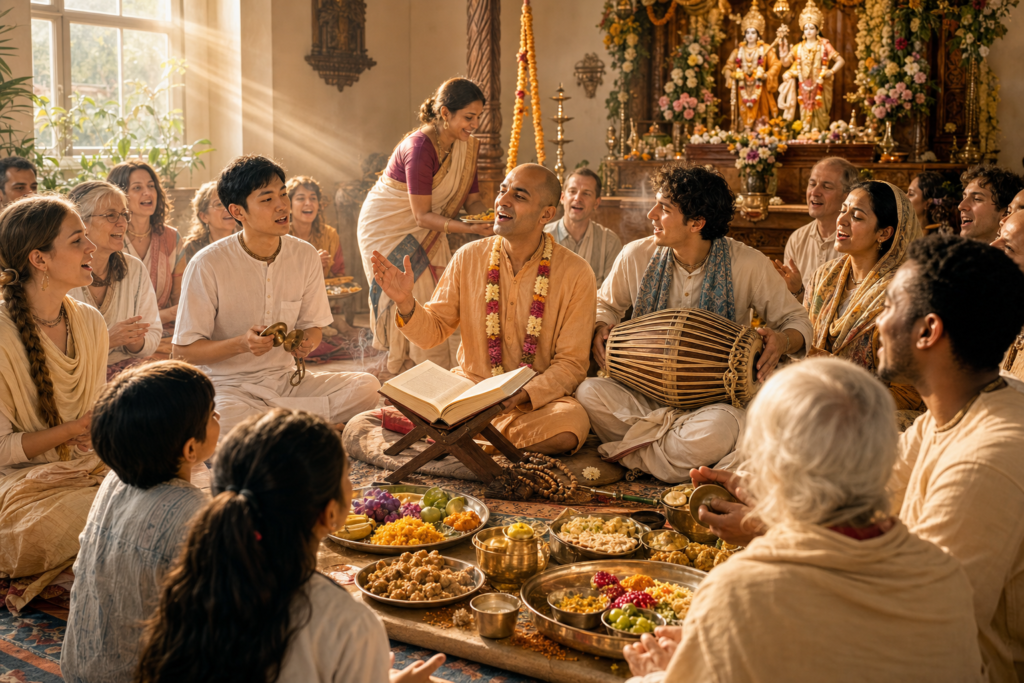
Prasadam makes hospitality material. In Vaishnava theology, prasadam is food prepared and offered to Krishna before it is respectfully shared. It is therefore understood by practitioners as grace rather than ordinary catering. Sociologically, the shared meal also performs important community work. It gives visitors a practical form of welcome, places bodily nourishment beside teaching and music, and reduces the distance between spectators and established participants. The Sunday feast announced for Day 7 linked remembrance with care: historical testimony was followed by an experience that could be received collectively, without requiring academic knowledge of the movement.
Why memories were central to Day 7. Legal documents can establish dates, names, and institutional purposes, but they rarely preserve the texture of daily religious life. Oral testimony can recover the sound of a room, the character of interpersonal encounters, the practical difficulties of maintaining a new center, and the ways teachings were understood by those present. A memory program is therefore valuable as more than ceremonial nostalgia. It can disclose how formal principles were translated into routines, relationships, artistic work, service, and personal transformation.
The published roster suggests several lenses on institutional memory. Radhanath Swami, Jadurani Devi, Yogesvara Dasa, Arcita Dasa, and Yadubara Dasa have each been associated with different forms of devotional service and historical transmission. Their experiences should not be collapsed into a single collective voice, and participation in ISKCON does not automatically make every recollection an eyewitness account of July 1966. The analytical value lies in preserving distinct testimony: where an individual was situated, what period is being remembered, whether a claim comes from direct observation, and how later experience may have shaped its interpretation.
Oral history requires both respect and verification. Memory can preserve affective and sensory details that no administrative record contains, yet recollection after many decades is selective and retrospective. A rigorous historical method compares testimony with contemporaneous letters, photographs, legal filings, press reports, audio recordings, diaries, and other interviews. Differences need not be treated as failures. They can reveal how communities assign meaning, how vocabulary changes, and which moments become central to collective identity. The Day 7 recording is thus a primary audiovisual source for the 2026 commemoration and a retrospective source for earlier history.
The room itself functions as an archive. A viewer can attend to the storefront’s scale, arrangement, images, instruments, movement patterns, and relationship between speakers and congregation. Such details help reconstruct how a multipurpose urban room supports worship and teaching. Nevertheless, a camera does not offer an unmediated view. Lens position, lighting, microphones, editing, internet compression, and the direction of attention determine what remote viewers can see and hear. Material evidence remains valuable, but it must be interpreted with awareness of the recording apparatus.
The emotional power comes from contrast. International institutions are often represented through headquarters, statistics, or large gatherings. At 26 Second Avenue, history is encountered through a small room. That human scale makes institutional development easier to grasp: global expansion can be traced back to a teacher, a few supporters, repeated classes, shared chanting, and the practical work of keeping a storefront active. For many viewers, the contrast between modest beginnings and long-term reach creates a sense of intimacy and wonder. Such emotion is historically relevant as evidence of how the community experiences its past, even though it is not proof of theological claims.
The livestream extends the meaning of pilgrimage. Physical presence remains distinctive because it includes bodily proximity, uncompressed sound, movement through the neighborhood, and a shared meal. Digital transmission cannot reproduce those conditions fully. It does, however, permit geographically dispersed participants to encounter the event in real time or through an archive. The livestream creates a mediated assembly around a fixed location, allowing one storefront to function simultaneously as a local ritual space and a global point of attention. This is a significant development in contemporary religious practice, where sacred place and networked communication increasingly operate together.
Digital preservation is now part of heritage preservation. A stable historical record requires more than leaving a video online. Good archival practice would retain an original-quality master, creation date, event date, exact venue, complete speaker list, program sequence, rights information, descriptive keywords, accessible captions, a corrected transcript, and persistent links. A time-coded index could distinguish kirtan, testimony, announcements, and ritual activity. Names and Sanskrit terms should be reviewed by knowledgeable editors without silently changing speakers’ meaning. These measures would make the recording more useful to researchers, descendants, devotees, educators, and viewers with hearing or language-access needs.
Anniversaries are acts of interpretation. A sixtieth anniversary does not merely retrieve the past; it selects events, speakers, places, images, and themes through which the past will be understood. The emphasis on 26 Second Avenue foregrounds humility, perseverance, sacred sound, and the transformation of a small beginning into an international network. An academic reading can appreciate that commemorative logic while still asking which experiences receive attention, which remain less visible, and how institutional priorities shape remembrance. Critical inquiry and devotional respect need not be treated as opposites when evidence and community categories are handled carefully.
Memory was directed toward the future. Placing a program of recollections before a finale titled The Future framed history as a resource for responsibility rather than as an endpoint. The central question is not whether contemporary ISKCON can reproduce 1966; the social environment, technologies, organizational scale, and global audience have changed profoundly. The more useful question is which founding commitments remain capable of guiding present conduct. Spiritual education, congregational practice, service, hospitality, responsible publication, and the cultivation of meaningful community are durable principles, but each generation must determine how to embody them with integrity.
Continuity does not mean immobility. The anniversary reveals several continuities: chanting remains central, Srila Prabhupada’s teachings retain institutional authority, prasadam continues to organize hospitality, and 26 Second Avenue remains a reference point. It also reveals change. A neighborhood storefront now addresses a digitally connected global audience, personal memories have become oral-history evidence, and an improvised early center has become a curated heritage site. Healthy continuity depends on distinguishing foundational commitments from historically contingent methods. Preservation is strongest when it protects evidence and practice while allowing transparent adaptation.
A respectful place within the wider dharmic family. ISKCON represents a particular Gaudiya Vaishnava theology within Hinduism; it does not stand for every Hindu tradition, nor for Buddhism, Jainism, or Sikhism. Dharmic unity is therefore best served by clarity rather than by erasing distinctions. Practices such as disciplined remembrance, seva, vegetarian hospitality, sacred learning, compassion, and community formation can support constructive dialogue with other dharmic traditions. At the same time, distinct teachings about Krishna, liberation, the self, nonviolence, meditation, scripture, and authority should be represented accurately. Unity becomes credible when difference is neither weaponized nor flattened.
A method for viewing the recording. A careful viewing can proceed in four passes. The first establishes factual metadata: date, location, participants, and sequence. The second observes ritual form, including music, call-and-response patterns, gestures, food sharing, and use of space. The third evaluates testimony by separating direct memory, inherited narrative, interpretation, and theological reflection. The fourth asks institutional questions: which founding purposes remain visible, how the storefront’s history is communicated, and what responsibilities emerge for future preservation. This method allows the video to be approached as worship documentation, oral history, urban religious history, and digital heritage without confusing those categories.
The enduring significance of Day 7. The program’s importance rests on the convergence of date, place, practice, testimony, and media. Sixty years after ISKCON’s incorporation, people again gathered at the original Matchless Gifts storefront to remember Srila Prabhupada, participate in bhakti practices, and transmit those experiences beyond New York. The recording does not replace documentary research or physical pilgrimage, but it preserves a meaningful layer of the movement’s living history. It shows how a modest urban room can remain active in collective memory when a community repeatedly returns to it with disciplined attention, gratitude, critical care, and a sense of responsibility for what comes next.
Inspired by this post on Dandavats.


Leave a Reply
You must be logged in to post a comment.