
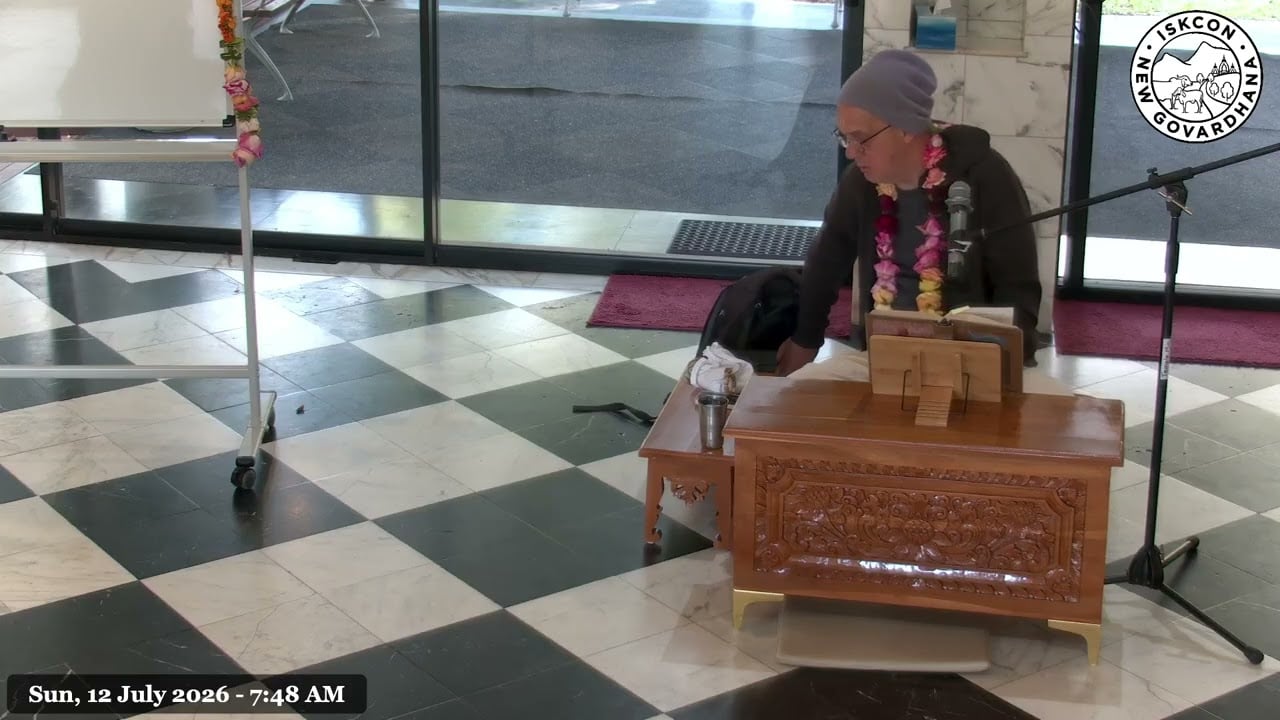
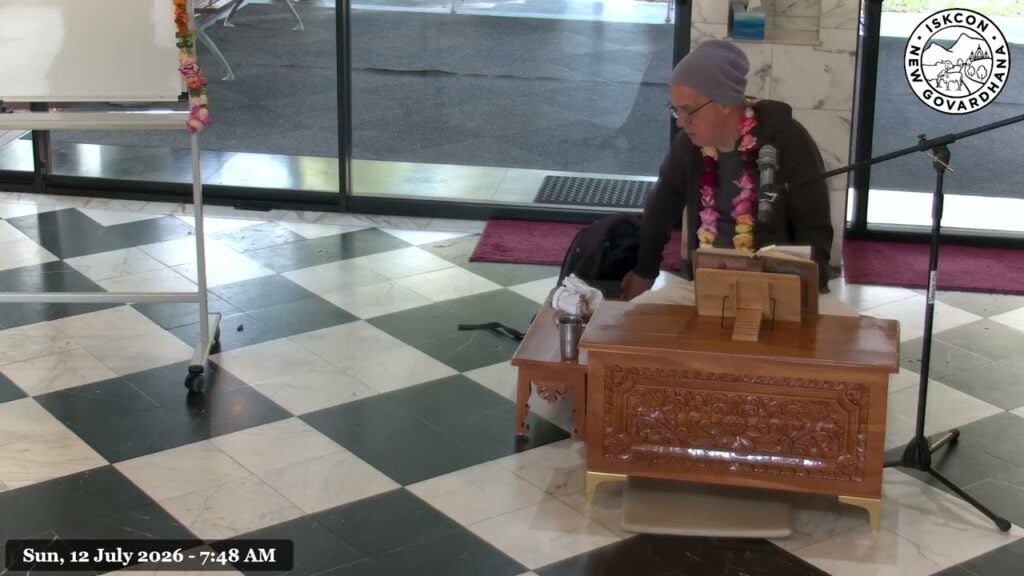
Class and textual focus. This study accompanies the Caitanya Caritamrita class presented by Nrsimha Kavaca Das at ISKCON New Govardhana Temple on Sunday, 12 July 2026. The recorded class considers Śrī Caitanya-caritāmṛta, Madhya-līlā 5.134–140, a compact sequence in which sacred narrative, Deity worship, devotional perception, communal joy, temple practice and pilgrimage converge.
These seven verses may initially appear to be a simple conclusion to the story of Sākṣi-gopāla. Their literary function is considerably richer. They show Śrī Caitanya Mahāprabhu hearing about Gopāla, sitting before the Deity, being perceived as remarkably similar to Him, sharing the devotees’ delight, remaining in the temple overnight, attending maṅgala-ārati and then continuing toward Bhuvaneśvara. The movement from narration to vision, from vision to worship and from worship to renewed pilgrimage presents a concise model of embodied devotional life.
Primary textual basis. The verse sequence and narrative setting can be consulted in the Bhaktivedanta Vedabase edition of Śrī Caitanya-caritāmṛta, Madhya-līlā, Chapter Five. The discussion remains anchored to verses 5.134 through 5.140 and distinguishes the direct content of those verses from broader theological interpretation.
The narrative setting: the activities of Sākṣi-gopāla. Chapter Five recounts how Śrī Caitanya Mahāprabhu reached Kaṭaka, or Cuttack, during His journey toward Jagannātha Purī. At the temple of Sākṣi-gopāla, Nityānanda Prabhu narrated the history of the Deity. Nityānanda had previously visited the site during his extensive pilgrimage and therefore served as both guide and transmitter of sacred memory.
The underlying story concerns two brāhmaṇas from Vidyānagara, one elderly and one young, who traveled together through places of pilgrimage. The younger man served the elder attentively without treating that service as a commercial exchange. Deeply grateful, the elder promised his daughter in marriage to him before the Gopāla Deity in Vṛndāvana. The younger brāhmaṇa warned that differences in wealth, education and family status would provoke resistance, but the elder repeated his promise and asked Gopāla to witness it.
After the pilgrims returned home, social pressure made fulfillment of the promise difficult. The village assembly eventually required evidence, and the younger brāhmaṇa returned to Vṛndāvana to appeal to Gopāla. In the theological world of the narrative, the Deity responded to sincere devotion, followed the young man to Vidyānagara and publicly confirmed the agreement. Gopāla consequently became celebrated as Sākṣi-gopāla, “Gopāla the witness.”
The story is not merely an account of a marvel. Its central concerns are truth, gratitude, service, moral courage and the tension between an individual promise and collective social pressure. The younger brāhmaṇa does not initially seek personal advancement; he is distressed that a sacred promise may be broken. The elder is not portrayed as casually dishonest but as a person caught between truthfulness and severe family opposition. Gopāla’s role as witness restores public accountability while protecting the ethical significance of the vow.
Verses 5.134–140 begin after Nityānanda has completed this extensive narration. The preceding story therefore supplies the emotional force of the passage. The devotees are not pleased by an unexplained spectacle. Their joy arises after hearing how service, truthfulness and divine reciprocity overcame pride, fear and social obstruction.
CC Madhya 5.134:
nityānanda-mukhe śuni’ gopāla-carita
tuṣṭa hailā mahāprabhu svabhakta-sahita
The verse states that Śrī Caitanya Mahāprabhu heard the account of Gopāla from Nityānanda and became pleased together with His personal devotees. Several details matter. The compound nityānanda-mukhe identifies the account as something heard from Nityānanda’s mouth, while gopāla-carita denotes Gopāla’s acts or sacred history. The expression svabhakta-sahita emphasizes that the response was communal: Mahāprabhu’s delight was shared with His devotees.
Hearing, or śravaṇa, functions here as a disciplined mode of receiving spiritual knowledge. The tradition does not reduce hearing to the passive reception of information. A sacred narrative is heard attentively, interpreted within a lineage of practice and allowed to shape memory, emotion and conduct. Nityānanda does more than report an event; he makes the significance of a place accessible to fellow pilgrims.
This structure clarifies why spiritual education is relational. Texts can be read privately, but oral explanation adds voice, context, emphasis and the presence of a community. A place that might otherwise be encountered only as architecture becomes intelligible through its remembered history. The temple, the narrative and the hearers form an integrated field of meaning.
The shared satisfaction of Mahāprabhu and the devotees also prevents the passage from presenting spirituality as solitary self-absorption. Their happiness is generated by another devotee’s service and by Gopāla’s protection of truth. Devotional joy is therefore ethical as well as emotional. It celebrates faithfulness, gratitude and the restoration of trust.
CC Madhya 5.135:
gopālera āge yabe prabhura haya sthiti
bhakta-gaṇe dekhe — yena duṅhe eka-mūrti
When Śrī Caitanya Mahāprabhu sat before Gopāla, the devotees perceived the two as though they were one form. The wording is precise. Yena means “as if” or “as though,” while eka-mūrti means “one form.” The line describes a devotional perception grounded in striking resemblance; it does not require readers to imagine that every distinction between the seated pilgrim and the installed Deity had disappeared.
The verse operates as visual theology. Mahāprabhu is positioned before Gopāla, allowing the devotees to behold both simultaneously. Their arrangement creates a comparison that could not have been conveyed in the same way through abstract doctrine alone. Posture, complexion, clothing, expression and spiritual mood become part of the passage’s theological vocabulary.
Within Gaudiya Vaishnavism, Śrī Caitanya Mahāprabhu is understood as Kṛṣṇa appearing in the role and inner mood of a devotee. Gopāla is Kṛṣṇa in His youthful cowherd identity. The perceived resemblance therefore carries a theological depth beyond physical similarity: the one who demonstrates devotion and the one who receives devotion are intimately related within the tradition’s understanding of divine self-revelation.
This moment can illuminate the Gaudiya principle commonly expressed as acintya-bhedābheda, inconceivable simultaneous unity and difference. The verse itself is poetic narration rather than a formal philosophical definition, so it should not be forced into the role of a technical treatise. Nevertheless, its image is compatible with that framework. Mahāprabhu and Gopāla remain available to the devotees as distinguishable forms, yet their profound unity becomes perceptible.
CC Madhya 5.136:
duṅhe — eka varṇa, duṅhe — prakāṇḍa-śarīra
duṅhe — raktāmbara, duṅhāra svabhāva — gambhīra
The comparison now becomes specific. Both figures are described as having the same complexion, imposing bodily forms, red or saffron-colored garments and a grave disposition. The repeated duṅhe, meaning “both,” gives the verse an anaphoric rhythm. Each repeated phrase asks the audience to look again and notice another correspondence.
The term prakāṇḍa-śarīra conveys large, impressive or powerful bodily form. It does not function as a clinical measurement. Like much sacred biography, the language communicates presence: neither form appears slight, ordinary or visually negligible. Their physical grandeur corresponds to the gravity of the encounter.
Raktāmbara joins rakta, red, with ambara, garment. The received translation identifies the clothing as saffron. For Mahāprabhu, saffron dress also marks His status as a sannyāsin. The verse does not claim that Gopāla has adopted monastic renunciation; instead, the matching garments form part of the visual parallel perceived by the devotees. Distinguishing poetic correspondence from literal equivalence prevents unnecessary theological confusion.
The word gambhīra can signify gravity, depth, dignity or profound composure. Its importance becomes clearer when placed beside the laughter of verse 5.138. Sacred gravity does not eliminate joy. The passage can hold dignified stillness and affectionate humor together, suggesting that mature devotion is neither emotionally barren nor carelessly frivolous.
CC Madhya 5.137:
mahā-tejo-maya duṅhe kamala-nayana
duṅhāra bhāvāveśa, duṅhe — candra-vadana
The description intensifies through four expressions: great effulgence, lotus-like eyes, absorption in spiritual emotion and moon-like faces. These are not random ornaments. They belong to a well-developed Sanskrit and Bengali devotional aesthetic in which light, lotuses and the full moon communicate vitality, beauty, tenderness and auspicious presence.
Mahā-tejo-maya describes both as filled with extraordinary radiance. In theological literature, radiance can indicate more than reflected light; it may express spiritual potency, charisma or a presence experienced as self-manifesting. An academic reading need not turn this poetic description into a laboratory claim. It can recognize that sacred literature uses luminosity to communicate how a person or Deity is perceived within devotional consciousness.
Kamala-nayana, “lotus-eyed,” evokes softness, beauty and compassionate attentiveness. Candra-vadana, “moon-faced,” evokes brightness, fullness and a cooling, comforting beauty. The metaphors work through culturally established associations. The lotus rises clean and beautiful from water, while moonlight offers relief from heat. Together they portray a form that is majestic without being threatening and attractive without becoming trivial.
The term bhāvāveśa is especially significant. Bhāva refers to an affective or devotional state, and āveśa indicates deep entrance, absorption or saturation. The verse depicts both figures as immersed in spiritual emotion. Devotion is consequently presented not as an external performance added to an otherwise unchanged life but as an absorption capable of shaping expression, perception and relationship.
Gaudiya discussions of bhāva and rasa employ technical categories for devotional emotion. This verse does not enumerate those categories, but it does show why aesthetic language is central to the tradition. Truth is communicated not only through propositions about divinity but also through carefully cultivated descriptions of beauty, mood and relational exchange.
CC Madhya 5.138:
duṅhā dekhi’ nityānanda-prabhu mahā-raṅge
ṭhārāṭhāri kari’ hāse bhakta-gaṇa-saṅge
Seeing Gopāla and Mahāprabhu together, Nityānanda Prabhu entered great jubilation and exchanged gestures or remarks with the devotees, who smiled with him. The word ṭhārāṭhāri suggests communicative indications, signs or knowing exchanges. The group recognizes the resemblance and responds with intimate delight.
This laughter should not be mistaken for mockery. Its narrative setting is reverential, and its emotional quality is affectionate. Nityānanda and the devotees are delighted by the visual correspondence before them. Their smiles reveal familiarity within a sacred community: profound theology is recognized not only through solemn exposition but also through a shared glance.
The episode offers an important account of communal interpretation. The devotees see, compare, gesture and respond together. No isolated observer monopolizes the meaning of the moment. Nityānanda’s reaction helps the community articulate what it is perceiving, while the devotees’ smiles confirm a shared understanding. Spiritual knowledge is shown moving through bodies, relationships and subtle forms of communication.
The repetition of mahā-raṅge, great delight or jubilation, links this verse to the next. The momentary smiles are not an incidental interruption. They establish the emotional atmosphere in which the entire night is passed. Joy becomes a sustained mode of temple residence rather than a fleeting reaction.
CC Madhya 5.139:
ei-mata mahā-raṅge se rātri vañciyā
prabhāte calilā maṅgala-ārati dekhiñā
Mahāprabhu passed the night in this atmosphere of great happiness. In the morning, after witnessing maṅgala-ārati, He resumed His journey. The sequence is understated but structurally important: sacred storytelling leads to contemplative seeing, seeing leads to shared joy, joy extends into residence at the temple, and residence culminates in dawn worship.
Maṅgala-ārati is the auspicious ceremonial offering of light performed early in the daily cycle of Deity worship. Its precise local procedures may vary, but its general liturgical function is clear. The community greets the Deity at the opening of the day through light, sound, song, reverence and coordinated attendance. Time itself is organized around service.
The dawn ceremony shows that powerful spiritual emotion is integrated with disciplined practice. Mahāprabhu does not treat the previous evening’s extraordinary experience as a reason to neglect the temple schedule. The narrative joins spontaneity and structure: deep feeling gives vitality to ritual, while ritual gives continuity and form to feeling.
Many practitioners recognize the difference between briefly feeling inspired and allowing inspiration to reshape the next morning. Verse 5.139 locates spiritual maturity in that transition. The night’s delight is carried into attendance at maṅgala-ārati, after which the pilgrimage continues. Emotion becomes durable when it supports regular practice and purposeful movement.
The temple stay also demonstrates hospitality and sacred pause within pilgrimage. A journey is not defined only by distance covered. It includes periods of listening, resting, worshiping and absorbing the significance of a place. Without such pauses, pilgrimage can become religious tourism; with them, geography becomes a framework for ethical and spiritual formation.
CC Madhya 5.140:
bhuvaneśvara-pathe yaiche kaila daraśana
vistāri’ varṇiyāchena dāsa-vṛndāvana
The final verse states that Vṛndāvana dāsa Ṭhākura described in detail the places Mahāprabhu visited on the way to Bhuvaneśvara. This is an explicit intertextual signal. Rather than duplicate an already extensive account, Kṛṣṇadāsa Kavirāja directs attention to the Caitanya-bhāgavata and acknowledges an earlier narrative authority.
Such cross-reference is technically important for reading Caitanya literature. The tradition’s sacred biography is distributed across multiple works, voices and narrative emphases. One text may summarize what another develops at length. Comprehensive study therefore requires comparison rather than the assumption that a single passage intends to supply every historical, geographical or theological detail.
The reference to Bhuvaneśvara also extends the passage beyond the boundaries of one temple. Mahāprabhu is moving through the sacred geography of Odisha toward Jagannātha Purī. The route associates Vaiṣṇava devotion with a landscape that also contains major Śaiva sites and regional traditions. Pilgrimage connects communities without requiring their distinctive forms of worship to be erased.
This geographical transition has particular value for a dharmic reading committed to unity. Hindu sacred landscapes commonly contain overlapping Vaiṣṇava, Śaiva, Śākta and local histories. The journey toward Bhuvaneśvara encourages respect for this layered inheritance. Unity is strongest when it is based on informed reverence and ethical cooperation rather than on the claim that every tradition teaches precisely the same doctrine.
Three connected modes of knowledge. The passage can be organized around hearing, seeing and practicing. Verse 5.134 emphasizes hearing Gopāla’s history. Verses 5.135–138 emphasize seeing Mahāprabhu and Gopāla together. Verse 5.139 emphasizes participation in the temple’s daily worship, while verse 5.140 returns the pilgrims to movement through sacred geography. No single mode is treated as sufficient by itself.
Hearing protects perception from becoming superficial because the story explains why Gopāla is known as a witness. Seeing prevents knowledge from remaining purely conceptual because the devotees encounter form, expression and relationship. Ritual stabilizes both memory and perception through repeated practice. Pilgrimage then carries what has been learned into a wider landscape.
The technical meaning of the Deity form. Within Gaudiya Vaiṣṇava theology, the arcā-vigraha is a form through which the divine becomes accessible to embodied worship. The Deity is not approached merely as a decorative representation or an object onto which devotees arbitrarily project emotion. Consecration, scriptural prescription, daily service and theological understanding establish the form’s religious identity.
This doctrine does not require the denial of material craftsmanship. A Deity form may be shaped from stone, wood, metal, pigment or other substances, and its ritual care involves ordinary material actions. The theological claim is that divine presence can become available through those elements without being limited by them. Matter is treated as capable of sacred service rather than as inherently opposed to spirituality.
The account of Sākṣi-gopāla dramatizes this principle by refusing a rigid division between an allegedly inert image and a living Lord. Within the narrative’s devotional worldview, Gopāla hears, speaks, walks, remembers, witnesses and reciprocates. The story asks its audience to reconsider whether divine agency must conform to ordinary assumptions about mobility and embodiment.
At the same time, verses 5.135–137 focus less on movement than on presence. Gopāla does not need to walk again to make the encounter meaningful. The Deity’s stillness before Mahāprabhu becomes the setting for intense recognition. Sacred agency can be narrated through miraculous action, but it can also be experienced through contemplative attention.
Darśana as reciprocal encounter. In common usage, darśana means seeing, viewing or having an audience with a sacred person or Deity. In temple practice, it carries a reciprocal implication: worshipers go to see the Deity while understanding themselves to be seen. This reciprocity helps explain why visual details in verses 5.135–137 matter so much. The devotees do not inspect an art object from a detached distance; they enter a relationship of attention.
Careful darśana slows perception. Complexion, garments, posture, eyes, facial expression and mood become meaningful because the observer remains present long enough to notice them. In contemporary life, where images are often consumed rapidly and discarded, this disciplined gaze offers a corrective. Attention becomes a form of respect.
Truth, testimony and accountability. The title Sākṣi-gopāla places testimony at the center of the chapter. A witness does not create truth but confirms what occurred. Gopāla’s intervention validates a promise made in His presence and prevents social power from determining reality. The narrative therefore connects devotion with public ethics rather than confining it to private emotion.
The episode remains relevant wherever spoken commitments are later obscured by status, convenience or group pressure. Families, institutions and spiritual communities all depend on reliable memory and accountable speech. The story’s miraculous element should not distract from its practical demand: a promise made solemnly carries moral weight, and vulnerable parties require fair processes when stronger parties deny responsibility.
The younger brāhmaṇa’s conduct is also instructive. He seeks a public hearing and accepts mediation by the village assembly. His appeal to Gopāla occurs after ordinary testimony proves insufficient. The narrative thus includes documentation, witnesses, communal deliberation and divine appeal rather than celebrating impulsive retaliation.
Service beyond social calculation. The younger brāhmaṇa serves the elder without initially expecting marriage, wealth or rank. His service is valuable precisely because it is not presented as a hidden transaction. The elder’s gratitude produces the promise, but the younger man immediately identifies the social complications and questions whether it can realistically be fulfilled.
The contrast in status should be interpreted carefully. The narrative exposes the instability of prestige when family pride becomes more important than truth. It does not need to be exaggerated into a complete rejection of every historical social structure. Its focused claim is that wealth, education and lineage cannot justify ingratitude, false testimony or contempt for sincere service.
The marriage language also reflects the social and literary world in which the narrative is set. Contemporary readers should distinguish its central concern with a solemn promise from modern legal and ethical requirements concerning the free consent and agency of the prospective bride. Responsible interpretation preserves the passage’s teaching on truthfulness without using historical idiom to dismiss present-day protections for personal dignity.
Divine reciprocity and devotional agency. Gopāla responds because the younger brāhmaṇa’s concern is aligned with service and truth. This does not establish a mechanical formula in which every sincere request must produce a visible miracle. It presents a theological ideal: the divine is not indifferent to integrity, and devotion is not merely one-sided human effort.
That reciprocity reaches its visual culmination when Mahāprabhu sits before Gopāla. The Deity who became a witness to human conduct is now beheld beside the exemplary devotee. The scene joins ethics and aesthetics. Truth restored in the earlier narrative becomes beauty perceived in the concluding verses.
Community as an interpretive discipline. Nityānanda narrates, Mahāprabhu hears, the devotees observe, and the group responds together. Each participant contributes to the event without dissolving into anonymity. This pattern offers a constructive model for scriptural communities: qualified explanation, attentive listening, shared observation and joyful discussion can reinforce one another.
Healthy community does not mean uncritical conformity. The chapter itself revolves around a community dispute and the need to distinguish truthful testimony from social pressure. Communal life becomes spiritually valuable when it protects integrity, makes room for evidence and refuses to let prestige decide every outcome.
A lesson for the digital age. Modern audiences encounter enormous quantities of religious content through short videos, images and isolated quotations. CC Madhya 5.134–140 recommends a slower sequence. A claim is heard in context, connected to a complete narrative, contemplated through sacred imagery, embodied in regular practice and situated within a larger textual tradition.
This sequence can improve religious literacy. Before sharing a striking statement, readers can examine its chapter, speaker, audience and narrative purpose. Before turning a visual resemblance into a sweeping doctrine, they can notice qualifying words such as yena, “as if.” Before presenting one text as exhaustive, they can follow its cross-references, as verse 5.140 directs readers toward Vṛndāvana dāsa Ṭhākura.
A practical contemplative method. A careful study session may begin by reading the seven Bengali transliterations aloud at an unhurried pace. The reader can then identify the principal action in each verse: hearing, seeing, comparing, smiling, staying, worshiping and journeying. This prevents the passage from being reduced to a single memorable image.
A second reading can attend to repeated words and paired descriptions, especially duṅhe and mahā-raṅge. A third can ask how the verses depend on the Sākṣi-gopāla story that precedes them. Reflection becomes more precise when language, literary structure, theology and ethical application are considered in that order.
In temple practice, the same method can be embodied through attentive hearing before darśana, deliberate observation of the Deity, respectful exchange with fellow practitioners and participation in the daily worship schedule. The aim is not to manufacture an extraordinary emotion. It is to cultivate conditions in which attention, gratitude and service can deepen naturally.
Dharmic unity without erasing difference. The passage belongs specifically to Gaudiya Vaishnavism and should be interpreted with that identity intact. At the same time, its ethical themes can support respectful conversation among Hindu, Buddhist, Jain and Sikh communities. Truthfulness, disciplined practice, reverence for teachers, compassion, self-restraint and responsible community life are widely intelligible dharmic concerns.
Such comparison must remain careful. Buddhist accounts of non-self, Jain analyses of nonviolence, Sikh teachings centered on the Guru and nām, and Vaiṣṇava teachings on loving service to Bhagavān have distinct histories and conceptual structures. Genuine unity does not require those differences to be blurred. It requires the traditions to meet through accurate learning, freedom from contempt and cooperation in protecting dignity, sacred heritage and ethical life.
Mahāprabhu’s continuing journey through Odisha offers an appropriate image for this approach. Sacred paths intersect, pilgrims visit places associated with different forms of worship, and inherited traditions remain recognizable. Movement across a plural landscape can deepen commitment while also expanding respect.
Relevance to the New Govardhana temple community. A class on these verses does more than preserve a historical account. It recreates the basic pattern described in verse 5.134: a sacred narrative is spoken, a community hears it, and Gopāla’s activities become present in collective memory. The modern temple classroom thus participates in the same culture of oral transmission represented by Nityānanda’s narration.
The passage also clarifies the purpose of temple education. Its goal is not the accumulation of information alone. Study should refine darśana, strengthen ethical accountability, deepen appreciation for ritual and help participants carry devotional principles into relationships beyond the temple. Knowledge reaches maturity when it shapes conduct.
Interpretive safeguards. The passage should not be reduced to a claim that outward resemblance automatically proves spiritual identity. It should not be used to dismiss the material artistry and ritual labor involved in Deity worship. It should not turn emotional intensity into the sole measure of devotion, nor should it separate miraculous testimony from the chapter’s sustained concern with ordinary truthfulness and service.
A balanced reading holds together form and meaning, emotion and discipline, miracle and ethics, unity and distinction. Mahāprabhu’s resemblance to Gopāla becomes compelling because it appears after the devotees have heard Gopāla’s history and while they remain engaged in temple worship. The image belongs to a complete devotional ecology.
Central insights. CC Madhya 5.134 teaches that sacred hearing can generate shared joy. Verses 5.135–137 show how devotional perception recognizes theological meaning through embodied form and poetic beauty. Verse 5.138 presents reverent laughter and subtle communication as legitimate dimensions of sacred community. Verse 5.139 unites emotional intensity with the discipline of maṅgala-ārati. Verse 5.140 places the episode within a wider textual tradition and a plural sacred geography.
The enduring power of the passage lies in its integration. Gopāla is remembered as the witness who protects truth; Mahāprabhu is seen as sharing His form and mood; Nityānanda transforms place into meaningful history; the devotees respond with intelligent affection; and the dawn ritual converts inspiration into practice. The result is a vision of Krishna consciousness in which theology is heard, seen, felt, enacted and carried forward.
For contemporary readers, the invitation is both simple and demanding: listen carefully, look deeply, speak truthfully, honor sacred commitments, participate in community without surrendering moral judgment and allow spiritual insight to shape the next day’s actions. In that disciplined movement from hearing to living, the activities of Sākṣi-gopāla remain more than a remembered wonder; they become a durable education in devotion, integrity and shared dharmic life.
Inspired by this post on Dandavats.





Leave a Reply
You must be logged in to post a comment.