
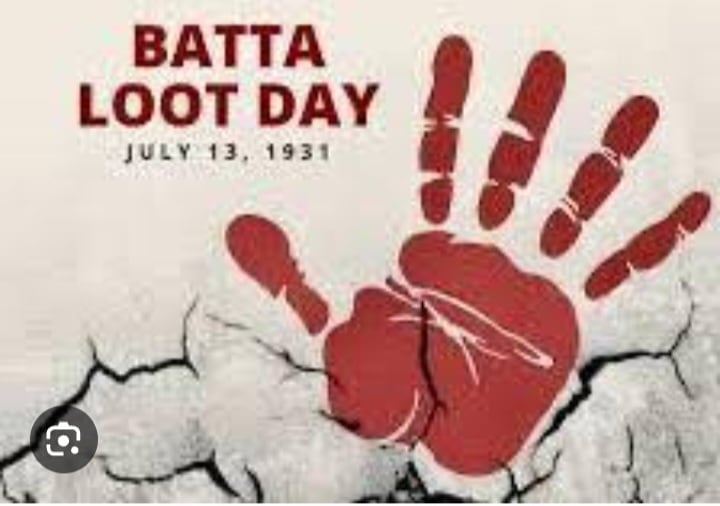
For displaced Kashmiri Hindu families, 13 July is not merely a date in a political calendar. It carries memories of violence, dispossession, contested public narratives, and the vulnerability of a minority community in its ancestral homeland. Many Kashmiri Pandits therefore observe the anniversary as ‘Black Day’, gathering in India and across the diaspora to remember the Hindus attacked during the disturbances of 1931 and to question an official narrative that historically concentrated almost exclusively on those killed by Dogra state forces.
The history of 13 July 1931 cannot, however, be understood through a single slogan. The day occupies two sharply different places in Kashmir’s collective memory. Many Kashmiri Muslims have remembered it as the beginning of an organized struggle against autocratic Dogra rule, particularly because state forces killed demonstrators outside Srinagar Central Jail. Kashmiri Hindus remember not only the firing but also the communal violence that followed, when Hindu civilians, homes, shops, and livelihoods were attacked. Both parts belong to the historical record, even though political commemorations have often privileged one while minimizing the other.
A contested anniversary and the responsibilities of history
An academically responsible reconstruction must distinguish documented events from later recollections, political interpretations, and allegations that remain disputed. Police firing, deaths among the demonstrators, and attacks on Hindu property are widely recorded. By contrast, claims about a coordinated British conspiracy, an intended Valley-wide genocide, or the precise instructions allegedly issued by individual political leaders require closer archival corroboration. Recognizing this difference does not diminish Kashmiri Hindu suffering; it protects that suffering from being weakened by assertions presented with more certainty than the surviving evidence permits.
Historical accuracy also requires a clear distinction between communities and perpetrators. The identity of an attacker does not transfer guilt to every person sharing the attacker’s religion. The violence directed at Hindus must be described without euphemism, but it should not be converted into an indictment of all Kashmiri Muslims. Such collective blame reproduces the same majoritarian logic that made an unprotected minority vulnerable in the first place.
Kashmir under Dogra rule
The political setting of 1931 originated in the structure of the princely state of Jammu and Kashmir. Dogra sovereignty was established in 1846 after the Treaty of Amritsar, and the resulting state brought together regions with markedly different languages, religions, economies, and political traditions. Kashmir Valley had a Muslim majority, while the ruling dynasty was Hindu. Authority remained concentrated in the monarchy and its administration, with limited opportunities for representative participation.
By the early twentieth century, grievances among Kashmiri Muslims included poverty, indebtedness, taxation, unequal access to education, limited representation in government employment, and the absence of meaningful political rights. These conditions were not imaginary, and later inquiries, including the Glancy Commission, treated several of them as requiring reform. The anti-Dogra agitation therefore had substantial social and political foundations. Reducing it entirely to religious fanaticism would obscure the material conditions that helped mobilization grow.
At the same time, legitimate opposition to an autocratic government did not justify aggression against Hindu civilians. Kashmiri Pandits were a small minority, not a ruling dynasty. Some Pandits occupied visible posts in education and administration, but the community was neither socially uniform nor collectively responsible for state policy. Treating ordinary Hindus as substitutes for a Hindu monarch transformed political grievance into communal punishment.
This distinction is essential. A protest against government can possess valid demands and still produce indefensible violence when communal actors redirect anger toward an exposed population. The history of July 1931 contains both realities: opposition to an unrepresentative state and targeted attacks on people who had no personal responsibility for that state’s decisions.
Maharaja Hari Singh and the Round Table Conference
Maharaja Hari Singh participated in the First Round Table Conference in London in 1930 as a representative of India’s princely states. His intervention supported a federal constitutional future and expressed the expectation that Indians should enjoy an honorable and equal political status. His position was notably more nationalist than British officials might have expected from a princely ruler, and it later became central to the argument that imperial authorities wished to weaken him.
Some Kashmiri Hindu accounts interpret the upheaval of 1931 as the product of a deliberate alliance between British interests and Muslim political elites directed against Hari Singh. The colonial government certainly possessed the capacity and incentive to influence politics within princely India. Nevertheless, the stronger allegation—that British officials designed the July violence and deployed specific agents to execute it—should be presented as a historical claim requiring direct documentary proof, not as an established conclusion inferred solely from the Maharaja’s London speech.
A careful account can therefore acknowledge two propositions simultaneously. Hari Singh’s independent posture could have generated British suspicion, and colonial power frequently operated through indirect pressure. Yet widespread discontent inside Kashmir had local causes that existed independently of British strategy. Recognizing those causes does not absolve colonial manipulation where evidence establishes it, nor does it excuse the later assault on Hindu civilians.
Education, political organization, and Sheikh Mohammad Abdullah
Higher education contributed to the emergence of a new Muslim political intelligentsia. Students who studied outside the princely state, including at Aligarh Muslim University, encountered modern political organization, journalism, constitutional debate, and arguments about communal representation. State scholarships helped some students obtain this education. Their subsequent criticism of the Dogra administration cannot by itself be treated as evidence of ingratitude or conspiracy; education commonly produces demands for participation and reform.
Sheikh Mohammad Abdullah became the most influential figure in this developing movement. In Srinagar, educated Muslims participated in study circles and the organization commonly remembered as the Reading Room Party. These networks publicized employment discrimination and broader political grievances. Abdullah’s oratory and organizational ability soon gave him a prominent position in the agitation.
Chronology matters here. The All Jammu and Kashmir Muslim Conference was formally established in 1932, after the disturbances of July 1931; it could not therefore have directed the July events as an already constituted political party. Individuals and networks that later formed the organization were active in 1931, but the two propositions are not identical. The Muslim Conference was renamed the National Conference in 1939 after a political shift toward a formally non-communal program.
Correcting this sequence does not erase the role of emerging political leaders. It prevents later institutional identities from being projected backward onto a fluid movement. In 1931, mobilization involved religious preachers, educated activists, local notables, crowds, and people responding to rumors and immediate events. Their aims and degrees of responsibility were not necessarily uniform.
Abdul Qadeer and the road to 13 July
Abdul Qadeer, an outsider commonly identified as being from Peshawar and associated with a European or British employer, entered this politically charged environment in June 1931. During a gathering at Khanqah-e-Moula, he delivered an inflammatory speech urging resistance to the Dogra government. Authorities arrested him and prosecuted him for sedition. His trial quickly became a rallying point because it was understood not simply as a case against one man but as a confrontation between the state and an expanding political movement.
Kashmiri Hindu narratives have often described Qadeer as a British agent specifically planted to incite rebellion. His outsider status and association with a European employer helped this interpretation acquire durability. Yet those circumstances alone do not conclusively establish an intelligence relationship or a British operational plan. The allegation deserves archival investigation, including examination of residency correspondence, police reports, travel records, and the identity of his employer. Until such evidence is produced, the responsible formulation is that Qadeer’s alleged role as a British agent remains disputed.
Qadeer’s prosecution was eventually conducted in or near Srinagar Central Jail because large crowds had begun attending the proceedings. On 13 July 1931, thousands assembled outside the jail. Tension escalated between the gathering and the authorities. Arrests, efforts to disperse the crowd, and confrontation were followed by police gunfire. The figure most commonly associated with the firing is twenty-two dead demonstrators, although particular reconstructions differ on the sequence and casualty details.
The shooting became foundational to Kashmiri Muslim political memory. Those killed were designated martyrs, and 13 July came to symbolize resistance to Dogra autocracy. The scale and lethality of the state response require acknowledgment. Whatever disagreements exist about the conduct of individuals within the crowd, lethal force by the authorities became the event around which a powerful movement and commemorative tradition developed.
When political confrontation became communal violence
The account cannot end at the jail gates. After the firing, sections of the crowd moved into Srinagar and surrounding localities, and the disorder acquired an explicitly communal dimension. Hindu-owned shops, houses, and commercial establishments were looted or damaged. Maharaj Ganj, an important center of business, was among the areas affected. Accounts also identify Vicharnag, Amirakadal, Hari Singh High Street, and parts of Bohri Kadal as locations where Hindu property was targeted.
Several histories record Hindu deaths alongside extensive material loss, although the precise number and circumstances vary among sources. Kashmiri Hindu recollections also preserve accounts of beatings, humiliation, destruction, and families fleeing immediate danger. One especially severe community account concerns Kanikoot village in present-day Badgam district, where Hindus were allegedly assaulted, property was vandalized, and members of a family were thrown from a three-storey house and killed. Such a grave claim warrants focused investigation through contemporary administrative records, family testimony, land documents, and local oral histories.
For Hindu residents, this was not experienced as an accidental spillover from a clash with police. The selection of Hindu premises gave the violence the character of a targeted raid. Shopkeepers watching generations of accumulated work disappear, parents fearing for children, and families realizing that neighbors or local authorities might not protect them confronted a form of terror that casualty totals alone cannot describe.
The distinction between the demonstrators killed by state forces and civilians attacked afterward must remain clear. A person may condemn the police firing while also condemning the looting and killing of Hindus. No principle of justice requires one set of victims to be forgotten so that another set may be remembered. The tragedy of Kashmir’s commemorative politics is that recognition has too often been presented as a choice between them.
Some later narratives describe prisoners breaking out of the jail and joining the disorder, while other chronologies place the decisive confrontation among protesters assembled outside. This discrepancy is consequential and should not be concealed. Jail registers, trial papers, police diaries, and contemporary newspapers would be necessary to determine whether an organized breakout occurred, whether detainees participated in later attacks, and how separate groups moved through Srinagar.
The Har-Chodah allegation and the Jwala Ji pilgrimage
Kashmiri Hindu memory also preserves an allegation that violence had been planned for Aashad Chaturdashi, the Birthday of Mata Shri Jwala Devi Ji of Khrew. In 1931, the observance fell on 29 July. Hindu families traditionally traveled in large numbers from Srinagar to the sacred shrine of Shri Jwala ji at Khrew, now in Pulwama district. According to this account, conspirators intended to exploit their absence by looting and burning Hindu homes and property on Har-Chodah, or Aashad Shukla Chaturdashi, the Isht-Devi’s day.
The alleged plan is said to have become known before it could be implemented on the intended date, while the violent intent found an earlier opportunity during the upheaval of 13 July. This interpretation is deeply significant within community remembrance because it depicts the attacks as premeditated rather than spontaneous. Academic treatment should preserve the testimony while clearly identifying its evidentiary status. A documented warning, police intelligence report, conspirator’s statement, or contemporaneous private letter would materially strengthen the claim; without such corroboration, it remains an important but not conclusively established community account.
This careful wording is not a dismissal of oral history. Communities displaced from their homeland often preserve experiences that official archives neglected, minimized, or deliberately excluded. Oral testimony can reveal fear, social rupture, and local detail unavailable in government files. It nevertheless becomes most persuasive when dates, places, names, and material evidence are compared systematically across independent witnesses.
Prof. Ram Nath Kaul’s account
A frequently cited narrative appears in Prof. Ram Nath Kaul’s Sheikh Mohammad Abdullah: A Political Phoenix, published in 1985. Kaul was an educationist and a retired principal of Government Degree College, Bemina, Srinagar. His proximity to the National Conference and Sheikh Abdullah makes his testimony noteworthy, although proximity can provide access while also requiring careful assessment of memory, political relationships, and the passage of time.
Kaul’s account describes injured participants reaching Mujahid Manzil, the headquarters associated with the emerging movement, after looting and burning Hindu property. One seriously injured man is said to have fallen into Sheikh Abdullah’s lap and declared, “Sheikh Sahib, Aap ney hamen jaisa kaha tha, humney vaisa kar diya” (whatever you had told us, we did the same), before dying.
The passage has been used to argue that Abdullah had prior knowledge of, or responsibility for, the attacks. It is a serious allegation, but source criticism remains necessary. The book appeared more than five decades after the event, and the statement is reported rather than reproduced from a contemporaneous deposition. The additional assertion that Sheikh Abdullah saw the manuscript before publication is relevant only if documentary evidence establishes what he reviewed and whether he accepted, disputed, or ignored the episode. A later silence cannot automatically be treated as a confession.
The episode should therefore be cited as Kaul’s account, not transformed into an independently verified transcript. Further comparison with Abdullah’s correspondence, Mujahid Manzil records, eyewitness statements, police files, and early newspaper reports would help evaluate it. This standard is especially important because assigning command responsibility requires more than demonstrating that violence occurred in a movement leader’s political environment.
“Bata-loot” and the language of wounded memory
From 1932 onward, Kashmiri Pandits commonly remembered the episode as “Bata-loot”. Some referred critically to the annual martyrs’ commemoration as ‘Lootus-Vorus’. The phrase “Har Chodah:Batan Seit Dagah” also survived in community recollection. These expressions emerged from a minority’s conviction that the public celebration of 13 July erased the Hindu families who had been robbed, assaulted, or killed.
Such vocabulary is evidence of historical memory and emotional injury, although a slogan cannot substitute for a complete chronology. Its importance lies in showing how official commemoration was received by those who believed that their victimization had been excluded from public mourning. Observances at Sheetalnath in Srinagar gave that counter-memory a public form, and exile later carried it far beyond the Valley.
For decades, Jammu and Kashmir’s official institutions commemorated 13 July as Martyrs’ Day. The holiday emphasized the demonstrators killed by Dogra forces and helped establish 1931 as the opening chapter of popular political awakening. After the constitutional and administrative reorganization of 2019, the date ceased to appear in the Union Territory’s official holiday calendar. That administrative change altered state commemoration, but it did not resolve the opposing historical interpretations.
From the shock of 1931 to the exodus of 1989–90
Kashmiri Pandits frequently interpret 13 July 1931 as an early warning of the catastrophe that overwhelmed the community in 1989–90. During the later insurgency, targeted killings, threats, public intimidation, and the collapse of confidence in state protection drove the overwhelming majority of Pandits from the Valley. More than three and a half decades of displacement have made earlier episodes of anti-Hindu violence appear not as isolated disturbances but as stages in a recurring pattern of vulnerability.
The connection is emotionally and historically understandable. In both periods, Hindu civilians confronted violence amid political movements shaped partly by religious identity. In both, failures of protection damaged the minority’s belief that it could live securely in Kashmir. The memory of 1931 consequently became sharper after 1990: an episode once remembered primarily within the Valley came to be interpreted through the experience of lost homes, temples, neighborhoods, professions, and community life.
Continuity should not, however, be confused with inevitability. The political conditions of 1931 differed substantially from those of 1989–90. The earlier upheaval occurred in a princely state under British paramountcy, before Partition and before Pakistan existed. The later insurgency developed amid India–Pakistan conflict, cross-border support for militancy, radical organizations, electoral distrust, and decades of post-Independence political change. A direct line between the two periods can illuminate recurring communal ideas, but it cannot replace analysis of the different institutions, actors, and causes operating in each era.
The fact that Pakistan did not exist in 1931 remains historically important. It demonstrates that communal majoritarianism and separatist sentiment in Kashmir cannot be attributed solely to the post-1947 Pakistani state. Yet it does not establish that every participant in the 1931 agitation sought separation, religious government, or the removal of Hindus. Constitutional reformers, economic protesters, religious activists, and communal agitators could occupy the same movement without sharing a single final objective.
Genocide, ethnic cleansing, and the need for precise language
Many Kashmiri Pandits describe 1931 as an early genocidal assault and 1989–90 as genocide or ethnic cleansing. These terms communicate the community’s perception of organized destruction and forced removal. In academic and legal analysis, however, genocide has a specific requirement: an intent to destroy, in whole or in part, a protected group. Establishing that intent demands evidence concerning planning, command, target selection, statements, and the relationship between individual attacks and a broader project.
The documented communal attacks of July 1931 were grave even without prematurely settling their final legal classification. Civilians were targeted because they were Hindu, livelihoods were destroyed, and a minority community was placed in fear. Describing those facts precisely is stronger than relying exclusively on the most severe available label. At the same time, evidence of the alleged Har-Chodah plan or other coordinated preparations, if authenticated, would be directly relevant to the question of organized intent.
The term ethnic cleansing is more readily associated with the mass displacement of 1989–90, but the full historical record still requires documentation of militant threats, targeted murders, administrative failures, property loss, and the barriers to return. Recognition should not depend on reducing a complex tragedy to a dispute over terminology. The durable facts are that a historic community was terrorized, uprooted, and has not been restored to its homeland in conditions of secure and dignified continuity.
Memory without collective blame
A responsible Black Day observance should name the ideology and acts being condemned: communal hatred, targeted violence, political incitement, looting, murder, and the erasure of minority victims. It should not portray every Kashmiri Muslim, including later generations, as an inheritor of guilt. Collective accusation undermines factual inquiry and makes reconciliation more difficult, while individual and institutional accountability gives remembrance moral clarity.
This approach is consistent with the larger objective of unity among Dharmic traditions. Hindu, Buddhist, Jain, and Sikh traditions differ in doctrine and practice, but each contains powerful resources for truth, compassion, restraint, justice, and the protection of human dignity. Dharmic solidarity is strengthened when persecution is documented honestly and weakened when grief is converted into indiscriminate hostility toward another population.
Recognition of Hindu victims is also compatible with mourning those killed in the jail firing. A civilian Hindu whose shop was burned did not become less innocent because Dogra police had earlier killed Muslim demonstrators. Likewise, a protester unlawfully shot by state forces did not lose the right to historical recognition because other members of a crowd later attacked Hindus. Ethical memory refuses to make one victim pay for the crime committed against another.
What a comprehensive historical inquiry should examine
A credible reconstruction of July 1931 would bring together the sedition proceedings against Abdul Qadeer, Central Jail records, police firing orders, casualty and hospital registers, official inquiry reports, British residency correspondence, newspaper coverage, property claims, and the papers of political organizations. These records should be compared with Kashmiri, Dogri, Urdu, Hindi, and English sources rather than filtered through a single political archive.
Oral histories should be recorded from descendants of Hindu victims, families of those killed in the firing, residents of the affected Srinagar neighborhoods, and people connected with Kanikoot and Khrew. Each testimony should document the witness’s relationship to the event, the date on which the account was first recorded, and the evidence supporting names, places, and property losses. This method would honor memory while allowing responsible verification.
Special attention should be given to the economic character of the attacks. Identifying which establishments were selected, whether looting followed commercial routes, and whether attackers used prepared lists or acted opportunistically could clarify the degree of planning. Land and insurance records, compensation files, family account books, and municipal documents may reveal patterns that political speeches cannot.
The same inquiry should examine the structure of the Dogra administration, the rules governing police use of force, the political demands raised before July, and the recommendations adopted afterward. Without this context, the violence against Hindus can be detached from the crisis that enabled it; without Hindu testimony, the political agitation can be romanticized as though it harmed no vulnerable civilians. Comprehensive history requires both dimensions.
Should 13 July be declared Black Day?
Those asking the Government of India and the Government of Jammu & Kashmir to recognize 13 July as Black Day argue that public institutions must finally acknowledge the minority victims of 1931. Their demand arises from a long experience of asymmetrical remembrance: the people killed by Dogra forces received official recognition, while Hindu families associated the same anniversary with violence that remained marginal in state ceremonies.
An official designation would carry the greatest credibility if accompanied by a documented statement of purpose. It should identify verified Hindu victims, acknowledge the destruction of homes and businesses, condemn communal targeting, and explain areas where the evidence remains contested. It should also avoid language that assigns hereditary guilt or treats an entire religious community as a hostile bloc.
Public remembrance could include a permanent digital archive, compensation and property documentation, preservation of Sheetalnath and other sites of memory, oral-history projects, and historically reviewed educational material. A joint scholarly commission with transparent access to records would provide more lasting value than an annual ceremony unsupported by research. Where evidence substantiates criminal planning or institutional complicity, the findings should be stated plainly.
Such recognition need not reproduce the exclusions of the older Martyrs’ Day narrative. A mature memorial framework can condemn the jail firing, remember those killed by state forces, and give equal moral visibility to Hindus murdered, assaulted, or dispossessed during the subsequent violence. The purpose should be historical truth and prevention, not competition over whose dead deserve compassion.
Why 13 July still matters
For Kashmiri Pandits, ‘Black Day’ expresses more than a judgment about one afternoon in 1931. It records the fear that political movements can erase the individuality of a minority and hold ordinary families responsible for a government merely because ruler and victim share a religious identity. It also protests a commemorative system in which the community’s losses were long treated as inconvenient to the dominant political story.
The anniversary also offers a demanding lesson for the present. Grievances against an unjust administration must never be redirected toward unprotected civilians. State violence cannot legitimize communal revenge, and communal violence cannot retrospectively legitimize state repression. Historical narratives become trustworthy only when they apply the same moral standard to every actor.
Observing 13 July as Black Day is therefore best understood as an assertion that Kashmiri Hindu lives, homes, sacred traditions, and historical testimony cannot be omitted from Kashmir’s public memory. Its strongest form is neither denial nor collective accusation. It is a disciplined act of remembrance—one that documents persecution, honors victims, tests disputed claims against evidence, and insists that no political cause can justify targeting a religious minority.
A truthful commemoration would allow grief to serve justice rather than deepen inherited hostility. It would recognize the wounds of 1931, understand how those wounds acquired new meaning after the exodus of 1989–90, and protect future generations from selective history. In that form, Black Day can become not only a record of Kashmiri Hindu pain but also a solemn warning against majoritarian violence, historical erasure, and the abandonment of any vulnerable community.
Inspired by this post on Hindu Post.

Leave a Reply
You must be logged in to post a comment.