
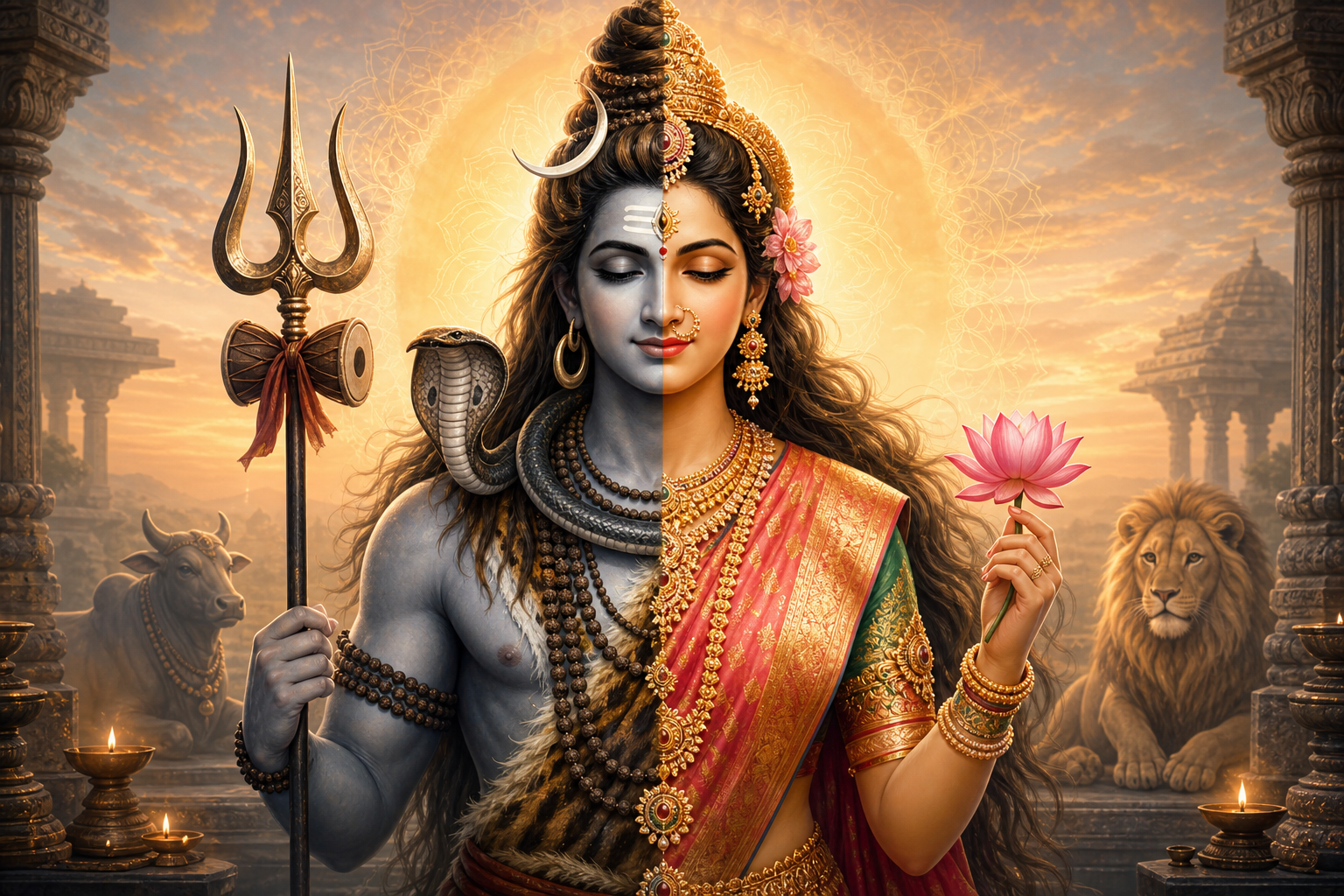
Ardhanarishvara Shiva stands among the most profound forms in Hindu iconography: a single divine body in which Lord Shiva and Parvati Mata appear as one, half male and half female. The form is usually depicted with Shiva on the right side and Parvati, also understood as Shakti, on the left side, though regional artistic traditions may vary. This image is not presented as a decorative curiosity but as a theological statement: consciousness and energy, stillness and movement, ascetic depth and creative abundance are inseparable.
The Sanskrit name Ardhanarishvara is commonly explained through three parts: ardha, meaning half; nari, meaning woman; and ishvara, meaning Lord. The name therefore points to the Lord who is half woman, yet its philosophical meaning goes far beyond physical division. It expresses a vision in which the divine is not restricted to one gender, one social role, or one narrow symbolic category. The form teaches that wholeness is born through integration, not opposition.
In devotional understanding, Ardhanarishvara represents the inseparability of Shiva and Shakti. Shiva is often interpreted as pure consciousness, the silent and unchanging principle. Shakti is understood as dynamic power, the Mother Goddess whose presence animates creation, sustenance, transformation, and spiritual awakening. Without Shakti, Shiva is stillness without expression; without Shiva, Shakti is movement without metaphysical ground. Ardhanarishvara brings these insights into a single sacred image.
The form also carries a powerful emotional appeal for devotees because it makes unity visible. In ordinary life, people often experience the world through separations: masculine and feminine, action and contemplation, intellect and feeling, body and spirit, domestic responsibility and renunciation. Ardhanarishvara does not deny these distinctions, but it refuses to treat them as hostile opposites. The image gently insists that harmony requires balance, mutual respect, and recognition of shared sacred origin.
Several Puranic traditions preserve stories and interpretations connected with Ardhanarishvara. The form is mentioned in relation to ancient Hindu scriptures and sacred literature, including the Shiva Purana, Skanda Purana, Linga Purana, Vishnu Purana, Vayu Purana, Kurma Purana, Markandeya Purana, Kalika Purana, and Matsya Purana. These texts do not always present a single uniform narrative. Instead, they offer layered theological reflections shaped by devotion, cosmology, ritual imagination, and regional storytelling.
In the Mahimnastava, the poet Pushpadanta refers to this united form through the expression dehardhaghatana, indicating the joining of bodies or the union of two halves. The Brihat Samhita uses the name Ardha-Gaurishvara, while the Vishnudharmottara Purana describes the form as Gaurishvara. These names are significant because they show that the idea of Shiva joined with Gauri or Parvati was not confined to one isolated tradition. It circulated through literature, temple art, devotional practice, and philosophical reflection.
The Skanda Purana preserves a devotional account in which Goddess Parvati performs worship and asks Shiva to allow her to reside with him. Shiva accepts her request, and the form of Ardhanarishvara arises as an expression of complete union. The story is simple, but its theological implications are deep. Parvati is not placed outside Shiva as a secondary figure; she becomes visibly one with him. The divine couple is understood as a shared reality rather than two competing principles.
Another Skanda Purana-related account connects Ardhanarishvara with the demon Andhakasura. When Andhakasura desires to seize and marry Parvati, she reveals the Ardhanarishvara form. The revelation becomes a teaching: Parvati cannot be possessed as an object separate from Shiva, and Shiva cannot be approached while ignoring Shakti. The form disrupts ego, desire, and domination by showing that the Goddess is sovereign, inseparable, and metaphysically complete.
The Shiva Purana gives another important cosmological dimension. Brahma, seeking the continuation of creation, worships the female half of Ardhanarishvara. From the Goddess arise female powers through which creation is able to proceed. This account places Shakti at the center of cosmic fertility and manifestation. Creation does not unfold through masculine agency alone; it requires the creative potency of the Divine Feminine.
Other Puranic accounts, including those associated with the Linga Purana, Vishnu Purana, Vayu Purana, Kurma Purana, and Markandeya Purana, describe Shiva appearing before Brahma as Ardhanarishvara when creation has not progressed with sufficient vitality. The symbolism is clear: creation requires polarity held in unity. It requires consciousness, energy, order, fertility, knowledge, and power working together. Ardhanarishvara therefore becomes a visual theology of cosmic completion.
The Matsya Purana presents another narrative in which Parvati performs severe penance and receives from Brahma the boon of a golden complexion. Shiva is then drawn toward Parvati and merges as one with her body. This story emphasizes tapas, grace, beauty, and union. Parvati’s spiritual discipline is not merely ornamental; it transforms the divine relationship into a visible form of non-separation.
South Indian tradition preserves a well-known story involving Bhringi, a devotee who worships Shiva alone and refuses to honor Shakti. To teach that Shiva and Shakti cannot be separated, the Goddess merges with Shiva, forming Ardhanarishvara. The lesson is especially important for Hindu spiritual life: devotion that excludes the Divine Feminine is incomplete, just as worship of power without awareness of consciousness remains partial. The image calls the devotee back to fullness.
The Kalika Purana offers a related idea in which Parvati merges with Shiva so that she may remain eternally with him. North Indian tellings also associate the form with Parvati’s wish to be united with Shiva, especially in narratives where Ganga is present on Shiva’s head and Parvati is described as feeling distant from him. Such stories should be read with care. Their deeper function is not to reduce the Goddess to jealousy but to communicate the devotional longing for inseparable presence.
Iconographically, Ardhanarishvara is one of the most refined visual expressions in Hindu art. The Shiva half may bear matted hair, a crescent moon, serpent ornaments, rudraksha beads, ash marks, a trident, or other Shaiva attributes. The Parvati half may carry graceful ornaments, a rounded breast, silk garments, feminine jewelry, a lotus, mirror, or other signs of beauty and auspiciousness. The result is not confusion but harmony: every detail helps the viewer recognize the sacred balance of the form.
The right half is usually the male Shiva, showing the conventional attributes of the ascetic Lord. The left half is usually Parvati Mata, representing Shakti, fertility, beauty, compassion, and cosmic activity. This placement itself has generated rich interpretation. In many ritual and symbolic systems, right and left are not merely directions but carriers of meaning. Ardhanarishvara unites these directional, bodily, and spiritual symbols into one coherent sacred image.
The vahanas, or vehicles, associated with Ardhanarishvara also express theological unity. Sometimes the form is shown with Nandi, the bull of Shiva, as the common vahana. In other depictions, Nandi appears with the Shiva side while the lion, associated with Parvati and the fierce protective power of the Goddess, appears with the Shakti side. These visual choices help worshippers understand that the form contains both serene devotion and royal power, both steadiness and courage.
Ardhanarishvara is especially important for understanding Hindu philosophy of unity. The image should not be reduced to a modern political slogan or a narrow social category, though it can certainly inspire reflection on dignity, gender balance, and mutual respect. Its primary meaning is metaphysical: reality itself is whole, and apparent dualities are held within a deeper unity. The divine is not fragmented by difference; rather, difference becomes meaningful when rooted in unity.
This principle resonates with wider Dharmic traditions. Hinduism, Buddhism, Jainism, and Sikhism each preserve distinct teachings, practices, and philosophical vocabularies, yet all value discipline, insight, ethical life, liberation from ego, and reverence for truth. Ardhanarishvara belongs specifically to Hindu Shaiva and Shakta traditions, but its broader lesson of integration can encourage respectful dialogue across Dharmic paths. Unity does not require sameness; it requires clarity, humility, and reverence for sincere spiritual striving.
In Shaiva thought, Shiva without Shakti is sometimes described as shava, a lifeless body, because power is necessary for expression. This is not a denial of Shiva’s supremacy in devotional Shaivism; it is a way of expressing that divine consciousness and divine power cannot be meaningfully separated. The Mother Goddess is not an accessory to the Lord. She is the energy through which the Lord is known, worshipped, and experienced.
In Shakta understanding, the emphasis naturally falls on the Goddess as the living force of the cosmos. Ardhanarishvara honors that insight while also preserving Shiva’s role as consciousness, witness, and transcendent ground. This is why the form is so effective as a bridge between Shaiva and Shakta devotion. It refuses sectarian rivalry and instead reveals that both devotional orientations can meet in one sacred body.
The form also speaks to household life and spiritual practice. Shiva is often imagined as the great yogi, detached from worldly entanglement, while Parvati is associated with family, fertility, tenderness, and the living rhythms of the world. Ardhanarishvara brings these modes together. A balanced life does not demand the rejection of the world nor the abandonment of spiritual discipline. It asks for inner integration, ethical restraint, devotion, and awareness.
For many devotees, meditating on Ardhanarishvara offers a quiet correction to imbalance. A person inclined only toward action may remember stillness. A person inclined only toward withdrawal may remember service. A person trapped in rigid identity may remember the subtlety of the soul. A person divided by inner conflict may find in the image a reminder that healing often begins when rejected parts of the self are brought into sacred relationship.
Temples dedicated to Ardhanarishvara are especially associated with Tamil Nadu. The form is worshipped in important shrines, including the celebrated temple at Tiruchengode and traditions connected with Kallakkurichi taluk. In South Indian temple culture, theology is not confined to manuscripts. It is experienced through darshan, sculpture, ritual, procession, music, lamps, flowers, mantras, and the embodied memory of generations. Ardhanarishvara becomes not only a doctrine but a living presence.
The worship of Ardhanarishvara also appears in hymns and stotras. Among the most popular is the Ardhanarishwara Ashtakam attributed to Adi Shankaracharya. This hymn praises the combined form of Shiva and Parvati through poetic contrasts: ascetic and adorned, fierce and gentle, masculine and feminine, still and dynamic. The devotional power of the hymn lies in its ability to make philosophy sing.
Ardhanarishvara should also be studied alongside other forms of Lord Shiva, such as Dakshinamurthy, Nataraja, Bhairava, Virabhadra, Sharabha, and Somaskanda. Each form reveals a different dimension of Shiva’s nature: teacher, dancer, protector, warrior, cosmic force, and family-centered deity. Ardhanarishvara is unique because it reveals Shiva not as solitary divinity alone but as divinity inseparable from Shakti.
The theological value of Ardhanarishvara is especially relevant in a time when societies often struggle with fragmentation. The image offers a disciplined way of thinking about complementarity without hierarchy. It does not erase difference, and it does not turn difference into conflict. It presents a sacred model in which two aspects retain their recognizability while participating in one truth.
Academically, Ardhanarishvara may be approached through iconography, textual history, ritual studies, gender symbolism, theology, and philosophy. Devotionally, the form may be approached through prayer, contemplation, temple worship, mantra, and reverence for Shiva and Parvati. Both approaches can enrich one another when handled with care. Scholarship helps clarify sources and meanings, while devotion preserves the living heart of the tradition.
The enduring significance of Ardhanarishvara lies in its ability to express a truth that is both simple and inexhaustible: the divine is complete. Shiva and Shakti are not rivals, and masculine and feminine are not enemies. Creation itself rests upon their unity. To contemplate Ardhanarishvara is to contemplate balance, wholeness, interdependence, and the sacred dignity of all complementary forces within existence.
Inspired by this post on Hindu Pad.




Leave a Reply
You must be logged in to post a comment.