
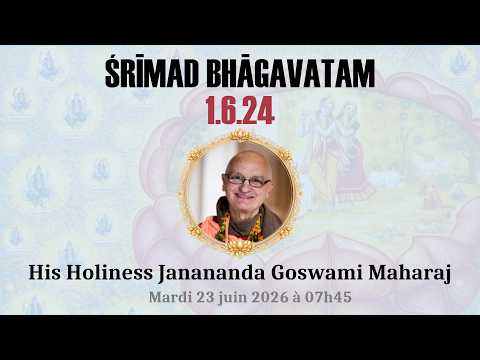

The featured discourse on Srimad Bhagavatam 1.6.24, delivered by His Holiness Janananda Goswami Maharaja on Tuesday, 23 June 2026, turns attention toward one of the most consoling and philosophically precise assurances in the Bhagavata Purana: devotion anchored in the Divine is not lost. The verse appears in the first canto, in the conversation between Narada and Vyasa, where Narada describes the formative spiritual experiences that transformed his earlier life and prepared him for his eternal service as a sage, teacher, and carrier of divine remembrance.
The Sanskrit verse reads: मतिर्मयि निबद्धेयं न विपद्येत कर्हिचित् । प्रजासर्गनिरोधेऽपि स्मृतिश्च मदनुग्रहात् ॥ २४ ॥ Its transliteration is: matir mayi nibaddheyaṁ na vipadyeta karhicit prajā-sarga-nirodhe ’pi smṛtiś ca mad-anugrahāt. In simple terms, the verse teaches that intelligence fixed in devotion to Bhagavan does not become separated from Him, and that remembrance continues by divine grace even through cosmic creation and dissolution.
This teaching is central to the devotional theology of the Srimad Bhagavatham. It does not present spiritual life as a temporary mood, a cultural habit, or a psychological comfort alone. It presents bhakti as an ontological realignment of consciousness. When the mind, intelligence, and memory become connected with Krishna, they are no longer merely private mental functions; they become instruments of an enduring relationship between the finite self and the eternal Divine.
The immediate narrative context is important. Narada, in his previous life, had received the association of saintly persons and had developed sincere devotion through service, listening, humility, and disciplined remembrance. After his mother died, he wandered alone and eventually received a brief vision of the Lord. That vision was withdrawn, yet the withdrawal was not rejection. It became a deeper form of instruction. The Lord assured him that the taste of devotion would mature and that remembrance would not be destroyed.
The verse therefore speaks to a common spiritual anxiety: whether effort in sadhana is ever wasted. In ordinary life, many efforts seem fragile. Memory fades, discipline weakens, relationships change, and achievements can be undone by time. Srimad Bhagavatam 1.6.24 offers a different measure of value. It suggests that devotional impressions created by sincere hearing, chanting, service, and remembrance are not erased by visible interruption. They are preserved by anugraha, divine grace.
The word mati refers to intelligence, understanding, or inward orientation. In this verse, intelligence is not treated as dry analysis. It is a faculty that can be bound, directed, and sanctified. When mati is mayi nibaddha, fixed in the Divine, thought becomes more than argument. It becomes a disciplined power of remembrance, discrimination, and love. This is why the Bhagavata tradition does not oppose reason and devotion. Rather, it asks reason to become purified through service to truth.
The phrase na vipadyeta karhicit carries a strong assurance: such devotion is not ruined at any time. This does not mean that practitioners never experience confusion, distraction, grief, or weakness. The Bhagavata Purana is too realistic for such simplification. It means that sincere devotional orientation creates a spiritual continuity deeper than the fluctuating states of the mind. Even when the surface of life becomes unstable, the inner current of remembrance can continue.
The phrase prajā-sarga-nirodhe ’pi expands the teaching from individual life to cosmic time. Creation and dissolution are not merely poetic images here; they represent the vast cycles through which material conditions arise and subside. The Bhagavata Purana places human life inside this larger cosmology to show that the soul is not reducible to one biography, one social identity, or one historical moment. Devotion belongs to a continuity that outlasts material rearrangement.
Smṛti, or remembrance, is a technical and devotional term of great importance. In daily practice, remembrance may begin with simple acts: reciting a name, listening to katha, bowing before the murti, reading a verse, serving prasada, or pausing before action to ask whether it is aligned with dharma. Over time, remembrance becomes less episodic and more formative. It begins to shape instincts, speech, priorities, relationships, and the way suffering itself is interpreted.
The verse also protects spiritual life from a purely achievement-oriented mentality. In many modern settings, discipline is judged by measurable output: how much was completed, how quickly progress occurred, how visibly success appeared. Bhakti operates by another logic. Sincere effort may be hidden, gradual, and even externally unimpressive, yet it can be spiritually decisive. A single act of genuine remembrance may become a seed that continues to grow beyond the practitioner’s immediate awareness.
His Holiness Janananda Goswami Maharaja’s featured Bhagavatam class is therefore best understood not only as a video lecture, but as part of the traditional discipline of shravana, sacred hearing. In the Vaishnava tradition, scripture is not merely read as literature. It is heard in a living chain of transmission, where guru, sadhu, and shastra work together to refine understanding. The listener receives not only information, but orientation.
This guru-shishya dimension is essential to the Bhagavata method. Narada himself becomes an example of learning through association. He does not become spiritually transformed through self-invention or intellectual pride. He receives grace through humility, service, and attentive hearing. That structure remains relevant for contemporary seekers, because it challenges the modern tendency to treat spirituality as a private consumer preference rather than a disciplined relationship with truth.
At the same time, the verse has broad significance across Dharmic traditions. Hindu, Buddhist, Jain, and Sikh paths preserve distinct metaphysical frameworks, yet each honors disciplined remembrance, ethical refinement, and the transformation of consciousness. Whether expressed as smarana, sati, anupreksha, simran, japa, dhyana, or seva, the principle is recognizable: the inner life is shaped by what it repeatedly remembers, serves, and loves.
Such unity does not require erasing theological differences. The Bhagavata Purana speaks from a Vaishnava vision centered on Krishna bhakti, while other Dharmic traditions articulate liberation, discipline, and compassion in their own precise vocabularies. Yet respectful comparison can strengthen mutual understanding. It shows that Dharmic civilization has long treated memory, conduct, and consciousness as sacred responsibilities rather than casual mental events.
For ordinary readers and listeners, the emotional force of Srimad Bhagavatam 1.6.24 lies in its assurance that spiritual beginnings matter. A person may not feel advanced. A household may be busy. A student may be distracted. A professional may struggle to maintain regular sadhana. A grieving person may feel spiritually numb. Yet the Bhagavata’s message is that a sincere devotional connection, once awakened, is not trivial. It can be protected, nourished, and revived by grace.
This is particularly relevant in an age of fragmented attention. Digital life trains the mind to move quickly from one stimulus to another. The Bhagavata trains the mind in the opposite direction: toward stable remembrance. The verse does not ask for passivity. It calls for intentional engagement of intelligence. Hearing the Srimad Bhagavatham, chanting the names of Krishna, studying with care, and serving with humility become practical ways to bind the mind to what is enduring.
The theological center of the verse is mad-anugrahāt, by divine mercy. This prevents devotion from becoming egoistic. The practitioner strives, but the final preservation of remembrance is not claimed as personal conquest. It is received as grace. This balance between effort and mercy is one of the defining features of bhakti. Sadhana prepares the heart, but the fruit of spiritual remembrance is bestowed by Bhagavan.
Srimad Bhagavatam 1.6.24 also clarifies why scripture study should not be reduced to moral advice alone. The verse is ethical, but it is more than ethics. It is devotional, metaphysical, and cosmological. It teaches what the self can become when intelligence is directed toward Krishna. It teaches why remembrance can outlast death and cosmic change. It teaches that divine relationship is not manufactured by the mind, but awakened and sustained through mercy.
The practical conclusion is direct: one should not underestimate small acts of sincere devotion. A verse heard attentively, a mantra chanted with humility, a service rendered without display, a moment of gratitude before Bhagavan, or a decision to act according to dharma can leave impressions that endure. The Bhagavata Purana asks the listener to trust that spiritual life has depth beyond immediate emotional evidence.
Viewed in this way, the featured video becomes an invitation to return to the discipline of sacred hearing. It places the listener before a verse that is brief in form yet immense in implication. Srimad Bhagavatam 1.6.24 teaches that when intelligence is fastened to divine devotion, remembrance is not finally defeated by time, instability, or even cosmic dissolution. By mercy, devotion continues; by remembrance, life becomes oriented toward the eternal.
Inspired by this post on Dandavats.
