
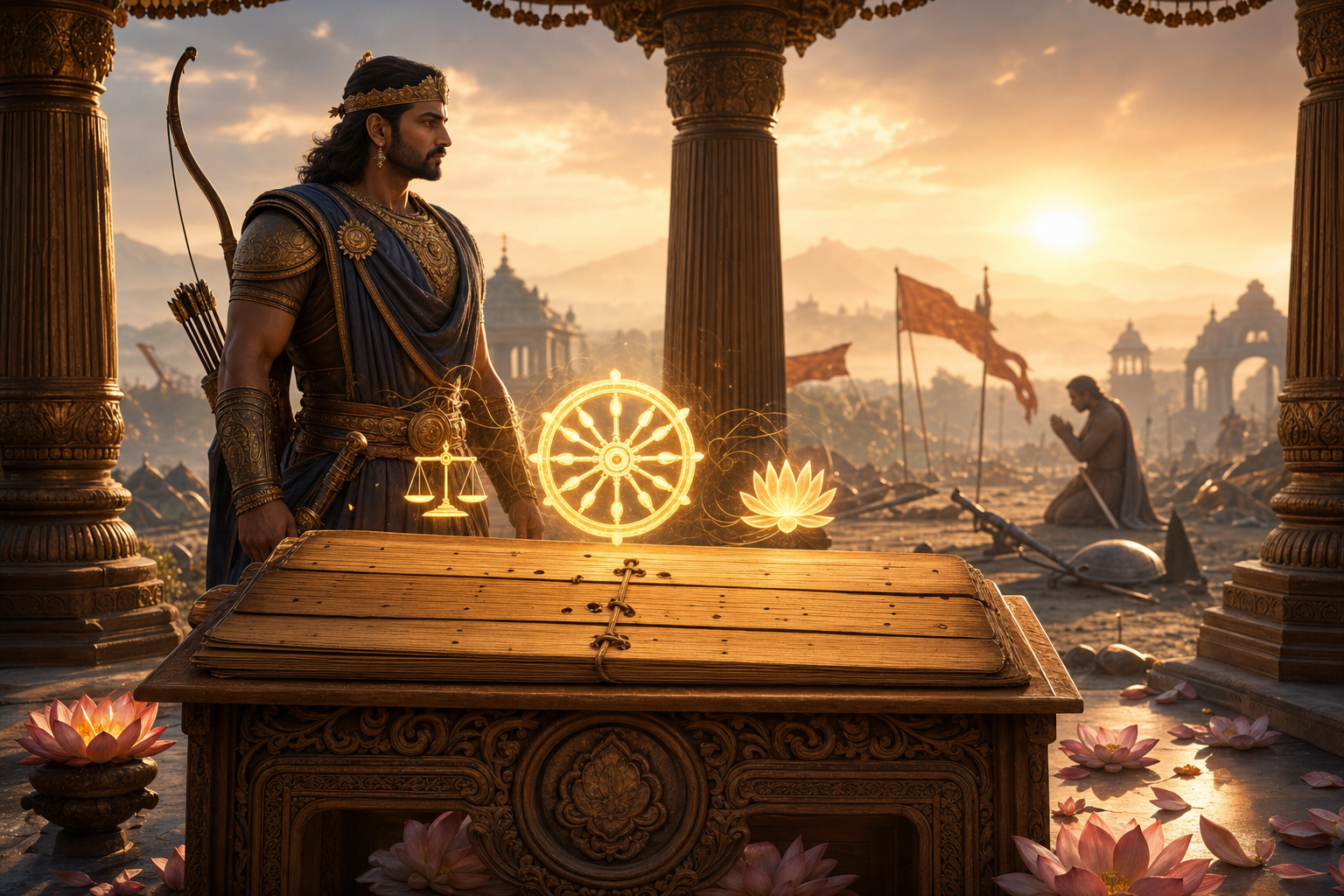
Dharmayuddha, often translated as righteous warfare, occupies a serious and morally demanding place in ancient Indian thought. It does not glorify violence; rather, it asks whether the use of force can be restrained by dharma, justice, discipline, proportionality, and compassion. In this sense, the Manusmriti presents warfare not as an unrestricted exercise of power, but as a sphere in which moral obligations continue to bind rulers, soldiers, and society.
The subject is especially important because ancient Indian political thought did not treat war as a lawless exception to ethics. The same civilization that reflected deeply on ahimsa, tapas, self-control, and spiritual liberation also recognized that rulers might face the harsh duty of defending people, territory, order, and sacred institutions. The question was therefore not merely whether war happens, but how conduct in war can remain answerable to a higher moral order.
In the Manusmriti, this concern appears within the broader framework of rajadharma, the duties of kingship. A ruler is expected to protect the vulnerable, punish aggression, preserve social stability, and act as a guardian of justice. Warfare, when unavoidable, is placed under this same discipline. It is not treated as an arena where anger, cruelty, revenge, or opportunism may rule unchecked.
The central insight of Dharmayuddha is that moral restraint is most meaningful precisely when restraint is hardest. It is easy to speak of ethics in peaceful times; it is far more demanding to preserve dignity when fear, rage, injury, and survival dominate human behavior. The Manusmriti’s rules on warfare speak to this difficult threshold, where political necessity and moral responsibility meet.
Several verses traditionally associated with the Manusmriti’s discussion of warfare lay down specific restrictions on battlefield conduct. They prohibit the use of certain cruel or deceptive weapons, including concealed weapons, poisoned weapons, barbed weapons, and weapons burning with fire. The underlying principle is clear: even when combat is permitted, unnecessary suffering and dishonorable methods are condemned.
This restraint is significant because it distinguishes legitimate force from mere violence. A battle fought for protection or justice may still become adharmic if it depends on treachery, torture, indiscriminate harm, or deliberate cruelty. The Manusmriti therefore links the righteousness of a war not only to its cause, but also to the conduct of those who fight it.
The text also identifies categories of persons who should not be attacked. These include the disarmed, the wounded, the frightened, the sleeping, the naked, those whose weapons are broken, those who surrender, and those who are no longer actively engaged in combat. Such rules point toward a moral distinction between a combatant who is presently fighting and a person who has ceased to pose an immediate threat.
That distinction is one of the most technically important aspects of Dharmayuddha. It shows that battlefield ethics in the dharmic tradition were not based only on courage, honor, or victory, but also on discrimination, self-command, and proportional response. The warrior is not allowed to become a machine of destruction. He remains morally responsible even while facing danger.
The Manusmriti’s prohibition against striking one who folds the hands in supplication is especially revealing. It recognizes surrender as morally meaningful. A defeated or pleading enemy is no longer to be treated as an object of vengeance. The warrior is expected to remember that power over a helpless person is a test of dharma, not an invitation to humiliation or cruelty.
The same logic applies to the instruction not to attack one who is already fighting another opponent. This rule discourages opportunistic violence and insists upon fairness within the limits of battle. It reflects an older heroic code in which combat is not simply about eliminating the enemy by any means, but about preserving a disciplined relation between force and honor.
Modern readers may notice a resemblance between these principles and later discussions of humanitarian restraint in war. The Manusmriti is not identical to modern international law, and it belongs to a very different historical and textual universe. Yet its concern for non-combatant protection, surrender, proportionality, and limits on weapons shows that ethical reflection on warfare has deep roots in Indian civilization.
Dharmayuddha must also be understood alongside the Mahabharata, especially the Kurukshetra War, where the tragedy of conflict is explored with extraordinary psychological depth. The Mahabharata repeatedly shows that war, even when fought for dharma, leaves wounds in families, kingdoms, and human conscience. Victory does not erase grief. This wider dharmic setting prevents righteous warfare from becoming a simplistic celebration of violence.
The Bhagavad Gita adds another dimension by focusing on intention, duty, and inner discipline. Arjuna’s crisis is not that he lacks courage, but that he understands the human cost of war. Sri Krishna’s teaching does not reduce dharma to aggression. It demands action without selfish attachment, hatred, or moral confusion. This philosophical background helps explain why Dharmayuddha is not merely military doctrine; it is also an ethical and spiritual problem.
Within the Manusmriti, the king’s duty to protect society is inseparable from self-control. A ruler who acts from greed, anger, vanity, or conquest for its own sake falls away from dharma. The disciplined use of force is therefore tied to governance, justice, and accountability. War is never presented as a normal or desirable condition; it is a grave instrument that must remain subordinate to order and righteousness.
This is why the term Dharma-Yuddha should not be reduced to a slogan. It is a demanding moral category. A conflict cannot become righteous merely because one side claims sacred language or cultural identity. It must be examined through cause, intention, conduct, restraint, treatment of the vulnerable, and willingness to restore peace. Without these tests, the language of dharma can be misused.
The technical structure of Dharmayuddha may be understood through several connected principles. The first is legitimate cause: force is justified only when it protects justice, order, and the innocent against aggression or grave disorder. The second is right intention: war must not be driven by hatred, revenge, greed, or needless expansion. The third is proportional conduct: the force used must not exceed the moral and practical necessity of the situation.
The fourth principle is discrimination between those who fight and those who do not. The Manusmriti’s concern for the disarmed, wounded, surrendering, sleeping, and frightened reflects this moral boundary. The fifth principle is honorable means: certain weapons and methods are rejected because they intensify suffering or undermine fairness. The sixth is restoration: the final aim of righteous force is not endless hostility, but the re-establishment of dharma.
These principles are not merely historical curiosities. They challenge contemporary society to think more carefully about power. Whether the context is national security, community protection, political conflict, or social debate, dharmic ethics asks that strength be joined with restraint. Power without dharma becomes domination. Courage without compassion becomes brutality. Justice without self-control can become vengeance.
At the same time, Dharmayuddha does not teach passivity in the face of injustice. The dharmic traditions of Hinduism, Buddhism, Jainism, and Sikhism all wrestle in different ways with the relationship between non-violence, duty, compassion, and protection. Jainism gives extraordinary emphasis to ahimsa. Buddhism explores compassion and the tragic consequences of hatred. Sikhism preserves the ideal of the saint-soldier, where spiritual discipline and defense of the oppressed are held together. Hindu texts develop layered discussions of kshatra dharma, rajadharma, and moral action.
Seen together, these traditions do not produce a careless approval of violence. They produce a shared civilizational concern: force, if ever used, must be ethically restrained and spiritually accountable. This is where unity among dharmic traditions becomes important. Their vocabulary differs, their historical circumstances differ, and their disciplines differ, but they all resist the reduction of human life to conquest, cruelty, and ego.
The Manusmriti must also be read with historical care. It is a Dharmashastra text, composed within a complex legal, ritual, and social world. It should not be treated as a modern constitution, a battlefield manual, or a single unchanging voice for all Hindus. Its teachings were interpreted by commentators, debated across regions, and situated among other sources of dharma, including shruti, smriti, sadachara, and practical judgment.
This careful reading matters because ancient texts are often flattened in public discussion. Some readers either romanticize them without context or reject them without close study. A more responsible approach studies the text historically, philosophically, and ethically. In the case of Dharmayuddha, such study reveals a serious attempt to limit violence through rules of conduct, even within a world where warfare was politically unavoidable.
The emotional force of these teachings lies in their realism. Human beings know that conflict can awaken the darkest impulses: fear, revenge, humiliation, and the desire to destroy. The Manusmriti’s restrictions remind the warrior that the enemy’s vulnerability does not cancel his own duty. In a moment when he can easily cross the line, dharma asks him to stop.
This idea has enduring relevance beyond the battlefield. In family disputes, institutional struggles, political disagreements, and intellectual debates, people often justify harsh conduct by claiming that the other side deserves it. Dharmayuddha offers a deeper standard: even when opposition is real, conduct must remain disciplined. The measure of righteousness is not only the cause defended, but the manner in which it is defended.
From a civilizational perspective, the Manusmriti’s rules on warfare show that ancient Indian ethics recognized the danger of unrestrained force. The warrior’s honor was not measured only by victory, but by the ability to refuse dishonorable advantage. The king’s authority was not measured only by conquest, but by protection. The society’s moral health was not measured only by security, but by the preservation of dharma under pressure.
Dharmayuddha therefore stands at the intersection of Hindu scriptures, Indian philosophy, military ethics, and spiritual responsibility. It asks a difficult question that remains relevant today: can force be governed by conscience? The Manusmriti’s answer is that it must be, because without conscience, force becomes adharma even when it is wrapped in noble language.
The most valuable lesson is not that ancient warfare was always noble or that every historical ruler followed these rules perfectly. The deeper lesson is that dharmic thought preserved a normative ideal against which conduct could be judged. Ideals matter because they create standards, and standards make moral criticism possible. A society that teaches restraint in war has already recognized that victory alone is not enough.
In this sense, the Manusmriti’s teaching on Dharmayuddha remains a profound contribution to the study of ethics. It does not ask society to deny the reality of conflict, but it refuses to let conflict become morally unlimited. It places the warrior, the ruler, and the community under the discipline of dharma. That discipline is the heart of righteous warfare: strength guided by justice, courage softened by compassion, and victory restrained by honor.
Inspired by this post on Hindu Blog.
