
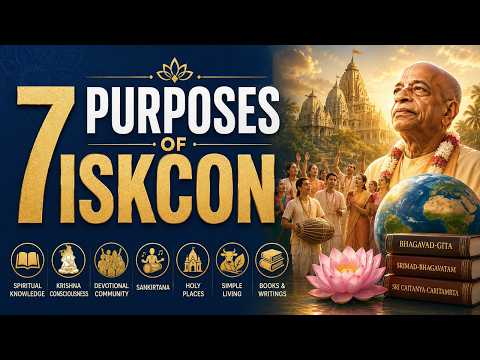
The featured discourse, The Seven Purposes of ISKCON | HH Krishna Kshetra Swami | ISKCON Radhadesh | 12.06.2026, offers an opportunity to revisit the institutional vision that shaped the International Society for Krishna Consciousness, widely known as ISKCON or the Hare Krishna Movement. Although the video format is brief in its presentation on the page, the subject itself is substantial: the seven foundational purposes articulated by A. C. Bhaktivedanta Swami Prabhupada when ISKCON was incorporated in 1966. These purposes are not merely administrative statements. They form a theological, educational, cultural, and social framework for the practice of bhakti yoga in the modern world.
ISKCON belongs to the Gaudiya Vaishnava tradition, a devotional current within Sanatana Dharma centered on Sri Krishna, the teachings of Bhagavad Gita, Srimad Bhagavatam, and the devotional legacy of Sri Chaitanya Mahaprabhu. Its seven purposes are best understood as a practical map: they move from spiritual education to Krishna consciousness, from community formation to sankirtana, from sacred space to simple living, and finally to publishing and knowledge distribution. Together, they present religion not as a private sentiment alone, but as a disciplined culture of learning, worship, service, and ethical transformation.
The first purpose emphasizes the systematic propagation of spiritual knowledge to society at large. This is a technically important phrase because it avoids reducing spirituality to emotion, ritual habit, or inherited identity. Spiritual knowledge, in the ISKCON framework, includes ontology, ethics, psychology, practice, and social responsibility. It asks what the self is, what consciousness is, how desire shapes conduct, how values become imbalanced, and how disciplined spiritual practice can help cultivate peace. In an age of distraction, loneliness, and moral fragmentation, this purpose remains deeply relevant because it treats spiritual education as a public good rather than a sectarian luxury.
The second purpose is to propagate Krishna consciousness as revealed in Bhagavad Gita and Srimad Bhagavatam. In academic terms, this gives ISKCON its scriptural center and theological identity. Krishna consciousness is not merely admiration for Krishna as a cultural figure; it is the cultivation of conscious relationship with the Divine through devotion, remembrance, service, and surrender. The Bhagavad Gita frames this through dialogue, duty, discernment, yoga, and devotion, while Srimad Bhagavatam develops a devotional theology in which love of Bhagavan becomes the highest aim of life. The emotional force of this teaching lies in its accessibility: the spiritual journey is presented not as an escape from ordinary duties, but as a transformation of intention within daily life.
The third purpose concerns community: bringing members together with each other and nearer to Krishna. This purpose is sociologically significant because religious life rarely matures in isolation. Association, or satsanga, provides correction, encouragement, shared memory, and continuity. A temple, congregation, study circle, kirtan gathering, or family practice becomes a living context where values are embodied. The deeper idea is that each soul is connected to Krishna and therefore spiritually related to every other being. Properly understood, this has the capacity to soften ego, reduce social alienation, and encourage humility in relationships.
This community principle also resonates with the broader dharmic emphasis on harmony among diverse paths. Hinduism, Buddhism, Jainism, and Sikhism differ in metaphysics, disciplines, language, and historical formation, yet they share serious concern for self-mastery, compassion, truthfulness, disciplined practice, and liberation from narrow egoism. A mature reading of ISKCON’s purposes should therefore strengthen dharmic unity rather than produce sectarian rivalry. Krishna bhakti can be honored in its own theological integrity while also respecting the ethical and contemplative contributions of other dharmic traditions.
The fourth purpose is to teach and encourage the sankirtana movement, especially the congregational chanting of the holy names of God as taught by Sri Chaitanya Mahaprabhu. Sankirtana is both a spiritual practice and a social technology. It joins sound, memory, rhythm, breath, attention, and collective participation. The Hare Krishna maha-mantra is central to ISKCON practice because chanting is understood as a direct method for purifying consciousness and reorienting the mind toward Krishna. Even from a nonsectarian perspective, congregational chanting reveals how shared sacred sound can create emotional cohesion, regulate attention, and open space for reflection beyond the pressures of ordinary life.
The fifth purpose refers to establishing holy places dedicated to the transcendental pastimes of Krishna. This includes temples, pilgrimage centers, and devotional spaces where worship, festivals, education, music, food distribution, and community life can be organized. Sacred architecture in ISKCON is not only decorative; it functions pedagogically. The altar, murti worship, kirtan hall, prasada area, book distribution table, classroom, and festival procession all teach through embodied experience. For many visitors, a temple is the first point of contact with Hindu spirituality, bhakti yoga, Sanskrit vocabulary, vegetarian sacred food, and the devotional arts.
The sixth purpose promotes a simpler and more natural way of life. This principle is often misunderstood if separated from its spiritual foundation. It does not necessarily demand nostalgia or rejection of modern tools. Rather, it asks whether consumption, speed, competition, and sensory overload have displaced clarity, gratitude, restraint, and service. In the Vaishnava context, simplicity includes disciplined habits, sanctified food, respect for cows and nature, meaningful work, family and community responsibility, and time reserved for chanting, study, and worship. Its technical significance lies in linking ecology, economics, psychology, and spirituality into one coherent lifestyle ethic.
The seventh purpose concerns publishing and distributing books, periodicals, and other writings. This has been one of ISKCON’s most visible contributions to global Hindu discourse. Textual transmission matters because a tradition survives not only through ritual performance, but also through commentary, translation, debate, and education. Srila Prabhupada’s translations and commentaries gave many readers outside India access to Bhagavad Gita, Srimad Bhagavatam, and Chaitanya Charitamrita through a devotional lens. In the digital age, this purpose extends naturally to lectures, archives, online courses, videos, podcasts, and carefully edited educational content.
HH Krishna Kshetra Swami’s association with this subject is especially appropriate because the seven purposes require both devotion and reflection. They cannot be reduced to slogans. Each purpose has practical implications for temple leadership, education, interfaith dialogue, family life, youth formation, food ethics, publishing standards, and public communication. The modern ISKCON community must therefore ask not only whether these purposes are remembered, but whether they are being implemented with intellectual honesty, compassion, cultural sensitivity, and fidelity to the bhakti tradition.
One of the most compelling aspects of the seven purposes is their movement from inner consciousness to public responsibility. Krishna consciousness begins with the transformation of the heart, but it does not end there. It expresses itself through education, community, music, sacred space, simpler living, and literature. This structure gives ISKCON a broad civilizational function: it seeks to preserve devotional wisdom while making it communicable across languages, cultures, and generations. That task requires accuracy, humility, and a willingness to engage contemporary questions without diluting core principles.
From a broader Hindu perspective, the seven purposes also show how a sampradaya can enter modernity without abandoning its scriptural roots. ISKCON’s public presence has often included festivals, Rath Yatra processions, prasada distribution, kirtan, book distribution, youth programs, and temple worship. These activities are not isolated events; they are expressions of a unified theological vision. When viewed through the lens of Bhagavad Gita, they reflect the integration of jnana, bhakti, karma, and disciplined practice in service of spiritual awakening.
The emotional appeal of this discourse lies in its reminder that institutions are healthiest when they remain accountable to their founding principles. Devotees and observers alike may feel the force of a simple question: what happens when spiritual communities remember why they exist? The answer suggested by ISKCON’s seven purposes is that spiritual life becomes more than ritual attendance. It becomes education for the mind, purification for the heart, friendship for the community, sacred sound for the senses, simplicity for the household, and wisdom for society.
In that sense, the seven purposes of ISKCON remain a valuable framework for anyone interested in Hindu spirituality, bhakti tradition, Krishna consciousness, and dharmic cultural renewal. They invite serious study rather than casual consumption. They also call for a generous but disciplined approach: devotion without fanaticism, scholarship without arrogance, community without exclusion, and tradition without hostility toward other dharmic paths. When interpreted in this spirit, the purposes become not only an institutional charter, but a living contribution to spiritual unity, ethical clarity, and cultural continuity.
Inspired by this post on Dandavats.
