

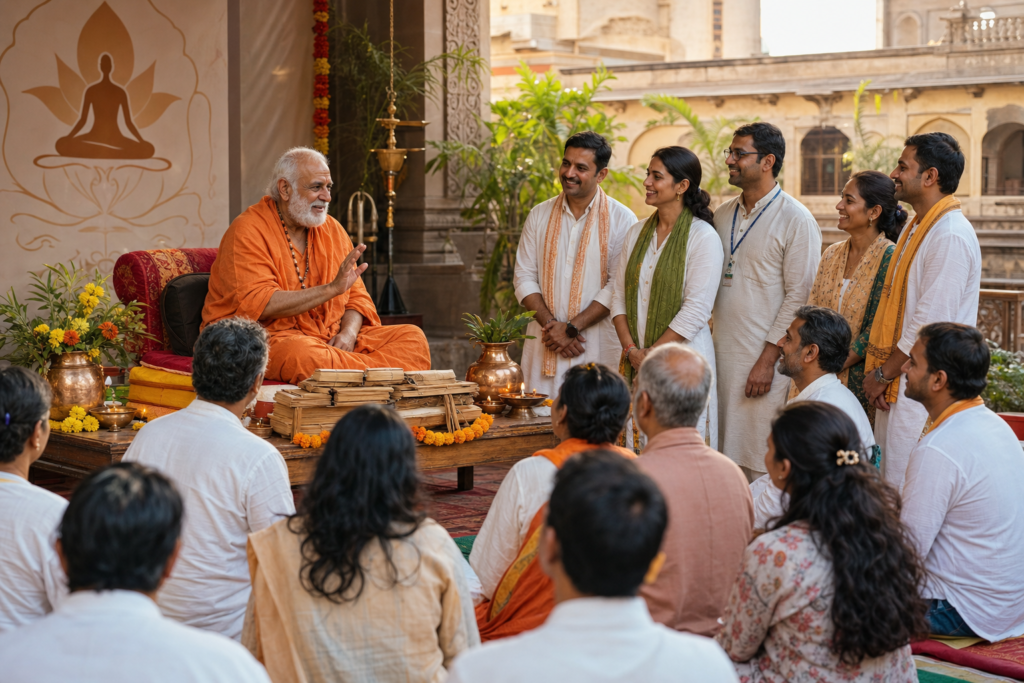
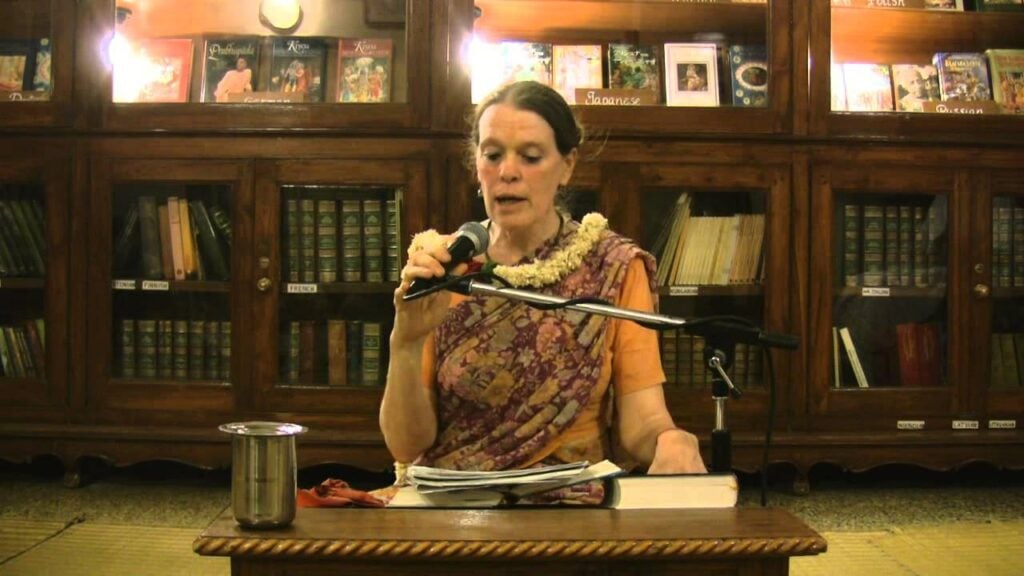
Śrīmad-Bhāgavatam 11.3.6, discussed in the lecture titled “His Grace Paramatma Prabhu || SB-11.03.06 || 24-06-2026,” presents a compact but profound diagnosis of human existence. The verse examines how the embodied living being, driven by desire, acts through the senses, accepts the fruits of action, and moves through alternating experiences of happiness and distress. Its teaching is not merely theological; it is psychological, ethical, and practical. It asks why human beings repeat patterns they already know to be painful, and how freedom can still exist within the apparent boundaries of karma.
The Sanskrit of the verse is: कर्माणि कर्मभि: कुर्वन्सनिमित्तानि देहभृत् । तत्तत्कर्मफलं गृह्णन्भ्रमतीह सुखेतरम् ॥ ६ ॥ In transliteration: karmāṇi karmabhiḥ kurvan sa-nimittāni deha-bhṛt tat tat karma-phalaṁ gṛhṇan bhramatīha sukhetaram. The central idea is that the embodied self performs action through the organs of action, motivated by inner causes, and then accepts the corresponding results while wandering through this world in pleasure and pain.
This verse appears in the Eleventh Canto of the Śrīmad-Bhāgavatam, within the broader teachings often associated with the Uddhava Gita and the wisdom of the nine Yogendras. The chapter is traditionally known for its analysis of liberation from māyā, or illusory identification. Its concern is not with abstract speculation alone. It studies the lived condition of the jīva, the conscious self, who mistakes the body, senses, desires, memories, and social roles for the whole of identity.
The phrase deha-bhṛt is especially important because it means the bearer or proprietor of the body. The body is not dismissed as evil, nor is embodied life treated as meaningless. Rather, the verse distinguishes between the conscious self and the embodied apparatus through which action is performed. This distinction is foundational to Hindu philosophy, particularly in Vedanta, Yoga, and Bhakti traditions. It also resonates with many dharmic approaches in Buddhism, Jainism, and Sikh thought, where unexamined attachment, egoic habit, and reactive living are treated as obstacles to freedom.
The verse identifies action as karmāṇi karmabhiḥ, actions performed through the instruments of action. In daily life, this includes speech, movement, consumption, work, reproduction, social behavior, and every outward expression of inward intention. Human life is not passive. Every day contains choices: what to say, what to avoid, what to pursue, whom to serve, what to remember, and what to normalize. The Bhāgavatam’s analysis is powerful because it does not reduce karma to fate; it connects karma to intention, desire, habit, and responsibility.
The word sa-nimittāni points to actions that are not random but motivated by causes. These causes include desire, fear, pride, envy, compassion, duty, devotion, ignorance, and longing. A person may perform the same external action with very different inner motivations. Giving charity may arise from compassion, prestige, guilt, or genuine seva. Speaking truth may arise from humility, cruelty, courage, or self-display. The verse invites a deeper ethical examination: the moral texture of karma is not found only in visible behavior but also in the intention that animates it.
In this sense, Śrīmad-Bhāgavatam 11.3.6 offers a remarkably practical map of spiritual psychology. Many people recognize the experience of repeatedly choosing what brings anxiety, exhaustion, or conflict, even after intellectually understanding the consequences. This is the condition of desire becoming momentum. A person may know that anger damages relationships, that indulgence weakens clarity, or that constant comparison destroys peace, yet still be drawn back into the same cycle. The verse calls this wandering, bhramati, a movement through the world shaped by the results of one’s own actions.
The phrase sukhetaram, happiness and its opposite, is deliberately realistic. Material life is not presented as only suffering, nor as stable happiness. It is mixed. There are pleasures of family, success, learning, service, beauty, food, music, and friendship. There are also losses, humiliations, illnesses, conflicts, disappointments, and separations. The embodied being moves through both, often trying to secure one and avoid the other. The Bhāgavatam’s insight is that both pleasure and pain, when tied to egoic action, keep consciousness bound to the cycle of reaction.
This teaching becomes especially relevant when examining the tension between karma and free will. A superficial reading may suggest that karma is fatalistic: past actions determine present circumstances, and present suffering is simply unavoidable. The Bhāgavatam tradition rejects that simplistic view. While past karma may create the field in which one acts, the human being retains meaningful agency within that field. One may not choose every circumstance, but one can choose the quality of response, the discipline of the senses, the sincerity of repentance, the direction of learning, and the cultivation of devotion.
Human freedom therefore does not mean total independence from cause and effect. It means the capacity to introduce conscious, dharmic, and spiritually informed action into the chain of causation. A person born into difficulty may still practice truthfulness. A person carrying painful memory may still refuse to pass that pain forward. A person habituated to selfishness may still begin seva. A person surrounded by distraction may still chant, study, meditate, and seek noble company. This is where dharma becomes active rather than theoretical.
The lecture theme implied by this verse is also deeply connected to the role of Paramātmā, the indwelling presence of the Divine. In Vaishnava theology, Paramātmā witnesses the actions of the living being, sanctions the field of experience, and offers guidance from within the heart. This does not erase responsibility. Rather, it deepens it. The inner witness means that spiritual life is not a public performance. The most consequential movements of the soul occur in intention, remembrance, surrender, and the quiet decisions that no audience sees.
Bhakti transforms the karmic cycle by changing the center of motivation. When action is performed only for personal enjoyment, social validation, or domination, it strengthens bondage. When action is offered in devotion, performed as duty, and purified by humility, it becomes a pathway toward liberation. This is the bridge between karma and Karma Yoga. The same hands that once grasped can serve. The same tongue that once criticized can chant and speak truth. The same mind that once wandered can remember Bhagavān.
From an academic perspective, this verse contributes to a larger dharmic conversation about moral causality. Hindu traditions often describe karma as a precise law connecting action and result. Jainism gives extraordinary attention to karma as a subtle bondage attached to the soul through passions and activity. Buddhism analyzes intentional action and its consequences through dependent origination and the formation of habit-patterns. Sikh teachings emphasize hukam, remembrance of the Divine Name, ethical labor, and freedom from ego. These traditions differ in metaphysics, but they share a serious concern with intention, attachment, discipline, and liberation from compulsive self-centeredness.
That shared concern is vital for dharmic unity. The verse should not be used to create sectarian superiority or to flatten all traditions into sameness. Its value lies in helping sincere seekers recognize a common problem: the mind becomes bound when desire governs action without wisdom. Whether one speaks of karma, māyā, avidyā, moha, haumai, or attachment, the practical challenge remains familiar. Human beings suffer when consciousness becomes trapped in craving, reaction, and false identification.
Śrīmad-Bhāgavatam 11.3.6 also corrects a common misunderstanding of spirituality as withdrawal from responsibility. The verse does not say that action should cease. It says that embodied action driven by material desire binds the living being to repeated results. The solution is not laziness, apathy, or denial of worldly duties. The solution is purification of motive, alignment with dharma, remembrance of the Divine, and disciplined engagement. In that sense, the Bhāgavatam supports a spiritually mature life of responsibility rather than escapism.
This has immediate relevance for modern readers. Contemporary life multiplies the instruments of action. Speech now travels through messages, comments, videos, and public platforms. Desire is amplified by advertising, algorithms, comparison, and constant stimulation. The senses are not merely tempted by nearby objects; they are pursued by entire industries designed to capture attention. Under such conditions, the teaching of the verse becomes sharper. The karmendriyas, the organs of action, now operate in an environment where one impulsive act can produce consequences far beyond the moment.
A dharmic reading of the verse therefore encourages attention before action. Before speaking, one may ask whether the words are truthful, necessary, and compassionate. Before consuming, one may ask whether the act strengthens clarity or deepens dependence. Before working, one may ask whether ambition is guided by service or by ego alone. Before reacting, one may ask whether the response will create more bondage or open space for wisdom. Such reflection is not sentimental morality; it is practical karma analysis.
The verse also explains why external success cannot by itself resolve inner restlessness. A person may obtain wealth, reputation, education, influence, or comfort, yet still remain governed by fear and dissatisfaction. This is not because material achievements are inherently worthless, but because they cannot substitute for self-knowledge. When the self is misidentified with temporary roles and outcomes, every gain becomes fragile and every loss becomes existential. The Bhāgavatam redirects attention from possession to consciousness.
In the bhakti tradition, the remedy is not merely intellectual discrimination but loving reorientation. The heart must be trained to desire rightly. Desire itself is not the enemy; misdirected desire is the problem. Longing for control binds, but longing for seva purifies. Longing for domination hardens the heart, but longing for divine remembrance softens it. Longing for endless consumption exhausts the senses, but longing for darśana, nāma, satsanga, and sacred study gives direction to human life.
The reference to happiness and distress also encourages humility in judging others. If every embodied being is moving through complex karmic conditions, then spiritual culture must combine accountability with compassion. Harmful actions should not be excused, yet the person acting under ignorance should not be reduced to that ignorance forever. Dharmic traditions at their best preserve both justice and the possibility of transformation. This balance is essential for families, communities, institutions, and public life.
For students of scripture, the verse provides a disciplined method of reading life itself. Every experience can become a site of inquiry: What desire is operating here? What action is being chosen? What result is being accepted? Is this pattern increasing clarity or bondage? Where is the opportunity for dharma? Where is the invitation to remember Paramātmā? Such questions bring the Śrīmad-Bhāgavatam out of the realm of distant sacred literature and into the immediacy of lived practice.
The enduring strength of Śrīmad-Bhāgavatam 11.3.6 lies in its refusal to flatter the ego. It states plainly that embodied beings wander under the influence of motivated action and its fruits. Yet the teaching is not pessimistic. By exposing the mechanics of bondage, it opens the possibility of freedom. One who understands the pattern can begin to interrupt it. One who sees the role of desire can purify desire. One who recognizes the witness within can act with reverence, responsibility, and devotion.
Thus, the verse becomes a powerful guide for inner awakening. It teaches that karma is not a doctrine meant for blame, fear, or resignation. It is a call to become conscious. Every action matters because consciousness matters. Every intention matters because it shapes the direction of the soul. Every moment of remembrance matters because it turns wandering into pilgrimage. In that transformation, the embodied being no longer moves helplessly between temporary pleasure and pain, but begins to walk the path of dharma, bhakti, and liberation.
Inspired by this post on Dandavats.






Leave a Reply
You must be logged in to post a comment.