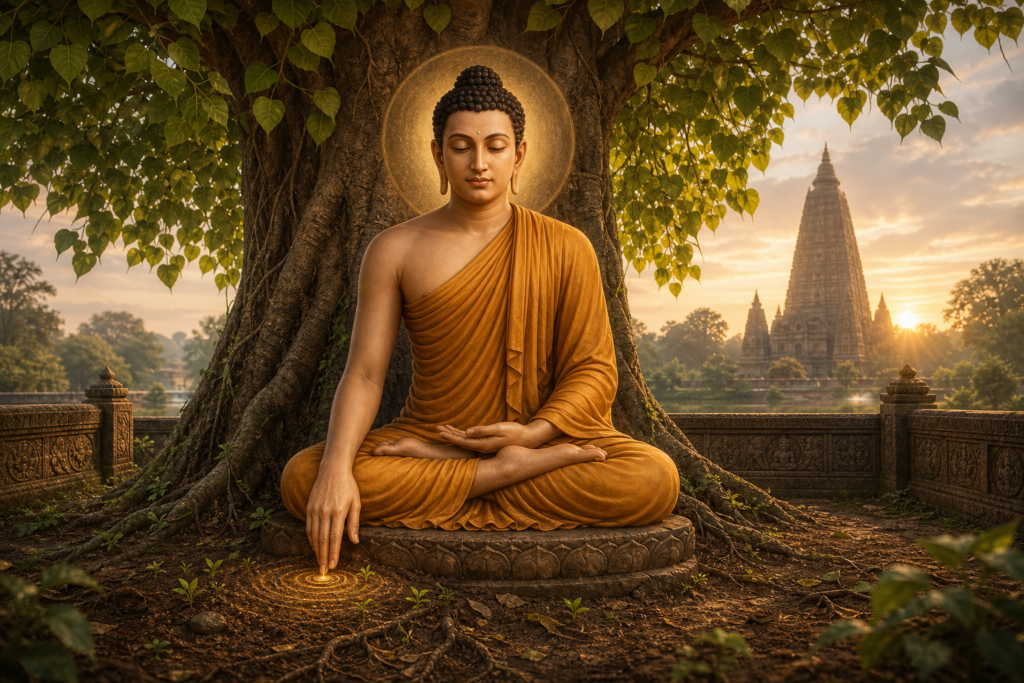
The statement, “Truth’s seed may be sown, but it must be nurtured by the soul,” encapsulates a central insight of Hindu philosophy with resonance across all dharmic traditions. It distinguishes between mere exposure to knowledge and the inward cultivation required for Self-Realization and Inner transformation. Within this understanding, truth initiates as an idea but matures through disciplined practice, reflection, and ethical living.
In classical Hindu thought, this maturation is mapped through the triad of shravaṇa (listening to the teaching), manana (reasoned contemplation), and nididhyāsana (deep meditation). The Upanishads and the Bhagavad Gita emphasize that knowledge aligned with dharma only bears fruit when stabilized by sadhanasteadfast Yoga, meditation, and mindful conduct. This process anchors Spiritual Growth not in abstraction, but in the lived clarity of action, intention, and awareness.
Across the dharmic family, the principle remains consistent. Buddhism describes the cultivation of truth as bhāvanāsystematic development of the mind through insight and compassion. Jainism, through anekantavada (the many-sidedness of truth) and aparigraha (non-possessiveness), elevates humility and disciplined living as essential conditions for truth to flourish. Sikh tradition integrates simran (remembrance) and seva (selfless service), demonstrating that truth matures when contemplation and action converge. Unity in spiritual diversity is thus not theoretical but practical, expressed through parallel commitments that nurture the same inner seed.
Placed in a contemporary context, the teaching offers a corrective to information saturation. Knowing about truththrough texts, talks, or digital mediadoes not equal living it. Many notice that only when ideas are repeatedly reflected upon, integrated into daily routines, and tested in relationships do they become stable traits. This is the difference between possessing concepts and embodying wisdom.
Practical nurturing begins with small, consistent disciplines. Brief daily meditation supports attentional steadiness; pranayama steadies emotion; svadhyaya (study of scripture) refines understanding; and karma yogaoffering one’s work without grasping at resultsaligns intention with dharma. Acts of seva cultivate compassion, transforming insight into conduct. Over time, these practices convert insight into character.
Obstacles naturally arise: distraction, doubt, and the pull of habit. Classical guidance recommends viveka (discernment) to differentiate the essential from the trivial, and vairagya (wise non-attachment) to release what impedes growth. By re-committing to foundational practicesYoga, meditation, and ethical clarityone reconditions attention and restores inner balance.
A helpful cycle for cultivation is fourfold: receive (shravaṇa), reflect (manana), practice (nididhyāsana and daily conduct), and review (honest self-assessment). Applied to teachings from the Upanishads or the Bhagavad Gita, this cycle transforms lofty truths into reliable capacitiespatience under pressure, compassion in conflict, and integrity in decision-making. The soul nurtures truth each time understanding becomes a steady response rather than a fleeting thought.
Because this insight is shared across Hinduism, Buddhism, Jainism, and Sikhism, it naturally fosters inter-traditional harmony. Where some approaches may promote a singular path, the dharmic vision recognizes plural means to the same summit. Such inclusion honors individual temperament while upholding a common purpose: to realize truth within and serve the world without.
When consistently nurtured, the “seed” of truth becomes a living strengtha stable center that guides choices, sustains resilience, and deepens compassion. In this way, the teaching moves from aphorism to lived reality: truth is sown by instruction, but only blossoms through the soul’s ongoing care.
Inspired by this post on Hindu Blog.