
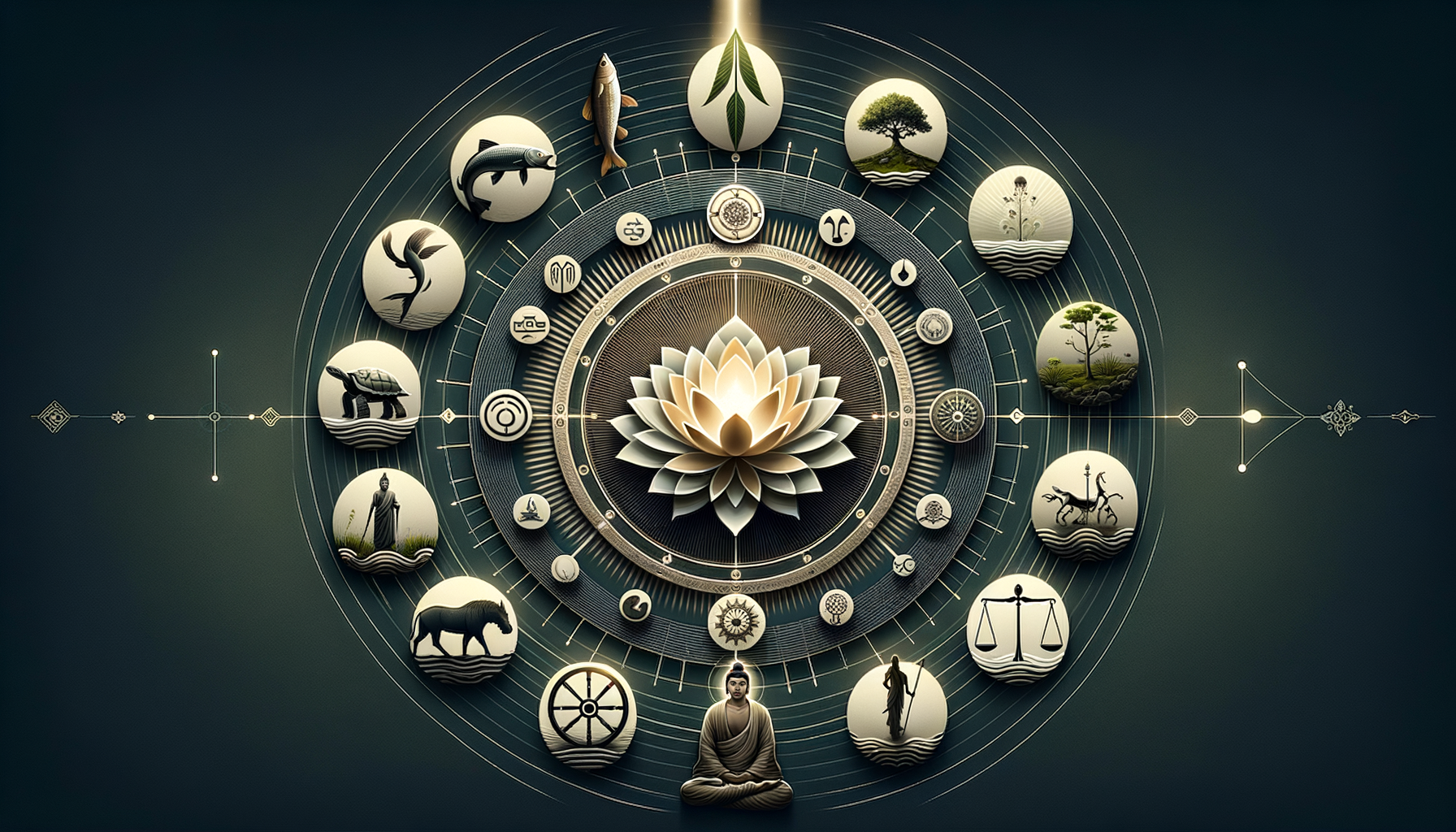
The Dashavatara, the ten incarnations of Lord Vishnu, has long inspired reflection beyond devotional practice. Read as a civilizational narrative, it offers a structured way to contemplate evolution, consciousness development, and cosmic order (dharma), while nurturing unity among the dharmic traditions of Hinduism, Buddhism, Jainism, and Sikhism. Rather than asserting anachronistic scientific claims, this perspective highlights how ancient India used symbolic storytelling to encode ecological insight, ethical formation, and metaphysical principles.
Interpreted through an academic lens, the sequence from Matsya and Kurma to Varaha and Narasimha evokes a movement from aquatic life and stabilization to terrestrial emergence and the crossing of boundariesmotifs that mirror evolutionary stages in a metaphorical, pedagogical sense. Vamana’s measured steps, Parashurama’s disciplined reform, Rama’s just statecraft, Krishna’s dynamic moral reasoning, the Buddha’s compassion-centered ethics, and Kalki’s eschatological renewal collectively map a journey from survival to societal order and ultimately toward inner awakening. This layered reading illustrates how ancient narratives guided communities to align personal growth with cosmic harmony.
In terms of consciousness, the avatars illustrate a progressive refinement of awarenessfrom instinct and protection to ethical deliberation and universal compassion. Hindu philosophy frames this ascent through dharma and the interplay of sattva, rajas, and tamas; Buddhist traditions emphasize bhavana (cultivation) and the transformation of mind; Jain philosophy underscores ahimsa, aparigraha, and disciplined self-mastery; Sikh thought illuminates living in harmony with hukam through seva and remembrance. Seen together, these dharmic voices converge on the shared goal of inner clarity, ethical action, and social responsibility.
The cosmology of the Puranas positions avataras as restorative responses to adharma, symbolizing periodic recalibration of moral order. This view complements ideas of cyclical time and ecological balance familiar to ancient India’s intellectual heritage. When read with sensitivity, the Dashavatara becomes not a sectarian claim but a civilizational grammar of resilience, reminding readers to uphold justice, steward nature, and cultivate compassion.
Textual memory preserves this motif succinctly: The Bhagavata Purana states: “Yada
Though fragmentary in the line cited, the implication is clear in the wider dharmic discourse: whenever order falters, renewal arises. In practical terms, Matsya and Kurma foreground protection and support; Varaha suggests recovery and ecological uplift; Narasimha challenges rigid binaries to secure justice; Vamana narrates rightful balance and measured expansion; Parashurama speaks to corrective discipline after excess; Rama models ethical governance; Krishna teaches adaptive wisdom in complex dilemmas; the Buddha centers compassion and non-violence; and Kalki symbolizes the moral courage demanded at civilizational tipping points.
Engagement with the Dashavatara today can thus be both scholarly and emotionally resonant. Many find in these narratives a mirror to personal growth: the early struggle for stability, the courage to cross thresholds, the discipline to reform habits, the commitment to fair conduct, and the aspiration to universal empathy. This alignment of story and self encourages reflective livingintegrating meditation, mindful action, and community servicewith benefits that harmonize individual well-being and social cohesion.
Crucially, a dharmic-unity approach shows the avatars as shared archetypes rather than exclusive claims. The values they embodynon-harm, truthfulness, restraint, compassion, service, and justiceare celebrated across Hinduism, Buddhism, Jainism, and Sikhism. Such a reading enhances interfaith understanding within the dharmic family, strengthens cultural confidence without triumphalism, and invites collaborative stewardship of knowledge, environment, and society.
Viewed as a repository of metaphor and method, the Dashavatara reflects ancient India’s scientific wisdom as it was expressed in symbols: careful observation of nature, structured ethical inquiry, and a living commitment to cosmic order. By studying these narratives with intellectual rigor and empathetic imagination, contemporary readers gain a practical framework for ecological care, ethical leadership, and inner transformationhallmarks of a living civilization that still speaks to the needs of the present.
Inspired by this post on Hindu Blog.










