
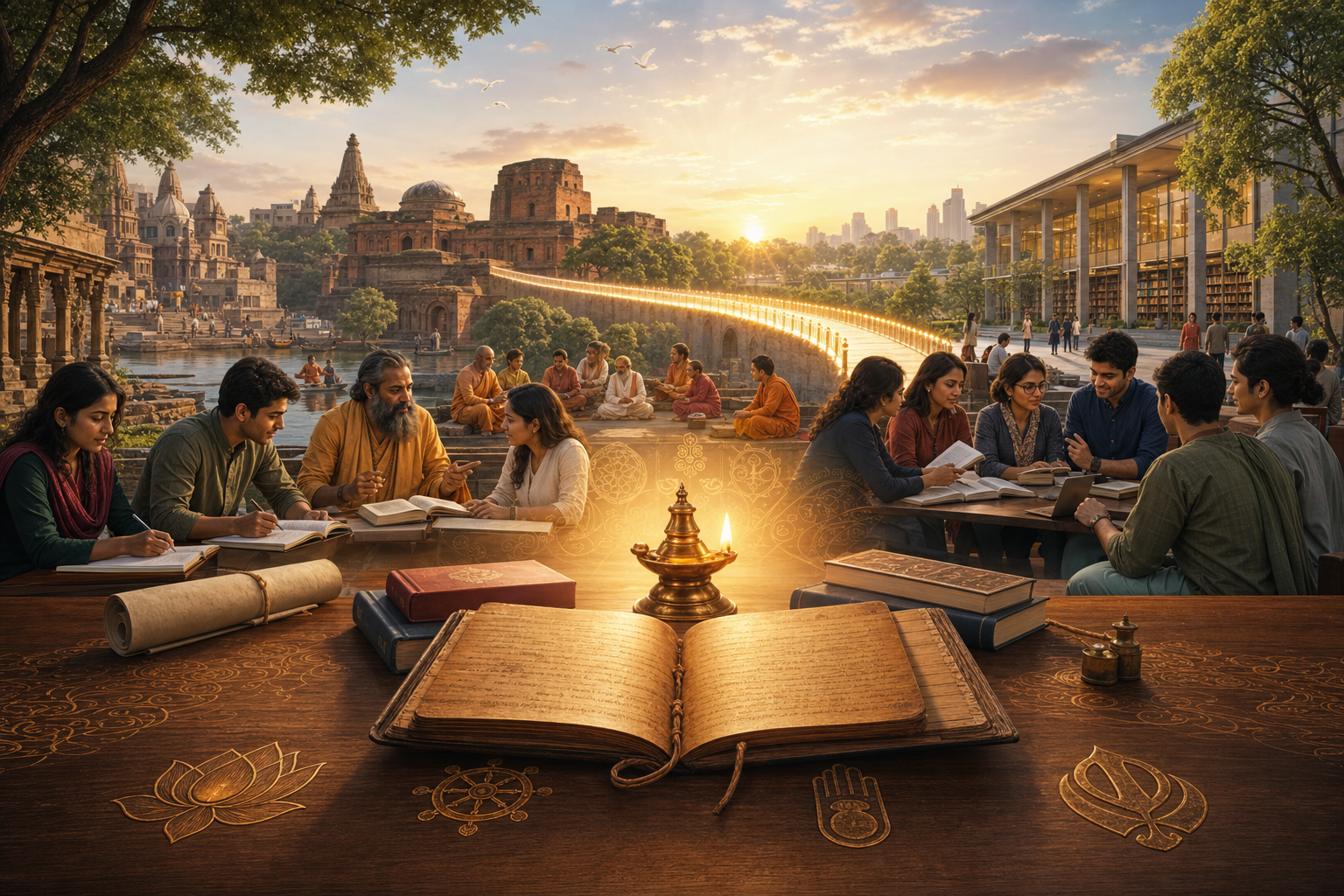
Indian civilization, often described as Indic or Bharatiya, cannot be understood only through the language of empire, economy, politics, or social structure. At its deepest level, it rests on a sustained inquiry into the human capacity for spiritual and transcendental realization. This civilizational orientation does not deny material life; rather, it asks how social order, education, culture, ethics, and political responsibility can be shaped by a higher understanding of human purpose.
This is why the civilizational study of India must begin with Dharma. Dharma is not merely a sectarian term, nor is it reducible to religion in the narrow modern sense. It is a conceptual framework through which life is ordered, duties are understood, knowledge is pursued, and liberation is made meaningful. It links the personal quest for refinement with the collective responsibilities of society. In this sense, Dharma is both philosophical and practical, metaphysical and civic.
The Rig Veda expresses this plural and integrative vision through the well-known statement, “Ekam Sat, Viprah Bahudha Vadanti” i.e. the Reality is one, but the wise speak of it in many tongues. This statement is not a casual slogan of tolerance. It is a profound civilizational insight: ultimate reality may be approached through many valid paths, and different traditions may preserve distinct disciplines, languages, symbols, and experiences while still participating in a wider search for truth.
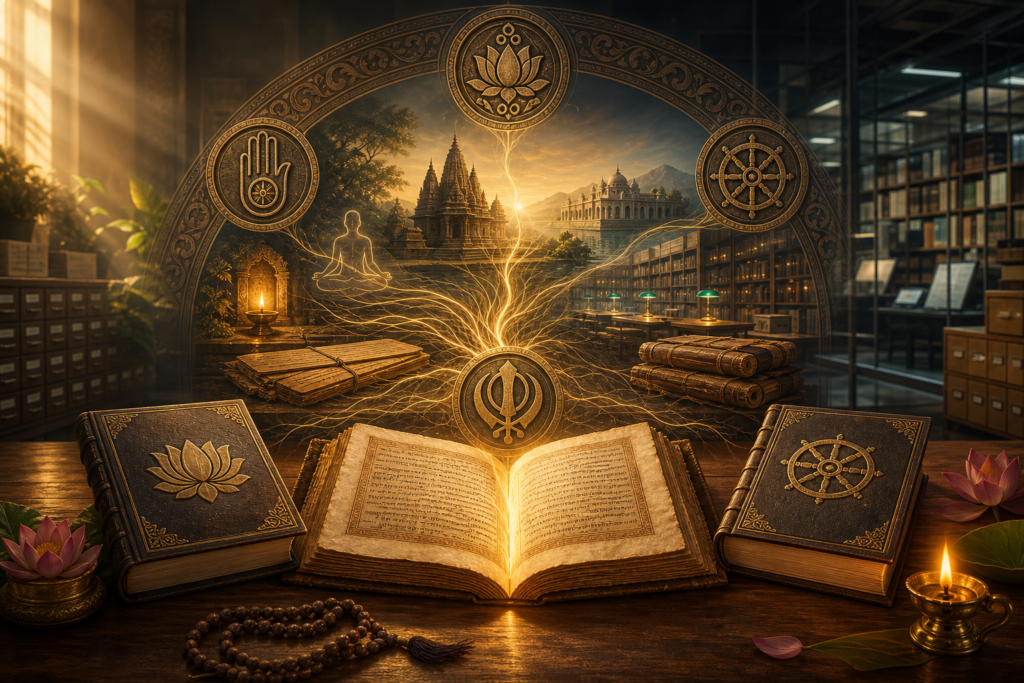
The Dharma Traditions of India, including Hindu, Buddhist, Jain, and Sikh traditions, each articulate Dharma in distinct ways. Their metaphysics, practices, monastic cultures, ritual forms, and philosophical vocabulary are not identical. Yet they share a civilizational field shaped by disciplined inquiry, ethical cultivation, spiritual practice, and the conviction that human life is capable of transformation. A serious study of Indian civilization must therefore treat these traditions not as isolated museum objects but as living knowledge systems.
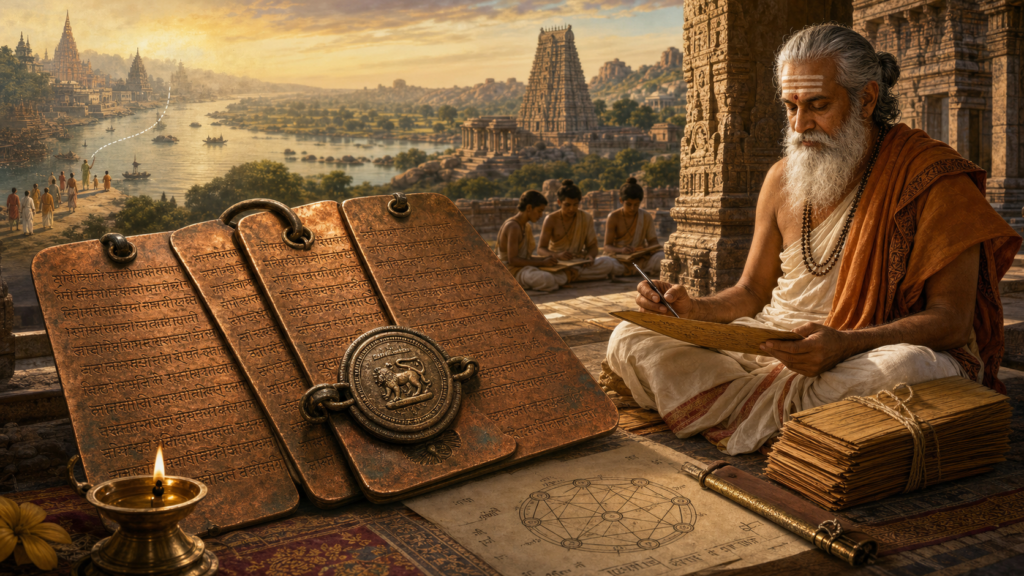
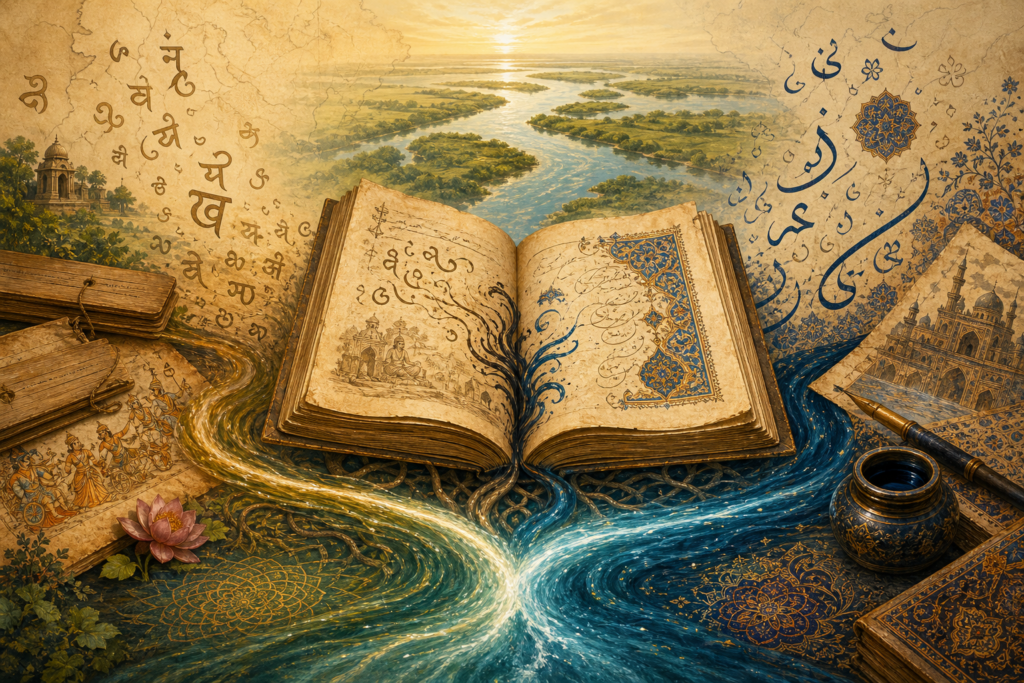
Pre-colonial India recognized this relationship between learning and spiritual formation with remarkable seriousness. Education was not limited to literacy, livelihood, or administrative utility. It included the study of sacred texts, commentaries, grammar, logic, metaphysics, ethics, ritual disciplines, and practices connected to Sadhana and Yoga. Sanskrit served as a major intellectual language across many institutions and traditions, while regional languages also carried devotional, philosophical, and literary knowledge to wider communities.
Traditional centers of learning such as Takshashila, Nalanda, Vikramashila, Odantapuri, Ratnagiri, Pushpagiri, Varanasi, Kanchi and Sringeri were not merely academic campuses in the modern sense. They functioned as ecosystems of scholarship, debate, memorization, commentary, discipline, and transmission. Knowledge was not treated as information alone; it was expected to refine conduct, deepen insight, and produce persons worthy of trust, respect, and emulation.
The colonial period introduced a major rupture in this continuity. British rule did not simply change political authority; it altered the institutions, categories, and intellectual habits through which India was studied and understood. Many modern interpretations of Indian civilization, both in Western academia and in Indian self-understanding, emerged through frameworks shaped by colonial administration, missionary critique, European philology, anthropology, and area studies. These frameworks often became so dominant that they appeared neutral, even when they carried deep assumptions of their own.
The result was a growing distance between living Indian traditions and the academic study of those traditions. Indian Gods, spiritual masters, rituals, texts, and institutions were frequently analyzed through external categories of suspicion. Marxist, Freudian, reductionist, or purely sociological readings sometimes illuminated certain dimensions, but they also often flattened spiritual meaning into power, psychology, economy, or social control. Such methods can become inadequate when they refuse to take seriously the self-understanding of practitioners and the philosophical claims of the traditions themselves.
This does not mean scholarship should abandon critique. Rigorous study requires questioning, comparison, historical method, philology, and openness to evidence. However, critique becomes intellectually weak when it begins with dismissal. A mature field of Hindu Studies, Buddhist Studies, Jain Studies, Sikh Studies, and broader Dharmic studies must be capable of engaging texts, institutions, practices, and communities from both scholarly distance and civilizational literacy.
For many students and families shaped by Indian heritage, this gap is not abstract. It appears when yoga is celebrated globally while the philosophical world that produced yoga is treated with suspicion. It appears when meditation is praised as wellness technology while the metaphysical and ethical traditions behind meditation are ignored. It appears when young Indians can master engineering, medicine, business, accounting, and science, yet remain unfamiliar with Dharma, Moksha, Vedanta, Buddhist philosophy, Jain ethics, Sikh teachings, Sanskrit learning, or the intellectual history of India.
Within modern India, the academic study of Religion and Spirituality has also faced structural difficulty. Constitutional secularism, institutional caution, and political sensitivities have often inhibited the development of robust departments dedicated to the systematic study of India’s own religious and philosophical traditions. As a result, deep learning remains available primarily in Ashrams, Gurukulams, monasteries, traditional lineages, and specialized spiritual communities, while universities and colleges often remain disconnected from these living repositories of knowledge.
This separation has serious consequences. Ashrams and monastic institutions preserve practice, discipline, memory, and lived experience, but they may not always communicate in the idiom of the contemporary university. Universities preserve methods of research, publication, debate, and public pedagogy, but they may lack practitioners who understand the inner logic of the traditions being studied. Without bridges between these worlds, the study of Indian spirituality risks becoming either academically thin or socially inaccessible.
A systematic intervention is therefore necessary. The future of Dharmic knowledge requires scholars who can read primary texts, understand traditional commentaries, respect Sampradayas, and engage contemporary academic standards. It also requires practitioners who can explain their traditions in clear, disciplined, and globally intelligible language. The goal is not propaganda, romanticism, or anti-intellectual defensiveness. The goal is a more complete and honest account of Indian civilization.
An authentic Indian self-understanding must recover the primary categories through which India has historically interpreted life. Dharma and Moksha are central among these categories. Dharma concerns order, duty, harmony, right conduct, and the sustaining principles of life. Moksha points toward liberation, transcendence, and freedom from bondage. Together, they show that Indian thought has never been satisfied with material success alone. It asks what kind of human being society should cultivate, what knowledge is worth preserving, and what freedom ultimately means.
Studying India through Indian categories does not require rejecting all Western scholarship. It requires intellectual balance. Western methods can offer valuable tools, including textual criticism, archaeology, historical analysis, sociology, and comparative philosophy. The problem arises when Western categories become the only legitimate categories, while Dharma, Moksha, Karma, Yoga, Ahimsa, Seva, and other indigenous concepts are treated as objects to be explained away rather than sources of knowledge in their own right.
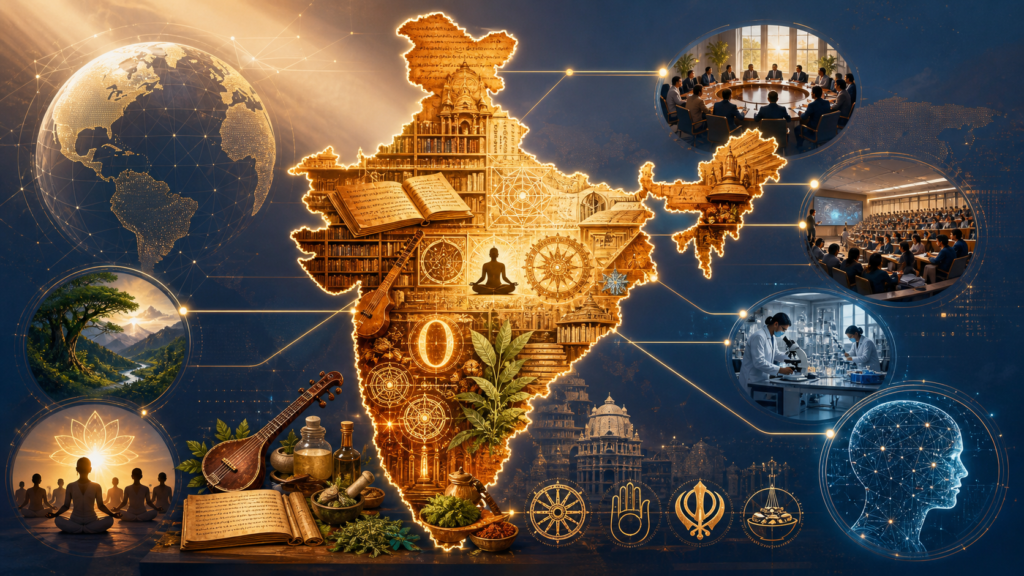
The recovery of Dharma as a category of thought has significance far beyond heritage preservation. Contemporary global challenges increasingly reveal the limits of purely materialist frameworks. Globalization, Economics, Politics, Development, Capitalism, Socialism, Democracy, Education, Poverty, Income Inequality, International relations, Innovation, Science and Technology, Spirituality, Humanities, Art and Culture, Multi-Culturalism, Pluralism, Terrorism, War and Peace, Health Care, Climate change and the Environment all raise questions about human purpose, restraint, responsibility, justice, and interdependence.
A Dharmic perspective can contribute to these debates by emphasizing duties alongside rights, inner discipline alongside external reform, pluralism alongside truth-seeking, and ecological responsibility alongside prosperity. It can help reframe development not only as consumption and production, but also as human flourishing. It can challenge political thought to consider ethical self-restraint. It can invite education systems to cultivate character and wisdom, not merely credentials and competition.
This contribution must be made with care. Dharma should not be reduced to a slogan, nor should it be used to erase the distinctiveness of Hindu, Buddhist, Jain, and Sikh traditions. Unity among Dharmic traditions becomes meaningful only when diversity is respected. The shared civilizational inheritance is strongest when it allows each tradition to speak in its own voice while recognizing common commitments to disciplined practice, ethical life, spiritual insight, and the pursuit of liberation or ultimate truth.
The need, then, is for a renewed field of Dharmic scholarship that is academically rigorous, spiritually literate, historically informed, and civilizationally rooted. Such scholarship can train young minds to engage ancient texts and modern problems together. It can build bridges between universities and traditional institutions. It can correct distorted narratives without falling into reaction. It can make Indian philosophy, Hindu Dharma, Buddhist thought, Jain wisdom, Sikh teachings, Sanskrit learning, and Indic civilization available to a new generation.
The deeper reason for this work is not nostalgia. It is the recognition that India’s original creative process still has something vital to offer humanity. A civilization that placed spiritual realization, plural pathways, intellectual debate, disciplined practice, and the search for transcendence at the center of life deserves serious study in contemporary language. Reclaiming Dharma as a living category of knowledge can enrich Indian self-understanding and offer the wider world a wiser vocabulary for facing its most difficult questions.
Inspired by this post on Dharma Civilization Foundation.



Leave a Reply
You must be logged in to post a comment.