
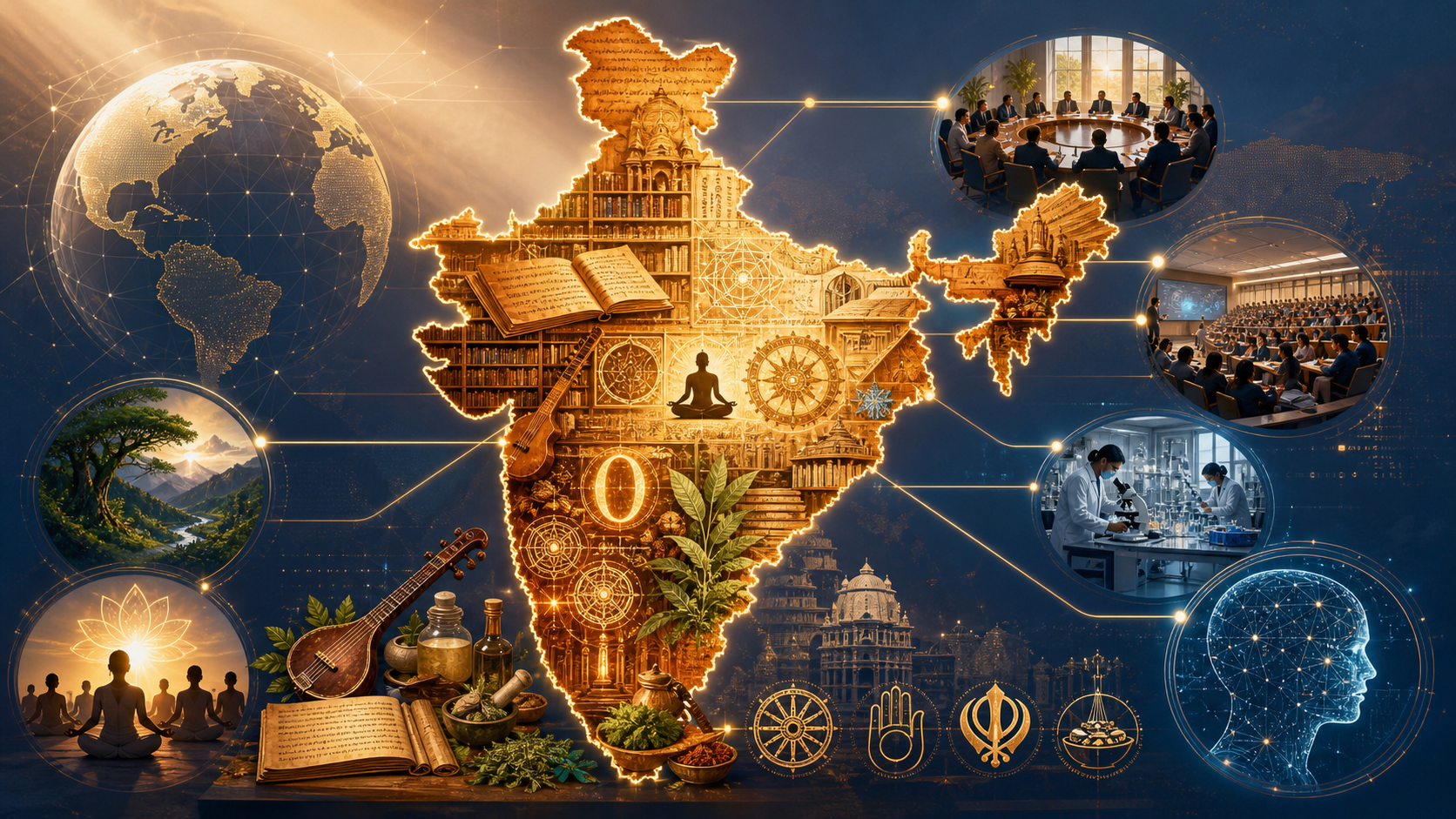
India occupies an unusual and historically consequential position in the contemporary global order. It is a rising economic power, a demographic force, a digital society, and one of the world’s oldest continuously living civilizations. Yet this inheritance has not always been converted into strategic influence with the coherence it deserves. In policy and diplomatic discourse, culture is too often treated as an appendage to foreign policy rather than as one of its formative foundations. It is showcased as heritage, hospitality, performance, or symbolism, but not consistently developed as an institutional framework capable of shaping geopolitical influence, economic ecosystems, global scholarship, technological ethics, and civilizational legitimacy.
This tension defines one of India’s central civilizational challenges. Few nations possess comparable depth in philosophy, language, spirituality, aesthetics, medicine, mathematics, ecology, ritual, and social thought. Yet few nations with such depth have underused their civilizational capital so visibly in strategic terms. Indian culture is widely projected abroad through festivals, cuisine, dance, yoga celebrations, tourism campaigns, handicraft exhibitions, diaspora gatherings, and embassy events. These are valuable expressions of national identity, and they often create warmth, familiarity, and admiration. However, when they remain isolated spectacles rather than components of a larger geopolitical architecture, they produce visibility without durable intellectual influence.
The need, therefore, is not merely to promote culture more aggressively. It is to understand culture differently. Culture must be approached not only as memory, identity, or entertainment, but as infrastructure. It must be studied as a long-term strategic resource and as a civilizational system capable of shaping the global imagination. India’s cultural diplomacy can mature only when culture, policy, education, Indian Knowledge Systems, international relations, technology, and strategic affairs are brought into sustained institutional alignment.
This alignment can be understood through the Purushartha framework, which offers a deeply Indian vocabulary for integrated purpose. In public life, Kama and Artha cannot be separated from a Dharmic orientation toward responsibility, order, human flourishing, and collective well-being. The dictum “Udaaracharitaam tu vasudhaiva kutumbakam.” points toward a world larger than narrow national self-interest: a world in which nations seek prosperity while also enabling self-realization, philosophical inquiry, education, and holistic development. In this sense, India’s civilizational diplomacy is not a retreat into the past; it is a proposal for shaping the future through a more integrated understanding of human life.
A major conceptual limitation in India’s current policy vocabulary is its dependence on the language of “soft power.” Joseph Nye’s formulation usefully described the ability of nations to influence others through attraction rather than coercion. India appeared naturally suited to this framework because of yoga, spirituality, Bollywood, Ayurveda, pluralism, cuisine, classical arts, and its global diaspora. Over time, however, the concept was often interpreted too narrowly. Soft power came to mean visibility, charm, and symbolic appeal, rather than institutional depth, intellectual authority, or strategic continuity.
The limitation matters because culture does not become strategically powerful merely when foreign audiences admire a nation’s food, music, dance, or cinema. Those forms of admiration are important, but they do not automatically reorganize international institutions, academic debates, or policy priorities. Culture becomes strategically meaningful when it shapes what societies aspire to become, how educational systems frame knowledge, how technological systems define ethics, how public health models understand the body, and how nations imagine human flourishing. In that deeper sense, culture is not a decorative layer of diplomacy. It is one of the instruments through which the world’s imagination is structured.
External Affairs Minister Subrahmanyam Jaishankar’s call for “international relations with Indian characteristics” is therefore significant. It suggests that India must not merely interpret itself through inherited Western categories, but should develop a geopolitical vocabulary rooted in its own civilizational experience. Prime Minister Narendra Modi’s use of Vasudhaiva Kutumbakam, the G20 theme “One Earth, One Family, One Future,” and the aspiration of India as a Vishwaguru also indicate an attempt to position India as more than a postcolonial nation-state. They present India as a civilizational actor whose philosophical resources remain relevant to global problems.
For this aspiration to become credible, India’s cultural diplomacy requires stronger systems integration. Culture, education, public diplomacy, research collaboration, translation, technology, Ayurveda, Sanskrit studies, Buddhist studies, Jain philosophy, Sikh thought, yoga, and Indian aesthetics cannot remain scattered across disconnected institutional silos. A systems approach would recognize culture as an interconnected matrix shaping economy, diplomacy, education, identity formation, technological innovation, and geopolitical influence. Such an approach would ask how Indian philosophy can contribute to global ethics discourse, how Sanskritic and Indic linguistic structures might inform artificial intelligence and multilingual computation, how Ayurveda can strengthen preventive healthcare diplomacy, how Indian music systems may contribute to neuroscience and cognition research, and how Indian ecological traditions can enrich climate diplomacy.
India’s own history offers powerful precedent for this kind of civilizational systems thinking. Ancient India’s influence did not depend primarily on military expansion. It moved through trade, scholarship, monastic networks, maritime exchange, aesthetics, ritual systems, mathematics, astronomy, medicine, language, and philosophy. Buddhism travelled across Asia because India exported systems of meaning and disciplined modes of inquiry. Sanskritic culture shaped Southeast Asian architecture, kingship, cosmology, literature, legal imagination, and sacred geography. Indian mathematics altered scientific history through advances in numeration, zero, algebraic reasoning, and astronomical calculation. This was not soft power in a shallow promotional sense. It was civilizational infrastructure.
Contemporary India struggles to recover this strategic understanding partly because Indian Knowledge Systems are still too often misunderstood. IKS is sometimes reduced to nostalgia, heritage revival, or cultural sentiment. At its most serious, however, Indian Knowledge Systems represent a sophisticated and interconnected understanding of knowledge itself. Traditional Indian epistemologies did not sharply separate science from philosophy, aesthetics from cognition, ecology from spirituality, or ethics from governance. Knowledge was relational, embodied, disciplined, and often oriented toward transformation, not merely accumulation.
This is highly relevant in the twenty-first century. The modern world is increasingly marked by fragmentation: ecological disruption, mental health crises, technological alienation, educational exhaustion, social polarization, hyper-individualism, and the erosion of community. Industrial modernity has generated immense material progress, but it has also produced deep instability in the domains of meaning, attention, belonging, and moral orientation. India’s civilizational frameworks offer alternative paradigms centered on balance, consciousness, relationality, sustainability, pluralism, and collective harmony. These are not abstract ideals alone; they are practical civilizational resources for an age searching for more humane models of development.
The problem is that India has not yet consistently translated these philosophical resources into structured geopolitical advantage. Yoga is global, but its philosophical foundations are often detached from its popular practice. Ayurveda is commercially visible, but global research infrastructure and epistemological engagement remain uneven. Indian contemplative traditions are widely consumed, yet frequently separated from the disciplines, texts, and lineages that produced them. Indian classical arts are admired, but rarely integrated into mainstream global conversations on cognition, education, creativity, or embodied intelligence. Sanskrit possesses extraordinary linguistic and philosophical depth, yet remains underleveraged in computational, philological, and comparative philosophical collaborations.
This is where India’s diplomatic imagination must change from event diplomacy to knowledge diplomacy. International Yoga Day, cultural festivals, embassy showcases, diaspora celebrations, and tourism campaigns all have value. They create recognition, emotional connection, and cultural goodwill. Many people first encounter India through precisely these portals: a yoga class, a Bharatanatyam performance, a Buddhist text, a Sikh langar, a Jain teaching on ahimsa, an Ayurvedic idea of balance, a Sanskrit mantra, or a film song heard far from the subcontinent. Yet first encounters must be followed by institutional pathways. Long-term influence emerges when knowledge systems enter universities, laboratories, policy forums, public health systems, technology ethics debates, and global curricula.
India must therefore build global ecosystems around Indian Knowledge Systems. Indian philosophy should be part of international ethics, governance, consciousness studies, and comparative political thought. Meditation traditions should be included in neuroscience, mental health, and contemplative studies collaborations. Indian aesthetic theories should contribute to global discussions on creativity, performance, rasa, cognition, and emotional intelligence. Indian ecological philosophies should inform climate ethics and sustainability policy. Indic linguistic frameworks should be studied in relation to artificial intelligence, semantic systems, multilingual computing, and knowledge representation. Civilizational knowledge should not remain confined to temples, archives, ceremonial occasions, or cultural performances. It must become part of the world’s future-oriented intellectual architecture.
The examples of Great Britain and South Korea show how culture can be converted into strategic infrastructure. Post-war Britain understood that declining imperial power did not necessarily mean declining cultural influence. British music, literature, broadcasting, education, fashion, publishing, and universities became systems of aspiration and legitimacy. The Beatles were not merely musicians in a commercial sense; they became carriers of British modernity, style, and identity. Institutions such as the BBC, the British Council, publishing networks, universities, museums, and recording industries worked together to sustain influence across continents. Britain converted culture into institutional presence, commerce, language prestige, and geopolitical relevance.
South Korea offers another instructive case. K-pop is often described as entertainment, but the Korean Wave is better understood as an integrated cultural economy. Music, cinema, television, gaming, fashion, beauty products, tourism, technology companies, language education, and state policy were brought into a mutually reinforcing system. Korean identity became aspirational because South Korea understood that culture shapes desire, and desire shapes influence. Cultural exports increased tourism, consumer demand, international visibility, brand strength, and geopolitical recognition. Culture became an economic and diplomatic multiplier.
India’s possibilities are even broader because its civilizational capital extends beyond entertainment into philosophy, spirituality, medicine, ecology, mathematics, aesthetics, language, education, and models of social life. India does not merely possess marketable cultural products; it possesses knowledge traditions accumulated over millennia. Yet it continues to export fragments rather than systems. It showcases yoga without consistently explaining Indian philosophies of consciousness. It celebrates Ayurveda without sufficient investment in rigorous global research frameworks. It promotes tourism without adequately supporting translation projects, international research chairs, Indic studies programs, and overseas civilizational institutes.
A serious cultural strategy would require a major expansion of overseas intellectual infrastructure. India needs well-funded IKS centers, Sanskrit chairs, Indic philosophy departments, Ayurveda research partnerships, Buddhist studies collaborations, Jain and Sikh studies programs, meditation neuroscience laboratories, Indian aesthetics institutes, translation missions, cultural technology incubators, and international fellowships. The overseas mandate of Indian diplomacy must expand beyond ceremonial representation into epistemic engagement. Embassies and cultural institutions should actively facilitate research partnerships, visiting scholar programs, university collaborations, language networks, archives, and public lectures rooted in Indian civilizational thought.
This also requires a broader understanding of who participates in cultural diplomacy. Culture cannot remain the exclusive domain of performers, nor can diplomacy remain detached from knowledge. India needs an ecosystem that brings together diplomats, scholars, artists, monks, acharyas, policy experts, neuroscientists, technologists, educators, translators, museum professionals, public health researchers, and cultural practitioners. Such an ecosystem would not flatten differences among Hinduism, Buddhism, Jainism, and Sikhism. Rather, it would highlight their shared civilizational grammar of inquiry, discipline, ethics, liberation, compassion, self-cultivation, and responsibility while respecting each tradition’s distinct history and practice.
The twenty-first century is not only a contest of military strength or economic scale. It is also a competition among narratives, identities, philosophical frameworks, technological ethics, and models of human flourishing. The West shaped the modern world not only through power, but through control over the global languages of science, modernity, rationality, rights, and legitimacy. China promotes civilizational continuity and state capacity. South Korea exports cultural modernity. Japan exports aesthetic discipline, design consciousness, and refined tradition. The United States exports technological aspiration, media ecosystems, and entrepreneurial mythology. India’s distinctive contribution can be different: integrated civilizational wisdom for an age marked by alienation, ecological anxiety, and fractured meaning.
That contribution, however, will not emerge automatically. Civilizations do not influence the future simply because they are ancient. They require institutions capable of transforming memory into strategy. India must cultivate intellectual confidence without falling into triumphalism. Postcolonial India has often oscillated between inherited colonial discomfort and civilizational romanticism. A mature cultural strategy requires neither insecurity nor exaggeration. It requires rigorous scholarship, openness to critique, institutional credibility, philological discipline, scientific engagement, and strategic clarity. Indian Knowledge Systems must not become slogans. They must become research-driven, interdisciplinary, globally engaged frameworks that can address contemporary human challenges with seriousness.
The dharmic traditions offer a particularly important foundation for such a strategy because they do not reduce human life to consumption, production, or political identity alone. Hindu, Buddhist, Jain, and Sikh traditions all contain rich reflections on conduct, consciousness, suffering, duty, liberation, compassion, self-discipline, community, and the ethical use of power. Their differences are real and intellectually significant, but their shared civilizational environment offers India a rare platform for plural knowledge diplomacy. In a world searching for ways to live with diversity without dissolving meaning, this dharmic civilizational inheritance can become a source of global dialogue rather than sectarian competition.
The central question is whether India will continue to treat culture as decorative nationalism or recognize it as strategic infrastructure. One path reduces civilization to spectacle. The other transforms civilization into policy, education, diplomacy, research, technology, public health, climate ethics, and long-term geopolitical influence. India’s next major geopolitical leap may not come only from trade agreements, military partnerships, digital platforms, or economic growth. It may also come from the ability to convert civilizational depth into a coherent global intellectual presence.
Culture is not merely heritage. Culture is not merely performance. Culture is not merely soft power. For India, properly understood, culture is strategy.
Bibliography
Joseph Nye, Soft Power: The Means to Success in World Politics, Public Affairs, 2004.
Subrahmanyam Jaishankar, The India Way: Strategies for an Uncertain World, HarperCollins India, 2020.
Narendra Modi, speeches on Vasudhaiva Kutumbakam and India’s G20 Presidency, Government of India archives.
“From a Latent to a ‘Strong’ Soft Power? The Evolution of India’s Cultural Diplomacy,” Humanities and Social Sciences Communications.
Santishree Dhulipudi Pandit, “Reviving Indian Knowledge Systems: Bridging Tradition with Modernity,” Indian Journal of Public Administration.
“Civilizational Exceptionalism in International Affairs,” International Affairs, Oxford Academic.
ORF Research Papers on India’s Soft Power Diplomacy and Cultural Strategy.
Kapil Kapoor, writings on Indian Knowledge Systems and civilizational epistemology.
Michel Danino, works on Indian civilization, knowledge traditions, and cultural continuity.
Vidya Dehejia, The Body Adorned: Dissolving Boundaries Between Sacred and Profane in India’s Art.
Amartya Sen, The Argumentative Indian, Penguin Books.
Dharampal, The Beautiful Tree: Indigenous Indian Education in the Eighteenth Century.
Reports and policy documents from the Ministry of External Affairs, ICCR, and Ministry of Education on Indian Knowledge Systems and cultural diplomacy.
Inspired by this post on Indica Today.
