
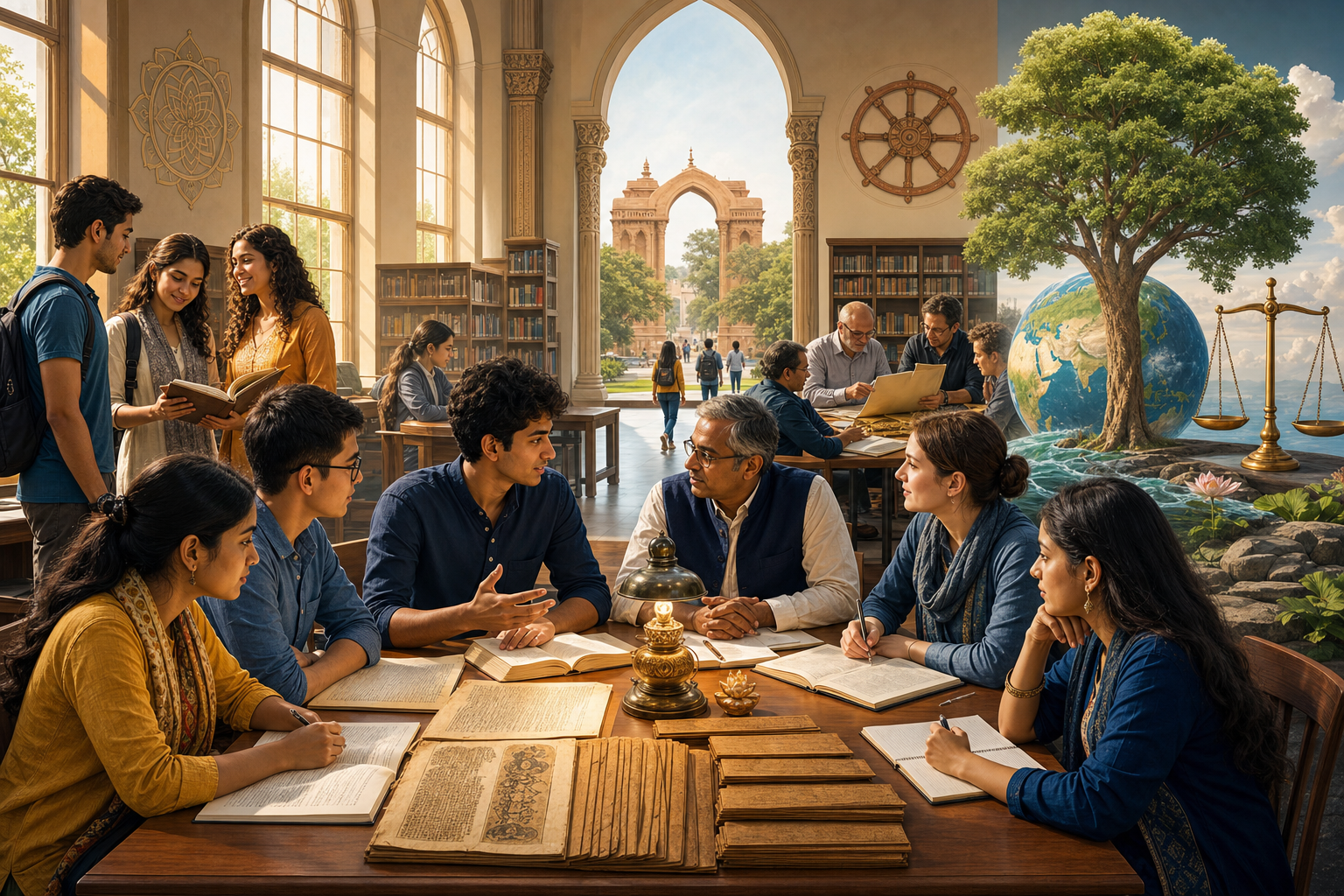
The work of funding Dharma studies in mainstream academic universities rests on three closely connected motivations: engaging students of the diaspora, cultivating a serious community of scholars, and developing Dharma-centered responses to contemporary human challenges. Each motivation addresses a different layer of public life. The first concerns identity formation among young people. The second concerns intellectual representation in the academy and in wider civic discourse. The third concerns the practical relevance of Dharma for ethics, sustainability, social harmony, and human flourishing.
At its strongest, the study of Hindu Dharma is not merely an exercise in cultural memory. It is a disciplined encounter with texts, traditions, practices, philosophical systems, ritual forms, languages, histories, and living communities. When such study is placed within accredited universities, it gains a structure that students and the wider public already recognize: syllabi, trained faculty, peer review, research methods, libraries, seminars, and degree pathways. This academic setting does not replace family, temple, sampradaya, or personal sadhana. Rather, it can give students an additional intellectual framework through which inherited traditions become more intelligible, more respected, and more confidently carried into public life.
First Motivation: Engaging Students of the Indian Diaspora
For many students of the Indian diaspora in the United States, undergraduate life is the first sustained period of intellectual independence. They leave the intimate world of family, festivals, temple visits, stories, food, language, and inherited customs, and enter a university environment that asks them to examine belief, identity, history, and ethics through new forms of questioning. This transition can be fruitful, but it can also be disorienting. A student may have grown up reciting a mantra, celebrating Diwali, hearing the Bhagavad Gita quoted at home, or watching grandparents perform puja, yet still lack the conceptual vocabulary to explain what these practices mean.
Introductory university courses on Hindu Dharma, the Bhagavad Gita, the Upanishads, Sanskrit literature, Indian philosophy, temple traditions, yoga, bhakti, Vedanta, and Dharmic traditions can help address this gap. Such courses allow students to examine their ancestral heritage through a rigorous and systematic academic lens. They can learn how texts developed, how philosophical schools debated questions of selfhood and reality, how ritual practices encode metaphysical ideas, and how Hindu communities have adapted across time and geography. This form of study can transform inherited familiarity into informed understanding.
The value of this engagement is especially clear when students encounter oversimplified or distorted descriptions of Hinduism in popular media, casual classroom conversations, or online spaces. Without structured knowledge, a student may feel defensive but unable to respond with clarity. With disciplined study, the same student can distinguish between criticism and caricature, between historical complexity and ideological reduction, between living diversity and superficial stereotyping. Academic Hindu Studies can therefore become an important part of cultural confidence, not because it encourages uncritical pride, but because it gives students the tools to think clearly about their own traditions.
Accredited courses and undergraduate minors can also normalize the presence of Hindu Dharma within general education curricula. When students can fulfill academic requirements while studying the Bhagavad Gita, the Upanishads, Indian philosophical systems, Sanskrit sources, temple culture, or the history of Dharmic traditions, they receive a powerful signal: these traditions belong in serious intellectual life. They are not merely private inheritances, ethnic markers, or occasional festival themes. They are subjects worthy of study alongside Greek philosophy, Abrahamic theology, Buddhist thought, Chinese classics, modern ethics, comparative religion, anthropology, history, and political theory.
This matters for Hindu students, but it also matters for non-Hindu students. A well-designed course on Dharma can introduce wider university communities to concepts such as karma, dharma, artha, kama, moksha, ahimsa, seva, yajna, atman, brahman, yoga, bhakti, and plural pathways of worship and realization. These concepts are often encountered casually in popular culture, but academic study can restore depth, context, and precision. In a plural society, such study contributes to interfaith understanding, religious literacy, and more respectful public discourse.
The long-term effect may be even more significant. Some students who begin with a basic 101-level course may pursue advanced study in Sanatana Dharma, Indian philosophy, religious studies, Sanskrit, Indology, anthropology, history, or comparative theology. A single undergraduate class can become the beginning of an M.A., a Ph.D., a teaching career, a publishing project, or a life of informed service to the community. Even for those who choose other professions, the study of Dharma can shape how they think about ethics, family, duty, ecology, leadership, and social responsibility.
Second Motivation: Creating a Community of Scholar-Practitioners
The second motivation is the need to cultivate a community of qualified scholars who can represent Hindu Dharma and related Dharmic traditions with intellectual confidence, methodological discipline, and lived sensitivity. Public discussions of Hinduism often involve journalists, activists, commentators, clergy, community leaders, and political voices. Each may have a role, but universities require another kind of authority: scholars trained in research methods, primary sources, historical analysis, languages, textual interpretation, and peer-reviewed argumentation.
A scholar-practitioner is not simply a believer with an academic title, nor merely an academic observer of a distant tradition. The term points to a more demanding ideal: someone who understands the tradition from within, respects its lived reality, and also meets the standards of academic scholarship. Such figures can read texts carefully, engage competing interpretations, recognize internal diversity, and participate in public debate without reducing Dharma to slogans. They can speak in classrooms, conferences, media forums, think tanks, temples, interfaith dialogues, and policy discussions with both clarity and restraint.
This need becomes especially urgent because misperceptions about Hindu Dharma have accumulated through many channels: colonial scholarship, missionary polemics, selective political readings, caste-only reductionism, exoticization, popular misinformation, and the tendency to flatten diverse traditions into a single stereotype. Serious scholarship cannot simply reject criticism or dismiss difficult history. It must examine complexity honestly. At the same time, it can correct distortions by presenting Hindu Dharma in its philosophical, ritual, devotional, ethical, social, artistic, and civilizational fullness.
Building such a scholarly community requires long-term institutional support. Professorships, endowed chairs, research fellowships, graduate scholarships, visiting lectureships, conferences, translation projects, archives, and publication platforms are not ornamental additions. They are infrastructure. Without them, Dharma-related subjects remain dependent on isolated individuals, temporary courses, or external interpretations. With them, students can find mentors, scholars can collaborate, and universities can sustain serious programs across generations.
This community should also strengthen unity among Dharmic traditions. Hinduism, Buddhism, Jainism, and Sikhism are distinct traditions with their own scriptures, disciplines, histories, institutions, and theological differences. Yet they also share a broad civilizational ecology shaped by concepts such as dharma, karma, liberation, ethical self-cultivation, renunciation, discipline, compassion, nonviolence, meditation, and respect for multiple paths of spiritual practice. Academic study can illuminate both difference and kinship, helping communities avoid sectarian narrowness while preserving the integrity of each tradition.
In the public square, this matters because religious literacy affects civic life. Misunderstanding Hindu Dharma can influence school curricula, media coverage, workplace diversity programs, interfaith relations, immigration narratives, and public policy debates. Scholars trained in Hindu Studies and Dharmic traditions can help communities respond with evidence rather than anxiety. They can explain why a temple matters, what a ritual symbolizes, how philosophical pluralism works, why Sanskrit terms resist simplistic translation, and how living traditions adapt without losing continuity.
Third Motivation: Developing Dharma-Centered Solutions
The third motivation is applied Dharma: the development of Dharma-centered approaches to the major challenges of contemporary humanity. This does not mean treating ancient texts as ready-made policy manuals. It means drawing from Dharmic principles, ethical reasoning, philosophical anthropology, social ideals, and spiritual disciplines to frame problems in deeper ways. Modern crises are not only technical; they are also moral, relational, ecological, and civilizational. Dharma can contribute to the way these crises are understood and addressed.
Consider climate change and environmental sustainability. A purely extractive model of nature sees the earth as material for consumption. Dharmic traditions offer another vocabulary: interdependence, restraint, sacred geography, reverence for life, duty toward future generations, and the moral consequences of desire without discipline. Concepts such as ahimsa, aparigraha, yajna, and stewardship can help shape an ethic of sustainable living. They do not replace climate science, economics, or engineering, but they can deepen the moral imagination required to act responsibly.
Economic disparity and poverty also invite Dharma-centered reflection. The Dharmic view of life does not reduce human beings to consumers or producers. It places wealth within an ethical framework, asking how artha should be pursued, how generosity should be practiced, how social obligations should be honored, and how dignity should be preserved. Applied scholarship in Hindu economics, social ethics, seva, community welfare, and traditional institutions can contribute to conversations about development, inequality, and responsible prosperity.
Violence, terrorism, and religious intolerance require equally serious engagement. Dharmic traditions contain rich resources for thinking about peace, justice, restraint, righteous action, pluralism, and the limits of force. The Bhagavad Gita, for example, does not offer simplistic pacifism or simplistic aggression; it asks difficult questions about duty, moral confusion, self-mastery, and action without selfish attachment. Jain, Buddhist, Sikh, and Hindu traditions all provide distinct but related reflections on courage, compassion, nonviolence, discipline, and protection of the vulnerable. These resources deserve careful academic development rather than casual quotation.
Holistic health and well-being represent another important field. Yoga, meditation, breath awareness, Ayurveda, mental discipline, ritual rhythm, family cohesion, and community belonging all intersect with modern concerns about stress, loneliness, burnout, and fragmentation. Academic research can examine these resources responsibly, avoiding both romantic exaggeration and dismissive reductionism. A Dharma-centered approach to well-being asks not only how to reduce symptoms, but how to cultivate meaning, ethical clarity, emotional balance, and a life oriented toward self-knowledge.
Family stability and social harmony are also central concerns. Many diaspora families experience generational tension: elders carry memory, language, and ritual; children inherit those worlds while navigating American schools, universities, workplaces, and social norms. Dharma-centered study can help translate inherited practices into meaningful categories for younger generations. It can explain why samskaras matter, why festivals organize memory, why elders emphasize duty, why food and worship carry symbolic weight, and why community institutions matter for continuity.
International relations and global ethics can also benefit from Dharmic reflection. Ideas such as Vasudhaiva Kutumbakam, plural paths, civilizational dialogue, restraint in power, and responsibility beyond narrow self-interest can contribute to discussions of global cooperation. These ideas must be handled carefully, with scholarship rather than sentimentality. Yet when developed rigorously, they can offer a valuable counterpoint to purely transactional models of geopolitics and development.
Why University-Based Dharma Studies Matter
The university is not the only place where Dharma can be studied, and it should never claim exclusive authority over living traditions. Temples, gurukuls, monasteries, families, satsangs, mathas, libraries, community organizations, and practitioners remain indispensable. Yet universities play a distinctive role because they shape public knowledge. What is taught in classrooms often influences textbooks, media narratives, policy language, teacher training, cultural literacy, and the assumptions of future professionals.
For this reason, the presence or absence of Hindu Dharma in academic life has consequences beyond campus. If students encounter Dharma only as an exotic subject, a political controversy, or a flattened social category, public understanding suffers. If they encounter it through serious courses, strong faculty, primary texts, historical depth, philosophical rigor, and engagement with living communities, the result is more balanced. The aim is not propaganda. The aim is intellectual fairness, methodological seriousness, and the recovery of complexity.
A mature academic approach must also include self-reflection within the community. Dharma studies should not merely defend tradition from external misrepresentation. It should also help communities understand internal diversity, historical change, ethical challenges, social responsibilities, and the difference between inherited habit and philosophical principle. Genuine respect for Dharma grows stronger when it is joined to inquiry, humility, and disciplined learning.
The three motivations therefore form a single integrated vision. Students need access to serious learning. Scholars need institutional support to teach, research, publish, and participate in public life. Humanity needs ethical and philosophical resources capable of addressing urgent problems. When these three dimensions come together, Dharma studies can serve both heritage and the broader world.
The deeper promise of this work is civilizational continuity with intellectual openness. A young student can understand the Bhagavad Gita with greater seriousness. A scholar can correct public misconceptions with evidence and grace. A community can see Hindu Dharma, Buddhism, Jainism, and Sikhism as distinct yet related traditions within a wider Dharmic family. A society can draw from ancient wisdom without abandoning modern research. In this sense, Dharma-centered education is not a retreat into the past; it is a disciplined contribution to the future.
Inspired by this post on Dharma Civilization Foundation.







Leave a Reply
You must be logged in to post a comment.