
In the intellectual history of Indian Philosophy, Garikapati Annam Bhaṭṭu, also known as Annambhaṭṭa, occupies a place of unusual quiet authority. His name is most closely associated with the Tarka Saṅgraha and its companion commentary, the Dīpikā, two works that have introduced generations of students to Nyāya darśana, valid cognition, inference, and disciplined reasoning. These texts are compact, technical, and pedagogically elegant; they show how complex śāstric systems can be made accessible without reducing their rigor. Yet the historical person behind them long remained partially obscured, known more through the clarity of his works than through firm biographical documentation.
The uncertainty surrounding him was noted even in the 1918 Bombay Sanskrit Series preface to Tarka Saṅgraha. Questions remained about whether the name should be read as Annambhaṭṭa or Anantabhaṭṭa, and whether the scholar belonged to the seventeenth century or to an earlier period. Such uncertainty is common in the study of Sanskrit Manuscripts, where the memory of a thinker often survives through colophons, oral traditions, family records, and the long life of classroom transmission. In the case of Annam Bhaṭṭu, inscriptional evidence helps bring that memory into a firmer historical frame.
A proverb remembered in Andhra households captures his stature with memorable force: “Kāśī gamana mātrēṇa nānnam bhaṭṭāyate dvijaḥ” — “By merely going to Kāśī, a Brahmin does not become Annam Bhaṭṭu.” The saying is not merely a compliment to an individual scholar; it is a cultural judgment about the nature of true learning. Travel to a great centre of scholarship may provide opportunity, but mastery requires tapas, humility, discipline, ethical steadiness, and the ability to transmit knowledge responsibly. The proverb preserves the emotional weight of a tradition that valued inner refinement as much as public recognition.
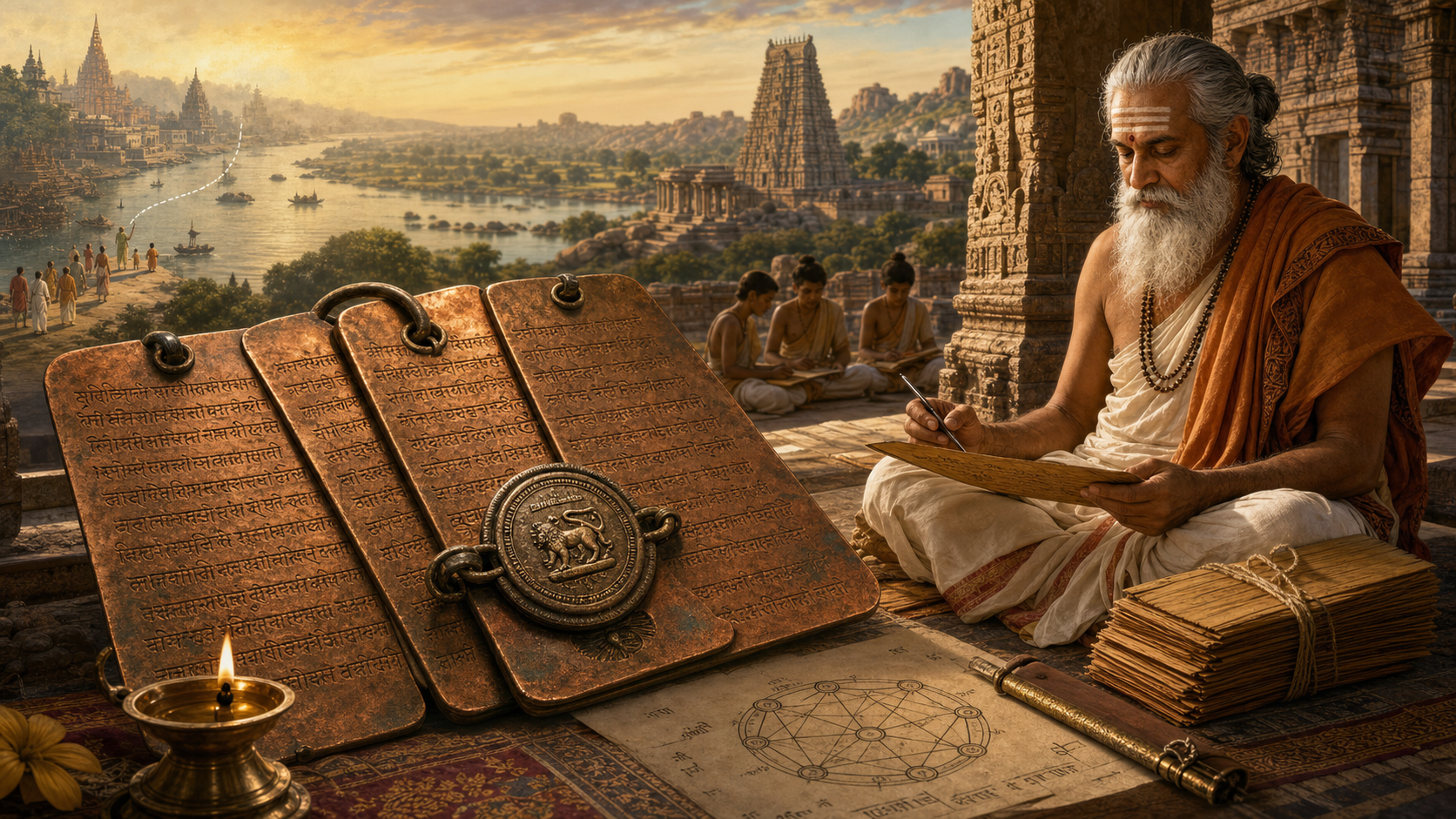
The Garikapāḍu Dāna Śāsana, a copper-plate inscription issued in 1560 CE by Sadāśiva Rāya, is central to this historical recovery. It records the formal grant of the Garikapāḍu agrahāra to Annambhaṭṭa, situating him within the dhārmic, political, and scholarly world of the Vijayanagara Empire. The inscription invokes divine authority, defines the boundaries of the grant, establishes its legal and ritual force, and frames the act of donation within cosmic order. Through this copper record, Annam Bhaṭṭu emerges not as a vague figure of scholastic memory but as a historically grounded ācārya entrusted with land, learning, and community responsibility.
Modern efforts to recover this legacy began significantly within the Garikapati lineage. Śrī Garikapati Lakṣmī Kantaiah, former Head of the Department of Telugu at Nizam College, Hyderabad, wrote on Garikapati Annam Bhaṭṭu in his 1976 collection Śārada Vyāsa Maṇihāram, connecting family memory with the evidence of the Dāna Śāsana. Later, Śrī Garikapati Lakṣmī Narasiṃham extended this work in Garikapati Vaṃśa Caritra (2007), drawing on oral history, lineage memory, and archival materials such as the Tadipatri Kaifīyat. These studies are important because they show how historical research, family continuity, and Sanskrit learning can illuminate one another.
The agrahāra granted to Annam Bhaṭṭu must be understood within the broader dhārmic vision of Vijayanagara statecraft. The empire cultivated Sanskrit learning, Vedic ritual, temple culture, and śāstric debate as essential components of social order. An agrahāra was not simply a landholding arrangement; it was a centre of education, ritual continuity, ethical authority, and cultural preservation. Under Sadāśiva Rāya and Aliya Rāmarāya, royal patronage supported scholars whose responsibility was to preserve and transmit śāstra across generations.
Sadāśiva Rāyalu upheld this scholarly order through brāhmaṇa pariṣats, or assemblies of learned specialists. These gatherings examined Vedic, tārkika, mīmāṃsaka, and dhārmic questions through disciplined debate. Pariṣats were held across the empire and typically spanned three days. Seats were arranged according to Veda, Śāstra, and Darśana, forming a living maṇḍala of discourse. The arrangement itself reflected an intellectual culture in which knowledge was ordered, embodied, and publicly tested.
At the conclusion of such assemblies, the court conferred titles that marked degrees of learning: śūrā cakravarti, śūrātiśūra, bahuśūra, and adhyayana śūra. The highest title, śūrā cakravarti, was associated with a vistāra agrahāra of forty kucchelas of land, with one kucchela understood as approximately twenty-five acres. Other distinctions carried smaller grants or gifts of gold to support adhyayana and adhyāpana. These were not casual rewards; they were dānas of responsibility, binding scholars to create spaces where śāstra, yajña, teaching, and community life could flourish together.
Within this world, a scholar was expected to embody śruti, yajña, tarka, and nīti. Intellectual excellence had to be joined with conduct, discipline, and service. Inscriptions and commentarial traditions repeatedly present such figures as custodians of dharma, not merely as specialists in argument. This context is essential for understanding why the Garikapāḍu grant mattered: it recognized Annam Bhaṭṭu as a stabilizing intellectual presence within a wider civilizational framework.
Garikapati Annam Bhaṭṭu was born into a Telaganya Brahmin family in Mamillapalli, in present-day Mahbubnagar district. His father, Kavarīśvara Bhaṭṭu, and grandfather, Sarva Deva Bhaṭṭu, belonged to a lineage traced to the mūla puruṣa Mamillapalli Rāghava Somayāji. The family tradition was rooted in learning, Advaita Vedānta, and dhārmic conduct. This lineage background gave Annam Bhaṭṭu access to a living world of śāstric instruction, but family memory also preserves a more human beginning: in his youth, he was said to be inattentive to formal learning.
That early indifference, followed by stern discipline from his father, gives the account an emotional texture familiar to many educational traditions. The transformation from reluctance to resolve became a defining feature of his life story. Once awakened to the seriousness of study, he pursued the Vedas and śāstras under local ācāryas. His father and forefathers, revered as Advaita Ācāryas, guided him through the Brahma Sūtras and foundational Vedānta texts. Under this guidance, he displayed unusual aptitude, perseverance, and capacity for philosophical analysis.
As his studies deepened, Annam Bhaṭṭu recognized the foundational importance of Nyāya and Vyākaraṇa. Vedānta required careful reasoning; reasoning required precise language; and precise language required grammatical discipline. This insight led him toward the Pāṇinian tradition and the search for a guru capable of teaching Vyākaraṇa with depth. Local scholars directed him to Śrī Śeṣa Vīreśvara Paṇḍita, a leading teacher associated with the tradition of Patañjali’s Mahābhāṣya. Kāśī was widely recognized as one of the most rigorous centres for such study.
In the sixteenth century, Kāśī, or Vārāṇasī, stood as a major centre of Sanskrit scholarship, public vāda, literary production, and guru-śiṣya paramparā. The Śeṣa family’s approach to Vyākaraṇa emphasized syntactic precision, exegetical discipline, and argumentative clarity. Students from many regions travelled to Kāśī to refine their command of grammar, logic, and philosophical method. Annam Bhaṭṭu joined a broader pattern of southern scholars, especially from Andhra, who travelled north for śāstric training and later returned to enrich their own regions.
Figures such as Jagannātha Paṇḍitarāja, Narasiṃha Bhaṭṭu, and Annam Bhaṭṭu illustrate this pan-Indian movement of knowledge. They show how Sanskrit learning was not confined to a single region but moved through pilgrimage, debate, manuscript circulation, teaching lineages, and royal patronage. Such movement strengthened the unity of the Dharmic intellectual world while allowing regional traditions to retain their distinctive voices. In this sense, Annam Bhaṭṭu’s journey from Mamillapalli to Kāśī and back to the south was not merely personal; it was part of the larger geography of Indian Scholarship.
After his return from Kāśī, Annam Bhaṭṭu stood transformed as a guru and scholar of distinction. His learning combined the Advaita orientation of his forefathers with rigorous training in Nyāya and Vyākaraṇa. This combination was significant because it enabled him to move across disciplines without losing technical precision. The later recognition given to him through the Garikapāḍu Dāna Śāsana therefore appears as the culmination of both lineage and personal achievement.
The inscription records his gotra as Kauśika, his sūtra as Āpastamba, and his veda as Yajur Śākhā. Its praśasti praises him as a mūlastambha, a stabilizing pillar of dharma. The metaphor is important: a scholar in this tradition was not simply a producer of texts, but a support for social, ritual, and intellectual continuity. The image of the mūlastambha connects the individual teacher to the cosmic and civic order upheld by the Vijayanagara state.
The inscription opens with an invocation to Śambhu:
नमस्तुङ्ग शिरश्चुम्बि चन्द्र चामरचारवे ।
त्रैलोक्य नगरारम्भ मूलस्तम्भाय शम्भवे ॥
namastuṅga śiraścumbi candra cāmara-cārave ।
trailokya-nagarārambha mūlastambhāya śambhave ॥
(Salutations to Śambhu, whose lofty head is caressed by the moon like a royal fly-whisk, who stands as the foundational pillar of the city of the three worlds.)
This invocation is not decorative. Śiva is invoked as mūlastambha, the foundational support of cosmic stability, while the moon functions like a royal cāmara, suggesting sovereignty and sacred authority. By beginning in this way, the inscription places the act of dāna within cosmic order. The symbolic logic extends to the recipient: just as Śambhu upholds the three worlds, Annam Bhaṭṭu is entrusted with sustaining the worlds of jñāna, śāstra, and dharma.
The inscription then gives the moment of donation through calendrical and geographical markers:
नासत्यानेकपाब्धीन्दु गणिते शकवత్సरे ।
सिद्धार्थि नामके पक्षे मासे चाषाढनामानि ॥
वलपक्षे च प्रथम द्वादश्यां गुरुवासरे ।
तुंगभद्रानदीतीरे विठलेश्वर सन्निधौ ॥
nāsatyānekapābdhīndu gaṇite śakavatsare ।
siddhārthi nāmake pakṣe māse cāṣāḍha nāmāni ॥
valapakṣe ca prathama dvādaśyāṃ guruvāsare ।
tuṅgabhadrānadītīre viṭhaleśvara sannidhau ॥
(“Calculated according to the Śaka reckoning of years, in the cyclical year named Siddhārthi, in the month of Āṣāḍha, on the first Dvādaśī of the bright fortnight, on a Thursday, on the banks of the Tuṅgabhadrā river, in the presence of Viṭhaleśvara.”)
The date is encoded through the bhūta-saṅkhyā system in the phrase “nāsatyānekapābdhīndu gaṇite śakavatsare.” Here, Nāsatya, referring to the pair of Aśvins, represents 2; anekapa, elephant, represents 8; abdhi, ocean, represents 4; and indu, moon, represents 1. The sequence 2-8-4-1 is read according to the rule aṅkānāṃ vāmato gatiḥ, meaning that digits are read from right to left. The resulting number is 1482 in the Śaka era, corresponding to 1560 CE. The calendrical details point to 14 July 1560, strengthening the inscription’s chronological value.
The setting is equally significant. The reference to the Tuṅgabhadrā and Viṭhaleśvara places the grant within the ceremonial and political heart of Vijayanagara, near the Vijaya Viṭṭhala temple at Hampi. The record suggests that Annam Bhaṭṭu was summoned to the capital by the trusted general Timma Nāyaka, son of Pemmasāni Timmanāyaka. The Dāna Śāsana was read before a royal assembly presided over by the Svayambhuvu sabhāpati at the Viṭhaleśvara sannidhi. This was not an ordinary administrative act; it was a public recognition of śāstric accomplishment.
The grant made Garikapāḍu a centre for sustaining śāstric learning, tarka, Vedic recitation, and dhārmic continuity. The village became a kṣetra of study, where knowledge was expected to circulate through teaching, recitation, debate, and community practice. Such a vision connects education with place: the land itself becomes part of the apparatus of learning. This is one of the most striking features of the agrahāra system, where agriculture, ritual, scholarship, and social responsibility were interwoven.
The copper plates themselves carry symbolic force. The Śāsana was inscribed across three plates, each written on both faces, forming six textual panels. Bound by a kadiyam clasp embossed with the Bhūvarāha mudrā, the plates were sealed under a symbol associated with cosmic protection, Viṣṇu’s raising of Bhūmi from the depths. The three plates evoke triloka, trayī vidyā, and the triśūla of Śiva, allowing the inscription’s physical form to echo its religious and philosophical meaning.
The grant is described as Mṛḍapadam, irrevocable and protected by dhārmic injunction. It is framed as putra pautra ādibhir bhogyam, to be enjoyed by sons, grandsons, and descendants. This language embeds generational continuity into the legal and ethical structure of the donation. The inscription therefore functions as more than a property record; it is a śāstric kavaca, a protective enclosure around knowledge, land, and lineage.
The boundaries of Garikapāḍu are mapped across the eight directions: prāgdiśa, āgneya, dakṣiṇa, nairṛti, paścima, vāyavya, uttara, and īśānya. Landmarks such as Bellamkonda hill, Kākarlavānipāḷeeya, Nāgavaram, Prattipāḍu, Tāḷḷūru, Guḍipāḍu, Nandipāḍu, and Nāgavaram anchor this mapping in physical geography. At the same time, the eightfold directional structure evokes aṣṭadikpāla cosmology, transforming the village into a maṇḍala of ordered dhārmic space.
The village is described as rich in crops, water sources, wells, ponds, hidden treasures, and five designated gardens. This prosperity is not presented merely as material abundance. It is the śubhāśraya, the auspicious foundation necessary for yajña, adhyayana, adhyāpana, and paramparā. The agrahāra thus appears as a living institution where ecological, economic, intellectual, and spiritual life support one another.
The praśasti of the inscription introduces Annam Bhaṭṭu as a radiant embodiment of śāstric discipline. It places him in the Kauśika lineage and identifies him as a follower of the Āpastamba Sūtra. It also describes him as a sapling arising from the wish-fulfilling tree of dharma. The metaphor is gentle but powerful: knowledge grows from lineage, discipline, and the soil of ethical life.
One of the most striking titles attributed to him is Vādi Vāraṇasiṃha, a lion among elephants in philosophical deliberation. This title reflects mastery of vāda, the disciplined form of debate aimed at truth rather than spectacle. Oral accounts describe his method as marked by careful listening, accurate restatement of an opponent’s position, and calm analysis of internal difficulties. He would then identify the doṣas and the nigrahasthāna, the point at which an argument could no longer stand. Such a method reveals not only sharp intelligence but intellectual courtesy.
This model of debate remains deeply relevant. In an age often marked by haste, assertion, and rhetorical victory, Annam Bhaṭṭu’s remembered practice presents a disciplined alternative: first understand, then respond; first clarify, then refute. His inquiry was anchored in śruti, smṛti, and darśana, and his composure remained steady whether he faced praise or challenge. That combination of rigor and restraint explains why the title Vādi Vāraṇasiṃha carried such force within the Vijayanagara scholarly world.
The inscription also praises him as yaśasvin, radiant and generous. His intellect is described through the triad of pada, vākya, and pramāṇa, indicating mastery across Vyākaraṇa and Nyāya. Yet the praise does not present logic as dry intellectualism. His prajñā is connected with contemplation upon Hari as revealed through the Upaniṣads. In this vision, Nyāya becomes a disciplined pathway toward ātma jñāna, and philosophy remains joined to spiritual insight.
The closing characterization of Annam Bhaṭṭu as puṇyamūrti, an embodiment of virtue, completes the portrait. He appears not only as a logician, grammarian, commentator, and teacher, but as one whose knowledge flowed outward into society. The agrahāra was therefore a trust of knowledge, and the texts associated with him stand as lasting expressions of that trust.
His most famous work, Tarka Saṅgraha, reflects a pedagogical principle that may be called sukhabodha, the making of knowledge graspable. The phrase bālānāṃ sukhabodhāya expresses this intention: profound systems should be intelligible even to beginners. This does not mean simplification in the weak sense. Rather, it means disciplined ordering, clear definitions, and conceptual sequencing that allow the student to move from the accessible toward the subtle.
One of the distinctive features of Tarka Saṅgraha is its decision to begin with prameya, the objects of knowledge, before pramāṇa, the means of knowledge. This ordering gives beginning students a first grasp of what is being examined before asking how it is known. The method reveals Annam Bhaṭṭu’s sensitivity as a teacher. It also explains why the text became so enduring in Sanskrit Schools and pāṭhaśālās: it organizes difficult material in a way that invites disciplined entry.
The Tarka Saṅgraha Dīpikā extends this pedagogy. It uses the structures of pūrvapakṣa, khaṇḍana, and siddhānta to unfold technical points through layered clarification. Definitions are expanded, distinctions are preserved, and inferential structures are illuminated step by step. The work is rigorous, but it retains the cadence of oral instruction. This is why students can encounter it not only as a text but as a voice shaped by the classroom.
Annam Bhaṭṭu’s intellectual range extended well beyond Nyāya. In Mīmāṃsā, he wrote the Ranakaojjīvinī ṭīkā on Bhaṭṭa Somāntha’s Rānaka, along with a ṭīkā on Tantravārttika. In Vedānta, he authored Mitākṣarā, Tattva Vivecana, and a Brahmasūtra Vṛtti. In Vyākaraṇa, his Mitākṣarā on the Aṣṭādhyāyī and Pradīpodyotanaṃ on Kaiyaṭa’s Pradīpa remain important testimonies to his command of grammatical thought. In Tarka, beyond Saṅgraha and Dīpikā, he composed Tarka Bhāṣā Tattvaprabodhinī and Siddhāñjana, a sub-commentary on Jayadeva Pakṣadhara Miśra’s Āloka commentary on Gaṅgeśa’s Tattvacintāmaṇi.
Across these works, a consistent method appears. Concepts are defined with care, distinctions are maintained with precision, and complex arguments are unfolded in teachable stages. Whether working in Tarka, Vyākaraṇa, Mīmāṃsā, or Vedānta, Annam Bhaṭṭu writes as an ācārya concerned with successful transmission. His clarity is not a stylistic ornament; it is the ethical form of teaching.
This commitment gives his legacy continuing relevance for Bharatiya Jnana Parampara. The endurance of Tarka Saṅgraha in traditional education shows that concise works can carry enormous intellectual power when they are structured well. Students encountering Nyāya for the first time often remember the text because it gives them a disciplined vocabulary for reality, cognition, inference, doubt, and certainty. The emotional force of such learning lies in the moment when difficult thought becomes graspable without losing its depth.
The Garikapati lineage preserved this learning not as a museum object but as a living current of paramparā. Through recitation, commentary, family memory, pāṭhaśālā training, and manuscript study, the works of Annam Bhaṭṭu continued to shape students. His life shows how an individual scholar can become a bridge between village, pilgrimage centre, royal court, agrahāra, and classroom. It also shows how land grants, when rooted in dharma, could become institutions for preserving knowledge across centuries.
From Mamillapalli to Kāśī and finally to Garikapāḍu, Annam Bhaṭṭu’s journey embodies the rhythm of śāstra and paramparā. A youth once remembered as inattentive to study became an ācārya whose works continued to illumine disciplined inquiry. The Dāna Śāsana stands as pramāṇa for this legacy, locating him in time, place, lineage, and responsibility. Its copper surface preserves more than a grant; it preserves a civilizational understanding of knowledge as sacred trust.
The legacy did not end with him. In 1952, his descendant, Śrī Garikapati Mahādeva Śāstrī, established a Veda Pāṭhaśālā in Achalapuram, Telangana. With more than fifty students engaged in daily recitation and study, that institution continues the rhythm of śāstra in embodied form. Such continuity is especially significant for Cultural Heritage because it demonstrates that Indian intellectual traditions survive not only through books and inscriptions, but through disciplined communities of learning.
The agrahāra, the śāstra, and the lineage together reveal a powerful principle: learning binds generations across time. Garikapati Annam Bhaṭṭu stands as a mūlastambha of knowledge, a teacher whose clarity made difficult reasoning accessible and whose life linked scholarship with dharma. His story belongs not only to the history of Nyāya or Sanskrit grammar, but to the broader unity of Dharmic Traditions, where disciplined inquiry, ethical life, and reverence for knowledge remain inseparable.
References
Annambhaṭṭa. Brahma Sūtra with Mitākṣarā Gloss. Edited by Śrī P. S. Rāma Śāstrī, general editor T. Candraśekharan, Government of Madras, 1950. Internet Archive, https://archive.org/details/bsmitakshara/page/n13/mode/1up.
Annambhaṭṭa. Tarka Saṅgraha. Bombay Sanskrit Series, 1918. Internet Archive, https://archive.org/details/TarkaSangrahaOfAnnambhatta1918BombaySanskritSeries.
Annambhaṭṭa. Vyākaraṇa-Mītākṣarā: A Gloss on Pāṇini’s Grammatical Aphorisms. Edited by S. P. S. Jagannāthaswāmy Āryavaragu and Bhattanātha Swāmyvidyārāta, Vidyā Vilās Press, 1906. Internet Archive, https://archive.org/details/in.ernet.dli.2015.345309/page/n933/mode/2up.
Caturvedi, Amareśvara Śāstrī. Agrahārōpahāramu: Śrī Narasiṃha Bhaṭṭa Caritrātmakamu [The Endowment of an Agrahāra – A Biographical Account of Śrī Narasiṃha Bhaṭṭa]. Śāntisrī Mudranālayamu, 1974.
Coward, H. G., and K. K. Raja, editors. The Philosophy of the Grammarians. Vol. 5 of Encyclopedia of Indian Philosophies, Princeton University Press, 1990. Internet Archive, https://dn721907.ca.archive.org/0/items/the-encyclopedia-of-indian-philosophies/5%20The%20Philosophy%20of%20the%20Grammarians.pdf.
Garikapati, Lakṣmī Kaṇṭaiyaḥ. “Garikapati Annam Bhaṭṭu.” Śrī Śāradā Vyāsa Maṇiharamu [Garland of Śāradā Vyāsa]. Dakṣiṇa Bhārata Press, 1976.
Garikapati, Lakṣmī Narasiṃham. Garikapati Vaṃśa Caritra [History of the Garikapati Lineage]. Uday Printers, 2007.
Inspired by this post on Indica Today.








Leave a Reply
You must be logged in to post a comment.