

When Professional Scholarship Becomes Epistemic Violence
In May 2026, a striking claim entered a familiar debate in religious studies: a European scholar of religion and teacher of yoga argued that Bhagavad Gītā and Patañjali’s Yoga Sūtra should not necessarily be called Hindu texts because the word “Hinduism” came into wider use much later and was shaped by colonial categories. At first glance, this may sound like a technical point about historical terminology. On closer examination, it reveals a larger problem in academic discourse: the power to decide when a tradition may name its own texts, its own memory, and its own inheritance.
The issue is not that historical categories should never be examined. Serious scholarship must examine them. The word “Hindu” has moved through geographic, civilizational, social, and religious meanings across centuries, and modern “Hinduism” as an English-language category was certainly affected by colonial administration, census-making, missionary writing, and nineteenth-century Indology. Yet the existence of a modern label does not mean the civilizational reality named by that label did not exist before the label became standardized. A name may be late in one language while the continuity it points toward is ancient, lived, disciplined, and transmitted through śāstras, ritual, commentary, lineage, temple, household, pilgrimage, and practice.
This distinction is crucial for understanding why the denial of Hindu belonging to the Gītā and Yoga Sūtra is not merely a neutral act of classification. The Bhagavad Gītā is embedded in the Mahābhārata, speaks through Kṛṣṇa and Arjuna, develops themes of dharma, karma, jñāna, bhakti, renunciation, action, and liberation, and has been received for centuries within Vedānta, Vaiṣṇava traditions, Smārta traditions, modern Hindu reform movements, and ordinary devotional life. Patañjali’s Yoga Sūtra stands at the foundation of the Yoga darśana, one of the classical systems commonly understood within Hindu philosophy, while also participating in a wider Indic world of ascetic, contemplative, and philosophical exchange.
A historically responsible account can acknowledge complexity without erasing belonging. The Yoga Sūtra shows affinities with Sāṅkhya, Buddhist contemplative vocabulary, and broader ascetic practices. The Gītā responds to renunciatory ideals while also affirming action, devotion, and the obligations of embodied life. Buddhism, Jainism, Sikhism, and Hindu traditions have never existed as sealed boxes; they have argued, borrowed, resisted, refined, and illuminated one another across the long history of Bhārata. That shared Dharmic ecology should be described with care. It should not be flattened into a linear genealogy in which Buddhism, Jainism, and asceticism are treated as simple “precursors” to yoga while Hinduism is denied the right to name texts that have nourished Hindu life for generations.
The problem becomes sharper when categories are applied unevenly. Buddhism and Jainism, as modern English-language academic categories, were also systematized and stabilized through European scholarly habits of classification. Yet they are rarely denied legitimacy on that basis. No serious scholar would argue that Buddhist communities cannot call the Dhammapada Buddhist because the modern academic category “Buddhism” was shaped by nineteenth-century translation and comparative religion. No one would deny Jains the right to understand the Tattvārtha Sūtra through Jain categories because European Indology helped standardize “Jainism” in English. Hinduism alone is too often treated as a category so contaminated by colonialism that its adherents must surrender the right to recognize their own textual core.
This asymmetry is what makes the question epistemic, not merely semantic. Edward Said’s critique of Orientalism remains relevant because it showed how knowledge about the “Orient” could be produced within structures of power that claimed authority over the people being described. The colonial archive did not simply collect facts; it arranged facts within hierarchies. It translated, renamed, separated, ranked, and often displaced native frameworks. The scholar appeared as the one who knew, while the community appeared as the object to be known. In such a structure, the right to name becomes inseparable from the right to govern meaning.
Gayatri Spivak’s question in “Can the subaltern speak?” deepens this concern. The subaltern is not silent because speech is physically impossible; the subaltern becomes inaudible when dominant institutions control the conditions under which speech can be recognized as knowledge. In the present case, a Hindu practitioner, scholar, or community may say that the Gītā and Patañjali’s Yoga Sūtra are Hindu texts. Yet that statement can be treated as devotional attachment, identity politics, or insufficiently critical insider speech, while the external academic denial is granted the status of historical sophistication. This is precisely where scholarship risks becoming epistemic violence: it does not merely disagree; it disqualifies the voice that carries the tradition.
The language of “Global North” and “Global South” has replaced older East-West binaries, but the hierarchy often remains. The “global” scholar is frequently the one located in institutions with funding, journals, conferences, citation networks, and digital reach. The “local” or “native” scholar is expected to supply material, emotion, memory, or lived experience, but not necessarily theory. This arrangement leaves a difficult question: who gets to define universality? If knowledge produced in European or North American institutions is treated as theory, while knowledge arising from Sanskrit learning, temple traditions, monastic orders, oral lineages, and Dharmic practice is treated as data, then the colonial grammar has changed its vocabulary without changing its structure.
Walter Mignolo’s idea of “epistemic disobedience” is useful here because it calls for delinking from the rules of knowledge imposed by colonial modernity. In the context of Hindu Studies, Yoga studies, and the study of Dharmic traditions, epistemic disobedience does not mean rejecting all Western scholarship. It means refusing to accept that Western categories are the only categories capable of producing rigor. It means allowing dharma, mokṣa, karma, bhakti, jñāna, yoga, śruti, smṛti, sampradāya, and darśana to function not as ornamental Sanskrit words, but as analytical categories with intellectual force.
This is especially important in the case of yoga. In many modern settings, yoga is encountered through studios, wellness platforms, teacher trainings, apps, and social media. A practitioner may first meet yoga as breathwork for anxiety, movement for flexibility, or meditation for emotional stability. These are meaningful entry points, and they should not be dismissed. Yet when yoga is severed from its Dharmic foundations, its philosophical grammar becomes thin. Patañjali’s terms such as citta, vṛtti, nirodha, abhyāsa, vairāgya, īśvara, samādhi, and kaivalya are not merely techniques; they belong to a disciplined metaphysical and soteriological vision. Removing that vision while retaining the techniques is not neutral translation. It is extraction.
The Gītā faces a similar reduction. It is often praised as universal wisdom, a manual of leadership, a psychology of action, or a text of inner resilience. It can indeed speak across cultures, and its universal reach is one reason it has moved so deeply through global intellectual life. But universality does not require deracination. The Gītā becomes universal precisely through its rootedness: Kṛṣṇa’s teaching to Arjuna is located in the crisis of dharma, the battlefield of Kurukṣetra, the world of the Mahābhārata, and the philosophical concerns of Hindu civilization. To make it acceptable by first making it less Hindu is to confuse hospitality with dispossession.
There is also a lived emotional dimension that academic prose often overlooks. For many Hindu families, the Gītā is not a museum object or a comparative religion artifact. It is recited in homes, remembered during grief, given to students, invoked in ethical dilemmas, placed near elders, discussed in satsangs, and carried into moments when ordinary life demands courage. For many yoga practitioners formed within Hindu lineages, Patañjali is not an abstract compiler but a revered name in the discipline of mind, body, breath, and liberation. When such texts are declared “not Hindu” from a distance, communities do not simply hear a technical claim. They hear a familiar civilizational wound: the inheritance may be used, quoted, taught, monetized, and theorized, but not named by those who preserved it.
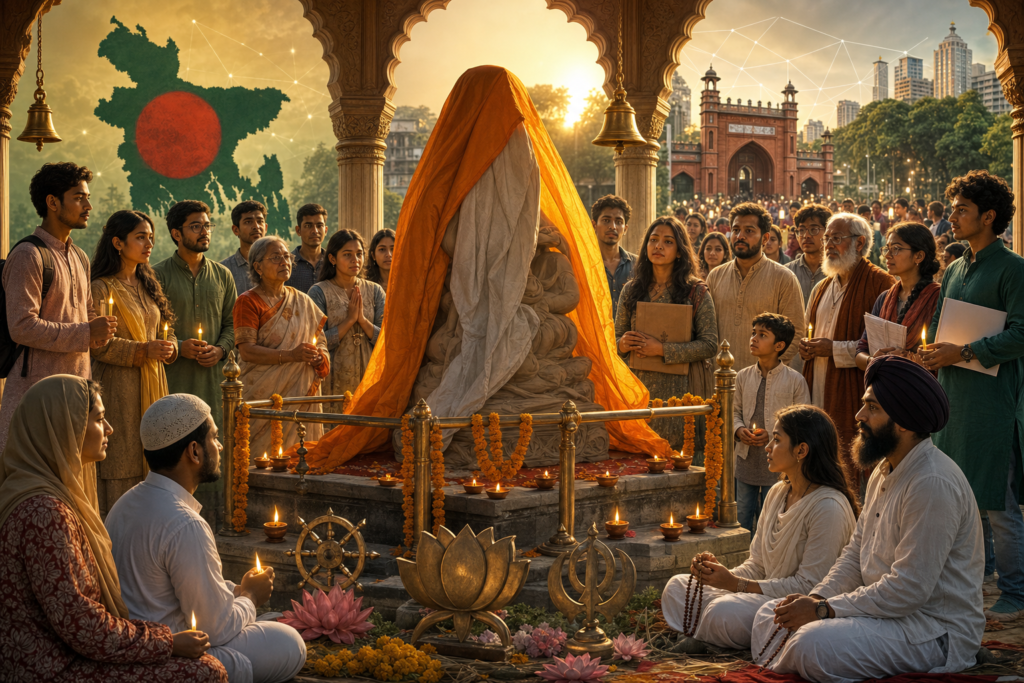
This does not require hostility toward Buddhism, Jainism, or Sikhism. On the contrary, the integrity of Hindu self-naming can strengthen Dharmic unity. Buddhism’s profound analysis of suffering, Jainism’s radical discipline of ahiṃsā and anekāntavāda, Sikhism’s luminous devotion, seva, and insistence on spiritual courage, and Hinduism’s vast synthesis of dharma, ritual, philosophy, bhakti, yoga, and metaphysics all belong to a broad Indic conversation. Unity does not demand sameness. It demands mutual respect, accurate distinction, and freedom from colonial habits that turn shared civilizational space into competitive ownership.
The original claim also raises the issue of what counts as “historically correct.” If historical correctness means using only the labels available at the exact moment of a text’s composition, then much of the modern study of religion would collapse. Terms such as “Christianity,” “Buddhism,” “Jainism,” “Sikhism,” “Daoism,” and “religion” itself have complex histories of formation, translation, and institutional consolidation. Scholars routinely use later categories to describe earlier continuities, provided they do so with nuance. The question, therefore, is not whether “Hinduism” as a modern English term has a history. It does. The question is whether that history invalidates the right of Hindu communities to recognize the Gītā and Yoga Sūtra as central to Hindu tradition. It does not.
Sri Aurobindo understood Hinduism not as a narrow sectarian label but as a vast and many-sided civilizational synthesis. His reading of India’s renaissance rejected the colonial assumption that Hindu tradition was a disorganized residue waiting to be classified by Europe. For Aurobindo, the tradition was capacious, layered, experimental, philosophical, devotional, ritual, and spiritual. It could hold Veda and Tantra, Vedānta and Yoga, temple worship and inner realization, personal deity and impersonal absolute. Such plurality is not evidence that Hinduism does not exist. It is one of the reasons Hinduism has endured.
M.K. Gandhi’s Hind Swaraj offers another key. Gandhi did not understand freedom merely as the exit of British administrators. He warned against desiring “English rule without the Englishman,” because political independence without civilizational self-respect would leave the deeper structure intact. His critique of modern Western civilization was not a rejection of every person from the West; it was a rejection of a model that measured India by external standards while weakening Indian confidence in its own moral and spiritual resources. Applied to scholarship, the lesson is clear: intellectual swaraj requires more than representation inside Western institutions. It requires the authority to think from within Dharmic categories.
The Mahābhārata’s Sabhā Parva offers a powerful metaphor for this condition. Draupadī is dragged into the Kuru court and subjected to vastraharan. Yet as Duḥśāsana pulls, the sari becomes inexhaustible through Kṛṣṇa’s grace. The episode is not only a scene of humiliation; it is a revelation of dharma under assault. In a similar way, Dharmic traditions have repeatedly faced attempts to strip their texts of context, lineage, and sacred meaning. Yet each act of stripping has also revealed the inexhaustibility of the tradition. The śāstras do not become empty when detached by hostile categories; they call forth deeper study, stronger memory, and renewed civilizational clarity.
Still, the critique must be precise. Not every Western scholar participates in appropriation, and not every Indian or Hindu scholar automatically produces better scholarship. There are rigorous, humble, and collaborative scholars across the world who approach Hinduism, Buddhism, Jainism, Sikhism, and other traditions with care. The problem lies not in geography or race alone, but in structures of authority: who receives funding, who is cited, who is treated as theoretical, who is reduced to an informant, who can speak emotionally without being dismissed, and who can name a tradition without being accused of essentialism.
In the digital age, these structures are intensified by Data and Capital. Academic consensus can be manufactured through citation clusters, institutional prestige, curated syllabi, conference networks, publishing gatekeepers, and social media amplification. Once a claim is repeated often enough by authoritative voices, it begins to look like neutrality. In such an environment, saying that the Gītā and Yoga Sūtra are not Hindu texts is not an isolated opinion. It participates in a larger economy in which Dharmic knowledge can be extracted as global content while Hindu civilizational ownership is treated as suspect.
A more responsible scholarly method would begin with several principles. First, it would distinguish between the history of a label and the history of a tradition. Second, it would treat insider categories as intellectual resources, not merely as objects of analysis. Third, it would recognize that Hinduism, Buddhism, Jainism, and Sikhism share Indic civilizational space without collapsing their differences. Fourth, it would avoid using “colonial construction” as a selective weapon against Hindu self-understanding while leaving other modern religious categories intact. Fifth, it would admit that academic humility is not optional when dealing with living traditions.
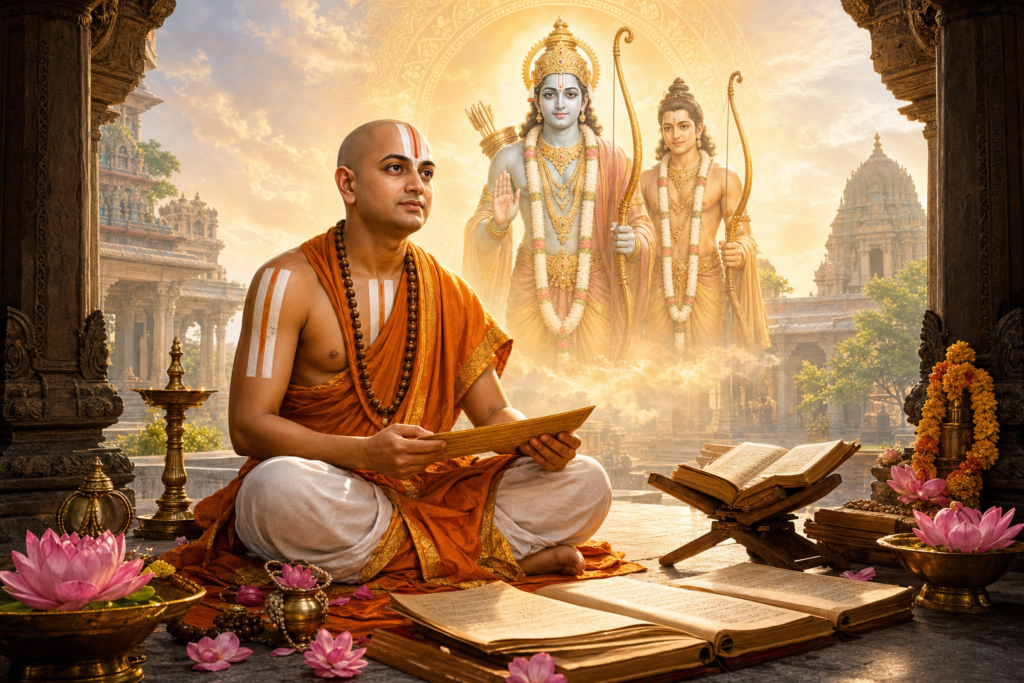
The Bhagavad Gītā and Patañjali’s Yoga Sūtra stand at the core of Hindu intellectual, spiritual, and practical life, even as they speak beyond Hindu communities and participate in wider Dharmic and global conversations. Their Hindu belonging is not weakened by their universality. Their universality is made meaningful by their belonging. To call them Hindu is not to imprison them. It is to acknowledge the civilizational matrix that preserved, commented upon, practiced, loved, debated, and transmitted them.
The challenge before contemporary scholarship is therefore not to protect yoga or the Gītā from Hinduism, but to protect scholarship from its own inherited habits of erasure. A decolonial and genuinely plural academic culture must allow Dharmic traditions to name themselves, interpret themselves, and enter global discourse without surrendering their roots. Hinduism, Buddhism, Jainism, and Sikhism can meet one another with dignity only when each is allowed the integrity of its own memory. In that integrity lies the possibility of unity, not as a slogan, but as a disciplined civilizational ethic.
Inspired by this post on Indica Today.









Leave a Reply
You must be logged in to post a comment.