
The Silent Intelligence Beneath Thought
A gut feeling is often treated as a figure of speech, yet the phrase points to a measurable biological reality. Butterflies before a difficult conversation, a sinking sensation during fear, appetite vanishing under stress, or a calm warmth in the abdomen during meditation are not merely poetic experiences. They are signs of a deeply integrated communication system linking digestion, emotion, immunity, cognition, and embodied awareness.
This system is now widely discussed as the gut-brain axis. In biomedical terms, it is a bidirectional network connecting the gastrointestinal tract, the enteric nervous system, the autonomic nervous system, the immune system, the endocrine system, the vagus nerve, and the gut microbiota. In Yogic and Ayurvedic language, the same field of experience is approached through Agni, prāṇa, Vāta, Rājasic activity, and the subtle relationship between digestion, perception, and mental steadiness.
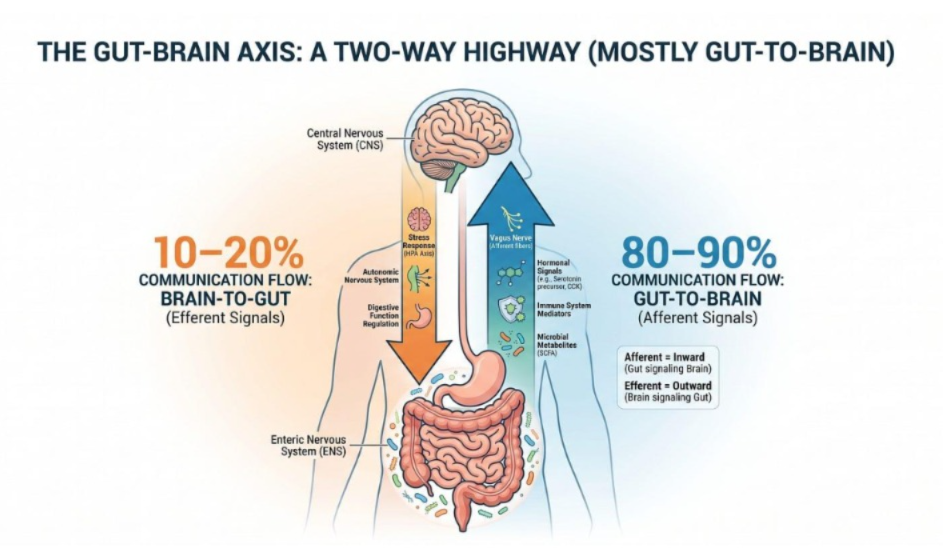
The modern tendency is to imagine the brain as a central command post and the body as a set of obedient organs. This model is useful but incomplete. A large share of signals traveling through the vagus nerve is afferent, meaning that information moves from the organs toward the brain. The body is not simply receiving instructions from the brain; it is continuously informing, shaping, and sometimes correcting the brain’s interpretation of the world.
That recognition changes the study of health. Emotional balance cannot be separated from digestion. Immunity cannot be separated from the gut barrier and microbiome. Stress cannot be separated from the autonomic nervous system. Even attention and intuition cannot be reduced only to thought, because the nervous system receives constant sensory intelligence from within the body.
Ancient medical traditions understood this in their own language. Hippocrates is often associated with the observation that disease begins in the gut. Ayurveda and Siddha systems placed Agni, the digestive and metabolic fire, at the center of health because food is not merely consumed; it is transformed into tissue, energy, clarity, immunity, and vitality. In that sense, digestion is not a local event. It is a whole-body process.
Shareeram and Kāya: The Body in Constant Transformation
Sanskrit preserves a precise physiological intuition through the terms Shareeram and Kāya. Shareeram means “that which constantly breaks down through decay and disease,” while Kāya refers to “that which is nourished and sustained through food.” Together, these words describe the living body as a continuous exchange between breakdown and rebuilding, depletion and nourishment, entropy and renewal.
Modern physiology expresses a similar principle through catabolism and anabolism. Cells are constantly damaged, repaired, replaced, and reorganized. Proteins are synthesized and degraded. The intestinal lining renews rapidly. Immune cells survey the gut environment. The microbiome responds to diet, stress, medication, sleep, infection, and lifestyle. Health depends on whether the body can transform inputs into coherent biological order.
Ayurveda describes this transformative capacity as Agni. Agni is not only stomach acid or digestive enzymes, although those are part of the physical process. It is a broader principle of metabolism: the capacity to digest food, impressions, emotions, and experiences without becoming burdened by residue. Acharya Chakrapāṇi, in his commentary on the Charaka Saṁhitā, summarized the matter with striking clarity: “The treatment of the body is nothing other than the treatment of the Agni within.”
This statement is not a rejection of modern medicine; it is a reminder that sustainable healing requires attention to the body’s fundamental processes of transformation. Nutrition, appetite, elimination, sleep, stress regulation, inflammatory balance, and mental clarity are all linked to the quality of digestion in both the biomedical and Ayurvedic frameworks.
The Siddha tradition offers the same insight in practical language. Thiruvalluvar wrote, “No medicine is needed for the body when it consumes healthy food after well digesting the previous meal.” This is not simplistic advice. It identifies timing, appetite, food quality, and digestive completion as pillars of preventive health. In contemporary terms, it points toward metabolic rhythm, gut motility, glycemic stability, microbial balance, and reduced inflammatory stress.
The Autonomic Nervous System and the State of Digestion
Digestion is profoundly dependent on the autonomic nervous system, the regulatory network that governs involuntary functions such as heartbeat, breathing patterns, blood pressure, gut motility, secretion, immune signaling, and stress response. Its two major branches, sympathetic and parasympathetic, do not act as enemies. They are complementary survival systems that become harmful only when one dominates chronically.
The sympathetic nervous system prepares the organism for action. In danger, it increases heart rate, mobilizes glucose, sharpens vigilance, and redirects blood flow toward the skeletal muscles. In this state, digestion becomes secondary. Gastric secretions may reduce, motility may become irregular, and the abdomen may feel tight or unsettled. Yogic and Ayurvedic traditions would recognize this pattern as disturbed Vāta and heightened Rājasic activity: movement without steadiness, stimulation without restoration.
This pattern is familiar in modern life. Many people eat while rushing, scrolling, arguing, worrying, commuting, or working. The food may be nutritious, but the nervous system is not always ready to digest it. A meal taken in a state of agitation enters a body prepared for defense rather than assimilation. Over time, this mismatch can contribute to bloating, acidity, irregular appetite, disturbed sleep, emotional reactivity, and fatigue.
The parasympathetic nervous system supports the opposite state. It slows the heart, deepens restoration, supports digestive secretion, coordinates gut movement, and allows repair processes to proceed. This is why the phrase “rest and digest” has become common. Healing is not an act of urgency. It requires the physiology of safety, rhythm, and receptivity.
The vagus nerve is central to this process. It extends from the brainstem through the neck and thorax into the abdomen, carrying signals between the brain and organs including the heart, lungs, stomach, and intestines. Its sensory pathways help the brain monitor internal states such as fullness, inflammation, motility, and visceral comfort. From a Yogic perspective, this communication may be contemplated as one of the gross physiological expressions through which prāṇa links bodily function and mental state.
The Enteric Nervous System: Why the Gut Is Called a Second Brain
The gut contains its own complex neural network known as the Enteric Nervous System. This system includes hundreds of millions of neurons organized in plexuses within the gastrointestinal wall. It regulates motility, secretion, blood flow, immune interactions, and local reflexes. It can coordinate many digestive functions without conscious control, which is why it is often described as the body’s “second brain.”
This phrase should be used carefully. The gut does not think in the way the cerebral cortex thinks. It does not compose arguments, solve equations, or plan future events. Yet it does sense, integrate, respond, and remember patterns of physiological experience. It detects stretch, nutrients, microbial signals, inflammatory markers, toxins, and chemical changes. It then communicates this information to the central nervous system through neural, immune, endocrine, and metabolic pathways.
When anxiety produces butterflies in the stomach, the sensation is not imaginary. When grief removes appetite, the effect is not merely psychological. When meditation softens the abdomen and lengthens the breath, the change is not only subjective. These experiences reveal the embodied nature of emotion. The mind is not floating above the body; it is continually shaped by the body’s signals.
Yogic anatomy associates this region with Maṇipūra Chakra, traditionally linked with digestion, transformation, courage, will, and the processing of experience. Whether approached symbolically or physiologically, the insight is coherent: the abdominal center is where nourishment becomes energy, where stress becomes sensation, and where experience is either assimilated or held as disturbance.
Microbiota, Neurochemistry, and Emotional Balance
The gut-brain axis also includes the gut microbiota, the vast community of bacteria, fungi, viruses, and other microorganisms inhabiting the digestive tract. These microbes participate in digestion, vitamin metabolism, bile acid transformation, immune education, gut barrier regulation, and the production of metabolites such as short-chain fatty acids. Their influence on the nervous system is an active area of research, especially in relation to stress, mood, inflammation, and cognition.
One commonly repeated claim requires careful phrasing. It is more accurate to say that most of the body’s serotonin is found in the gastrointestinal tract, much of it produced by enterochromaffin cells, and that gut microbes can influence serotonin biology. It is not accurate to say that nearly all “brain chemicals” are produced by microbes in the gut. The science is more nuanced and more interesting: the gut, its microbes, immune cells, endocrine cells, and nerves participate in neurochemical signaling that can influence mood and behavior without replacing the brain’s own neurotransmitter systems.
Serotonin supports intestinal motility and also has central roles in mood, sleep, appetite, and emotional regulation. Dopamine participates in motivation, learning, reward, and movement. GABA helps regulate neural excitability and stress responses. Melatonin is associated with circadian rhythm, antioxidant activity, immune modulation, and gut physiology. Microbial species can produce or modulate neuroactive compounds, but their effects depend on context, barrier function, host metabolism, diet, and immune signaling.
This is where ancient and modern frameworks can be placed in dialogue without forcing one to collapse into the other. Ayurveda speaks of Agni, dosha balance, prāṇa, and the consequences of improper digestion. Neuroscience speaks of vagal tone, enteric neurons, microbiota-derived metabolites, inflammatory cytokines, autonomic balance, and the hypothalamic-pituitary-adrenal axis. The vocabulary differs, yet both traditions recognize that digestion, emotion, vitality, and clarity are inseparable.
Tridosha and the Patterns of Digestive Imbalance
Ayurveda further explains digestive and emotional patterns through the Tridosha principle: Vata, Pitta, and Kapha. These are not crude labels for personality. They are functional patterns that describe movement, transformation, structure, fluidity, heat, stability, and responsiveness within the body-mind system. When applied carefully, they provide a practical language for observing recurring patterns of imbalance.
Vata, associated with movement and the air element, tends toward irregularity when disturbed. Digestively, this may appear as bloating, gas, variable appetite, constipation alternating with looseness, and sensitivity to routine disruption. Emotionally, it may appear as anxiety, worry, overthinking, restless sleep, and fluctuating energy. In contemporary physiology, such patterns may overlap with stress arousal, altered gut motility, visceral sensitivity, and nervous system instability.
Pitta, associated with fire and transformation, tends toward intensity when disturbed. Digestively, this may appear as acidity, burning sensations, loose stools, strong hunger, inflammatory tendencies, or irritability when meals are delayed. Emotionally, it may appear as impatience, sharp criticism, competitiveness, or anger. Biomedical language may describe overlapping patterns through acid secretion, inflammatory signaling, metabolic heat, and stress-related reactivity.
Kapha, associated with water, earth, cohesion, and stability, tends toward heaviness when disturbed. Digestively, this may appear as sluggish appetite, heaviness after meals, slow metabolism, mucus accumulation, lethargy, or dullness. Emotionally, it may appear as attachment, inertia, low motivation, or resistance to change. In modern terms, this may resemble slowed metabolic rhythm, reduced movement, inflammatory burden, or lifestyle-related stagnation.
Balanced digestion is therefore not merely the absence of stomach discomfort. It is reflected in steady appetite, appropriate hunger, comfortable elimination, lightness after meals, emotional steadiness, clear perception, restful sleep, resilient immunity, and sustained energy. Ayurveda calls this the strengthening of Agni. Modern health science might describe it as coordinated metabolism, autonomic regulation, gut barrier integrity, microbial diversity, and reduced inflammatory load.
Eating as a Nervous System Practice
The practical implication is simple but demanding: eating is not only a nutritional act; it is a nervous system practice. The body digests best when it is present enough to receive food. Attention, posture, breathing, meal timing, chewing, and emotional state all influence digestion. A distracted meal may satisfy calories while failing to support assimilation.
Traditional guidance to eat after the previous meal has been digested reflects a sophisticated respect for rhythm. Modern research has its own language for this principle through gastric emptying, migrating motor complex activity, insulin response, circadian timing, and metabolic flexibility. Constant grazing, late-night eating, emotional snacking, and hurried meals can disturb the signals by which the gut coordinates repair and renewal.
This does not mean that health requires rigidity or fear around food. Dharmic traditions generally emphasize discernment rather than obsession. The goal is not purity as anxiety; it is harmony as practice. Food should nourish the body, steady the mind, support ethical living where possible, and fit one’s constitution, season, work, age, and digestive capacity.
Simple practices become powerful when repeated: pausing before meals, breathing slowly, chewing thoroughly, eating at regular times, avoiding overeating, respecting appetite, choosing fresh and suitable food, allowing digestion before eating again, and observing how different foods influence sleep, mood, clarity, and energy. These are not glamorous interventions, but they are foundational.
Yoga, Breath, and Vagal Regulation
Yoga contributes another layer to the gut-brain discussion. Breath, posture, attention, and meditation can influence autonomic state. Slow breathing, especially with extended exhalation, is associated with parasympathetic activation and improved heart-rate variability in many contexts. Gentle asana can support circulation, mobility, and body awareness. Meditation can reduce habitual reactivity and increase interoceptive awareness, the capacity to sense internal bodily states.
In traditional terms, prāṇa becomes steadier when breath and awareness become steadier. In physiological terms, the nervous system shifts away from chronic threat signaling toward regulation. The abdomen softens. The diaphragm moves more freely. The vagal pathways involved in digestion and cardiac regulation are supported. A person may not think about the gut-brain axis during practice, yet the body experiences it directly.
Maṇipūra Chakra also becomes relevant here as a contemplative map. It represents the fire of transformation, confidence, discipline, and digestive power. When this center is disturbed, one may experience either collapse or aggression, dullness or overcontrol, weak digestion or excessive intensity. When balanced, it supports courage without harshness, discipline without rigidity, and vitality without restlessness.
A Shared Dharmic Insight
The broader Dharmic traditions of Hinduism, Buddhism, Jainism, and Sikhism each approach food, discipline, awareness, and self-regulation with distinct theological and philosophical foundations. Yet they share a practical reverence for mindful living. Food is not treated as a trivial indulgence. Breath is not treated as a mechanical process. The body is not treated as separate from ethical and spiritual life.
Ayurveda emphasizes Agni and constitution. Yoga emphasizes prāṇa, attention, and integration. Buddhist practice often highlights mindful eating and awareness of sensation. Jain traditions emphasize restraint, non-violence, and purity of conduct around consumption. Sikh tradition honors disciplined living, seva, and the sanctity of shared food through langar. These traditions differ, but they converge on a central insight: how one consumes shapes how one lives.
This shared insight is especially relevant in an age of overstimulation. The modern person may have abundant food but poor digestion, endless information but little assimilation, constant connectivity but diminished inner listening. The gut-brain axis offers a scientific language for a very old warning: when rhythm is lost, the mind becomes unstable and the body bears the cost.
Listening to the Gut Without Romanticizing It
To listen to the gut does not mean obeying every impulse. Cravings may arise from habit, stress, microbial shifts, sleep deprivation, emotional need, or metabolic imbalance. Fear may masquerade as intuition. Avoidance may feel like wisdom. Therefore, gut feeling requires discernment. A regulated nervous system is more reliable than a reactive one.
The deeper lesson is that intuition becomes clearer when physiology is less disturbed. A calm gut, steady breath, balanced appetite, and rested mind create better conditions for judgment. This is where the academic and the experiential meet. The gut-brain axis does not reduce intuition to chemistry, but it shows that clarity is embodied. The state of the body participates in the quality of perception.
For readers interested in the scientific foundation, useful starting points include peer-reviewed work on the gut-brain axis and enteric microbiota, research on the vagus nerve in microbiota-gut-brain communication, studies on gut microbiota and serotonin biosynthesis, and reviews of the enteric nervous system and neurogastroenterology. These sources do not replace traditional knowledge; they help clarify where modern mechanisms illuminate long-observed experience.
The essential message remains practical. Strengthen Agni. Respect rhythm. Calm the nervous system. Eat with awareness. Digest before consuming again. Attend to breath, sleep, movement, and emotional steadiness. The gut-brain superhighway is active at every moment. Health begins when its signals are neither ignored nor exaggerated, but understood with disciplined attention.
Inspired by this post on Indica Today.
