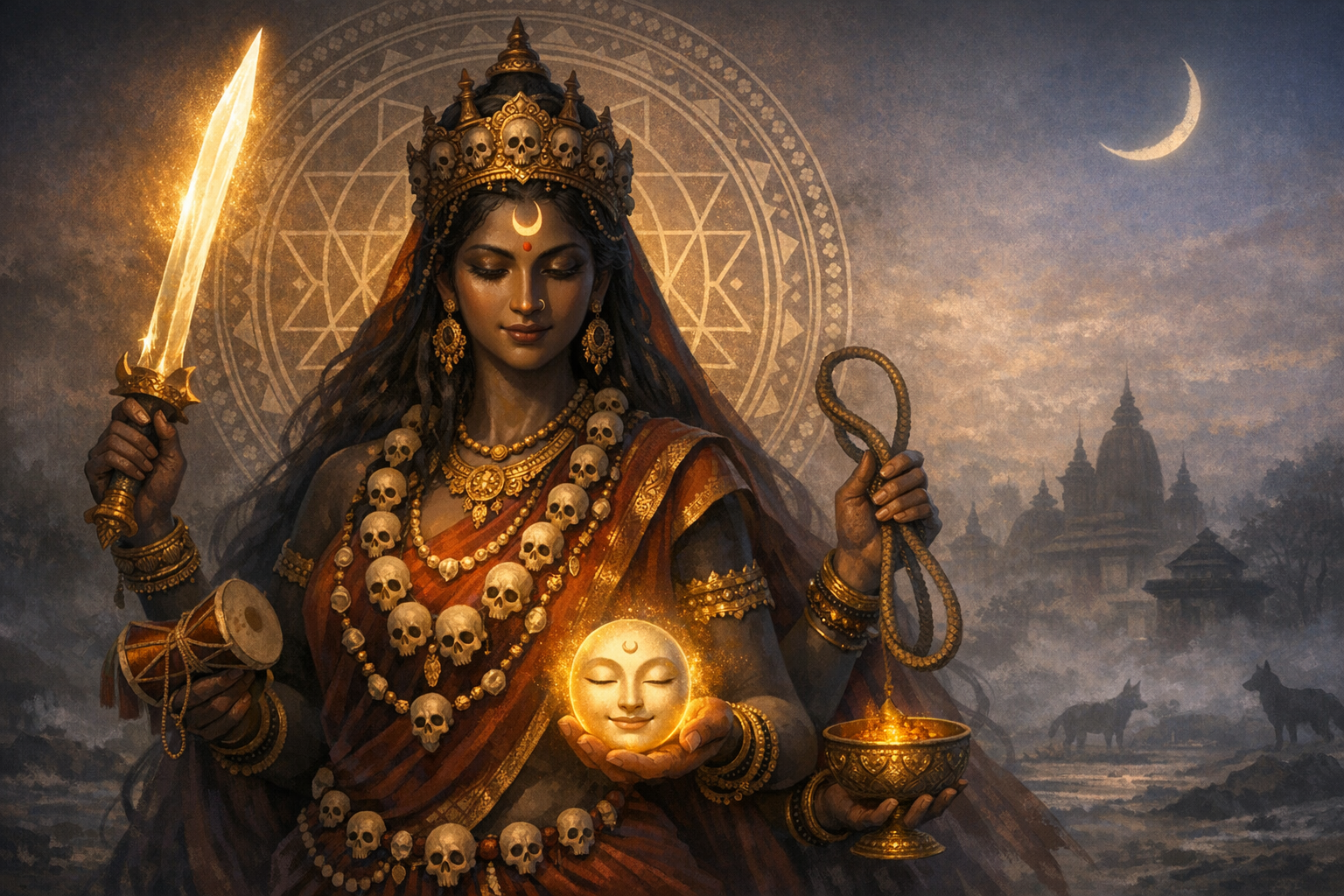
The decapitated head in the left lower hand of Goddess Chamunda is not a scene of terror; it is a meditation on liberation. In this Shakta iconography, the face on the severed head is often calm, even radiant. This visual choice is deliberate and doctrinal: the image communicates that, once the ego (ahamkara) is cut away, what remains is serenity, contentment, and the unshakeable bliss associated with moksha. Put simply, the decapitated head held by Chamunda shows happiness, not pain or fear.
Chamunda appears in the Devi Mahatmya as the formidable power who subdues chaos and slays the asuras Chanda and Munda, from whom her name arises. Within the Sapta Matrika tradition and broader Shakta tantra, she is depicted emaciated, adorned with a mundamala (garland of skulls), and enthroned in the cremation ground. These elements are not morbid decorations but pedagogical symbols, aligning the viewer with impermanence, truth, and the existential ground of spiritual practice. This fierce but compassionate Goddess embodies the paradox central to many Dharmic traditions: only by confronting finitude does one discover fearlessness (abhaya) and joy.
In iconographic terms, Chamunda’s attributes typically include a khadga (sword), a kapala (skull cup), a pasha (noose), and occasionally a damaru (drum). Her association with jackals, cremation grounds, and the night sky emphasizes liminality, dissolution, and the ultimate horizon of human life. In this visual grammar, the severed head is not a trophy of violence, but a sign of spiritual surgery: the clean excision of that which bindsignorance, clinging, and the self-referential mind. Read in context, the smile on the head is a report from the other side of fear.
Theologically, Shakta texts and tantric praxis present decapitation as an archetype of ego-shedding. The head stands for the seat of discursive thought and self-importance; its removal symbolizes the cessation of the restless “I-maker.” Once this turbulence is silenced, clarity (vidya) and bliss (ananda) emerge. The serene expression thus corresponds to a jivanmukta’s composurefreedom realized while life still flowsand anticipates the videhamukti implied by the cremation-ground setting. The head smiles because the contraction of individuality has yielded to expansive awareness.
This reading harmonizes with broader Shakta iconography. The mundamala is not a garland of death, but a rosary of lessons: each skull can be understood as a vanquished delusion, a past identity, or a klesha (affliction) that no longer binds. The kapala is similarly revalued; in tantric hermeneutics, it is a vessel of wisdomsometimes shown brimming with “amrita,” the nectar of immortality that signifies bodhi, not bloodlust. Such inversions are central to tantra’s pedagogical approach: what frightens, when rightly understood, becomes the gateway to freedom.
Ritually, Chamunda’s association with smashana-sadhana (cremation-ground practice) invites practitioners to contemplate impermanence without evasion. This is not ascetic gloom; it is exacting clarity. The setting strips away the consolations of habit and identity, revealing a life inseparable from death and a consciousness that is not erased by endings. Within this atmosphere, the smiling head teaches that the release from fear is not achieved by denial but through profound intimacy with reality as it is.
Many temples and sculptures underscore this meaning through compositional cues. The face of the head often features softened eyelids, relaxed brows, and a slight smileiconographic signals of tranquility familiar across classical Indian art. Even when dynamic movement surrounds Chamundawhirling hair, poised weapons, animated attendantsthe head remains still, an axis of composure in the scene. The juxtaposition is instructive: fierce compassion removes bondage; liberated awareness abides in peace.
Panchamundi Asana symbolism further deepens the message. The ritual seat made of five skulls is understood variously as the transcendence of the five kleshas, the harmonization of the five elements (pancha mahabhutas), or the sublation of five social or cognitive constraints. In all interpretations, multiplicity is resolved in non-dual awareness. The smiling head in Chamunda’s hand visually echoes the same attainment at a micro-level: the subduing of the personal ego, the most intimate of the “five.”
Comparative Shakta iconography supports this non-violent reading of violent images. Kali’s severed head and blood-bowl can be read as the conversion of life’s flux into wisdom; Chinnamasta’s self-decapitation powerfully depicts prana’s circulation and the sovereignty of consciousness over bodily identity. Chamunda’s smiling head belongs to this family of symbols, each dramatizing a common soteriological point: ego-death reveals a joy that ordinary pleasure cannot equal.
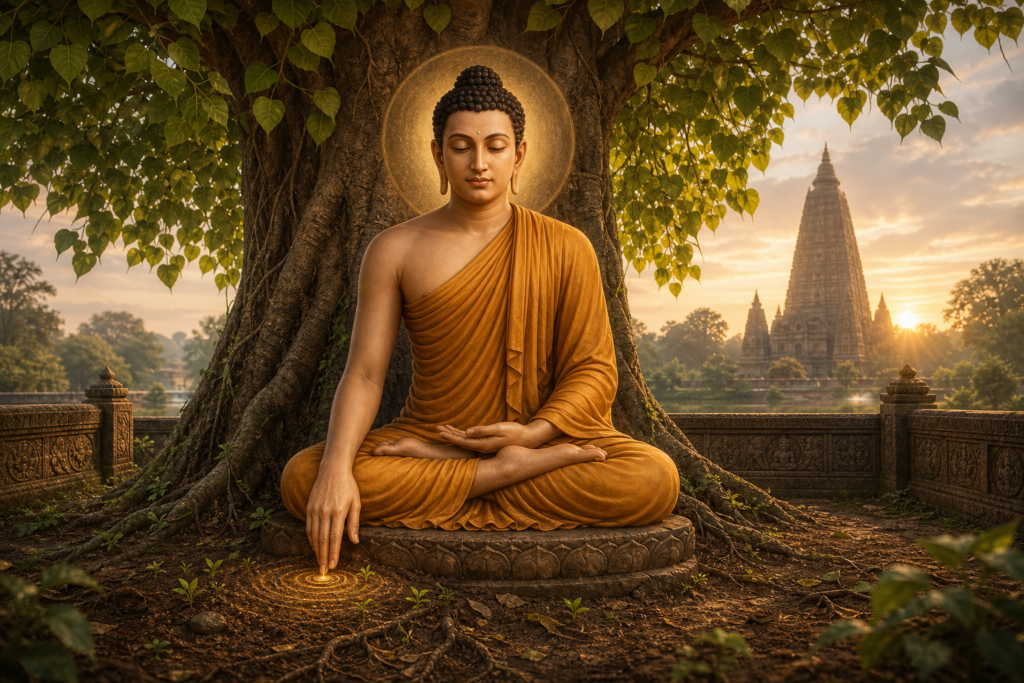
Cross-traditional resonances reinforce the unity of Dharmic insights. In Vajrayana Buddhism, dakinis wield the kapala not as a mark of nihilism but as a chalice of insight; fierce deity yoga turns aversion into awakening. In Jainism, the conquest of kashaya (passions) and the aim of kevala jnana parallel the same ascent beyond egoic turbulence. In Sikh thought, haumai (egoism) is the primary veil; “mann marna” (subduing the mind) opens the path to the Divine. Although aesthetics and ritual methods differ, the shared thesis is unmistakable: overcoming ego discloses inner freedom, serenity, and compassion.
Art-historically, Chamunda has been rendered from early medieval to late medieval periods across North and South India, with notable examples among the Chandelas, Hoysalas, and in temple complexes where Sapta Matrika panels occur. Regional idioms varysome emphasize skeletal austerity, others the dynamism of attendant spiritsyet the facial language of the severed head tends toward equanimity. This recurrent detail across centuries suggests a widely recognized hermeneutic: death as a metaphor for shedding ignorance, life as an opportunity for realizing the ground of awareness.
Chamunda’s association with jackals, frequently depicted nearby, also carries layered meaning. In the cremation ground they are agents of dissolution, yet within the sacred frame they function as reminders of nature’s impartial recycling of forms. This is part of the broader Goddess Chamunda jackals symbolism: the natural world, unflinching and cyclical, is not an enemy of spirit but its teacher. The smiling head, in this context, is nature’s own smileform dissolves, awareness remains.
For practitioners and visitors, the image’s impact is both emotional and practical. Many initially encounter unease, which then becomes curiosity and, finally, solace, as the scene is recognized as a visual teaching. In meditation, one may take the head’s smile as a drishti-bhava (contemplative focus), recalling that fear is bound to clinging. When a surge of anxiety or pride is noticed, the symbol suggests an inner “decapitation”: cutting the story, returning to awareness. Over time, this practice cultivates a composure mirroring the icon’s serene face.
Philosophically, the symbol invites a precise distinction between brutality and transformation. In the worldly register, severing a head is violence; in the spiritual register, it is a cipher for cutting ignorance. The icon’s grammar shifts the register by coupling the act with unmistakable signs of beatitude. The consequence is crucial for ethics: the ultimate victory celebrated here is mastery over oneself, not domination over others.
This insight naturally supports interfaith respect within the Dharmic family. Hinduism’s Shakta tantra, Buddhism’s Vajrayana, Jain tapas, and Sikh gurmat all map the same interior territory with different cartographies. Each tradition, in its own vocabulary, discloses that the path to freedom runs through the relinquishing of ego and attachment. Such common ground strengthens mutual understanding and unity, even as ritual forms and doctrines retain their individuality.
The smile on Chamunda’s severed head also illuminates the paradox of fear and love in sacred art. Fierce imagery generates initial distance, which is then bridged by a sign of intimacythe smile. Devotional psychology thus moves from awe to trust: what first appears terrible is revealed as compassionate surgery. The image performs a transformation in the viewer akin to the transformation it depicts within the aspirant.
From an interpretive standpoint, the statement “The decapitated head held by Chamunda shows happiness, not pain or fear” is neither poetic hyperbole nor a mere aesthetic choice. It is an exact doctrinal shorthand for the culmination of sadhana: when the compulsive selfing process ceases, the natural radiance of awarenesspeaceful, fearless, and joyousshines by itself. In that sense, the icon is less a narrative and more a mirror, reflecting what is possible for human consciousness here and now.
Viewed through this lens, Chamunda’s imagery ceases to be an artifact of a bygone era and becomes a living guide. It offers a practical ethiccourage in the face of truth, reverence for life’s cycles, and an unsentimental compassion born from insight. It offers a mystic psychologyhow to meet fear and transmute it into clarity. And it offers a unifying bridge among Hindu, Buddhist, Jain, and Sikh philosophies by pointing, in different idioms, to the same summit: freedom beyond fear.
Thus, the enigmatic smile on the severed head in Chamunda’s hand is not an anomaly to be explained away but the very heart of the teaching. Where the ego imagines an ending, wisdom perceives release. Where fear anticipates pain, insight recognizes bliss. The icon does not glorify death; it sanctifies awakening.
Inspired by this post on Hindu Blog.