In living Hinduism, sacred weapons (āyudhas) borne by gods and goddesses are not instruments of destruction alone but charged emblems of spiritual authority, moral protection, and cosmic order. Two of the most recognizable are the śūla (Shoola) and the triśūla (Trishul). Because both are spear-like and often appear in Shaiva and Shakta contexts, they are frequently conflated. Yet the distinction matters: it refines understanding of deity iconography, enhances temple darśana, and clarifies the theological grammar through which dharma is visually communicated.
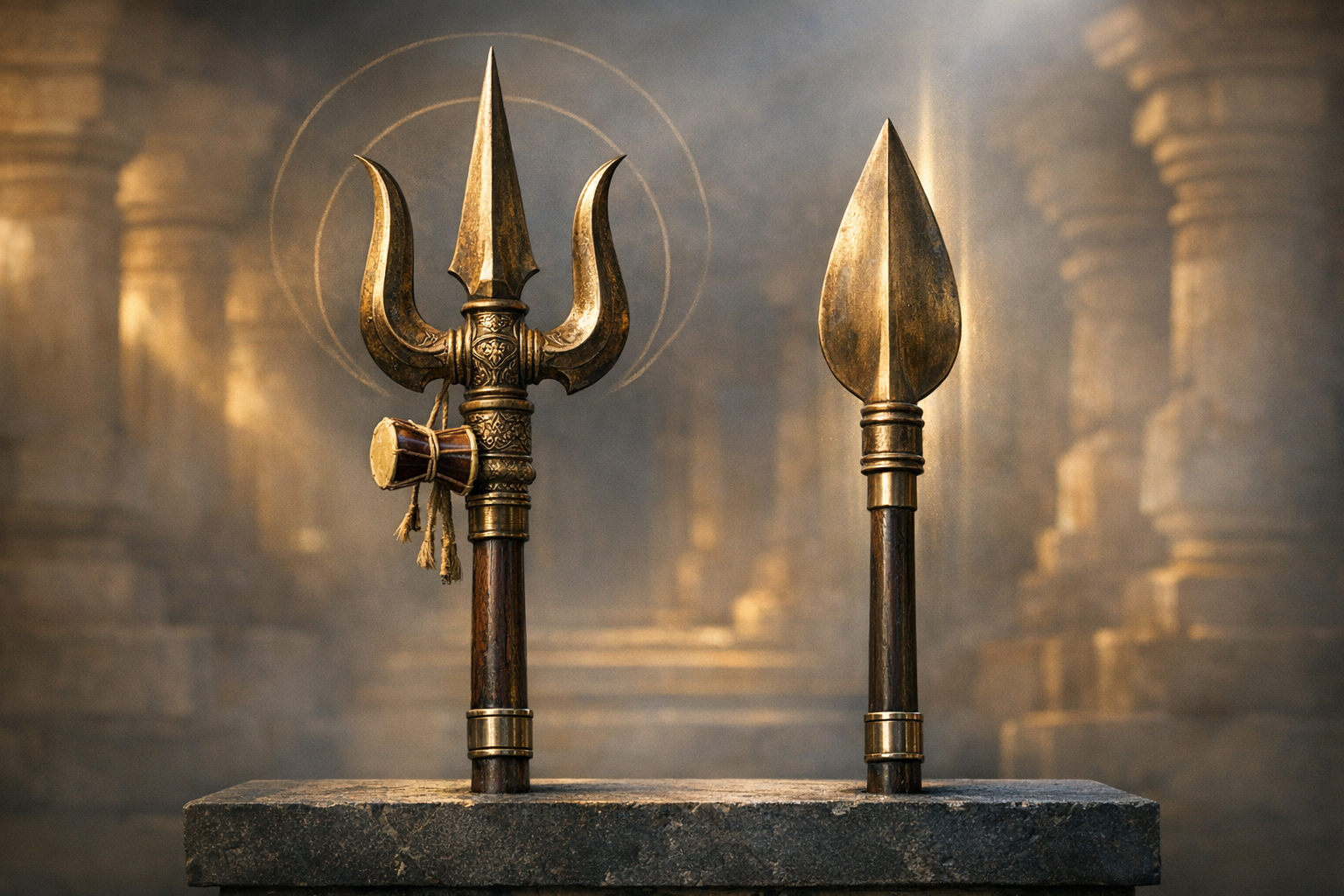
At the most basic level, Shoola refers to a single-pointed spear or lance, while Trishul is a tridentliterally a “three-spear” with a central, elongated prong flanked by two lateral, often slightly curved prongs. The two are cognate but not identical: every Trishul is a specialized form of spear, but not every spear is a Trishul. In practice, a Shoola emphasizes singular focus and directed energy; a Trishul encodes a triadic synthesis of powers.
Etymology supports the distinction. The Sanskrit śūla (शूल) denotes a spike, spear, or impaling instrument and also, in Ayurvedic usage, a kind of acute pain. The compound triśūla (त्रिशूल) means “three-spear” or trident. Across Indian languages, usage varies: in Tamil, sūlam commonly denotes a trident, whereas vel is the spear of Murugan/Skanda; in Hindi and Bengali, “trishul/trisul” universally signals the trident. Recognizing this linguistic fluidity helps explain why lay speech sometimes collapses the difference.
Iconographically, a Shoola is a single, leaf-shaped or flame-shaped blade set on a long shaft, sometimes with a metal ferrule, occasionally barbed or flanged, and proportioned for thrust. The Trishul, by contrast, has a tall, straight central prong representing the principal piercing force, with two shorter prongs to right and left that may curve slightly outward or remain straight for symmetry. Manuals of Śilpa Śāstra and the Agamas emphasize harmony of line, balance of mass, and proportion between blade and shaft so that the weapon reads as an integrated sign of power and composure rather than mere aggression.
Associations with deities align with this formal vocabulary. Śiva is renowned as Triśūla-dhārin (bearer of the Trishul) and as Śūlapāṇi (he whose hand holds the spear). Fierce forms such as Bhairava likewise carry the Trishul. The Goddess (Devī) in her Mahīṣāsuramardinī aspect wields the Trishul decisively; Śūlinī (Śūlini), venerated in Himalayan regions, explicitly signals the spear-bearing power of Śakti. While Vaishnava iconography centers on the cakra, śaṅkha, gadā, and padma, regional or tantric forms occasionally adopt the spear, reinforcing the pan-dharmic understanding that righteous power is protective and ultimately compassionate.
The Trishul’s theological density comes from its triadic coding. It can be read as icchā-śakti, jñāna-śakti, and kriyā-śakti (will, knowledge, action) in perfect consonance; as the three guṇassattva, rajas, tamasbrought under mastery; as the triad of timepast, present, futurepierced by consciousness; or as the three planesbhūr, bhuvaḥ, svaḥheld in equilibrium. Tantric and yogic readings often align the central prong with suṣumṇā, the axial channel of spiritual ascent, and the flanking prongs with iḍā and piṅgalā, bringing breath, mind, and prāṇa into non-conflictual alignment.
The Shoola’s symbolism is complementary rather than inferior. A single spear concentrates energy into one unwavering line. It becomes a sign of ekāgratā (one-pointedness), discriminative insight that cuts through confusion (viveka), and the resolve to uphold dharma without diffusion or delay. In yogic metaphor it is the piercing of the granthisthe psychological knots that bind awarenessso that clarity and courage flow unobstructed.
Scriptural and purāṇic narratives reinforce these meanings. In the Devī Māhātmya, the Goddess employs the Trishul as a decisive implement against demonic turbulence, restoring moral order with discriminating force. The Śiva Purāṇa and Skanda Purāṇa preserve episodes in which Śiva’s Trishul subdues delusion and hubris, while his epithet Śūlapāṇi signals the spear’s role in guarding sacred boundaries. These texts present weapons not as glorification of violence but as iconographic pedagogyteaching that authentic power protects, heals, and ultimately liberates.
Art-historical evidence corroborates the antiquity of both forms. Early reliefs from Mathura and Sanchi, Kushan coinage depicting Oešo (Śiva) with a trident, and medieval bronzes from South India all testify to an enduring grammar of spear and trident. In Southeast AsiaKhmer, Thai, and Javanese contextsthe Trishul appears on temple lintels and standards, demonstrating the symbol’s wide diffusion across the Indic ecumene.
Temple architecture and ritual practice make the distinction tactile. Shaiva and Shakta temples often display a Trishul on dhvaja-stambha, at gateways, or as a finial motif, signaling sacred presence and apotropaic protection. Processional images of Śiva, Durgā, and Bhairava frequently carry a Trishul, sometimes entwined with a ḍamaru, visually marrying rhythm and restraint. In Murugan/Skanda temples, by contrast, the vel (a spear) dominates; its singular blade communicates the focused grace through which ignorance is dispelled.
Regional language adds nuance. In Tamil, sūlam typically means trident; in colloquial North Indian usage “trishul” is ubiquitous for the three-pronged emblem, while “bhala” or “barchhī” can denote a spear. This fluidity explains why devotees, vendors, and even guides sometimes label any long-bladed implement a “trishul.” A careful iconographic eyecounting prongs, noting curvature and balancedissolves the confusion instantly.
The unity of dharmic traditions becomes visible through these symbols. In Vajrayāna Buddhism, triadic emblems appear in trident-like finials and ritual implements, teaching integration of wisdom and method; Newar Buddhist art in Nepal prominently features such motifs. In Jain art, attendant deities and guardians sometimes bear spears as signs of vigilant protection of ethical space. Sikh symbolism centers on the khanda, kirpān, and chakkar, articulating the mīrī–pīrī synthesis of temporal responsibility and spiritual depth. Across Hinduism, Buddhism, Jainism, and Sikhism, sacred arms signify the defense of truth, compassion, and communal well-being rather than dominationan ethic of power in service of dharma.
From a contemplative perspective, both Shoola and Trishul operate as mnemonic diagrams. The Trishul invites reflection on balancing knowledge, will, and action, or harmonizing the three guṇas in everyday decisions. The Shoola focuses attention on ekāgratā: choosing the right action without vacillation. Many devotees report that simply viewing a Trishul crowning a temple spire, or a spear accompanying a processional deity, evokes steadiness and reassurancean experiential reminder that spiritual authority is ultimately protective love.
Material culture further clarifies their roles. Temple āyudhas are cast in pañcaloha or forged in iron and steel, then ritually consecrated within the temple’s prāṇa-pratiṣṭhā ecosystem. A Trishul’s side prongs are crafted to create a gentle visual cadence around the central axis, while a spear’s single blade is often wider and leaf-shaped for visual emphasis. Over centuries, guild lineages of artisans encoded these balances into regional stylesKalinga, Chola-Pandya, or Himalayanwithout erasing the fundamental distinction between spear and trident.
Common misunderstandings deserve brief correction. Because both implements can appear in fierce iconography, some assume they glorify violence. In classical sources, however, weaponry is a metaphor for discernment and a pledge of protection, not an endorsement of harm. Others conflate Murugan’s vel with a Trishul; yet the vel is a single spear whose theology is about penetrating ignorance with razor clarity. Recognizing these nuances refines temple education, curatorial practice, and everyday conversations about “Hindu symbols.”
A quick identification habit helps: if three discrete tips are present, the emblem is a Trishul, with the central prong typically the longest; if there is one bladewhether slim and spike-like or leaf-shapedthe implement is a spear, or Shoola. The base furniture also differs: Trishuls may feature a distinct socketed mount or decorative cuff balancing the triple head, whereas spears often emphasize the blade-to-shaft transition. Such observational literacy deepens darśana and makes pilgrimages more rewarding.
Textual exegesis supports sustained engagement. The Skanda Purāṇa and Shaiva Agamas narrate the Trishul as a binder and releaser of energies, subordinating chaos to order. The Devī Māhātmya dramatizes the Trishul’s surgical strike against adharma, teaching that firmness is compatible with compassion. Meanwhile, the very epithet Śūlinī reminds practitioners that the single-pointed spear of Śakti is the interior power of concentration through which liberation becomes practicable.
Art history and practice converge on a unitive message: Shoola and Trishul are pedagogical devices in metal and wood, encoded to teach the responsibilities of strength. When communities honor these forms, they implicitly affirm shared dharmic valuestruthfulness, self-discipline, non-cruelty, and readiness to protect the vulnerable. This convergence is why similar symbolic grammars surface across Hinduism, Buddhism, Jainism, and Sikhism, despite differences in liturgy and theology.
In summary, the Shoola and the Trishul differ in form, semantics, and iconographic work. The Shoola, a single spear, concentrates force and signifies laser-like discernment; the Trishul, a triple spear, integrates complementary powers into poised equilibrium. Learning to see that differenceon murals, bronzes, temple finials, and processional standardsdoes more than solve a vocabulary puzzle. It trains the eye to read dharma in line and metal, and it trains the heart to recognize that true power in the Indic traditions is ethical, protective, and ultimately liberating.
Inspired by this post on Hindu Blog.