Goddess Jogadyaalso rendered as Yogadya or Jogadya Durgais venerated in Bengal as a distinct, powerfully intimate manifestation of Goddess Durga. Described as the divine union of Yoga and Adya, her name condenses a profound theological vision: the disciplined stillness of yogic concentration and the primordial, maternal source of all energy, Ādyā Śakti. In Bengal’s living Shakta heritage, Jogadya is not merely an epithet; she is a felt presence in seasonal festivals, in village shrines, and in the rhythm of family life that honors the Goddess as protector, guide, and Kula Devata. The result is a tradition where rigorous spiritual practice, community belonging, and maternal compassion converge seamlessly. This essay maps her theology, ritual grammar, iconography, and cultural footprint with a focus on Bengal, while drawing connections to the unifying strands shared across dharmic paths.
Etymologically, Jogadya joins two key ideas: Yoga (one-pointedness, internal integration, and ascent toward samādhi) and Adya (the primal, foundational Mother). Within Shakta thought, the synthesis suggests that the primordial energy is realized through Yoga and, at the same time, Yoga itself is animated by the primordial energy. Bengali Shakta literature frequently invokes the term Ādyā, reflecting a vision found in the Devi Mahatmya of the Markandeya Purana and echoed across Tantric currents in eastern India. This doctrinal frame helps explain why devotees approach Jogadya with both contemplative discipline and affective devotion. To worship Jogadya is to honor disciplined inwardness and the timeless, originative Mother in one gesture.
Geographically and historically, veneration of Jogadya is closely tied to Bengal. A prominent center of worship is associated with Khirgram (often written as Kshirgram) in present-day Purba Bardhaman, with further devotional footprints in districts such as Murshidabad, Birbhum, Hooghly, and Bankura. This regional spread reflects the ease with which Shakta worship has braided itself into Bengal’s agrarian calendar, artisan networks, and domestic rites. Local legends, oral histories, and ritual manuals together construct an enduring sacred geography that places Jogadya within a dense web of village shrines and temple customs. In these spaces, the sacred is encountered as heritage, kinship, and ethical formation.
Historical patterns suggest that the Jogadya current, like many regional Shakta forms, grew through a centuries-long dialogue between folk goddesses and pan-Indic Durga theology. Medieval Bengal (c. 10th–13th centuries) saw the consolidation of Shakta idioms, often patronized by local elites and sustained by temple-communities. Over time, this produced worship repertoires that balanced scriptural recitation with vernacular performance traditions. The outcome is a resilient synthesis: Puranic names and Tantric ritual logics suffuse local festivals, while village memory and seasonal rites preserve a strikingly personal bond with the Goddess.
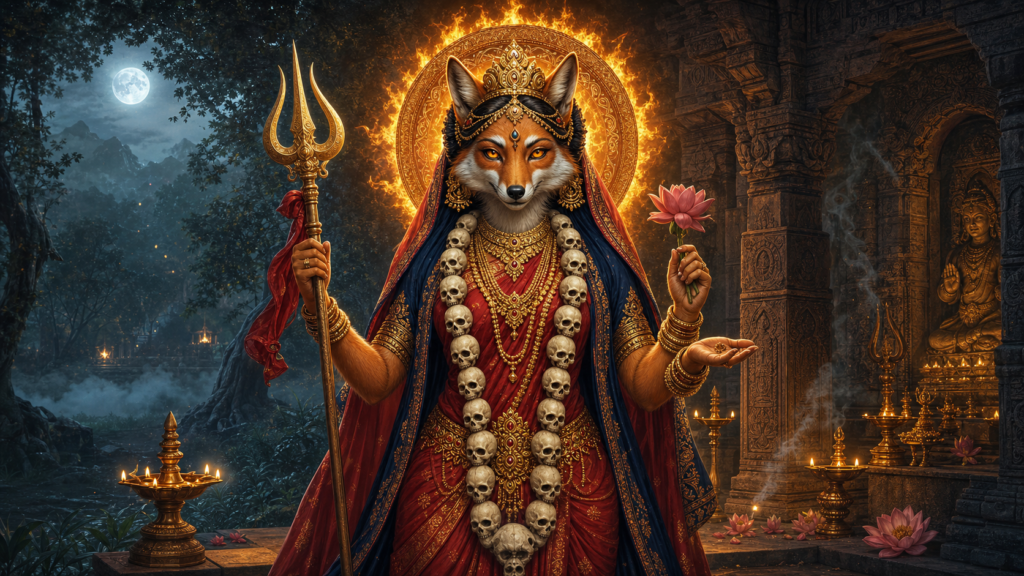
Iconographically, Jogadya’s form varies by temple and lineage. In many shrines she appears as Mahishamardinilion-borne, multi-armed, and triumphant over the buffalo-demonholding emblems such as trishula, chakra, shankha, bow, and sword. In other places, she may be honored in an aniconic emblem or in more yogic visualizations that stress inward stillness over martial dynamism. The parivara-devata ensemble familiar in Bengali Durga worshipLakshmi, Saraswati, Karttikeya, and Ganeshaoften accompanies her during major festivals. Within Tantric imagination, references to a Panchamundi Asana symbolism underline the Goddess’s capacity to transmute base instincts into spiritual insight, though such imagery today is typically treated as symbolic and contemplative rather than literal.
Ritually, the daily worship of Jogadya follows the classical upachara system. Many temples observe Panchopachara or Dashopachara, offering gandha (fragrance), pushpa (flowers), dhupa (incense), dipa (lamp), and naivedya (consecrated food), with extended sequences on tithi-specific or festival days. Abhishekam is undertaken on select occasions with water, milk, or other sanctioned substances, accompanied by mantra-japa and dhyana. The recitation of the Devi Mahatmya remains a touchstone across Bengal; its narrative of cosmic protection and moral courage resonates with the lived experience of communities that seek the Mother’s sheltering gaze. In this ritual grammar, technical precision and tender emotion share the same altar.
The festival calendar deepens Jogadya’s regional character. During the Chaitra Month, temples often host Gajan rites and Charak Puja and Charak Sankranti, which in many locales interweave Shaiva-Shakta motifs and vows of self-discipline. With the onset of Ashwin Month, Sharadiya Durga Puja and Navaratri take center stage, culminating in Vijaya Dashami. Mahalaya, which ritually invites the Mother before Navaratri, is observed with scriptural recitation and collective remembrance. Across these observances, communal drumming, conch-blowing, and processional art bind households and neighborhoods into a palpable fellowship around the Goddess.
The “Yoga” in Jogadya is more than etymology; it is pedagogy. Devotees are often guided to cultivate a yogic interioritythrough breath awareness, mantra-japa, and moments of maunaso that ritual becomes a mirror for inner steadiness. This contemplative temper does not diminish ecstatic devotion; rather, it stabilizes it. The union of Yoga and Adya thus educates attention, ennobles emotion, and orients action to dharma. In practical terms, it harmonizes mind, word, and deed around the Mother’s presence.
Scriptural and exegetical frames further anchor the tradition. Puranas such as the Markandeya Purana (via the Devi Mahatmya) articulate the Goddess as supreme cause and compassionate redeemer, while later Tantric texts from the region expound ritual details and philosophical nuances. The Skanda Purana and other Puranic compendia invest eastern India with sacred geographies, which, in regional memory, sustain numerous pitha-like sites of Shakti. Within this broader textual ecology, Jogadya’s worship reads as a locally accented commentary on an all-India Shakta vision.
As Kula Devata for many families, Jogadya Durga mediates rites of passagenaming, marriage, and annual household vowsshaping a moral imagination centered on gratitude and responsibility. The Mother’s image works pedagogically: children learn reverence and elders transmit memory, ensuring continuity between private devotion and public festival. These layers of meaning also radiate outward, encouraging seva, stewardship, and neighborly bonds that benefit the wider community. In this way, spiritual capital converts into social cohesion.
Ritual practice has also evolved ethically over time. Where historical records note animal offerings in certain Shakta centers, many contemporary communities have moved to symbolic or vegetarian naivedya in alignment with local norms and the spirit of ahimsa. This transition exemplifies the adaptability of Bengal’s Shakta tradition: fidelity to theological core, paired with responsiveness to ethical reflection in society. The result is continuity without rigidity.
Jogadya’s theological grammar resonates broadly across the dharmic world. The idea of Adya Shakti as creative ground parallels how Buddhist traditions in eastern India historically honored feminine wisdom (e.g., Prajnaparamita) and compassionate protectresses such as Tara. Jain practice, while emphasizing ahiṃsā and renunciation, preserves protective goddesses like Ambika within a cosmology that respects disciplined conduct and inner clarity. Sikh teachings center on the oneness of the Divine (Ik Oankar) and, in poetic-theological strata such as portions of the Dasam Granth, reflect on valor and cosmic energy that sustains righteousness. Across Hinduism, Buddhism, Jainism, and Sikhism, the shared esteem for self-mastery, compassion, and truth-seeking forms a natural bridge, making Jogadya’s twin emphasis on Yoga and primal Motherhood a unifying, not exclusivist, symbol.
Bengali aesthetics infuse this worship with distinctive color. Alpana floor motifs, the cadence of the dhak, and the oceanic swell of conch soundscape the sanctum and its courtyards. Kumor artisans shape murtis and ritual accessories, carrying forward techniques honed over generations. The visual language of devotionterracotta reliefs, painted backdrops, floral toranasextends the temple into a precinct of memory and craft. Every festival season, a collaborative choreography of priests, artists, and volunteers renews the mythology in lived time.
Temple architecture reflects Bengal’s vernacular variety: do-chala and char-chala roofs, navaratna spires, and terracotta façades featuring narrative panels from Puranas and local legends. The sanctum is typically intimate, encouraging proximity and shared silence. Such architectural choices prioritize community gathering and line-of-sight darshan over monumental scale, aligning with the region’s devotional temperament.
Devotees often recount an atmosphere of concentrated stillness when the arati lamp arcs before Jogadya’s visagethe moment when drums soften, conches recede, and attention settles. In oral histories, blessings are framed less as sudden interventions and more as gradual clarities: a decision seen more clearly, a habit worn more lightly, a grief borne more steadily. These testimonies, collected across villages and towns, convey what texts teach in another registerthat Yoga joined to the Mother’s grace yields inner steadiness and moral courage.
For those planning a yatra, two periods are especially formative: Charak Sankranti at the close of Chaitra Month and the Sharadiya Navaratri in Ashwin Month. Pilgrims to Khirgram/Kshirgram commonly approach via the Bardhaman–Katwa corridor, proceeding by local road to the temple area, while allied shrines across Birbhum and Hooghly districts can be woven into a regional circuit. As with any sacred geography rooted in village life, sensitivity to local customs, eco-responsibility, and quiet participation enrich both personal experience and community wellbeing.
From a research perspective, Jogadya worship invites interdisciplinary reading. Regional narrative poetry (including strands of the Mangal-Kavya tradition), inscriptional notices, and temple records offer historical texture, while Shakta Tantra manuals preserve ritual detail and metaphysical categories. Ethnographic work in contemporary festivals captures the living negotiations between scriptural ideal, ethical aspiration, and logistical reality. Together, these sources illuminate how Bengal’s Shakta devotion creates continuity between text, temple, and township.
In the broader moral horizon, Jogadya Durga frames courage not as aggression but as lucid responsibility. Yoga focuses attention, Adya fortifies compassion, and the community’s seasonal vows give these virtues practice and place. The combination produces a civic ethic recognizable across dharmic paths: seek truth, master oneself, honor the other, and serve the common good.
Goddess Jogadya Durga thus stands as Bengal’s eloquent answer to a perennial spiritual question: how to join inner stillness with world-affirming care. As the divine union of Yoga and Adya, she teaches that contemplative concentration and maternal solicitude are not rival paths but reciprocal powers. In honoring her, communities across Bengal preserve a Shakta legacy that is scripturally grounded, ritually precise, aesthetically rich, and, above all, unifyingbridging families, villages, and the wider dharmic family in a single, compassionate arc.
Inspired by this post on Hindu Blog.