
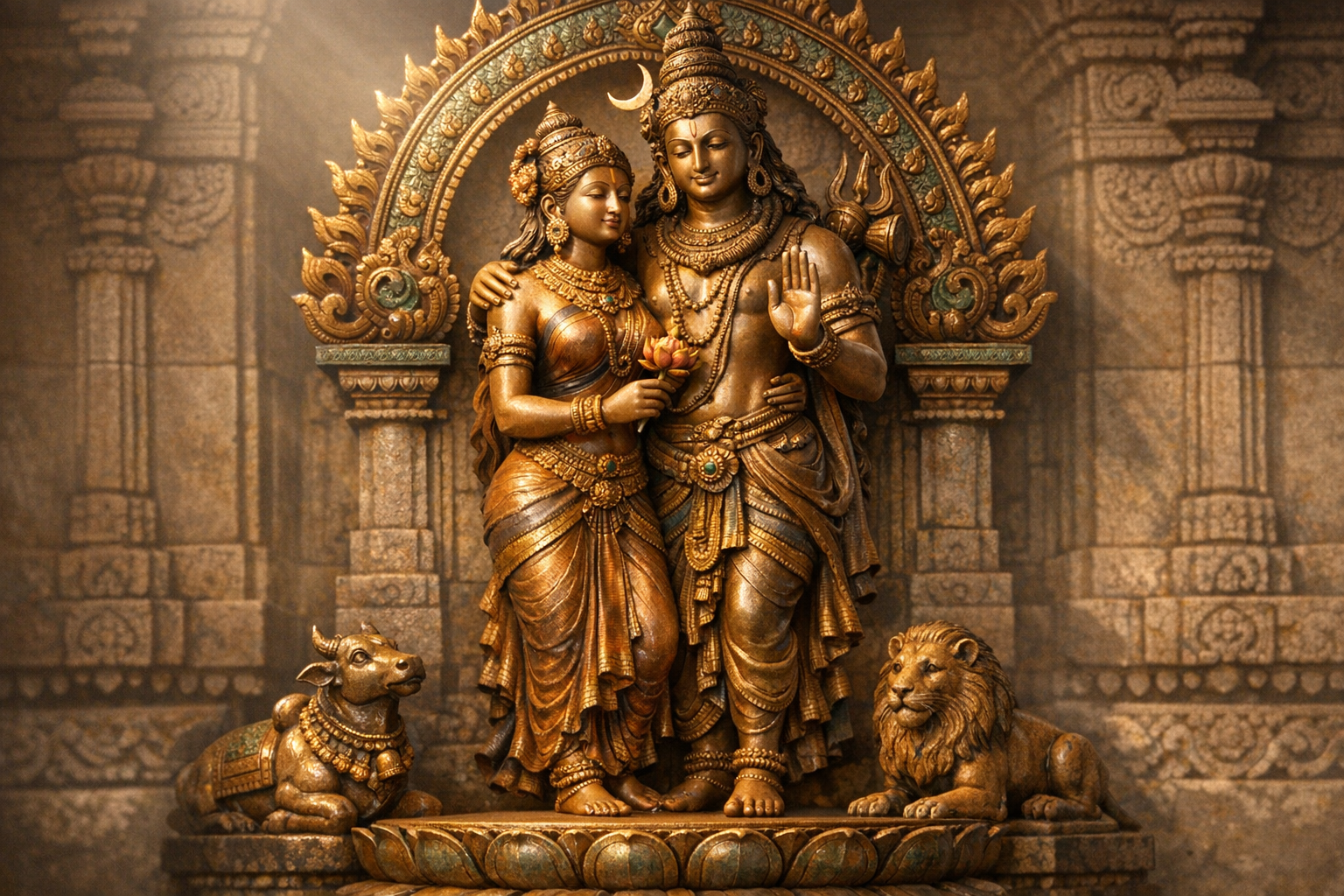
Among the eloquent gestures that animate Hindu sacred art, Alinga Mudra—literally “the embrace”—occupies a distinctive place. In Sanskrit, āliṃgana connotes holding close, drawing near, and enfolding with tenderness, while mudrā signifies a sign or seal. In Hindu sculptures and bronzes, this embrace crystallizes the theological union of consciousness (Purusha) and energy (Prakriti), commonly personified as Śiva and Śkti. Alinga Mudra thus communicates an intimacy that is not merely romantic; it is cosmic, ethical, and contemplative, shaping how devotees and scholars alike read the deeper meaning of Hindu sculptures within temple architecture and ritual life.
As an iconographic device, Alinga Mudra appears most recognizably in Uma–Maheśvāra imagery, where Śiva and Pārvatī are seated or standing in gentle embrace. Agamic and śilpa treatises reference the pair in close proximity or touch (paraspara-āliṃgana), specifying harmonious proportions, balanced postures, and auspicious hand-gestures (hastas) that signal protection (abhaya) and generosity (varada). Closely related, yet distinct, are Kalyāṇasundara (the marriage moment or pāṇigrahaṇa) and Somāskanda (the familial triad with Skanda), where affection is conveyed without a full embrace. Beyond the divine couple, outer temple walls frequently display mithuna (auspicious couples) whose embraces signify fertility, prosperity, and an aesthetic of sacred well-being (maṅgala-lakṣaṇa).
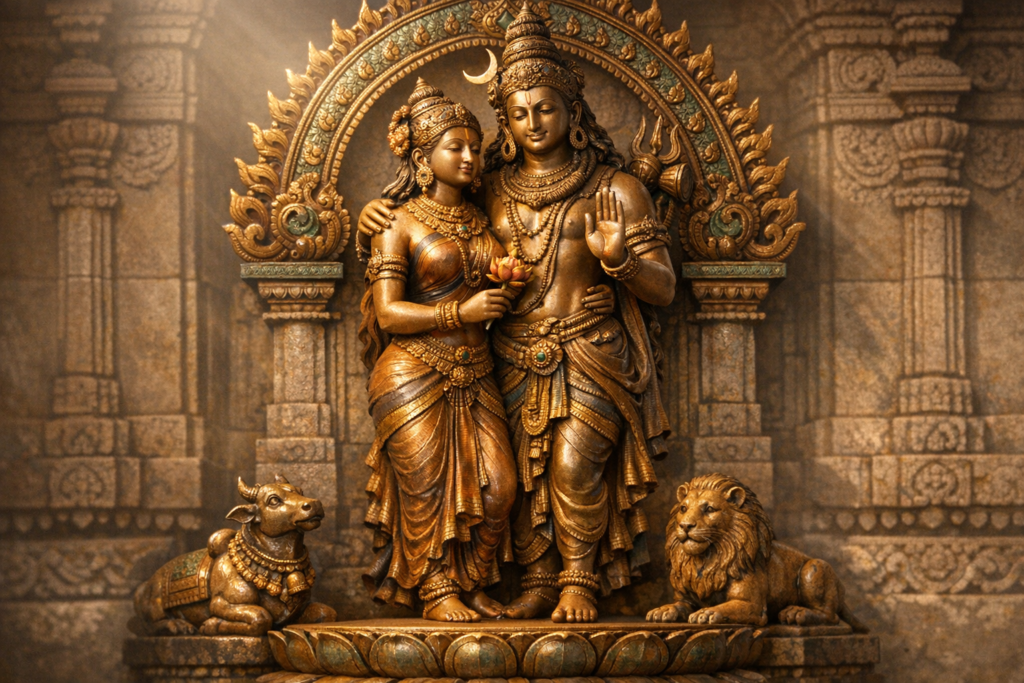
Iconographically, several constants create the visual grammar of Alinga Mudra in Hindu sculptures. The goddess is typically to the left of Śiva (vāmāṅga-nivāsinī), with one arm encircling or lightly resting upon the partner’s torso or shoulder. Śiva may place an arm around Pārvatī while simultaneously offering abhaya or varada to the devotee, balancing intimacy with public beneficence. Postures range from the elegant tribhaṅga to the serene samabhaṅga, while hands may display kataka or kapittha hasta when a lotus or mirror appears. The result is a studied equipoise: a sculpted theology of nearness that remains decorous, protective, and liturgically resonant.
Textual frameworks in the Śilpaśāstras and Agamas (e.g., Manasāra, Mayamata, Śilparatna, and regional temple manuals) guide the proportions (pramāṇa), module systems (tāla), and iconometric canons that underwrite Alinga Mudra. These works align aesthetic canons with metaphysical meanings, ensuring the embrace is never a casual motif but an encoded sign of dharma, welfare, and spiritual concord. The couple’s measured proximity, their gazes, and the discrete play of ornaments all serve as visual cues that link intimate love (śrṛṇgāra) with compassion (karuṇā) and parental tenderness (vātsalya).
Regional idioms enrich the embrace with stylistic nuance. In Chola bronzes of Tamil Nadu (c. 9th–13th centuries), the lost-wax tradition yields fluid Uma–Maheśvāra forms in which subtle torsion, clear silhouettes, and luminous surfaces translate theological union into rhythmic metal. The embrace is often gentle, the line continuous, and the space between the figures carefully modulated to suggest both oneness and distinction—a hallmark of Hindu sacred art and its sophisticated visual metaphors.
Nepal Valley stone reliefs from the Licchavi and Malla periods popularize Uma–Maheśvāra panels with an easeful intimacy, frequently installed above doorways and shrines. There, the divine embrace functions as a potent threshold sign: the household or shrine is under the aegis of auspicious unity, and the viewer’s daily passage is ritually enfolded by divine nearness. The stone itself, with its fine-grained carving, supports crisp jewelry, supple drapery, and serene expressions that temper intimacy with public grace.
In the Kalinga temples of Odisha, such as at Bhubaneswar and Konark, mithuna figures abound along jangha and bhadra projections. Here the embrace is festive, rhythmic, and architecturally integrative, binding narrative friezes to sacred geometry. The Odishan treatise Śilpa Prakāśa emphasizes auspicious iconography in temple programs, and the coupling of figures underlines both fertility and cosmic order. Even when overtly sensuous, the visual rhetoric remains sacred, inscribed within a ritual architecture that privileges transcendence through beauty.
Hoysala soapstone sculpture (e.g., Belur and Halebidu) introduces dynamic movement into the embrace. The fine-grained medium permits intricate jewelry, complex body bends, and lively narrative vignettes around the divine pair. The result is a plentiful dramaturgy of affection, guardianship, and celebration, where Alinga Mudra becomes a fulcrum for reading the entire sculptural program—from the tender glance of the divine couple to the attendant figures that amplify rasa.
Philosophically, Alinga Mudra encodes the non-duality of Śiva and Śkti: inseparable poles whose union sustains manifestation. As Purusha and Prakriti, they are distinction-in-unity, a metaphysical embrace that births worlds and recollects them in dissolution. In the language of devotion (bhakti), their nearness signifies the soul’s desire to rest in the Divine, while in aesthetic theory the gesture navigates śrṛṇgāra and vātsalya rasas with equal grace. Viewers often report a quieting of the mind at darśan: the embrace communicates safety, tenderness, and a felt assurance that anugraha (divine grace) is near.
Comparative readings across Dharmic traditions show a shared semiotics of sacred union that honors unity in diversity. In Vajrayāna Buddhism, yab–yum iconography (the compassionate method, upāya, in union with wisdom, prajñā) parallels the Hindu reading of Śiva–Śkti complementarity, re-centering the embrace as a contemplative cipher rather than a merely erotic sign. In Jaina temple programs, mithuna at the periphery serve auspicious, protective functions, while the inner sanctum conserves the ascetic, luminous stillness of the Jina—a carefully balanced temple ecology of renunciation and worldly prosperity. In Sikh teachings, metaphors of the soul-bride and Divine Groom express anubhava (direct experience) of oneness with Ik Onkar; though figural embraces are not central, the motif of union remains profoundly present in gurmat philosophy. Together, these perspectives foster interreligious understanding and highlight the shared aspiration toward harmony across Hinduism, Buddhism, Jainism, and Sikhism.
Alinga Mudra also functions as a practical guide for reading temple art. A visitor can look for: (1) paired central figures with balanced postures and measured proximity; (2) a protective or benedictory hand extended toward devotees; (3) a consistent left-right logic that places the goddess at the divine left; and (4) attendants, vāhanas, or ancillary motifs that frame the couple as an axis of auspiciousness. Such cues help distinguish the embrace from adjacent themes—e.g., Kalyāṇasundara’s marriage rite or Somāskanda’s familial tableau.
Museologically, understanding the embrace as a liturgical and philosophical sign encourages responsible curation and conservation. Contextual labels that name Uma–Maheśvāra, explain Agamic canons, and identify key hastas elevate public comprehension while dissuading reductive readings. Conservation strategies that protect surface detail (particularly in Chola bronzes and Hoysala soapstone) preserve the nuanced vocabulary of touch—fingers that do not grasp but bless, arms that do not possess but shelter. Such care sustains the integrity of Hindu sacred sculpture within global collections and living temples alike.
While Alinga Mudra is principally an iconographic sign, related ideas sometimes appear in embodied practice. Devotees describe spontaneous gestures of self-embrace during kīrtana or silent prayer as a way to internalize the protective nearness communicated by the murti. Though distinct from codified yogic hastas, such experiential resonances reflect a common intuition: the heart (anāhata) recognizes the embrace as a seal of reassurance and integration, aligning aesthetics, devotion, and subtle-body awareness.
Ultimately, Alinga Mudra is a sacred shorthand for harmony. It permits Hindu sacred art—from Chola bronzes to Nepalese reliefs, from Odishan temples to Hoysala friezes—to say many things at once: that love can be protective, that power can be tender, and that the Divine, in embracing the world, invites the world into wisdom. Read this way, Alinga Mudra becomes a shared cultural heritage emblem that strengthens unity among Dharmic traditions and deepens interfaith appreciation through careful, compassionate looking.
Inspired by this post on Hindu Blog.




Leave a Reply
You must be logged in to post a comment.