
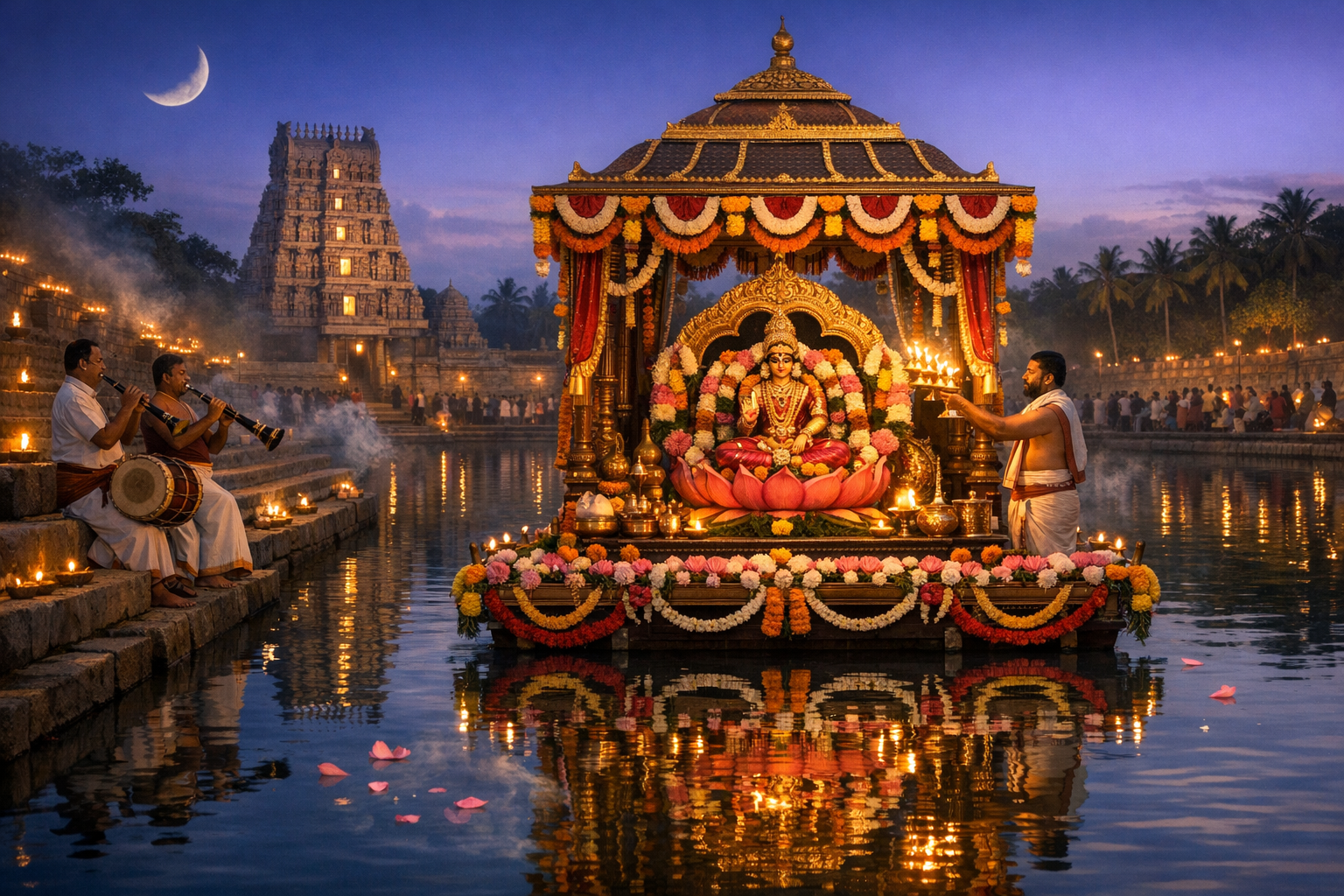
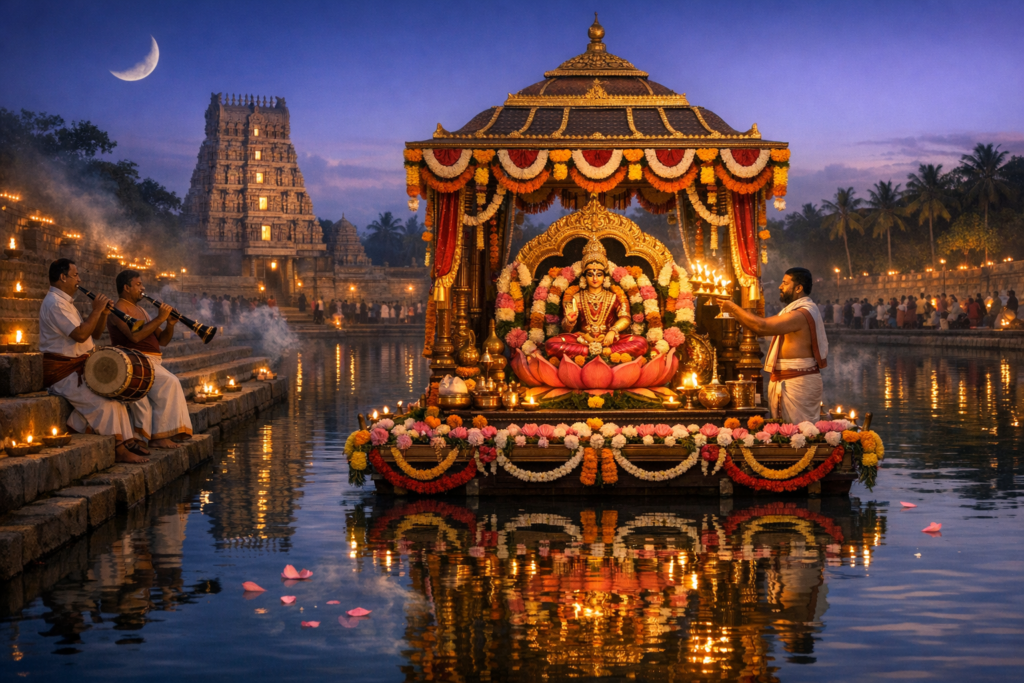
The five-day annual Teppotsavam (float festival) of Sri Padmavathi Ammavaru at Tiruchanur (Alamelu Mangapuram) is scheduled for 25–29 June 2026. Each evening, the Utsava Murti of the Goddess offers darshan from the richly decorated float on Alavelu mangamma Padmavati Sarovar, with Pancharatra agama pujas performed on the teppa itself beginning from Shuddha Ekadasi and continuing each day of the festival.
Known locally as Padmavathi Ammavari Varshika Theppotsavams, this observance is one of the most visually compelling Vaishnava celebrations in the Tirupati region. The festival integrates precise agamic liturgy with a public procession on sacred waters, enabling devotees to receive the Goddess’s anugraha (grace) beyond the sanctum’s threshold and into the community’s shared space.
The date range corresponds to the bright fortnight of the lunar month, commencing on Shuddha Ekadasi and running through the subsequent tithis. In 2026, this coincides with 25–29 June on the Gregorian calendar. As with all tithi-based utsavams, the operational schedule and exact timings are announced by Tirumala Tirupati Devasthanam (TTD) closer to the event and may be adjusted in line with temple protocols and prevailing conditions.
The theological symbolism of the Teppotsavam is profound. The temple tank—Padmavathi Sarovaram—evokes the cosmic waters, while the float bearing Sri Padmavathi signifies compassionate movement through samsara to bless every seeker. The lotus imagery embedded in the goddess’s siddhanta (doctrine) is mirrored by the still surface of the tank, reinforcing the attributes of Sri—auspiciousness, abundance, and benevolence—offered to all who assemble for darshan.
The agamic framework guiding the festival is Pancharatra, an authoritative Vaishnava tradition upheld across many TTD temples. Under Pancharatra procedure, daily worship follows a disciplined sequence: sankalpa, purification (punyahavachana or equivalent), alankara (decoration), archana (mantra-based offering), naivedya (food offering), dhoopa and deepa (incense and lamp), and mangala harati, with continuous Veda parayanam and Divya Prabandha recitation. During Teppotsavam, selected segments of this liturgy are performed either prior to boarding the float or while the Goddess is on the teppa, in accordance with the day’s sankalpa and temple directive.
On the inaugural day (Shuddha Ekadasi), after preliminary pujas and alankara, the Utsava Murti is brought in procession (purappadu) to the tank amidst nadaswaram, tavil, and Veda ghosha. The float then commences its circumambulations (pradakshinas) on the waters. On subsequent days, the number of rounds, the thematic alankara, and ancillary rituals may vary, culminating in an especially elaborate observance on the final evening. Throughout, priests maintain meticulous agamic discipline—both on the steps leading to the sarovar and upon the float—so that darshan, mantra-recitation, and arati proceed seamlessly.
From a devotee’s perspective, the experience is both intimate and expansive. The gentle sway of the teppa, the reflection of lamps upon the water, and the resonance of sankeertana produce a contemplative atmosphere that many pilgrims describe as deeply reassuring. Families, elders, and children alike can witness the Goddess’s utsava form at close quarters from the tank’s bunds, transforming collective darshan into a shared moment of serenity.
Crowd management measures are typically robust at Tiruchanur during major utsavams. Barricaded viewing corridors, designated entry and exit points, and separate lanes for the elderly and persons with disabilities are commonly arranged to facilitate safe darshan. Photography is regulated by temple norms; while public areas around the tank may permit limited photography, it is prohibited in restricted zones and during sensitive ritual moments. Devotees are advised to follow on-ground directions provided by security and volunteers (Srivari Seva) for an orderly, respectful experience.
Travel logistics are straightforward. Tiruchanur (Alamelu Mangapuram) lies a short distance from Tirupati town, with frequent local buses, auto-rickshaws, and taxis connecting the temple to Tirupati Railway Station and Renigunta Junction. Tirupati International Airport serves domestic and limited international routes; from the airport, ground transport to the temple precincts is readily available. Pilgrims are encouraged to arrive well before evening hours—when most float processions occur—to secure comfortable viewing positions along the tank’s embankments.
Practical preparation enhances the spiritual experience. Modest attire suitable for temple premises, light footwear that can be left outside designated zones, and a small cloth or shawl for seating along the bund can be helpful. Hydration is important in late-June conditions; reusable water bottles are recommended, and litter must be strictly avoided. Devotees are requested to maintain a meditative ambience—minimizing loud conversation, keeping queue discipline, and offering prayers with focused attention as the Goddess approaches on the waters.
The Teppotsavam’s ritual logic also affirms a broader civilizational ethos shared across dharmic traditions. Sacred water bodies—sarovar, pushkarini, and tirtha—anchor communal life in Hindu, Buddhist, Jain, and Sikh contexts alike. The reverence expressed at Alamelu Mangapuram parallels the veneration of sarovars and dharma-sthalas elsewhere, underscoring a unifying principle: water as purifier, sustainer, and medium of compassionate outreach. Such shared sensibilities foster inter-traditional harmony while allowing each sampradaya to preserve its distinctive forms of worship.
From the standpoint of ritual studies, Teppotsavam is also a moving classroom of Pancharatra praxis. Observers can note the transition of worship spaces—from garbha-griha to the teppa platform—as priests carry the sanctified presence (divya sannidhya) into a liminal setting upon the water. The continuity of mantra, mudra, and offering validates the principle that sanctity is neither confined nor diminished by spatial translation when proper agamic procedure and intention (bhava) are maintained.
Music and recitation further deepen the experience. Veda parayanam and Divya Prabandha chanting interweave with sankeertanas associated with Sri Padmavathi and Sri Venkateswara, often including compositions attributed to the Tallapaka lineage (e.g., Annamacharya). This soundscape is not ornamental; it is a functional limb of worship (upachara), elevating collective consciousness while the float completes each circumambulation.
Temple prasadam distribution and anna dana generally operate in parallel with major events, subject to administrative guidance and crowd conditions. Devotees engaging in voluntary service are encouraged to coordinate through formal channels well in advance of the festival. All offerings of flowers, lamps, and coconuts must adhere to temple instructions, with environmentally responsible disposal. The sanctity of the sarovar is protected by strict prohibitions on throwing materials into the water.
For planning purposes, it is prudent to track official bulletins for any changes due to weather, maintenance of the tank and floats, or special directives linked to tithi alignment. While the festival is announced for 25–29 June 2026, devotees should consider arriving in Tirupati a day early for orientation, and, where possible, avoid the final-minute rush on the concluding day, which typically draws the highest attendance.
In the ethics of pilgrimage, reverence extends beyond the sanctum to the community of co-pilgrims and the environment. Observing silence during arati, ensuring elders and children have clear sightlines, and practicing zero-litter discipline are not merely courtesies; they are expressions of dharma that honor the Goddess whose grace, during Teppotsavam, flows as widely as the water upon which her teppa glides.
Seen through the lens of cultural heritage, the Tiruchanur Temple Teppotsavams 2026 stand at the confluence of ritual precision, architectural setting, and communal devotion. The stone-banked sarovar amplifies the temple’s sacred geometry while the evening lamps sketch shimmering mandalas upon the water. The result is a living tradition—academically rich, aesthetically refined, and spiritually accessible—that renews itself each year to welcome seekers from every walk of life.
Ultimately, the festival’s enduring appeal lies in its quiet pedagogy. As the float makes its rounds, the scene teaches the heart to become like a still lake: reflective, receptive, and steady. Many pilgrims return year after year for this reason, carrying home the conviction that in the gentle motion of the teppa, Sri Padmavathi extends a promise of protection and prosperity to all who look upon her with devotion.
Inspired by this post on Hindu Pad.







Leave a Reply
You must be logged in to post a comment.