
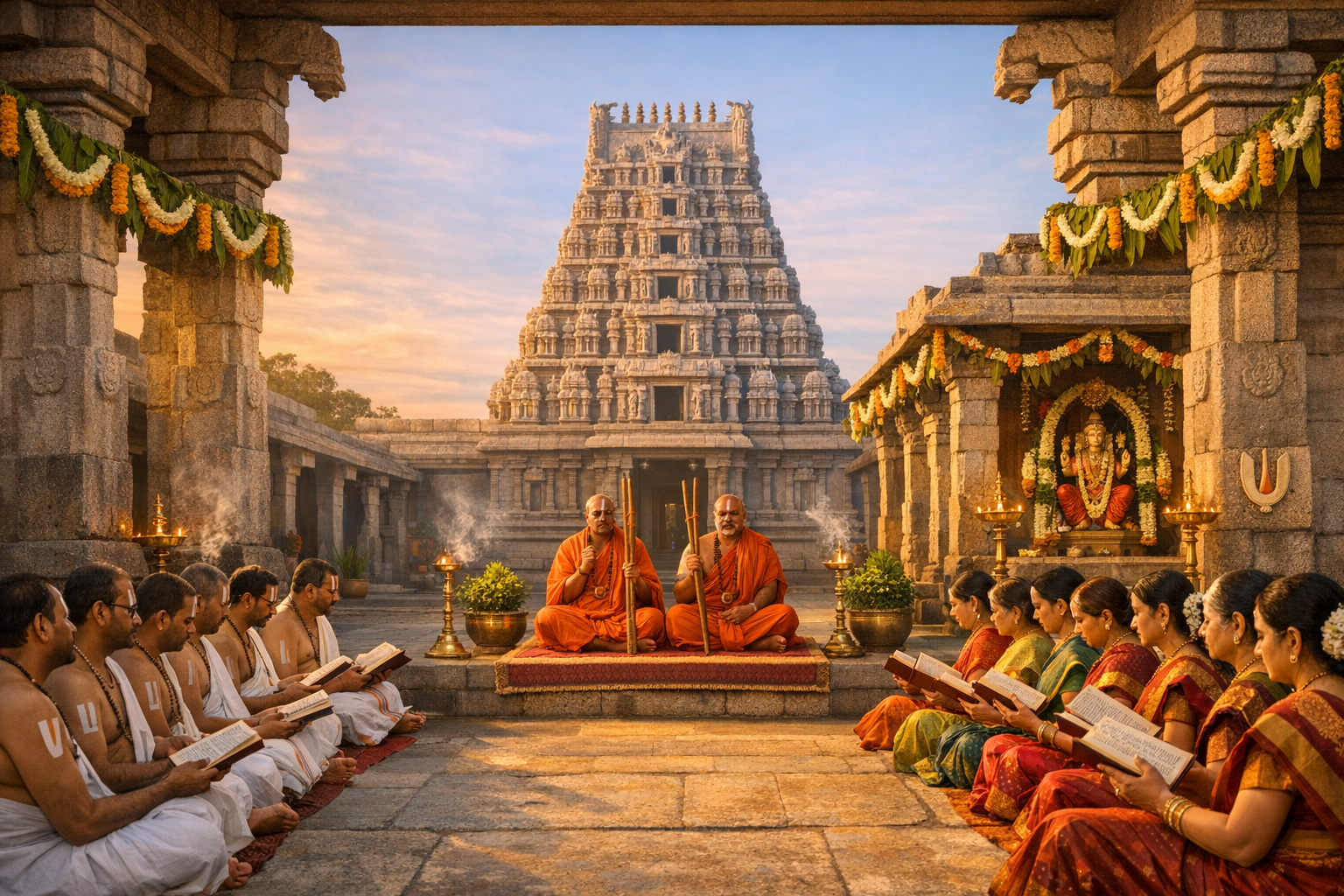
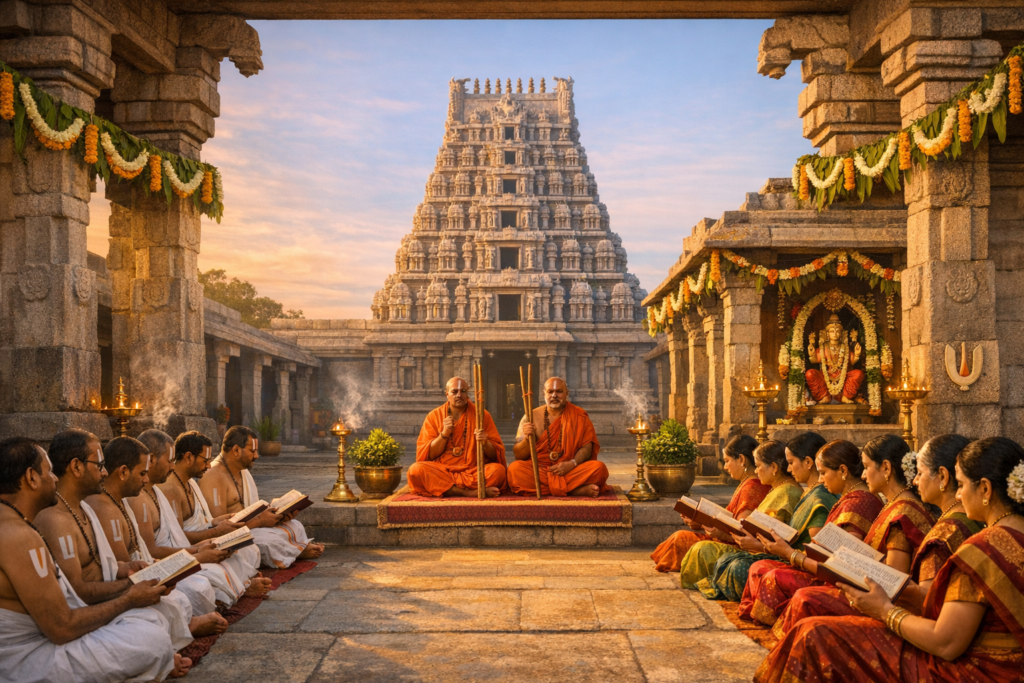
From 16 June to 25 June 2026, Sri Periyalwar Utsavam will be observed with solemn devotion at Sri Lakshmi Narayana Swamy Temple, attached to Sri Govindaraja Swamy Temple, Tirupati. Across these ten days, HH Pedda Jeeyar Swamy and HH Chinna Jeeyar Swamy, together with their disciples, will lead the morning and evening recitations of Divya Prabandham Pasurams, continuing a distinctive Tirupati tradition within the Tirumala Tirupati Devasthanam (TTD) framework.
Sri Periyalwar—revered as Vishnuchitta and celebrated as the father of Andal—stands among the foremost poets-saints of the Sri Vaishnava bhakti movement (circa 7th–9th centuries CE). His Tiruppallandu, a benedictory hymn that opens the canon of Nalayira Divya Prabandham, sets the theological and emotional tone for this utsavam: devotion expressed through protective praise (mangala-āśāsana) for the Lord and, by extension, for all beings who live in dharma.
The festival’s recitational core—the Divya Prabandham Pasurams—is both literary and liturgical. The 4,000 Tamil verses of the Nalayira Divya Prabandham are intoned in structured sequences, with “taniyan” invocations and call-and-response cadences by the prabandha goshti (recitation assembly). In the mornings and evenings, this sonic tapestry draws pilgrims and residents alike into a shared contemplative space, where bhakti is not merely heard but embodied through rhythm, breath, and collective memory.
HH Pedda Jeeyar Swamy and HH Chinna Jeeyar Swamy serve as living custodians of this oral-ritual heritage in Tirupati. Their leadership underscores the unbroken guru-paramparā of Sri Vaishnavism descending from Sri Ramanujacharya, ensuring that textual fidelity, ritual precision, and devotional ethos are transmitted intact to each new cohort of disciples and lay participants.
As venue, Sri Lakshmi Narayana Swamy Temple is integrally linked to the historic Sri Govindaraja Swamy Temple, a major TTD shrine associated in tradition with Sri Ramanujacharya’s consecratory labours in the 12th century CE. While the Sri Venkateswara Temple on the hill adheres to Vaikhanasa Agama, the Govindaraja Swamy Temple complex is noted for Sri Vaishnava and Pancharatra Agama practice; the attachment of Sri Lakshmi Narayana Swamy Temple to this sacred nexus renders it an apt home for a Periyalwar-centred utsavam.
Liturgically, Periyalwar’s composition is unique in commencing with protection-offering to the Divine (Pallandu, Pallandu), a theological inversion that magnifies the intimacy of the devotee’s love. During the utsavam, the recitations often foreground Periyalwar’s own Tirumozhi and key benedictory passages, interwoven with other Alvar hymns that collectively chart an arc from praise to surrender (śaraṇāgati), and from aesthetic relish (rasa) to ethical resolve (dharma).
Participants typically experience the recitation as both study and prayer. For many families, the morning goshti becomes a pedagogic moment—children quietly track the lines in their Nalayira Divya Prabandham books while elders follow the specific metres and refrains. First-time visitors often remark how quickly the cadences of Periyalwar’s Tamil become intuitively graspable through repetition, melody, and the guiding chorus of the Jeeyars’ disciples.
In technical terms, the parāyana segments are organised to balance thematic continuity with congregational stamina. The taniyans open each section, the core pasurams unfold in an orchestrated tempo, and the concluding benedictions fold the congregation back into reflective silence. This ritual grammar is designed to conserve voice and attention over multiple days, ensuring consistent quality of recitation morning and evening.
Beyond recitation, the festival commonly includes enhanced alankaram and special archana to Sri Lakshmi Narayana. While the precise daily schedule is subject to TTD notifications, the established pattern across TTD Festivals is a morning sequence following suprabhata and an evening parāyana leading devotees from twilight into a serene night rhythm, uniting scholarship and devotion.
For those preparing to participate meaningfully, three practical approaches have proven helpful. First, pre-familiarity with Tiruppallandu and selections from Periyalwar Tirumozhi enables deeper listening. Second, following transliteration alongside Tamil verses bridges linguistic gaps without diluting the poetry’s flow. Third, attentiveness to the goshti’s lead intonations, rests, and crescendos fosters collective coherence in large recitations.
The temple precincts invite disciplined participation. Modest attire, punctual arrival before recitation commencements, and avoidance of photography in inner prakarams maintain sanctity. Many pilgrims bring a small cloth and text compendium to sit comfortably during the parāyana, preserving both personal focus and the dignity of the assembly’s shared space.
Historically and culturally, Sri Periyalwar Utsavam also frames the luminous figure of Andal, whose life and poetry form a continuum with her father’s bhakti. Parents often note that the affectionate, familial tone of Periyalwar’s devotion makes this utsavam a natural setting to introduce children to Sri Vaishnava values—humility, seva, and reverence for the divine as present in all relations.
Tirupati’s accessibility supports broad participation. The Sri Govindaraja Swamy Temple area lies near the city’s major transit points; local transport connects efficiently to the temple complex. Accommodation options span TTD facilities and private lodgings across budgets, enabling families, students, and senior pilgrims to plan stays aligned with the multi-day recitation calendar.
Seasonal considerations matter in June. The afternoons can be warm and humid; hydration, light meals, and measured rest between morning and evening sessions help sustain participation. Seniors and children benefit from shaded waiting areas and unhurried movement between spaces, especially during peak-attendance days of the utsavam.
The inclusive spirit of this festival resonates across dharmic traditions. The shared practices of devotional recitation—Tamil pasurams in Sri Vaishnavism, shabad kirtan in Sikhism, stavan in Jainism, and paritta chanting in Buddhism—reflect a familial ethos of sound-based contemplation, ethical formation, and community cohesion. In this sense, Sri Periyalwar Utsavam models unity in spiritual diversity, affirming values cherished across Hindu, Buddhist, Jain, and Sikh lineages.
In heritage terms, the festival safeguards intangible cultural knowledge: authoritative tunes (pāṇs), prosodic conventions, and interpretive nuances transmitted orally in the goshti. The Jeeyar-led pedagogy maintains textual precision while nurturing new voices, ensuring that the sonic architecture of the Nalayira Divya Prabandham remains a living tradition rather than a museum relic.
Scholars often note how Periyalwar’s hymns integrate theology and aesthetics. Theologically, they articulate a protective love that reverses the devotee-deity hierarchy to signal radical intimacy; aesthetically, they demonstrate meticulous metrical craft and rhetorical balance. The utsavam setting allows this integration to be appreciated experientially—through breath, cadence, and communal presence.
As with all TTD Festivals, specific timings, alankarams, and ancillary events are determined by the temple administration and may be updated through official notifications. The essentials, however, remain constant: morning and evening prabandha parāyana under the guidance of HH Pedda Jeeyar Swamy and HH Chinna Jeeyar Swamy, within the consecrated precincts of Sri Lakshmi Narayana Swamy Temple attached to Sri Govindaraja Swamy Temple, Tirupati.
In sum, Sri Periyalwar Utsavam 2026 offers a layered experience—scriptural learning, liturgical immersion, and communal devotion—set within one of India’s most revered temple ecosystems. Devotees and culture-bearers alike find that ten days of attentive listening to Divya Prabandham Pasurams refine inner stillness and outward empathy, renewing both personal resolve and shared belonging in the wider dharmic family.
Those who attend often carry home more than memories: the cadence of Tiruppallandu, a few memorised pasurams, and a renewed appreciation for the way Tirupati holds together scholarship, service, and song. In doing so, the festival sustains the very heart of Sri Vaishnava tradition—uniting intellect and emotion, precision and love, in the service of the Divine and the common good.
Inspired by this post on Hindu Pad.





Leave a Reply
You must be logged in to post a comment.