
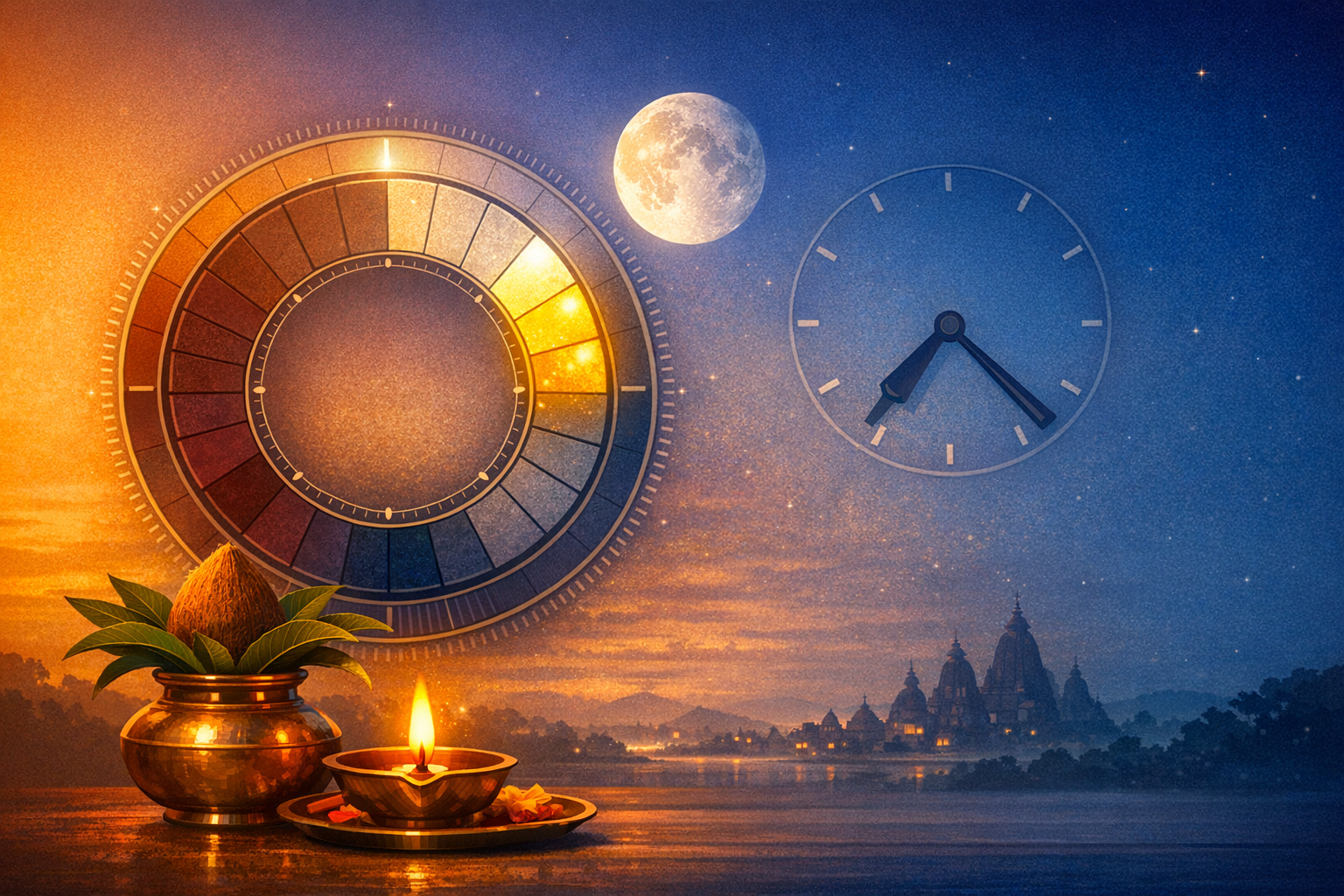
Monday, June 22, 2026, in the Hindu calendar marks Shukla Paksha Ashtami, the eighth lunar day of the waxing phase of the Moon, across most regions. As per standard panchang computation, Shukla Paksha Ashtami prevails until 7:23 PM (19:23) on June 22, after which Shukla Paksha Navami begins. This day’s structure, with a clear evening transition from Ashtami to Navami, offers a practical framework for daily worship, vratas, and time-bound observances that many households and temples plan around.
In practical usage, most daily observances follow the udaya-tithi convention, which takes the tithi prevailing at local sunrise as the day’s defining tithi. Accordingly, June 22, 2026 is observed as Shukla Ashtami for general puja and sankalpa purposes. Where a specific ritual prescribes a different rule—such as pradosha-vyapini or nishita-vyapini tithi—practitioners align their timing with the respective textual guideline. The evening onset of Navami at 7:23 PM provides a clear marker for those rituals that intentionally bridge the twilight period (sandhya) or anchor actions to the tithi present during the night.
Technically, a tithi is defined by the angular separation between the Moon and the Sun in 12-degree increments. Ashtami corresponds to an elongation between 84° and 96°, while Navami spans 96° to 108°. Because the Moon’s motion is continuous and variable, a tithi can start and end at any civil clock time, occasionally causing it to straddle two calendar days or, more rarely, to be absent or repeated at sunrise. The given end time of Ashtami at 7:23 PM reflects this astronomical dynamic and underscores why panchang computations list precise start and end times for each tithi in addition to the sunrise-based day convention.
Regional month naming can differ depending on the amanta (new-moon ending) or purnimanta (full-moon ending) systems. In years with an intercalary month (Adhik Maas)—and 2026 features Adhik Jyeshta Maas—month labels around June can vary by region and tradition. Consequently, while the tithi itself is uniform in meaning, its attribution to a named lunar month may be recorded as Jyeshtha or as Ashadha in different regional almanacs. This diversity is a strength, reflecting living traditions that map the same celestial events through distinct but internally consistent calendrical frameworks.
Nakshatra and Rashi are central to muhurta and sankalpa, yet they are highly time- and location-sensitive because they are calculated from the Moon’s precise position. A nakshatra represents a 13°20′ lunar segment among the 27 lunar mansions (from Ashwini to Revati), while a rashi is one of the 12 zodiacal signs of 30° each. On any given date, the nakshatra and Moon’s rashi can change during the day. For June 22, 2026, local panchang or trusted ephemerides should be consulted to identify the nakshatra and the Moon’s rashi for a specific city and desired ritual window. This approach maintains accuracy and fidelity to tradition, especially for samskaras, griha-karya, or vocational muhurta selection.
For those planning auspicious activity, it is helpful to distinguish broadly auspicious daily junctures from activity-specific muhurta. Abhijit Muhurta—centered around local midday—is widely regarded as shubha for general undertakings when a bespoke muhurta is unavailable. Because Abhijit Muhurta is anchored to local solar noon, its clock time varies by location and season; a reliable panchang for the practitioner’s city is the correct source. Likewise, Brahma Muhurta, occurring roughly 96 minutes before local sunrise, is particularly valued for meditation, japa, pranayama, and study, and can be located each day by subtracting the appropriate interval from the day’s sunrise time.
Rahu Kaal, Yamaganda, and Gulika are traditionally avoided for initiating new ventures, travel, or ceremonies, though they remain perfectly suitable for sadhana, study, and routine work. On Mondays, the diurnal Rahu Kaal typically falls in the second segment after sunrise in the classical eight-part division of daytime; however, its exact clock span depends on that day’s sunrise and sunset where one lives. A precise computation divides the day (sunrise to sunset) into eight equal parts and maps each segment to the standard weekday pattern for Rahu Kaal, Yamaganda, and Gulika. This simple proportional method, used alongside local sunrise/sunset, yields accurate windows without reliance on fixed clock times.
The transition to Shukla Paksha Navami at 7:23 PM offers two complementary spiritual emphases within the same civil date. Ashtami, a tithi often associated in popular practice with steady discipline and fortified devotion, lends itself to sustained japa, recitation of stotras such as Vishnu Sahasranama or Lalita Sahasranama, and mindful seva during the day. With Navami beginning in the evening, practitioners who follow night-bound or pradosha-aligned observances may choose to commence Navami-appropriate worship after the tithi change, while most vratas continue to observe Navami the following day based on the sunrise criterion.
Across dharmic pathways—Hinduism, Buddhism, Jainism, and Sikhism—lunar rhythm has long served as a quiet scaffold for practice. The early morning Brahma Muhurta for dhyana aligns naturally with mindfulness (sati) in Buddhist traditions, the introspective tapas and ahimsa focus in Jain traditions, and the Nitnem discipline in Sikh practice. The shared intent is clarity, compassion, and inner steadiness. On days like Shukla Ashtami, many find that even brief windows of silence, metta-bhavana or maitri (cultivating loving-kindness), and selfless service deepen a sense of connectedness that transcends sectarian boundaries.
For householders organizing the day, a practical flow might include dawn meditation or japa in Brahma Muhurta, nitya-puja after sunrise under the prevailing Ashtami, and study or svadhyaya during a calm midday Abhijit Muhurta when feasible. As evening approaches, those observing tithi-specific practices can note the 7:23 PM transition to Navami and, where appropriate, perform a short sandhya arati or quiet reading of sacred texts during twilight. In all cases, the guiding principle in muhurta is preparedness of mind and purity of intention; favorable timing refines practice, while sincerity completes it.
The presence of Adhik Jyeshta Maas in 2026 is a reminder of the astronomical sophistication of the lunisolar calendar. Intercalary months are inserted to realign the lunar months with the solar year so that seasonal festivals remain in their appropriate time of year. This adjustment preserves ecological and agricultural coherence, ensuring, for example, that monsoon-linked observances continue to fall within their intended climatic window. Panchang traditions may employ slightly different computational philosophies—drik-ganita (observational/astronomical) and vakya (rule-based)—as well as different ayanamsas (with Lahiri/Chitra Paksha commonly used), which can produce minor differences measured in minutes rather than hours.
For ritual exactitude on June 22, 2026, a city-specific panchang remains essential for identifying nakshatra, Moon’s rashi, yoga, and karana at chosen times. Yoga (one of 27/28 daily combinations derived from the sum of the Sun’s and Moon’s longitudes) and karana (half-tithi divisions that carry their own auspiciousness profiles) further tune muhurta selection. Many practitioners consult a trusted family almanac or temple board for these micro-calculations, especially when planning samskaras, griha-pravesha, or devata-pratishtha-linked rites, where even small differences in the Moon’s position can matter.
Key takeaways for decision-making can be summarized thus. First, the udaya-tithi for June 22, 2026 is Shukla Paksha Ashtami, with a clear transition to Navami at 7:23 PM. Second, Brahma Muhurta and Abhijit Muhurta are generally supportive for spiritual and study-related endeavors if a custom muhurta is not mandated. Third, Rahu Kaal, Yamaganda, and Gulika—computed from local sunrise and sunset—are best avoided for initiating fresh undertakings. Finally, for nakshatra, Moon’s rashi, yoga, and karana, accurate, location-specific data should be used, particularly when planning rites that explicitly depend on these parameters.
Beyond timing, the enduring value of days like Shukla Ashtami lies in the habits of attention cultivated around them. A small act of dana, a sincere reconciliation, an extra round of mantra-japa, or a mindful meal taken in gratitude can serve as a living commentary on the calendar’s purpose. The panchang is not merely a schedule; it is a pedagogical tool, aligning inner intention with cosmic rhythm in a manner recognizable across the shared ethical landscapes of Hinduism, Buddhism, Jainism, and Sikhism.
In summary, Monday, June 22, 2026 is best approached as a steady, sattvic day under Shukla Paksha Ashtami, with evening awareness of the Navami onset at 7:23 PM. Aligning daily practice to Brahma Muhurta and Abhijit Muhurta, while observing caution during Rahu Kaal and related windows, offers a balanced path for both spiritual and practical goals. With location-precise nakshatra and rashi details in hand, practitioners can confidently anchor vows, pujas, and personal milestones to an auspicious and well-understood temporal framework.
Inspired by this post on Hindu Blog.


Leave a Reply
You must be logged in to post a comment.