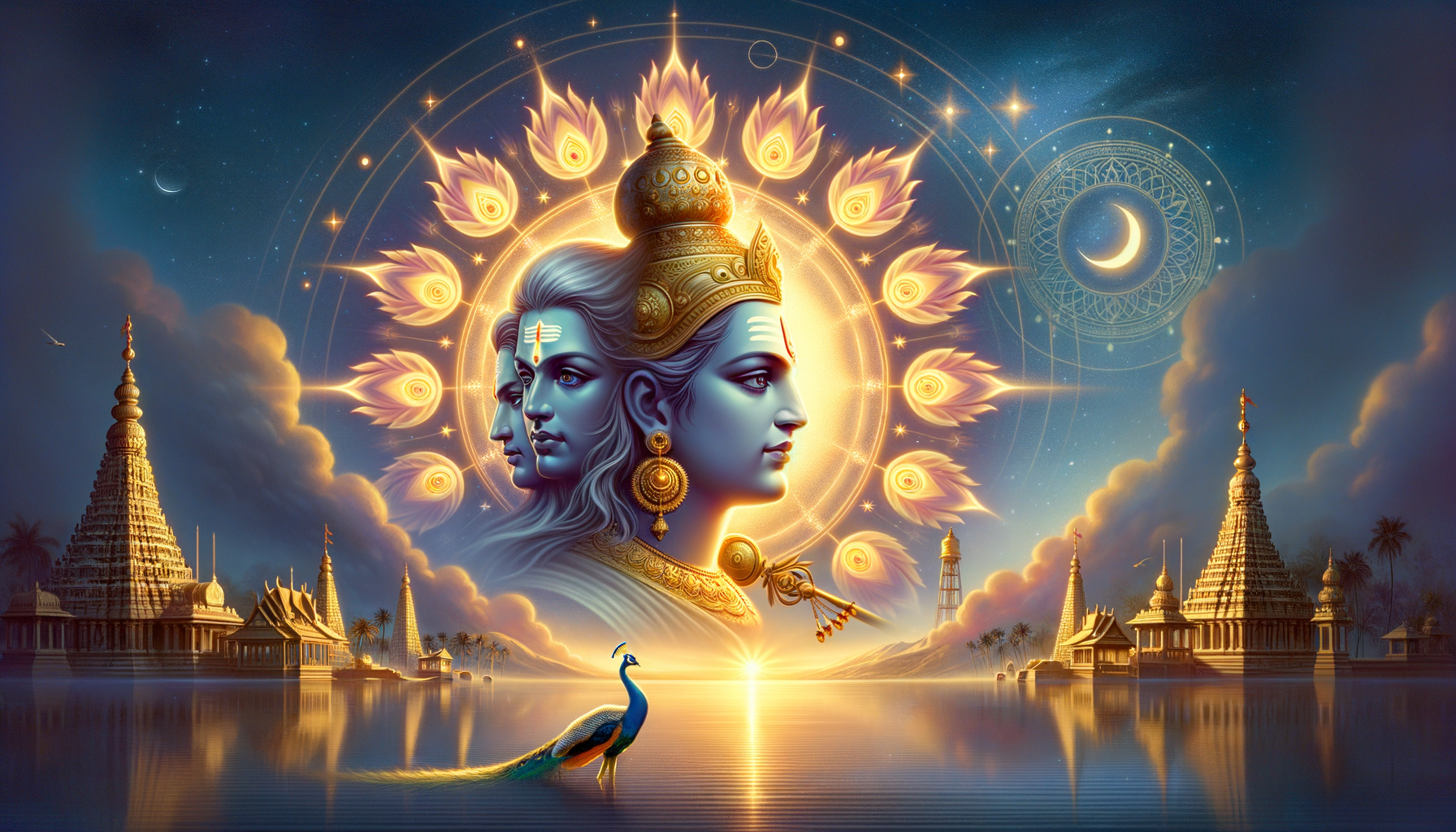
Across Hindu sacred literature, the birth of Lord Murugan (Skanda, Kartikeya, Subrahmanya) is remembered as a blazing revelation of consciousnessfire issuing from Shiva’s third eye and crystallizing into form. This manifestation is read as the embodiment of Iccha Shakti, the divine will whose luminous intention orders creation and protects dharma. Interpreted in this way, the origin of Murugan is not merely miraculous narrative; it is a spiritual map that illuminates how disciplined will, insight, and compassionate action can align human life with Sanatana Dharma.
In Puranic accounts, sparks from Shiva’s third eye become six radiant forms, carried by Agni and Vayu to the waters sanctified by Ganga. Nurtured by the Krittikas in the Saravana lake, the six infants are later unified by Pārvatī into Shanmukhathe six-faced deity whose very being signifies integrated awareness. These strands of the story, deeply cherished in Tamil tradition, convey that Murugan’s emergence is a sacred convergence of elemental forces, maternal care, and cosmic purpose.
Symbolically, the third eye corresponds to the ajna centerinsight beyond dualityand Murugan’s appearance from that locus signifies will awakened by wisdom. Iccha Shakti is not mere desire; it is volitional clarity aligned with truth. The six faces of Shanmukha are commonly interpreted as mastery over the arishadvargas (kāma, krodha, lobha, moha, mada, matsarya), or as fully directed awareness capable of perceiving and responding to reality from all directions without fragmentation.
Philosophically, Iccha (will), Jñāna (knowledge), and Kriyā (action) are interdependent modalities of Shakti. Murugan, whose spear (Vel) pierces ignorance, embodies their harmony: lucid intention informed by wisdom, expressed as compassionate and courageous action. As Subrahmanyathe great teacherhe also represents the guru principle, guiding seekers to align personal resolve with dharma rather than impulse.
For many practitioners, devotion to Murugan is lived experience rather than abstraction. Pilgrims describe the kavadi vow as tapas that transforms scattered urges into focused energy. Contemplation on the ajna center, recitation of “Om Saravanabhava,” and reflection on the Vel as a symbol of ethical clarity become practical means of integrating will and wisdom in daily life. In festivals such as Karthigai and Thaipusam, communities witness a shared renewal of purpose grounded in discipline, humility, and joy.
The narrative also fosters dharmic unity. In Buddhist traditions across East and Southeast Asia, Skanda-Kumāra appears as a protective deity, reflecting the shared valuation of disciplined intention and guardianship of the path. Jain reflections on tapas and self-restraint resonate with the same inner architecture of will purified by insight. Sikh teachings on nishkām sevā and inner discipline similarly affirm action guided by higher principles. Read together, these perspectives underscore a common ethic: will is most luminous when it serves truth and the welfare of all.
Culturally, Murugan’s presence is especially vibrant in Tamil heritageat Palani, Tiruchendur, Swamimalai, Palamuthircholai, and Thiruttaniyet his veneration is pan-Indian and extends to Sri Lanka and Southeast Asia. This wide devotion indicates a shared spiritual grammar in which Iccha Shakti is not the assertion of ego but the alignment of intention with cosmic order (ṛta) and moral law (dharma).
Contemporary seekers often find in Murugan a model for purposeful living. The teaching is clear: clarify intention, cultivate insight, and act with courage and compassion. Whether through meditation, study of the Puranas, or participation in community worship, the practice aims to kindle the “fire of consciousness” so that choices become lucid, relationships become ethical, and service becomes joyful.
Ultimately, Murugan’s birth from Shiva’s third eye portrays Iccha Shakti as sacred will awakened by wisdom and expressed as benevolent action. By understanding this origin as living symbolism rather than distant myth, practitioners glimpse a practical path: transform desire into disciplined intention, intention into insight, and insight into service. In this way, the fire that first flashed as divine revelation becomes an inner light guiding a life of clarity, courage, and compassion.
Inspired by this post on Hindu Blog.