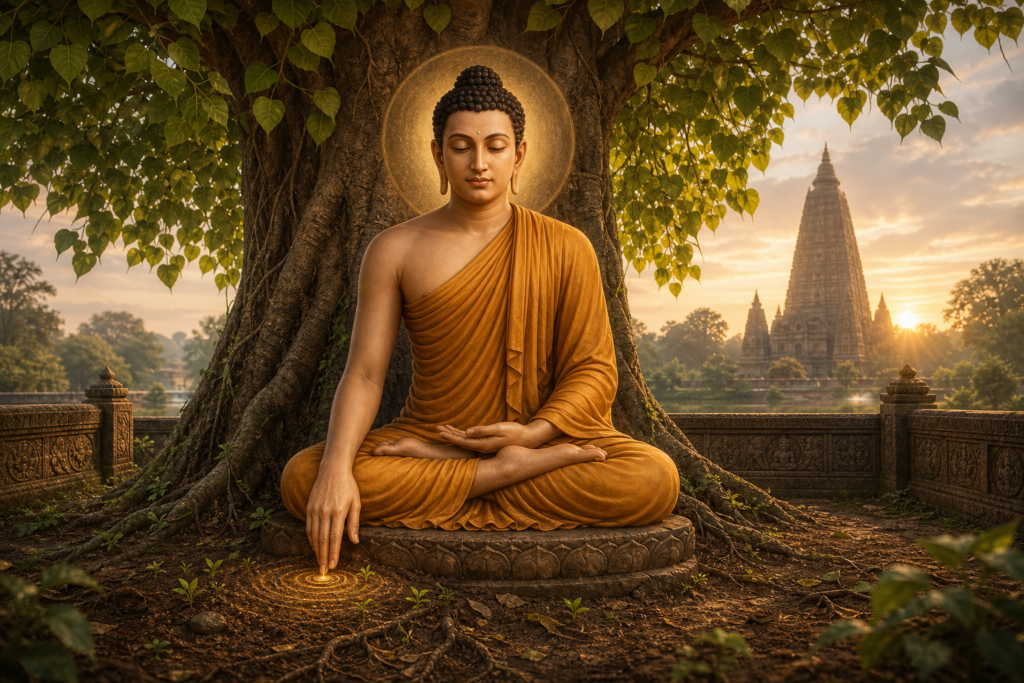
The teaching that one is already infinite pure consciousness remains among the most profound and frequently misunderstood insights in Hindu philosophy. The common assumption is that realization demands an arduous journey or extraordinary attainment. Advaita Vedanta consistently clarifies otherwise: the essence is not becoming something new, but recognizing what is always present.
In the Vedantic lexicon, infinite pure consciousness refers to Atmanunbounded awareness that is identical with Brahman. The Upanishadic mahavakya Tat Tvam Asi points not to an achievement but to an immediate identity. This insight reframes spiritual practice as gentle unveiling rather than forced transformation, aligning self-realization with clarity rather than conquest.
Dharmic traditions converge around this center. Hinduism articulates the non-dual ground in Advaita; Buddhism highlights luminous awareness through the language of awakening and mindfulness; Jainism emphasizes the inherent purity of jiva and the epistemic humility of Anekantavada; Sikhism proclaims Ik Onkar, the singular reality infusing all. Together, these traditions reinforce unity in spiritual diversity and encourage respectful coexistence of methods while honoring a shared, ineffable truth.
Misunderstanding arises when practitioners attempt to force a state that is already the substratum of experience. Effort can become subtle resistance, and striving can inadvertently reinforce the sense of separateness it hopes to transcend. The non-dual instruction is simple and radical: awareness recognizes itself. No destination is required for what is ever-present.
Classical sources illuminate this paradox with precision. The Atman is not an object to be reached but the very subject of all experience. Practices therefore function as means of clearing obscurations (avidya), not as tools for manufacturing a new self. When the impulse to manipulate the mind relaxes, natural clarity often becomes self-evident.
Discipline remains valuable, yet its aim is ease rather than achievement. Yoga and Vedanta describe sustained, steady orientationnairantarya abhyasewhere consistency softens reactivity and stabilizes attention. Such abhyasa is less a struggle and more a refinement of sincerity, creating conditions in which the effortless truth stands revealed.
Practical approaches across Dharmic lineages converge on this ethos. Meditation and breath awareness cultivate stillness; mindfulness integrates clarity into daily life; atma-vichara (self-inquiry) examines the sense of doership; japa gently focuses attention. Each method, whether framed within Yoga philosophy, Buddhist mindfulness, Jain contemplative ethics, or Sikh remembrance of the Naam, points toward the same unbroken awareness.
Many practitioners report ordinary moments that quietly disclose this truth: a pause during prayer, a silent walk in nature, or an instance of selfless seva where boundaries soften and presence feels vast yet intimate. Emotions and thoughts continue, yet they appear within a wider field that is untouched. Such glimpses do not demand control; they invite recognition.
Ethically, living from this understanding fosters humility, compassion, and inclusivity. Ishtahonoring one’s chosen pathsupports pluralism without rivalry. As unity in diversity deepens, respect for differing practices becomes an expression of realization itself, advancing Religious tolerance in Hinduism and strengthening bonds across Hinduism, Buddhism, Jainism, and Sikhism.
When doubt surfaces, traditional guidance encourages returning to simplicity: neti netineither this nor thatgently negates what is transient, allowing the self-luminous nature of awareness to remain. Clarity grows not by accumulation, but by resting as the witness in which sensations, thoughts, and identities rise and fall.
The culmination is practical: one does not force becoming infinite pure consciousness; one discovers that it has never been otherwise. With steady practice and open-hearted inquiry, life itself becomes the field of realization. Actions align with compassion, relationships with understanding, and the mind with quiet confidence in the truth that You are already That.
Inspired by this post on Hindu Blog.