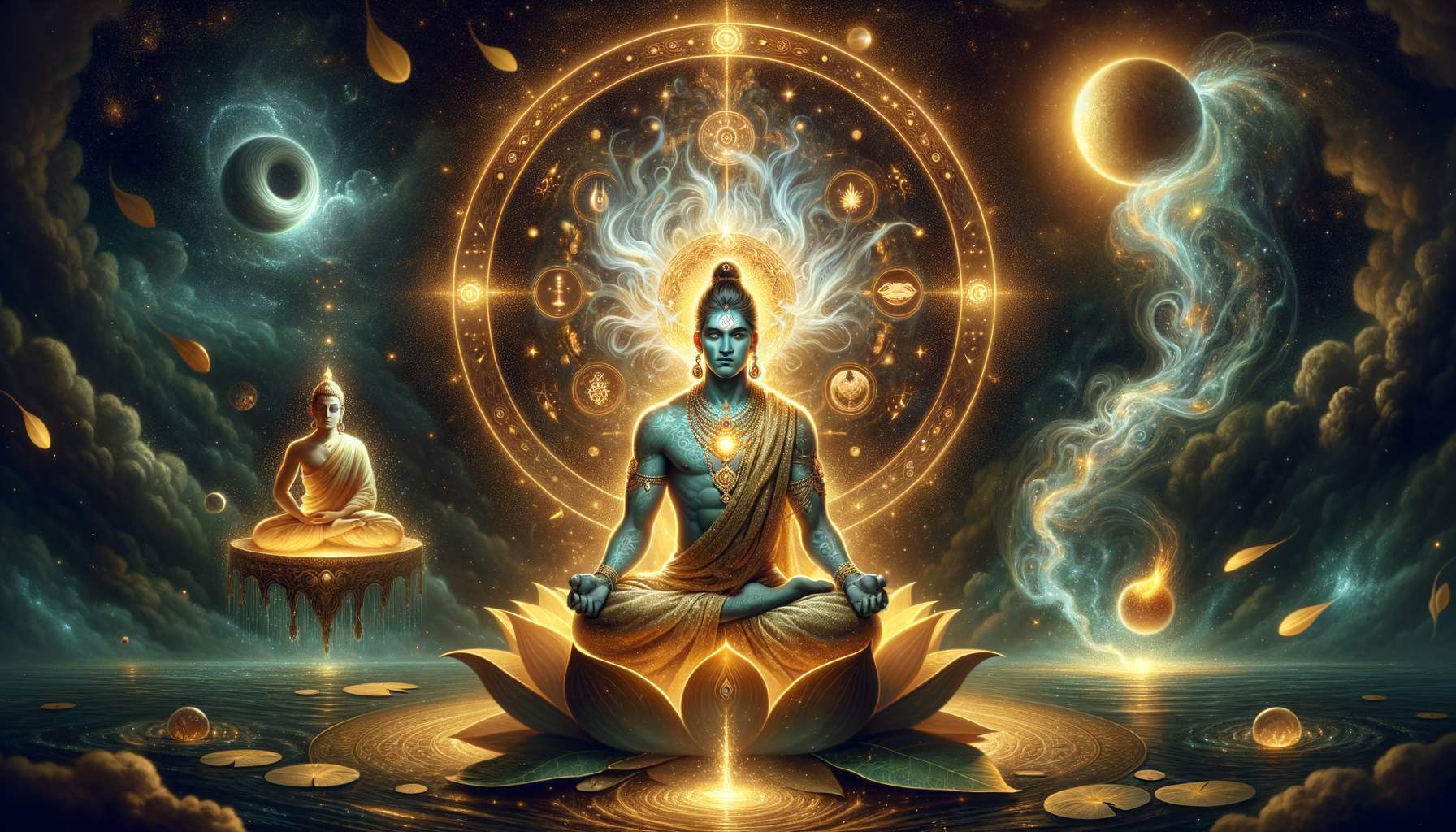
The Devi Bhagavata Purana preserves a compelling strand of Hindu cosmology in which Vishnu is envisioned in child form upon a mystical leaf, with Lakshmi manifest beside him. From this primordial scene arises Brahma, the creator, who brings forth the pancha mahabhutas (five great elements) and organizes the emergent realms of existence. This narrative situates creation, preservation, and transformation within a single continuum, offering a cohesive framework for understanding the Trimurti.
Within this arc, Rudra’s appearance from Brahma’s browoften described as the awakening of the third eyesignals the manifestation of transformative energy. Rather than a mere episode of wrath, the emergence functions as a cosmological pivot: where creative expansion requires an equally profound capacity for purification, return, and renewal. In this sense, Rudra’s birth is less a rupture than a necessary balancing motion within the fabric of Dharma.
Read symbolically, the “third eye” (jnana-chakshu) marks intensified awareness. In many Puranic and yogic contexts, it indicates a state where hidden insight burns through obscuration. The Devi Bhagavata Purana thus places Rudra at the juncture where vision becomes action, and where clarity, once kindled, reshapes the cosmos. The narrative’s power lies in showing how insight and energy converge to protect order (rta) through timely transformation.
The pancha mahabhutas provide a helpful lens here. Creation assembles the elementsearth, water, fire, air, and akashayet the cosmos remains dynamic. Rudra’s arising expresses the purificatory force that prevents stagnation, ensuring that what is created continues to evolve. In practical terms, the tale encodes the insight that growth requires periodic letting goan insight as psychological as it is metaphysical.
In Trimurti terms, the scene can be read as a harmony of modalities: generative impulse (Brahma), sustaining equilibrium (Vishnu), and transformative return (Rudra/Śiva). The Devi Bhagavata Purana accentuates this harmony by locating Rudra’s emergence within Brahma’s own field of awareness, implying that transformation is not external to creation but inherent to it. Such framing invites integrative rather than sectarian readings of Hindu symbolism.
This integrative spirit resonates across dharmic traditions. The third eye as a marker of discernment aligns with meditative emphases found in Hindu, Buddhist, Jain, and Sikh traditions, where inner vision, ethical restraint, and compassionate action are valorized. Read in this light, Rudra’s emergence signifies the conversion of raw force into responsible agencyan ideal that supports unity rather than division within the broader dharmic family.
For many seekers, the narrative’s emotional clarity comes through its psychological parallels. Moments of intense focus in study, service, or sadhana can catalyze a shift as decisive as Rudra’s appearance: a sudden insight that resolves confusion, a courageous decision that restores balance, or a disciplined restraint that averts harm. The story, therefore, is not only cosmic; it is also intimate and ethical.
Iconographically, the motif of the third eye underscores vigilant awareness capable of both protection and purification. Fireoften associated with Rudrafigures as the luminous intelligence that cauterizes error. When aligned with Dharma, this energy does not destroy for its own sake; it clarifies, resets, and makes way for renewed order. The Devi Bhagavata Purana’s symbolism thus invites contemplative engagement alongside textual study.
Puranic literature presents multiple genealogies and narrative arcs for Rudra/Śiva, Brahma, and Vishnu. Attending to the Devi Bhagavata Purana’s specific idiom reveals how variations enrich rather than diminish the tradition. Each retelling illuminates different facets of Hindu cosmology, encouraging readers to value complementarity over competitionan interpretive stance conducive to inter-sect harmony and dharmic cohesion.
As an interpretive guide, this episode recommends a practical synthesis: cultivate insight (the third eye of discernment), act with steadiness (sustaining order), and welcome necessary transformation (purifying imbalance). Approached this way, Rudra’s emergence from Brahma’s brow becomes a luminous lesson in cosmic balance, ethical clarity, and spiritual maturityan enduring contribution of the Devi Bhagavata Purana to Hindu symbolism and to the shared wisdom of dharmic traditions.
Inspired by this post on Hindu Blog.