
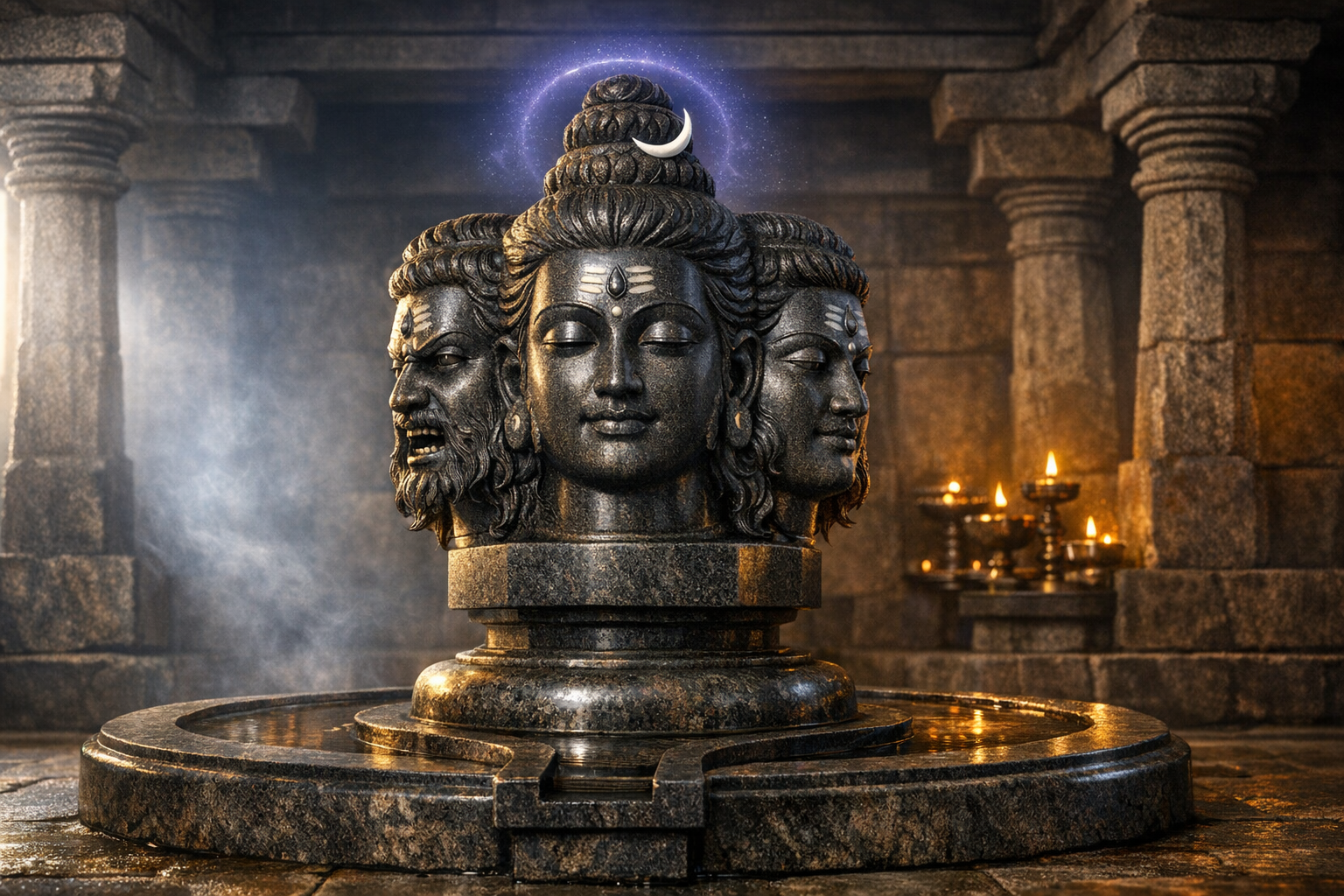
The Panchamukha Linga stands at the dynamic threshold between the formless and the formed, translating an ineffable principle into a rigorous iconographic language. In Shaiva thought, this threshold is not a compromise but a revelation: the aniconic Shivalinga is the axis of the cosmos, and the emergence of five faces upon it articulates the universe’s functions, elements, and inner pathways of realization. The result is a theology in stone and metal—precise, symbolic, and contemplatively complete.
As an image-type, the Panchamukha Linga (five-faced linga) belongs to the family of mukhalinga, where visages of Shiva appear upon the cylindrical rudra-bhāga. Unlike anthropomorphic Panchamukha Śiva, whose five heads and multiple arms narrate attributes in full figuration, the Panchamukha Linga retains the metaphysical modesty of the Linga while revealing faces cardinally and at the summit. This synthesis preserves non-figurative transcendence and offers directed access to the divine through each face.
Agamic sources present the five faces—Sadyojāta, Vāmadeva, Aghora, Tatpuruṣa, and Īśāna—as the Pañcabrahma, the fivefold self-revelation of Śiva. Each facet carries a theological function (pañca-kriyā): sṛṣṭi (emanation), sthiti (maintenance), saṁhāra (withdrawal), tirobhāva (veiling), and anugraha (grace). Together they map reality from cosmogenesis to liberating consciousness, not as linear stages but as simultaneous operations of the Absolute.
Iconographically, directions and stations reinforce meaning: Tatpuruṣa faces East (inner witness and prāṇa), Aghora faces South (transformative, fear-dissolving power), Vāmadeva faces North (beauty, balance, preservation), Sadyojāta faces West (immediacy of manifestation), and Īśāna crowns the summit (transcendent sovereignty and pure awareness). While schools vary in nuances of color and elemental correlations, a common Agamic thread associates Īśāna with ākāśa (space), Tatpuruṣa with vāyu (air), Aghora with agni (fire), Vāmadeva with ap (water), and Sadyojāta with pṛthvī (earth).
The Panchamukha Linga also encodes key mantra-structures. The Pañcabrahma salutations—“Sadyojātāya Namaḥ, Vāmadevaya Namaḥ, Aghorāya Namaḥ, Tatpuruṣāya Namaḥ, Īśānāya Namaḥ”—and the pithy Pañcākṣara “Om Namaḥ Śivāya” converge in practice: the five syllables (Na–Ma–Śi–Vā–Ya) and the five faces establish a shared rhythm between form, sound, and awareness. This convergence is central to Śaiva ritual science (tantra, āgama) and meditative absorption.
Structurally, the Linga preserves its triune anatomy: the hidden square base (Brahma-bhāga), the octagonal neck (Viṣṇu-bhāga), and the circular top (Rudra-bhāga)—a cosmogram of stability, relation, and transcendence. The yoni-pīṭha encircling and receiving the Linga manifests Śakti, so that every abhiṣeka and every circumambulation ritually reenacts Śiva–Śakti co-generativity. In Panchamukha forms, faces arise upon the Rudra-bhāga on the four sides and at the crown, leaving the Linga’s core metaphysics intact.
Shilpa-Śāstra canons and Śaiva Āgamas (e.g., Kāmīkāgama, Suprabhedāgama, Mayamata, Manasāra) prescribe proportions, facial placement, and devotional orientation. General rules preserve harmonious ratios among the three bhāgas, while the faces are scaled for readability in the sanctum’s dim light, often with high brows (ūrṇā), matted locks (jaṭā-mukuṭa), and the third eye indicating omniscience. The Aghora face tends toward austere intensity, while Vāmadeva emphasizes grace; the ensemble resolves into a contemplative equilibrium rather than theatrical contrast.
Materials range from hard stone (granite, schist) to pañcaloha (sacred five-metal alloys). Regional ateliers leave discernible signatures: delicate facial modeling in southern workshops, crisp lineation in Deccan idioms, and restrained abstraction where aniconism remains paramount. Regardless of medium, Panchamukha works are crafted as meditative instruments—precise enough for ritual focus, subtle enough to point beyond form.
Consecration (prāṇa-pratiṣṭhā) weaves mantra, mudrā, and nyāsa into the image’s life. Priests install the Linga to the garbhagṛha axis and anoint with sequential abhiṣekas—water, milk, yogurt, honey, ghee, and fragrant waters—often referred to as pañcāmṛta. With Panchamukha forms, the Pañcabrahma mantras are intoned in directional order, allowing devotees to internalize the fivefold circuit of protection, purification, and grace.
Devotional grammar follows this theology in motion. Circumambulation (pradakṣiṇā) honors each face in turn; bilva leaves are offered with “Om Namaḥ Śivāya,” while the five salutations seed attentive silence before each visage. In many temples, the priest signals the apex moment by revealing the upper face—symbolically lifting perception to Īśāna, where all distinctions attenuate into luminous awareness.
Philosophically, the Panchamukha Linga resolves a classical polarity. The Linga as aniconic “mark” (liṅga) protects the apophatic core of Śaiva metaphysics, while the five faces permit pedagogical articulation within time, space, and practice. The devotee need not choose between transcendence and immanence; the icon teaches how both are simultaneously true—nirguṇa shining through saguna without remainder.
Cosmologically, the five faces index the pañca-bhūtas (earth, water, fire, air, space), the five primary vital winds (prāṇa, apāna, vyāna, udāna, samāna), and the five sheaths (pañca-kośa) of embodiment. In contemplation, the practitioner may pair each face with an element, a breath, and a sheath, performing an inner pradakṣiṇā that harmonizes body, life-force, and awareness. This integral mapping is typical of Śaiva Āgamic method—ritual, cosmology, and psychology mirroring one another.
Textual references across the Śiva Purāṇa, Liṅga Purāṇa, and Āgamas reinforce this fivefold grammar. The Pañcabrahma hymns and the ubiquitous Rudra lore contextualize both temple worship and private practice. Upanishadic insight—especially in the Śvetāśvatara—provides a non-dual horizon against which iconic plurality becomes a compassionate pedagogy rather than theological fragmentation.
Historically, mukhalinga types surface widely from the early medieval period onward, with notable concentrations across Tamil Nadu, Karnataka, Odisha, the Deccan, and the Himalayan rim, including Nepal. Some are portable for procession; others are fixed in sanctums with lighting designed to articulate each face sequentially. Variations reflect local śaiva lineages, but the Panchamukha principle remains consistent: a disciplined fivefold reading of the One.
In temple design, Panchamukha Lingas invite architectural responses. Circumambulatory paths (pradakṣiṇā-patha) are dimensioned to allow pause and recitation at each cardinal face. The sanctum axis, doorway width, and lamp placement become part of a choreography of seeing (darśana), hearing (mantra), and touching (abhisheka remnants), ensuring that icon and architecture collaborate in the devotee’s interiorization of meaning.
The Lingodbhava motif—Śiva as an infinite column of light—complements Panchamukha theology by safeguarding transcendence even as multiplicity appears. The summit face Īśāna is a visual reminder: all faces arise from and dissolve into the unbounded. This prevents the five from hardening into separate deities; they are five windows, not five walls.
Practice traditions integrate breath and mantra with striking technicality. A daily sādhanā may align inhalation with Tatpuruṣa (east/prāṇa), retention with Īśāna (space), exhalation with Aghora (fire/transform), and stillness with Vāmadeva (preserve) and Sadyojāta (stabilize the manifest). Advanced ritualists add nyāsa—placing the five names upon the body—to tie somatic awareness to cosmological function.
Ritual economy echoes this fivefoldness through pañcāmṛta offerings, five incense types, five lamps, and five circumambulations, each nested within canonical saṅkalpa. Even the tri-foliate bilva leaf, offered in sets that honor elemental and directional matrices, becomes a precise theological instrument rather than a generic token of devotion.
In plural Dharmic contexts, the Panchamukha Linga provides a luminous template for unity without uniformity. Buddhism’s Pancha Tathāgata mandalas, Jainism’s Pañca-Parameṣṭhi reverence, and Sikhism’s insistence on the formless One (Ik Onkar) reveal cognate commitments: structure guiding seekers toward a reality that exceeds structure. The Panchamukha grammar affirms shared Dharmic intuitions—multiplicity as skillful means, oneness as the abiding truth.
This shared grammar strengthens inter-traditional respect. Where some might see competing iconographies, Dharmic hermeneutics sees complementary pedagogies. The Panchamukha Linga thus becomes an emblem for civilizational harmony: many faces, one light; many methods, one awakening; many sanctums, one sanctity.
From a conservation perspective, Panchamukha Lingas demand careful stewardship. Weathering first blurs the facial reliefs and then undermines the Linga’s cylindrical integrity; ritual abhiṣekas, while sacral, can accelerate salt deposition and micro-fractures if drainage is poor. Best practice balances living worship with material care—managed water flow, periodic cleansing, and documentation that preserves both ritual continuity and heritage longevity.
For contemporary seekers, the Panchamukha Linga offers a compact curriculum in spiritual integration. One may approach any face according to temperament—gravitating toward Aghora’s courage in times of fear, Vāmadeva’s harmony amid conflict, Tatpuruṣa’s inwardness for meditation training, Sadyojāta’s immediacy for grounding, or Īśāna’s vastness for non-dual contemplation. The icon invites not passive viewing but active alignment.
Ethically and ecologically, the five-element mapping encourages responsible living: to honor Aghora is to transmute rather than pollute; to honor Vāmadeva is to preserve rather than waste; to honor Sadyojāta is to care for the manifest earth; to honor Tatpuruṣa is to breathe consciously; to honor Īśāna is to recover spaciousness in public life. Symbolism becomes a bridge from sanctum to society.
Scholarly interpretation recommends humility before regional and textual variance. Agamic lineages transmit distinct color schemes, mantra sets, and installation rites; temple epigraphy and local oral traditions often clarify practice where texts are terse. This plurality is not noise but data—attesting to the living nature of Śaiva worship and the adaptability of Panchamukha symbolism across landscapes and centuries.
In sum, the Panchamukha Linga condenses Śaiva metaphysics into an icon that is at once precise and spacious. It speaks through direction, element, mantra, and ritual, yet continually points back to the unconditioned source. Encountered with informed attention—supported by the Pañcabrahma mantras and the Pañcākṣara—it becomes a complete sādhana: to see the many without losing the One, and to find the One faithfully expressing as the many.
Inspired by this post on Hindu Blog.

Leave a Reply
You must be logged in to post a comment.