
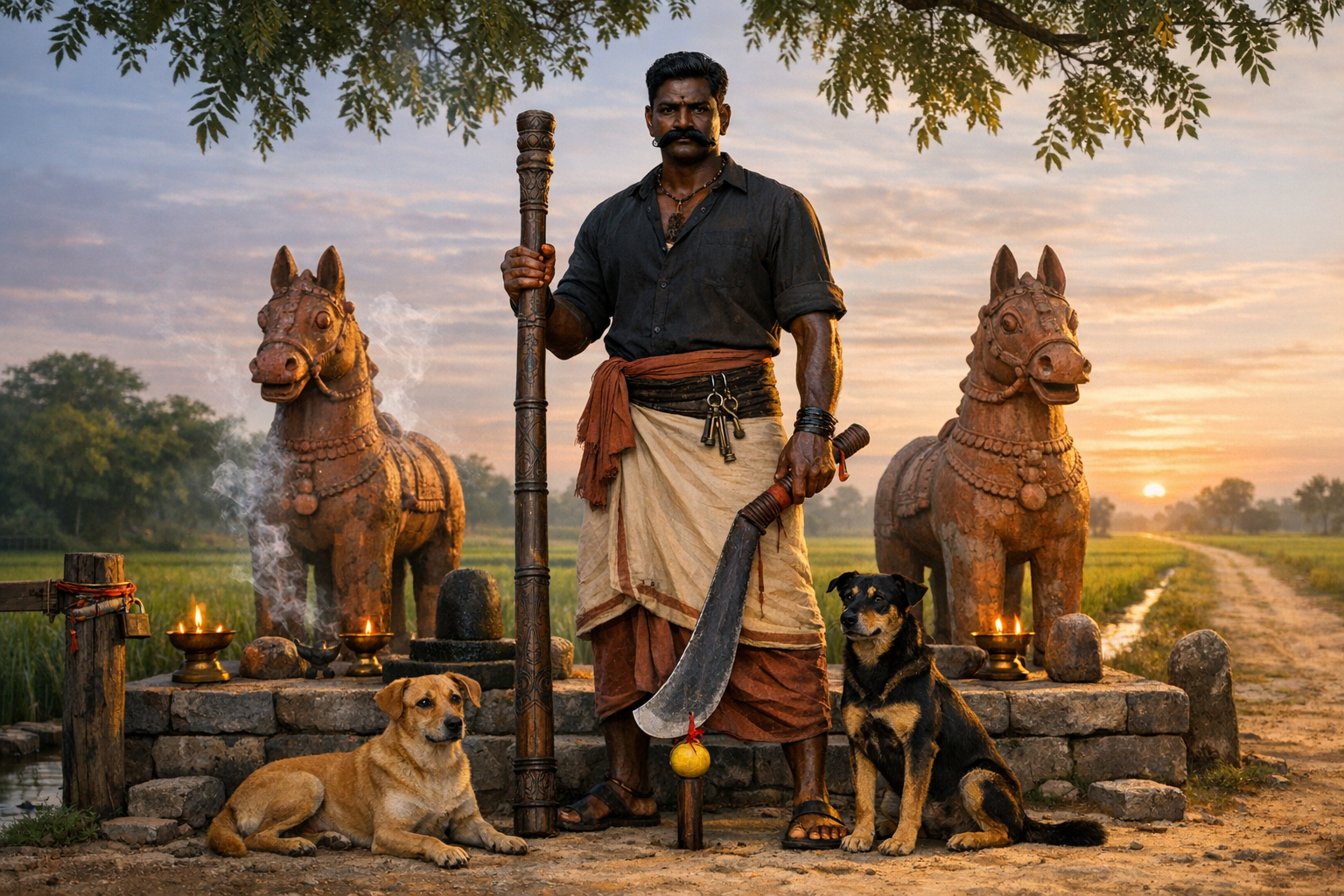
Periya Karuppar stands within Tamil folk religion as an unyielding sentinel—both intimate to village life and immense in symbolic reach. The name itself, translating as “the Great Dark One,” encodes a worldview in which darkness (karuppu) is not a negation but a protective mantle: the hue of fertile soil, the stillness of night patrol, and the power that absorbs disorder at the boundaries of community life. As a Kaval Deivam (guardian deity), Periya Karuppar is invoked at thresholds—village borders, crossroads, field edges—where liminal spaces invite vigilance, justice, and care.
Etymologically and philosophically, the epithet “great” (periya) asserts seniority and stewardship. In regional practice, Periya Karuppar is often understood as the chief among Karuppar forms—a figurehead who marshals order across social and ecological thresholds. This protective darkness is not moral darkness; rather, it is a cosmological grammar aligned with guardianship, concealment of the vulnerable, and swift visibility of transgression. Darkness, thus, is a watchful friend of the village.
Geographically, devotion to Periya Karuppar is concentrated in southern Tamil Nadu, though shrines and practices are found across the Tamil cultural sphere. Shrines typically ground themselves where vigilance is most consequential: at ellai (boundary stones), near groves, on approach roads, and by irrigation channels. The placement encodes an ethic: social peace is safeguarded at the margins so the interior may flourish. In community memory, these boundary shrines function as the village’s alert senses—eyes and ears turned outward, conscience tuned inward.
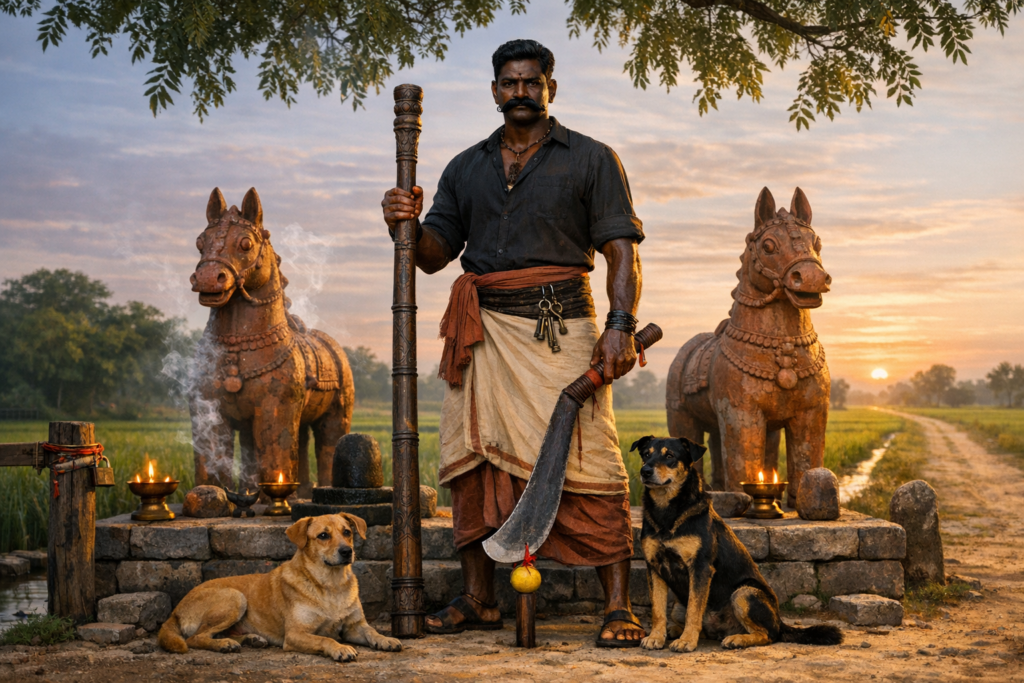
Periya Karuppar commonly appears in association with Ayyanar, the well-known village guardian whose open-air shrines often host terracotta horses and a retinue of fierce protectors. In that Ayyanar–Karuppar complex, Periya Karuppar is the uncompromising marshal of rules and oaths, the voice that gives sharp edge to guardianship. While forms and names vary by locality (including Chinna Karuppar or specific Karuppar epithets), the deontic function remains: protect, adjudicate, and restore balance.
Iconographically, Periya Karuppar is represented with a dark complexion, prominent mustache, and a commanding stance, often holding the aruval (sickle-like billhook), sword, staff, or whip. Each implement is semiotic: the aruval signals agrarian belonging and the right to prune disorder; the sword stands for swift justice; the staff or scepter indicates legitimate authority; and keys or chains (in some locales) mark custodianship over thresholds and taboos. Dogs depicted near the deity or as a vahana (vehicle) signify fidelity, nocturnal vigilance, and the moral memory of the village.
Shrine design varies from unadorned boundary stones and low open-air platforms to anthropomorphic images sheltered under simple mandapams or trees (notably neem). Many are purposefully austere. Their architecture voices a principle: it is function, not ornament, that matters at the frontier. Terracotta votives—horses, swords, or lamps—often surround the shrine, creating an archive of fulfilled vows and living gratitude.
The ritual calendar for Periya Karuppar aligns with the rhythms of work, weather, and communal decision-making. Tuesdays and Fridays are frequent observance days; Amavasya nights and the Tamil month of Aadi often carry heightened significance. In many villages, ritual specialists (poosari) lead offerings of lamps, flowers, betel leaves, lemons (sometimes fixed to weapons), and sweet rice; in some communities, specific non-vegetarian offerings or local beverages may be part of vows. Practices are community-specific and transmitted through oral tradition; they function as ethical contracts between devotees and their guardian.
A distinctive feature of Periya Karuppar worship is the practice of arul vaaku—oracular speech delivered through a samiyadi (trance medium) in certain settings. Beyond the dramatic surface, this practice is a social technology: it externalizes communal conscience, spotlights contested facts, and reasserts norms. While not universal, where it is present, arul vaaku often converges with village councils and elders, contributing to rapid, locally trusted conflict resolution.
Oath-taking before Periya Karuppar is a powerful ethical instrument. Individuals publicly affirm truthfulness, renounce wrongful claims, or pledge restitution. The deity’s fearsome repute renders perjury socially unthinkable; in oral histories, a single oath at the boundary shrine has halted feuds, deterred theft, and restored estranged relations. In this way, Periya Karuppar becomes the village’s living contract—binding speech to consequence.
The socio-legal function of Periya Karuppar complements, rather than replaces, formal institutions. Anthropologists observing grama devata (village deity) systems note that such guardians structure everyday accountability: irrigation turns respected, property lines honored, and disputes guided to closure with minimal escalation. The deity’s presence allows the community to economize on coercion by investing in consensus, reputation, and reverence.
Periya Karuppar’s role often extends into the sphere of kula devata identity, especially among families linked by occupation or ancestry. Here, the guardian is not only a village sentinel but an intergenerational witness to births, vows, migrations, and returns. Diasporic Tamils frequently sustain this connection through periodic offerings, remittances for shrine upkeep, or devotional gatherings in new locales, reinforcing cultural continuity beyond geography.
Symbolically, the color black articulates an advanced theology of guardianship. It absorbs glare to let others see clearly, veils the vulnerable, and commands the night so that daylight labor can proceed without fear. The mustache and martial implements express lawful strength rather than aggression; the overall figure emphasizes restraint with readiness, not indiscriminate force. The sentinel’s discipline is the villagers’ confidence.
Thresholds and crossroads—Periya Karuppar’s favored sites—are classic liminal zones in South Asian cultural geography. At these interstices, human and ecological systems intersect: trade meets agriculture, strangers meet kin, and forest meets field. By concentrating sacred attention on these edges, Tamil tradition encodes a principle familiar to systems thinkers: protect perimeters to stabilize cores. Periya Karuppar embodies that principle as living ritual.
Within the broader Hindu landscape, Periya Karuppar resonates with Kshetrapala (field guardian) and Bhairava-type guardianship, while retaining distinct Tamil iconography and ritual grammar. Comparative religion highlights cognate forms across the dharmic family: Buddhist communities venerate protective Dharmapāla like Mahākāla (whose very name evokes the fertile potency of “the Great Dark”); Jain traditions recognize vigilant yakṣa–yakṣī guardians attached to Tirthankara cults; Sikh tradition honors the saint–soldier (sant–sipahi) ideal, cultivating moral vigilance and defense of righteousness. These parallels reveal a shared civilizational intuition—dharma requires guardians who are compassionate in intent and unwavering in resolve.
Ritual semiotics further deepens understanding. Lemons fixed to blades can signify the neutralization of malevolent forces; tied threads, small locks, or padlocks mark vows to desist from harmful actions or to complete penance. Drums at the shrine announce communal time, calling neighbors not only to worship but also to witness—reminding that ethics is a public practice.
Gendered participation varies across regions, but women’s vows, offerings, and songs commonly animate the shrine’s life. In many villages, women recount the guardian’s interventions in household health, child safety, or resolution of simmering kin disputes. Such testimonies, while personal, function collectively as moral pedagogy—stories that teach courage, patience, and truth-telling.
The austerity of many Periya Karuppar shrines is deliberate. Unlike elaborately sculpted temple enclosures, the open-air platform faces the road, the field, and the distant tree line. The message is clear: guardianship is not enclosed; it is enacted in the open, under the same sky where promises are made and broken. This unfenced sacredness invites approach with clean intention rather than curated performance.
Contemporary relevance is unmistakable. As rural to urban migration accelerates and village commons contract, the social functions long held by guardians like Periya Karuppar—oath-making, conflict containment, and protection of thresholds—offer valuable insights for modern community-building. Civic projects that value local memory, shared rituals, and transparent sanctions mirror, in secular form, what boundary shrines have practiced for centuries.
For visitors, respectful engagement begins with local guidance. One may greet the shrine from its approach path, observe existing patterns before participating, and consult the poosari regarding appropriate offerings. Photography is best requested rather than presumed, and abstaining from intrusive behavior maintains the shrine’s social contract. The guardian’s role, after all, is upheld by collective dignity.
From an ethical standpoint, Periya Karuppar integrates justice and compassion. The sword is balanced by the oath; the boundary by hospitality; the fearsome visage by the tenderness of fulfilled vows. This union of firmness and care is not sectarian; it aligns with the dharmic unity that prizes many paths but one commitment—to truth, duty, and the protection of the vulnerable.
In sum, Periya Karuppar, the Great Dark Guardian of the Tamil land, is a living deity whose guardianship is enacted daily—in the hush of night patrols, in the steady gaze at village edges, and in the measured words spoken under an open sky. His symbolism clarifies the ethics of darkness as shelter and scrutiny; his rituals transform private conscience into public trust; and his shrines inscribe a timeless lesson: communities endure when their boundaries are watched, their promises kept, and their compassion armed with courage.
Inspired by this post on Hindu Blog.



Leave a Reply
You must be logged in to post a comment.